Sunday, 11 December 2016

The Bourbon Branches

The Bourbon dynasty spread itself out in quite a few branches - like every other family - besides the royal family itself. This post is about the the families that also descended from the Capetian dynasty but were not members of the immediate royal family.


Bourbon-Condé

The name is derived from the main title held by the house; that of Prince de Condé. Originally, the family line began in 1557; since then the Princes and Princesses of Condé were:

Louis de Bourbon (uncle of Henri IV) married Eléanor de Roucy de Roye (1) and Francoise d'Orléans (2)


Henri I de Bourbon married Marie of Cleves (1) and Charlotte Catherine de La Trémoille (2)


Henri II de Bourbon married Charlotte Marguerite de Montmorency


Louis II de Bourbon (the Grand Condé) married Claire-Clémence de Maillé-Brézé


Henri Jules de Bourbon married Anne of Bavaria


Louis III de Bourbon married Louise Francoise de Bourbon (Daughter of Louis XIV and Madame de Montespan)


Louis IV Henri de Bourbon married Marie Anne de Bourbon (1) and Caroline of Hesse-Rotenburg (2)


Louis V Joseph de Bourbon married Charlotte de Rohan (1) and Maria Caterina Brignole (2)


The house died out two lines after the last mentioned here but since the last two lived after the ancien regime they are not included.
Both the sub-cadets of Bourbon-Soissons and Bourbon-Conti are descending from this branch.

The titles held by the House of Bourbon-Condé:
Prince de Condé
Duc de Bourbon
Duc d'Enghien
Duc de Montmorency
Marquis de Graville
Comte de Pézenas
Comte de Clermont

Besides these court titles the head of the family was the First Prince of the Blood which meant that he was addressed as Monsieur le Prince at court and his wife as Madame la Princesse. However, the title was transferred to the House of Bourbon-Orléans in 1710 and from then on the heads of the Bourbon-Condé house went by Monsieur le Duc.


Bourbon-Conti

This house was founded by the third son of Louis de Bourbon, Prince de Condé whose name was Francois de Bourbon. However, this line went extinct in the following generation and was not taken up again until 1626 when the new House of Bourbon-Conti was founded by the younger brother of the Grand Condé: Armand de Bourbon.

The Princes and Princesses of Conti were:

Armand de Bourbon married Anne Marie Martinozzi

Louis Armand I de Bourbon married Marie Anne de Bourbon

Francois Louis de Bourbon married Marie Thérèse de Bourbon

Louis Armand II de Bourbon married Louise Élisabeth de Bourbon-Condé

Louis Francois I de Bourbon married Louise Diane d'Orléans

Louis Francois II de Bourbon married Maria Fortunata d'Este

Titles held by the House of Bourbon-Conti
Prince de Conti
Prince de La Roche-sur-Yon
Duc de Mercæur
Comte d'Alais
Comte de La Marche


Bourbon-Maine

Founded by the first son of Louis XIV and Madame de Montespan, Louis-Auguste, who was legitimised and given the title of Duc du Maine. However, the title did not pass on to his children who were instead given other titles.

Louis-Auguste de Bourbon married Anne-Louise-Bénédicte de Bourbon-Condé

Louis-Auguste II de Bourbon never married

Louis Charles de Bourbon never married

The house died in 1775.

Titles held by the House of Bourbon-Maine:
Duc du Maine
Duc d'Aumale
Prince de Dombes
Comte d'Eu


Bourbon-Orléans

During Louis XIV's reign there were two Bourbon-Orléans cadet branches. One was led by his uncle, Gaston, Duc d'Orléans while the other was founded by Philippe, Duc d'Orléans - brother of Louis XIV. The daughters of Gaston carried on his side of the Bourbon-Orléans branch but with Gaston's death in 1661 it was Philippe's branch that became dominant. With the deatb of Gaston's only male heir his side of the Bourbon-Orléans line was considered extinct.

Descendants of Gaston:

Anne Marie Louise d'Orléans - better known as La Grande Mademoiselle - who was Duchesse de Montpensier in her own right

Marguerite Louise d'Orléans married Cosomo II de Medici

Élisabeth Marguerite d'Orléans married Louis Joseph de Lorrane, Duc de Guise

Jean Gaston d'Orléans did not marry

Marie Anne d'Orléans did not marry


House of Bourbon-Orléans:

Philippe d'Orléans married Henriette of England (1) and Elizabeth Charlotte of the Palatinate (2)

Philippe II d'Orléans married Francoise Marie de Bourbon (legitimised daughter of Louis XIV)

Louis d'Orléans married Joanna of Baden-Baden

Louis Philippe I d'Orléans married Louise Henriette de Bourbon (1) and Charlotte Béraud de La Haye de Riou

Louis Philippe II d'Orléans married Louise Marie Adélaide de Bourbon

This branch was the most powerful during the reign of Louis XIV and Louis XV because of their close relations to the crown. Should the royal family had died out - as it almost did in 1712 - the house of Bourbon-Orléans would have succeeded to the throne.
In 1709 the title of First Prince of the Blood was transferred to this cadet-branch.

Titles of the house of Bourbon-Orléans:
Duc d'Orléans
Duc de Chartres
Duc de Valois
Duc de Nemours
Duc de Soissons (bestowed in 1740)
Comte de Dourdan 
Comte de Romorantin
Marquis de Coucy
Marquis de Folembray


Bourbon-Penthièvre

Founded by the son of the Comte de Toulouse (legitimised son of Louis XIV) whose name was Louis Jean Marie de Bourbon. During the Comte de Toulouse's life-time the branch was called Bourbon-Toulouse.

House of Bourbon-Penthièvre:

Louis Jean Marie de Bourbon married Marie Thérèse Félicité d'Este

Louis Alexandre de Penthièvre married Marie Louise of Savoy (better known as the Princesse de Lamballe)

Louise Marie Adélaide de Penthièvre married Philippe II d'Orléans


Titles:
Duc de Penthièvre
Prince de Lamballe
Prince de Carignan
Duc de Rambouillet
Duc d'Aumale
Duc de Gisors
Duc de Châteauvillain
Duc d'Arc-en-Barrois
Duc d'Amboise
Comte d'Eu
Comte de Guingamp

Bourbon-Soissons

The line began in 1566 when it was bestowed on another son of Louis de Bourbon, Prince de Condé whose name was Francois de Bourbon. At court they were known as Monsieur le Comte and Madame la Comtesse. In 1641 the male line died out and the title was passed on to a sister of the former holder who was married into the house of Savoy. As such the title came to be intertwined with that of the Savoyard royal family.


The Comtes and Comtesses de Soissons were:

Charles de Bourbon married Francoise d'Alencon

Jean de Bourbon-Soissons married an unknown woman

Louis de Bourbon (Prince de Condé - he was Jean's brother) married Eléanor de Roucy de Roye (1) and Francoise d'Orléans (2)

Charles de Bourbon married Anne de Montafie

Louis de Bourbon married Marie de Bourbon

Marie de Bourbon-Soissons (sister of Louis) married Thomas Francois of Savoy

Joseph-Emmanuel of Savoy-Carignano married an unknown woman

Eugène-Maurice of Savoy-Carignano married Olympia Mancini


The house went extinct in 1734 since Eugène-Maurice and Olympia had no issue.


Bourbon-Vendôme

The second House of Bourbon-Vendôme was founded by the legitimised son of Henri IV and Gabrielle d'Estrées, César de Bourbon.Once César had been made legitimate he was granted the title of Duc de Vendôme.

Ducs and Duchesses of Vendôme:

César de Bourbon married Francoise de Lorraine

Louis II de Bourbon-Vendôme married Laura Mancini

Louis Joseph de Bourbon-Vendôme married Marie Anne de Condé

Philippe de Bourbon-Vendôme did not marry

The house went extinct in 1727; after that it was used as a courtesy title by the Comte de Provence, brother of Louis XVI

Titles held by the House of Bourbon-Vendôme:
Duc de Vendôme
Duc d'Etampes
Duc de Beaufort

Thursday, 8 December 2016

Ducs in the Ancien Regime

Some of these were created before Louis XIV's ascension to the throne while others were created by him or his successors. As a duc you were normally also a peer of France.

Duc d'Aiguillon
Held by the House of Vignerot du Plessis

Duc d'Albret
Held by the House of Bourbon-Condé from 1641-1651
Held by the House of La Tour d'Auvergne from 1651-1771

Duc d'Amboise
Made a duchy in 1787
Held by Louis-Jean-Marie de Bourbon

Duc d'Antin
Made a duchy in 1711
Held by the House of de Pardaillan de Gondrin

Duc d'Arpajon
Made a duchy in 1650
Held by Louis d'Arpajon

Duc d'Aubigny
Made a duchy in 1711
Held by Louise-Renée de Kéroualle from 1684-1734
Held by Charles Lennox de Richmond from 1777-1790

Duc d'Aumale
Made a duchy in 1547
Held by the Houses of Lorraine and Savoy from 1547-1652
Held by the House of Bourbon from 1695-1790

Duc d'Aumont
Made a duchy in 1665
Held by the House of d'Aumont de Rochebaron

Duc de Beaufort
Made a duchy in 1597
Held by the House of Bourbon-Vendôme from 1598-1668

Duc de Biron
Made a duchy in 1598
Held by the House of Gontaut

Duc de Boufflers
Made a duchy in 1708
Held by the House of Boufflers

Duc de Bournonville
Made a duchy in 1652
Held by Ambroise-Francois de Bournonville

Duc de Brissac
Made a duchy in 1611
Held by the House of Cossé

Duc de Brunoy
Made a duchy in 1777
Held by Louis Stanislas Xavier, brother of Louis XVI

Duc de Châteauroux
Made a duchy in 1616
Held by the House of Bourbon-Condé from 1661-1736
Held by Anne-Marie de Mailly from 1743-1744
Held by Charles, brother of Louis XVI, from 1776-1790

Duc de Châteauvillain
Made a duchy in 1703
Held by the House of Bourbon

Duc de Châtillon
Made a duchy in 1736
Held by the House of Châtillon

Duc de Charost
Made a duchy in 1672
Held by the House of Béthune

Duc de Choiseul
Made a duchy in 1665
Held by the House of Choiseul

Duc de Clermont-Tonnerre
Made a duchy in 1571
Held by the House of Clermont-Tonnerre

Duc de Coigny - last peerage made before the revolution
Made a duchy in 1787
Held by Francois-Henri de Franquetot

Duc de Coligny
Made a duchy in 1643
Held by the House of Coligny

Duc de Crèquy
Made a duchy in 1652
Held by Charles de Bonne de Blanchefort

Duc de Damville
Made a duchy in 1610
Held by the House of Lévis from 1648-1661
Held by the House of Bourbon from 1694-1719

Duc de Duras
Made a duchy in 1668
Held by the House of Durfort

Duc d'Elbeuf
Made a duchy in 1581
Held by the House of Lorraine

Duc d'Enghien
Made a duchy in 1566
Held by the House of Bourbon-Condé

Duc d'Épernon
Made a duchy in 1581
Held by the House of Nogaret

Duc d'Éstrées
Made a duchy in 1648
Held by the House of d'Estrées

Duc de Ferté-Senneterre
Made a duchy in 1665
Held by the House of Senneterre

Duc de Fitz-James
Made a duchy in 1710
Held by the House of Fitz-James

Duc de Fleury
Made a duchy in 1736
Held by the House of Rosset

Duc de Fronsac
Made a duchy in 1608
Held by Cradinal de Richelieu from 1634-1642
Held by the House of de Maillé from 1642-1646
Held by Louis II de Bourbon-Condé from 1646-1674
Held by the House of de Vignerot du Plessis from 1674-1790)

Duc de Gesvres
Made a duchy in 1648
Held by the House of Potier

Duc de Gisors
Made a duchy in 1748
Held by Charles-Louis Fouquet de Belle-Isle from 1748-1761
Held by Louis-Jean-Marie de Bourbon from 1776-1790

Duc de Gramont
Made a duchy in 1643
Held by the House of Gramont

Duc de Guise
Made a duchy in 1528
Held by the House of Lorraine from 1528-1675
Held by the House of Bourbon-Condé from 1675-1790

Duc d'Harcourt
Made a duchy in 1709
Held by the House of d'Harcourt

Duc d'Hostun
Made a duchy in 1715
Held by the House of d'Hostun

Duc de Joyeuse
Made a duchy in 1581
Held by the House of Joyeuse from 1581-1608
Held by the House of Lorraine from 1608-1688
Held by Louis II de Melun from 1714-1724

Duc de La Force
Made a duchy in 1637
Held by the House of Caumont

Duc de La Meilleraye
Made a duchy in 1663
Held by the House of de La Porte-Mazarin

Duc de La Valette
Made a duchy in 1622
Held by the House of Nogaret

Duc de La Vallière
Made a duchy in 1667
Held by the House of La Baume de Blanc

Duc de La Vauguyon
Made a duchy in 1758
Held by the House of de Quelen de Stuer de Caussade

Duc de Le Lude
Made a duchy in 1675
Held by Henri de Daillon

Duc de Lavedan
Made a duchy in 1650
Held by the House of Montaut-Navailles

Duc de Lévis
Made a duchy in 1723
Held by Charles-Eugène de Lévis-Charlus

Duc de Lesdiguières
Made a duchy in 1611
Held by the House of dee Bonne de Blanchefort

Duchesse de Louvois
Made a duchy in 1711
Held jointly by Mesdames Sophie and Adélaide, daughters of Louis XV

Duc de Luynes
Made a duchy in 1619
Held by the House of d'Albert

Duc de Mercæur
Made a duchy in 1569
Held by the House of Lorraine from 1569-1649
Held by the House of Bourbon-Vendôme from 1649-1712
Held by the House of Bourbon-Conti from 1723-1770
Held by Charles, brother of Louis XVI

Duc de Montausier
Made a duchy in 1664
Held by Charles de Sainte-Maure

Duc de Montaut
Made a duchy in 1660
Held by Philippe de Montaut-Navailles

Duc de Montbazon
Made a duchy in 1588
Held by the House of Rohan (later combined to Rohan-Guéméné)

Duc de Montmorency
Made a duchy in 1551
Held by the House of Montmorency

Duc de Montpensier
Made a duchy in 1539
Held by the House of Bourbon-Montpensier from 1582-1627
Held by the House of d'Orléans from 1627-1790

Duc de Mortemart
Made a duchy in 1650
Held by the House of Rochechouart

Duc de Noailles
Made a duchy in 1663
Held by the House of Noailles

Duc de Noirmoutier
Made a duchy in 1711
Held by Louis de La Trémoïlle

Duc d'Orval
Made a duchy in 1652
Held by the House of Béthune

Duc de Penthièvre
Made a duchy in 1569
Held by the House of Lorraine from 1575-1608
Held by the House of Bourbon-Vendôme from 1608-1687
Held by the House of Bourbon from 1697-1790

Duc de Piney-Luxembourg
Made a duchy in 1581
Held by the House of d'Albert from 1620-1661
Held by the House of Montmorency from 1661-1790

Duc de Praslin
Made a duchy in 1762
Held by the House of Choiseul-Praslin

Duc de Rambouillet
Made a duchy in 1711
Held by the House of

Duc de Randan
Made a duchy in 1711
Held by the House of Bourbon

Duc de Retz
Made a duchy in 1581
Held by the House of Gondi

Duc de Richelieu
Made a duchy in 1631
Held by the House of Vignerot du Plessis

Duc de Roche-Guyon
Made a duchy in 1621
Held by Roger du Plessis-Liancourt

Duc de Rochefoucauld
Made a duchy in 1622
Held by the House of La Rochefoucauld

Duc de Rohan
Made a duchy in 1603
Held by the House of Rohan-Chabot

Duc de Rohan-Rohan
Made a duchy in 1714
Held by the House of Rohan-Soubise

Duc de Roquelaure
Made a duchy in 1652
Held by Charles de Bonne de Blanchefort

Duc de Rosnay
Made a duchy in 1651
Held by Francois de L'Hospital

Duc de Saint-Aignan
Made a duchy in 1663
Held by the House of de Beauvillier

Duc de Saint-Fargeau
Made a duchy in 1575
Held by the House of d'Orléans

Duc de Saint-Simon
Made a duchy in 1635
Held by the House of Rouroy

Duc de Sully
Made a duchy in 1606
Held by the House of Béthune

Duc de Thouars
Made a duchy in 1595
Held by the House of La Trémoïlle

Duc d'Uzès
Made a duchy in 1572
Held by the House of Crussol

Duc de Valentinois
Made a duchy in 1642
Held by the House of Monaco

Duc de Vendôme
Made a duchy in 1515
Held by the House of Bourbon-Vendôme

Duc de Ventadour
Made a duchy in 1589
Held by the House of Lévis

Duc de Verneuil
Made a duchy in 1652
Held by Henri de Bourbon

Duc de Vieuville
Made a duchy in 1651
Held by the House of La Vieuville

Duc de Villars-Brancas
Made a duchy in 1652
Held by the House of Brancas

Duc de Villeroi
Made a duchy in 1651
Held by the House of Neufville

Duc de Vitry
Made a duchy in 1650
Held by Francois-Marie de L'Hospital

The Queen's Hamlet

In 1783 Marie Antoinette ordered the construction of her personal hamlet where she would indulge in "rural" activities with her friends. Richard Mique designed the little hamlet with the assistance of Hubert Robert. The result was a little hamlet resembling a little Norman village complete with a working farm housing cows, pigs and chicken which provided the Queen with milk and cheese. Besides the farmhouse there was a dairy, a barn (burnt down during the revolution), a dovecote, a mill, a small house called the boudoir, a tower and a little house known as "the Queen's House". All the animals housed here were imported from Switzerland.

Note: the farm was placed somewhat outside the rest of the hamlet so it is not featured on the layout below.


Here is an aerial view of the hamlet to give you a clear idea of the layout:


1) The Dairy and the Marlborough Tower
2) The Guard's House
3) The Dovecote
4) Billiard Room
5) The Warming Room
6) The Queen's House
7) The Boudoir
8) The Mill

Wednesday, 7 December 2016

The Poor Health of Marie Anne Victoire

The Bavarian princess, Marie Anne Victoire, was not a great success when she arrived at court to marry the Grand Dauphin. Described as terribly unattractive she quickly gained a reputation for being boring - that was enough to keep her isolated at court. But what really angered her father-in-law, Louis XIV, and drove her husband mad was her constant complaints of illness.

Louis XIV was convinced that Marie was "faking" it and insisted that she performed her duties as the leading lady of Versailles (which she was after the death of the Queen).

It was said that the birth of the Duc de Berri had not gone smoothly; something had gone wrong which allegedly left the mother's figure slightly "deformed". It would seem that pregnancies did not generally go too well with Marie Anne Victoire; she had several miscarriages (three in 1685 alone and then two in 1687) which often rendered her terribly ill - however, she still managed to give birth to three living boys. The toll these pregnancies - and miscarriages - must have had on her already weakened body can only be imagined.


Billedresultat for la grande dauphine
Marie Anne Victoire


Madame de Caylus was convinced that the Grande Dauphine was slightly herself to blame. Always being "locked in" in her small cabinets without proper ventilation she was bound to suffer the consequences - or so Madame de Caylus argued. She went on and said that in her constant search for a cure for her ailments she subjected her body to all sorts of various "treatments" which eventually killed her. This opinion was shared by other members of the court but the autopsy would reveal that it was not quite so.

Marie Anne Victoire herself was well-aware that her family did not believe her complaints of illness. According to Elizabeth Charlotte of the Palatinate (Monsieur's second wife) shortly before her death she said: "I shall convince them today that I was not mad in complaining of my sufferings". She was not always so stoic since her frustration of never being taking seriously led her to exclaim that she would have to die to justify herself. Eventually, she was right.

It is possible that Marie Anne Victoire's mental health attributed to her physical illnesses; she was depressed and as Madame de Caylus correctly reported preferred to lock herself away rather than endure the petty insults of the court.


Billedresultat for la grande dauphine


In 1689 the Grande Dauphine took to her bed again but was ignored by the court. As Madame La Fayette recalled: "No one believed in her illness". Voltaire was also of the opinion that she was "always dying" and undoubtedly many courtiers thought the same. Thanks to Madame La Fayette we also know that she had lost a great deal of weight and was swollen.

In the spring of 1690 she experienced another bout of intense illness - probably the same as the previous year - which left her doctors perplexed. They thoroughly examined her and found several abscesses in her abdomen that they could neither treat nor explain. She soon developed a fever, too. Consequently, poor Marie Anne Victoire was left to fend for herself in her apartment.

After her death an autopsy was carried out which revealed that she suffered from a "generalised infection spreading from her lungs to her intestines".

Culottes

Culottes were the breeches worn by the nobility and upper gentry; they reached only to about the knee in comparison to the full-length trousers worn by the peasantry. To add to the class distinction the culottes were often made of silk rather than the coarse cloth affordable to the peasantry.

During the beginning of the 18th century the socks reached just above the hem of the culottes; this changed over the decades so that stockings eventually were tucked in underneath the culotte.
The hem of the culotte was fastened either by a buckle or by string to ensure that the breeches fit tightly to the wearer's legs.

The culotte was also equipped with a fly which was usually closed by buttons.


Billedresultat for 18th century breeches
Silk culottes


The upper classes' culottes had a slit at the side which was then fastened by a buckle; those of fewer means simply tied the culottes around the knee.
Over the 18th century the culottes became tighter as the waistcoats got shorter which meant that a man's silhouette altogether became slimmer. Those who insisted on wearing the tightest version occasionally had to be helped into them by their valets!

The culottes were part of the standard military uniforms in the 18th century. For riding the delicate silks were laid aside and the culottes were made of leather or other tougher materials.


Billedresultat for french nobility 18th century
French nobleman showing off his culottes in the park
of Versailles

Due to the connection with the aristocracy the term sansculotte - which emerged around the time of the revolution - implied a person without culottes (sans = without) and referred to a revolutionary.

Saturday, 3 December 2016

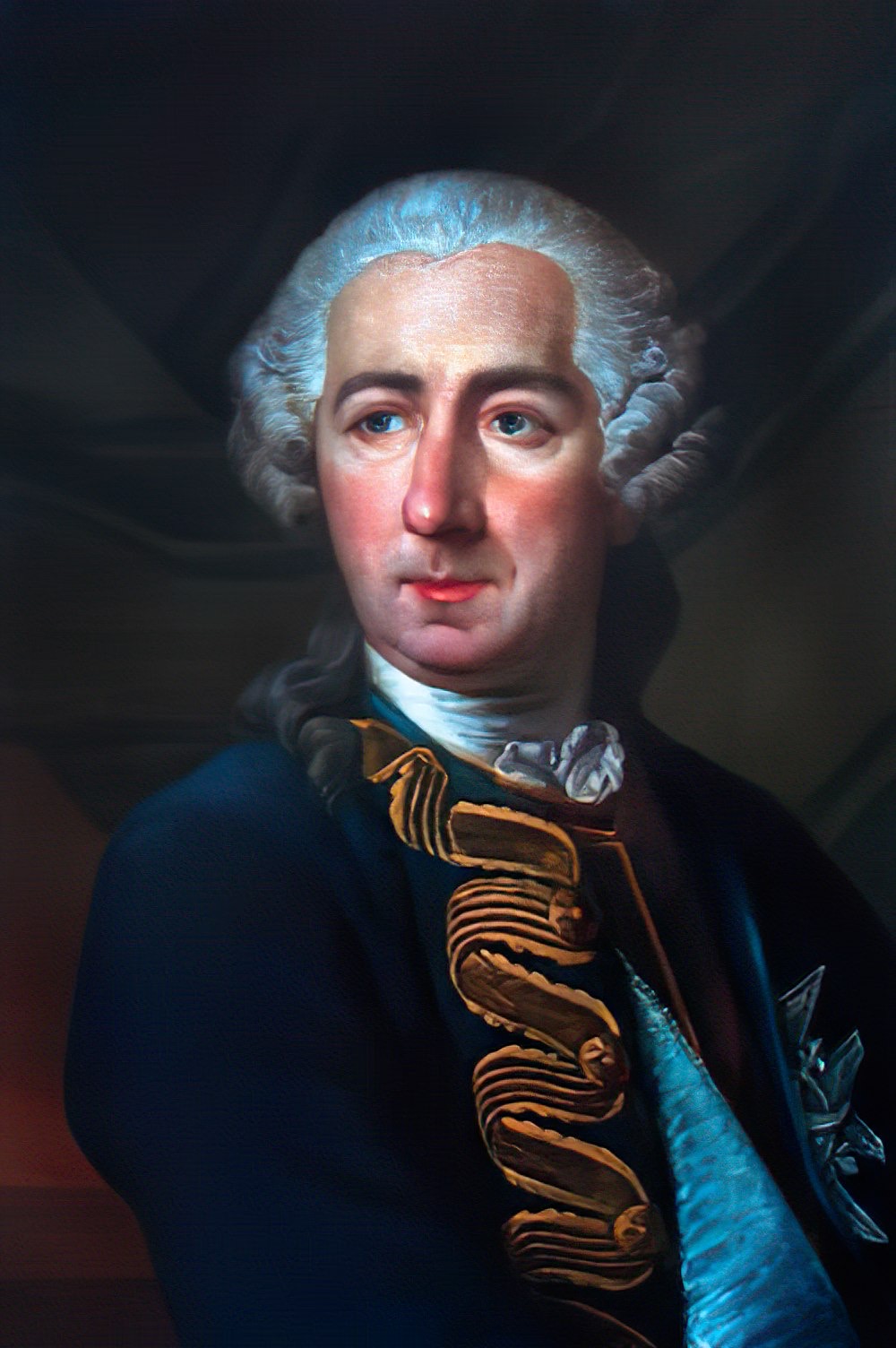
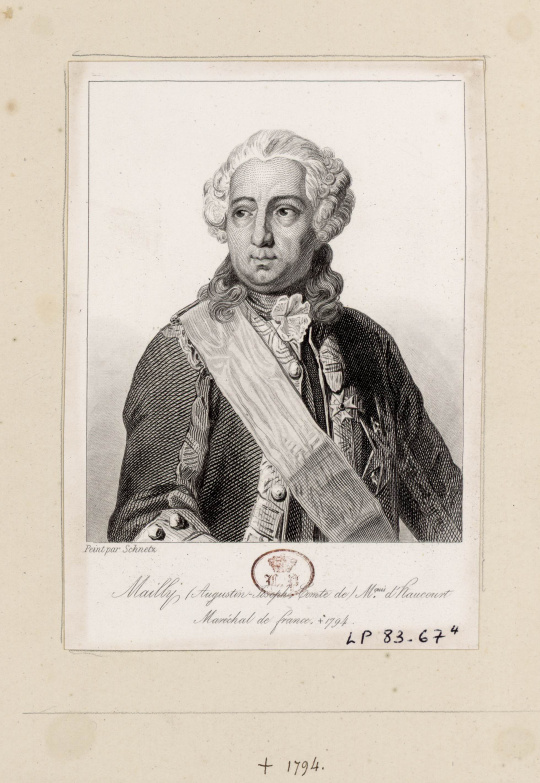
Augustin-Joseph de Mailly, Marquis d'Haucourt

Augustin-Joseph was born on 5 April 1707 into one of the oldest noble families in France: de Mailly. As such he was guaranteed a place at the court of Versailles; here he was hired as a page in the King's stables which was reserved for boys of the nobility. Not much else is known about his childhood.

It was soon decided that Augustin-Joseph should join the royal regiments. In 1726 he was enrolled in the regiment named for his family (de Mailly) and two years later he was promoted to captain of the Scottish gendarmes. As most men of noble families he was soon sent abroad to fight in Flanders, Westphalia and Bohemia. Augustin-Joseph must have impressed his superiors because by 1734 he had risen to Master of Cavalry.
On one of the few occasions when he was actually home he was married to the grand-niece of Colbert, Constance Colbert de Torcy. The marriage was celebrated with Louis XV as a personal guest; Augustin-Joseph's success in the army had made him a popular man with the King. The two would have two children: both of them were girls but the first-born died young. It is possible that the two girls were twins since their mother died within the same year of the marriage.


Image illustrative de l'article Augustin-Joseph de Mailly


Since Augustin-Joseph's marriage had only lasted for a year he was remarried three years later to Michelle de Séricourt. With her he had his son and heir Louis-Marie de Mailly.

His military exploits earned him the Order of Saint Louis at the age of just 32; he was awarded a pension of 3000 livres for having lead a regiment of 150 Scottish gendarmes against the foe who had already defeated two French regiments. In 1745 he was awarded the title of Field Marshal which raised some eyebrows since he had hitherto only been in charge of minor regiments.
Augustin-Joseph proved the sceptics wrong; during the War of the Austrian Succession he defended Provence from invasion -  during this period he stood against a far larger foe but still managed to take 150 prisoners as well as capture 4 cannons.

Louis XV knew that without the Marquis d'Haucourt France would have been invaded and showered him with well-deserved honours. He was granted the governorship of Abbeville and was made Lieutenant-General of the King's armies in 1748. The following year he was made Inspector General of the royal cavalry.
He was put to the task of negotiating the borders with Spain in 1750; upon his return to France he founded - with the King's permission - an academy for young boys to be trained for the army.

Augustin-Joseph - now a general - was commissioned to establish a port for the French navy. Augustin-Joseph founded the port of Port-Vendres.


Billedresultat for Augustin-Joseph de Mailly


However, having so much success is bound to win you some enemies and that was what happened to Augustin-Joseph. The Marèchal de Noailles was in the midst of an argument with Augustin-Joseph had him removed from his military command and soon after Jean-Baptiste de Machault d'Arnouville succeeded in having him exiled from court in 1753.
It soon turned out that the King could not spare his talented general for long and Louis XV not only recalled him to court but charged him with bringing the new dauphine, Marie Thérèse Raphaëlle, back to France.

During the Seven Years' War he was wounded and taken prisoner by Frederick of Prussia. Now under his command Augustin-Joseph fought for Frederick of Prussia who awarded with him with several pieces of land for his successful efforts.
However, Augustin-Joseph gained his freedom and with the war over he could return to Rousillon (which he had been made governor of).

In 1778 he was widowed again and he married his third and last wife: Marie Blanche Félicité de Narbonne-Pelet with whom he had another son, Adrien.
Louis XVI finally awarded him the last honour missing, the title of Marèchal de France, in 1783 as well as giving him the title of Director-General of the armies in the Pyrenees.


Billedresultat for Augustin-Joseph de Mailly
Louis XVI and Augustin-Joseph inspecting
the guards of the Tuileries
When the revolution broke out Augustin-Joseph was 81 years old and refused to emigrate. To him the idea of the King being abandoned in Paris was horrendous. Louis XVI initially wanted to give him command of one of the four armies of the National Assembly but when they required him to take a civic oath he refused.
It was Augustin-Joseph who was given command of the troops of the Tuileries who defended the royal family when their prison was stormed in 1792. Augustin-Joseph himself escaped - barely.
He was not able to escape capture long and was put on trial. Due to his age he was spared being thrown in prison and instead he retired to his family estate of Mareuil-Caubert. However, it was thought that he was too much of a threat and eventually he was imprisoned with his family in 1793.

Augustin-Joseph was sentenced to death and faced the crowd without fear. His last words were "Long live the King! I serve him as my ancestors always has" - Augustin-Joseph was the oldest aristocrat to be guillotined. He was executed on 25 March 1794.

Thursday, 1 December 2016

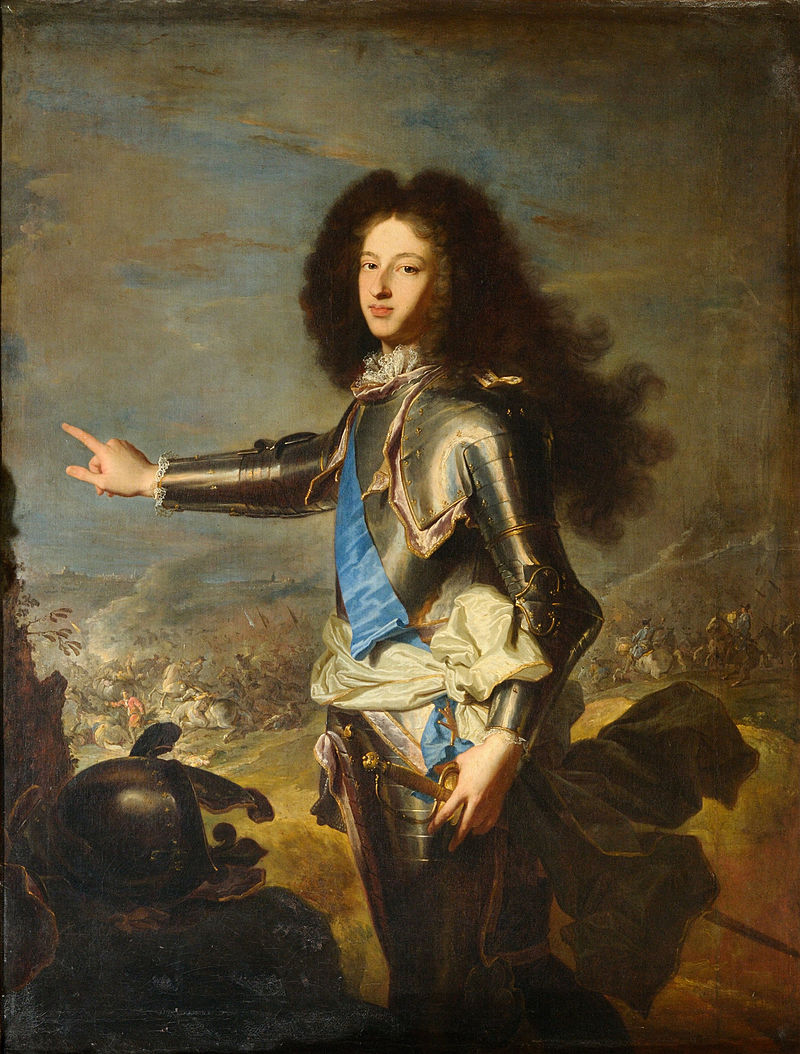
Louis, Duc de Bourgogne

Louis de Bourbon was the eldest son of the Grand Dauphin and as such was the direct grandson of Louis XIV. He was born on 16 August 1682 at Versailles which had recently been made the permanent residence of the court. Soon he was to be joined by two other brothers; the Duc d'Anjou and the Duc de Berry.

At the age of just eight years old he lost his mother; at this point he had only just been removed to the care of men which happened at the age of seven. Reports have it that he was a very difficult child who had fits of rage and never did as he was told. In an attempt to combat this behaviour Francois Fenelon was appointed as the young boy's tutor. This turned out to be a perfect match.


Hyacinthe Rigaud - Louis de France, duc de Bourgogne (1682-1712) - Google Art Project.jpg


Fenelon and Louis were fitted immensely well with each other. Fenelon soon learned that his pupil was intelligent and the best way to get through to him was by activating his mind. Louis immediately responded to this new approach and his character changed abruptly. Louis turned into a delightful young man according to the accounts of his contemporaries. He became pious, patient, attentive and his intellect was well-noted. Louis XIV was particularly pleased to see that his grandson was developing a keen interest in the army and enjoyed mock battles.
Fenelon was eventually exiled after his religious persuasion turned out to be a bit too Jansenist for the Sun King but Louis and Fenelon continued a firm friendship.

Louis XIV decided that Louis was to marry Marie Adélaide of Savoy (the Sun King's own great-niece since she was the granddaughter of Monsieur). They were married in December 1697 when Louis were 15 and Marie Adélaide just 12.
The first years of their marriage was uneventful due to their youth. Louis XIV had ordered that the marriage was not to be consummated until the bride was older which Louis naturally agreed to.

Louis XIV came to consider the Duc de Bourgogne as his true heir since the Grand Dauphin was basically useless when it came to politics. Known to happily spend entire days sitting in his chair and tapping his cane the Grand Dauphin seemed an unworthy successor to Louis le Grand. Consequently, Louis involved the Duc de Bourgogne far more in politics than the latter's father. For example Louis was allowed to sit in on the high council's meetings from the age of twenty - something his father would never be permitted to do.


Medallion of Louis, duc de Bourgogne by Ribou:


Louis himself was eager to prove his worth on the battlefield which he did quite well in the first campaigns. However, in 1708 the Duc de Bourgogne was sent to Flanders where he crossed paths with the Duc de Vendôme whom he was to share command with. The two were complete opposites and one disaster followed another. When Louis eventually was called back to court he was nevertheless received like a hero.

When it came to politics Louis was a supporter of a decentralised government which spread power out to the individual provinces. At this point in his life both he and his wife were considered adults and thus lived together. They had three children together; Louis was notoriously fond of his wife and seems to have been genuinely in love with him. While it is contested that she returned his feelings in such strong terms she always respected him and treated him with kindness and affection.

In 1711 the Grand Dauphin died and Louis and Marie Adélaide became Dauphin and Dauphine. However, they were only to enjoy that title for a short while. The following year Marie Adélaide contracted measles which the doctors could not get the better of. Louis remained by her side until he was forcibly removed due to concern for his own safety. Marie Adélaide died which plunged Louis into a state of depression.
Sadly, the fears of contamination turned out to be too little too late. While grieving for his beloved wife Louis himself fell ill. He died on 23 February 1712 at the age of just 29.