Showing posts with label hair. Show all posts

Wednesday, 16 January 2019

L'Herisson - the Hedgehog

"Imagine, if you can, a hedgehog lying on top of my lady's head, and, what is more, considered to be beautiful!"

These words give both a clear indication of the "hedgehog" as well how ridiculous some of the ladies of Versailles found it (according to Joyce Konzelman at least)

Léonard invented a great deal of coiffures during his reign as one of Versailles' foremost hairdressers. One of them was nicknamed "the hedgehog" or l'herisson. The name was derived from the abundance of curls that made up the hairdo. Curls upon curls were piled on top of each other in tiers; some curls were left to fall freely against the back of the neck. To keep the entire structure from falling, an abundance of hairpins were needed. Finally, the locks could be powdered (however, this was not a must) and a ribbon would be tied around the entire concoction.


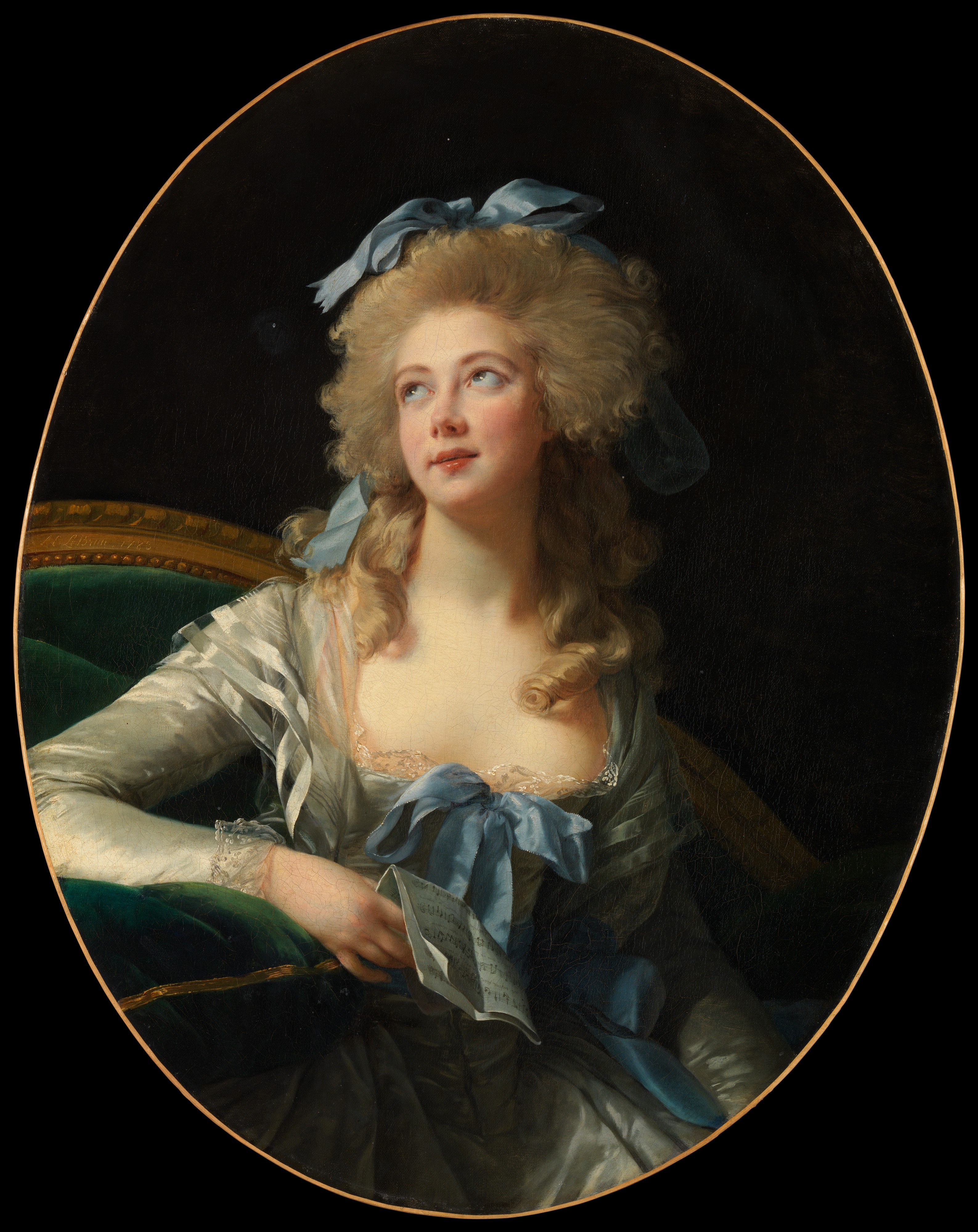
The Princesse de Lamballe, 1789, sporting a
l'herisson


This particular hairstyle can only have been hard on the natural hair of the wearer. To achieve the desired "spikes" - curls - the hair would have to be frizzed, warmed and curled. Some sources places the number of tiers at three but that number could be added to if so desired. As if a three-tier hairstyle was not intimidating enough a cap could be added at the very top - one can only imagine that a stepping stool must have been needed to place it there!

Léonard first created this style for Marie Antoinette but she was quickly copied by her ladies. One of her imitators was the Princesse de Lamballe who could not resist intertwining a few artificial flowers into her tower of tangles. She would even appear in a portrait of 1788 wearing the hairstyle. Considering that the style first saw the day of light 1778, it can be said to be one of the more persisting styles of the day.

Some chose to dial it down a notch which saw the rise of the "half-hedgehog". The entire concept was to introduce something new and different from the towering hairstyles that had dominated the years from 1773-78. Thus, a "half-hedgehog" was considered short in comparison.

Both men and women could style their hair à l'herisson. The male version included the same mass of curls but the back featured a pigtail in the back.

Saturday, 31 March 2018

The Coiffure à l'Enfant

The elaborate hairstyles of the 1770s took their tolls on the fashionable lady's real hair. Marie Antoinette was not unfamiliar with the struggles of hair which was only added to by the intense stress she was under to produce an heir.
Once Marie Antoinette had given birth to her first child something very unfortunate began to happen: the royal hair began to fall out. At first it was not much but by 1781 it posed a real threat to the royal hair. In an attempt to save the locks Monsieur Léonard cut the queen's hair quite short. Naturally, short hair did not become the public trend since Marie Antoinette would be dressed in wigs while her hair recovered. Nevertheless, the idea spread to other ladies at court who began to imitate her - no doubt that they experienced similar issues as their queen.


Naturally, the queen's friends did not disappoint. Here is both the Princesse de Lamballe and the Duchesse de Polignac in the coiffure à l'enfant: 

Detail from a portrait of Yolande Martine Gabrielle de Polastron, duchesse de Polignac, by Elisabeth Vigee-Lebrun. 1782.
The Duchesse de Polignac

Princesse de Lamballe, 1782, Elisabeth Vigée-Lebrun
The Princesse de Lamballe


The new style was christened "coiffure à l'enfant" which translates roughly to the child's hairdo. It brought with it a new era of style; whereas the hairstyles had hitherto been reaching higher and higher dimensions, the child's coiffure was far more "grounded". It did of course help that by 1776 the tall hair-dos had become the norm and was thus no longer a trend amongst the aristocracy. The new wigs were far more trimmed and could be remarkably relaxed. 

The style meant that the hair would be cut to just beneath the ears; however, the hair at the back would would longer. Thus it was only when seen from the front that the style was dramatically different.
From the side it was clear where the hairstyle was divided between the front and the back since a rather obvious hairline ran vertically down behind the ears. To prevent the front from seeming too flat, Léonard used curlers to slightly coop up the hair - he still had to be careful not to overdo it, though. The curlers would first be slightly heated and applied and then cooled down; to finish off the front the hairdresser would use a comb with wide spaces between the "teeth". The overall result was that the look was much less styled and seemed more natural.

The hair in the back was not left completely to its own devices. Once again the curlers were brought out and heated; the result were wavy curls.

Relateret billede
Élisabeth Louise Vigée le Brun

Another aspect that varied was the use of pomade. The higher hairstyles had depended on the sticky substance to keep everything in tight order but the coiffure à l'enfant favoured a more natural look. Consequently, the pomade was completely taken out of the equation. Given that the hair at the front was loosely combed it would easily have looked very greasy.
Likewise, the use of powder was not as vital as before. Some could still be used but without the pomade to keep it in place it would quickly become a mess.

It was possible to style the coiffure up a bit if so needed. Ribbons and flowers were great favourites when it came to adorn the simple hairstyle. The point was to restrain oneself - otherwise the entire impression of simplicity would be ruined. 


Billedresultat for coiffure à l'enfant


The coiffure represented not only a new fashion trend but a new phase in the queen's life. She was now a mother and had begun to appreciate her privacy at the Petit Trianon more. To a woman such as Marie Antoinette who cherished the natural it must have been a relief to quit the court-demanded fashions of her teenage years for a more mature look. Sadly, although the look was far less extravagant it still caused her to be critiqued. Some simply did not think that a queen of France should wear such simple styles and others were determined to tarnish her name no matter what.

Quite a few of the queen's portraits in the 1780's show her in the new style. These are some examples:


Billedresultat for coiffure à l'enfantBilledresultat for coiffure à l'enfant marie antoinette

Marie-Antoinette wearing the coiffure à l’enfant, by Louise-Elisabeth Vigee-LeBrun, 1783. Wikimedia Commons


From a more modern point of view the style was beneficial in another way. Although it is unlikely that people's awareness of hygiene suddenly became awakened there were certain benefits. For example the previous styles were often filthy and itchy due to the intense amounts of pomade. At least he scalp could breathe more freely now and dust would not stick to one's hair.
It is equally possible that not only the queen but all those who followed the trend experienced stronger hair after a few months. Since the hair was no longer worked on so much it was torn less - although the curlers still did its damage.


Friday, 10 February 2017

The Periwig

The periwig - or perruque - was quite a popular wig-style during Louis XIV's reign but it lost a good deal of its popularity after the Sun King's death. Actually, it had been popular with his father's, Louis XIII, court but waned a little during Anne of Austria's regency.

The long, flowing hair that Louis XIV had in his early years became the ideal for a wig. Unfortunately, the Sun King was prone to baldness and used wigs to cover up the increasing number of bald spots. Consequently, the periwig became all the rage amongst his male courtiers - Charles II of England was another big fan of the periwig ensuring its popularity in England as well.
Thus, the periwig re-entered the fashionable circles in 1660 and already in 1665 it was considered an absolute necessary part of a gentleman's attire.

A periwig had to have curls or at least waves. By the 1670's the style favoured was long rows of cork-screw curls and by the 1690's the periwig would rise high above the wearer's head and would often be parted in the middle.


Billedresultat for periwig 17th century
A periwig made from horsehair which happens
to be in a terrible state

The style of the periwig changed to and fro over the decades. At some point it became fashionable to powder it more white which would later be transferred to other types of wigs. The styling aside, periwigs for the upper classes were made of human hair. The hair used for the wigs could be collected from a wide array of "donors": novices entering a convent had their hair cut for example. It became a symbol of power to have a "natural" wig compared to those made of goat or dog hair.
Cardinal Mazarin was concerned about the expense of importing hair and attempted to turn the court towards "domestic goods". However, he soon gave up when he discovered that the expense was equalled by French trade.

It was rather unfortunate that the wigs had a tendency to emit an unpleasant odour; that they were never washed but pomaded and powdered did not help. To combat the smell the wigs were often scented with flowers.

With Louis XIV's dependency on wigs for his illustrious appearance it is no wonder that the artistry of wig-making flourished during his reign. Rumour has it that the King had forty wig-makers in his personal employ; it is more certain that he issued a decree naming them artists. The odd thing was that his courtiers were so eager to follow their master's fashion that they often had their heads shaved even if they were equipped with a full head of hair.


Billedresultat for periwig 17th century
The style favoured by soldiers due to practicality

The fashion was not merely confined to the upper classes and the trend quickly spread. However, it was not always practical to have long and luscious hair tumbling over one's shoulders. Soldiers and sportsmen were annoyed by the style and tied their locks at the nape; this did only became acceptable elsewhere after 1710.

As stated, the periwig became less popular after 1715 when Louis XIV died. The periwig would still be used in formal instances and some professions - such as lawyers and financiers - used it as a part of their working uniform. Although the periwig became less popular it did not quite disappear but was seldom used in the latter part of the 18th century.

Billedresultat for periwig louis xiv
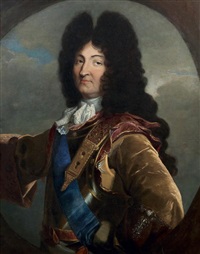
Louis XIV wearing a dark periwig

Billedresultat for periwig louis xiv
The Grand Dauphin wearing a powdered periwig

Billedresultat for periwig louis xiv
Mansart with the characteristic wig which has been parted
in the middle 

Billedresultat for periwig louis xiv
A whole array of powdered periwigs

Billedresultat for periwig louis xiv
A perfect example of a late 17th century periwig

Saturday, 22 November 2014

The Pouf

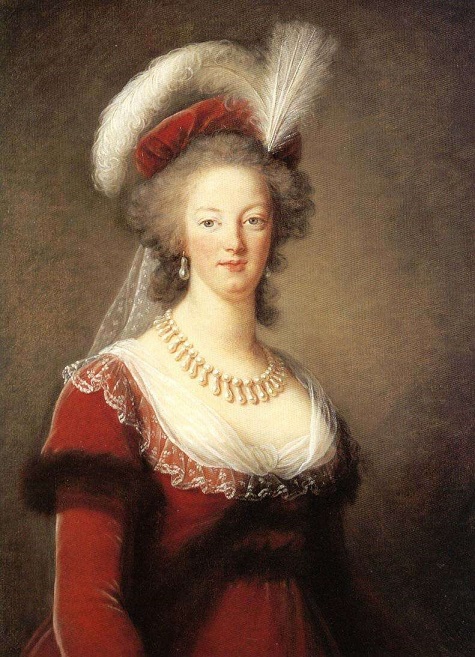
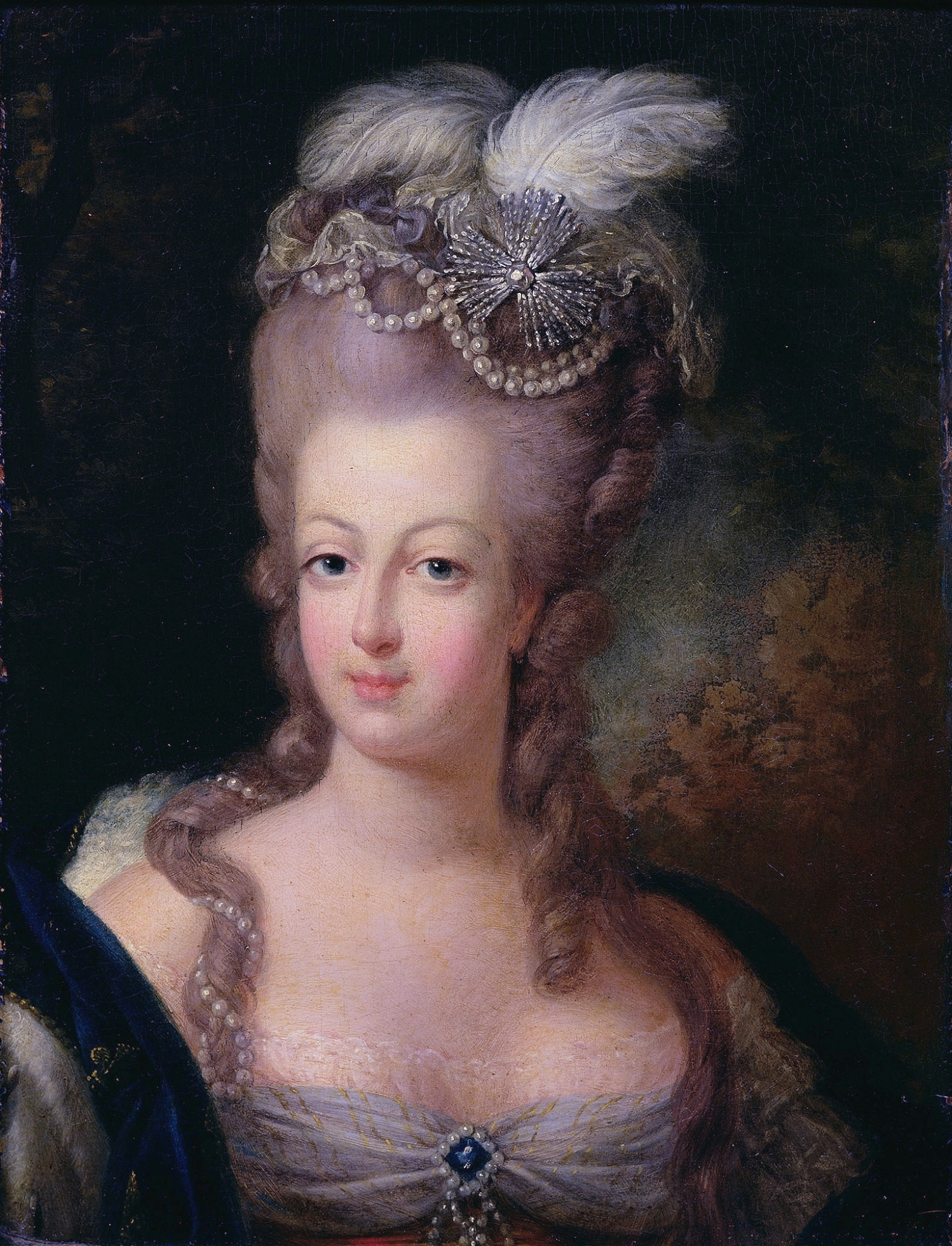
Marie Antoinette was responsible for introducing the Pouf to the French court in 1774 when she appeared at Louis XVI's coronation with such a hairstyle. Immediately, it spread like wildfire.

The Pouf was ideal to express the wearer's mood, celebrating an event or even the political view; there was no limit for the creativity that could be put into the hairstyle. The hair would be arranged high above the head in rolls of the wearer's natural hair intertwined with false hair. Once the rolls were safely fastened decorations could be added. Gemstones, ribbons, pearls and feathers were popular but for special occasions more was needed. Most of you have probably heard of the time when Marie Antoinette wore a small ship in her hair to commemorate the French rescue of the American colonies which did indeed happen.


Marie Antoinette was herself quite a fan of ostrich-feathers, as can be seen from the portrait above. Besides the feathers she is also wearing diamond jewellery, gauze and long rows of pearls are intertwined with the Queen's hair. Normally, the feathers would be snow-white but on special occasions they could be dyed to match a gown.

Marie Antoinette's English friend, the Duchess of Devonshire, was a keen follower of the trend. The famous portrait of her shows the Duchess showcasing the hairstyle which has been topped off by a large hat.
Back in France Leonard and Rose Bertin seemed locked in a rivalry of who could create the most outrageous hairstyles. Admittedly, Leonard had the upper hand in the beginning of the trend's life span.

Some of the more elaborate poufs. Notice that the lady to the left is actually wearing a hat topped with a lot
of feathers. The lady to the right has decided to use jewellery as well.


The Pouf Sentimental
This kind of pouf was first seen on the Duchesse de Chartres at the opera in April 1774 and as the name suggests was adorned with symbols relating to events in the wearer's life. The Duchesse's hairstyle was immense. 14 yards of gauze were wrapped around a tower as well as two figures representing the baby Duc de Beaujolais in his nurse's arms with an African boy (a particular favourite of the Duchesse) at her feet. A parrot and a plate of cherries were also added.

Leonard - favourite hairdresser of Marie Antoinette - was behind this masterpiece and he was to become a seemingly endless source of inspiration to the court ladies.

The Duchesse de Lauzun made another spectacle when she appeared showing a roaring sea complete with little ducks swimming near the shore where a hunter was aiming at them as well as a mill at the top. The miller's wife was with an abbé while the miller was leading a donkey. Needless to say, the price of these Poufs Sentimental could be quite steep.


A pouf sentimental to celebrate the defeat of the British
Over time the height of the Pouf rose to astonishing heights but you will find more on that subject in a later post.

Thursday, 20 November 2014

Tête de Mouton

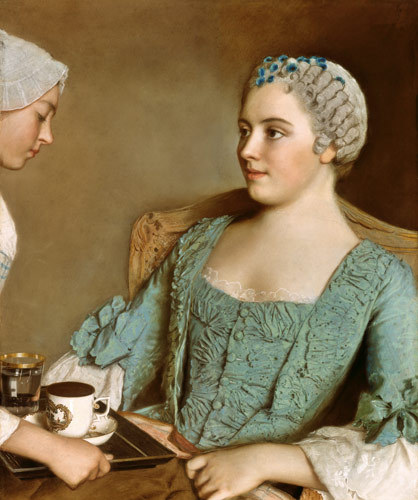
Literally meaning "sheep's head" the "tête de mouton" was a discreet hairstyle which gained popularity around the 1750's and remained in style throughout the 1760's. The hairstyle was close-fitted unlike the much more elaborate hairstyles otherwise known at court. The hair would be curled and arranged in neat rows and set close to the scalp. Possibly it was Marie Leszczynska's subtle lifestyle that inspired the hairdo and she is indeed portrayed with her hair in that style in official portraits.

Marie Josephe de Saxe
Normally, the curls would be powdered with white powder before being attached to the head. For those who were not blessed with thick, luscious hair it was common to add false hair (human or animal) to add volume. Even though the style was closely fitted at first there was some who took it to whole new heights which meant that the hoods of the females' capes had to be suspended with wires to keep from destroying the style.


As shown on the portrait above it was quite common to decorate the hairstyle with different sorts of accessories - after all, it would not do to be too simple. Artificial flowers, pearls and gemstones were lavishly added to the hairstyle and most women would try to match the colour of their gown with that of their hairstyle's accessories. 

Wednesday, 18 September 2013

The Pompadour Hair Style

You can probably guess who this one is named after, so I am just going to leave it at that. It was popular among both men and women and even made a comeback in the 20th century. The style is simply achieved by making the hair stand up and sway slightly out from the forehead. The hair on each side of the head is pinned up and gathered with the hair of the Pompadour itself. At the court of Versailles it was popular to use bear grease to make the hairdo stay in place. Often ornaments were used to decorate the hairstyle like diamonds or flowers.
It was quite normal to have your hair curled behind the head but the hairdo in the front was tall but still simpler than most hairdos found at Versailles.


This is a very small version of it

The Fontange Hairstyle

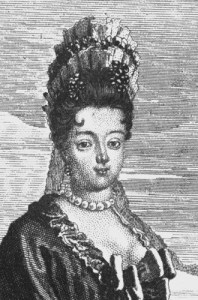
This particular hairstyle was named after one of Louis XIV's mistresses, the Duchesse de Fontagne. It is also known as the "frelange". It became popular in the 1680's and was in fashion both in France and in England. Like every other element in fashion this evolved from the moment it became popular. At first it was merely a simply arrangement of curls at the top of the head gathered by ribbons (anyone who has ever tried to tie their hair with ribbons know of difficult this is). The story goes that Madame de Fontange was out hunting when her hairdo was suddenly ruined and since loose hair was not permitted she quickly gathered her hair with a ribbon from her dress.
Later it became taller and far more elaborate curling were all the rage. To make the hairdo even higher the hair was often tied around a wire "cap" placed on top of the head and often false curls were added - sometimes made of horsehair. Also, it was custom to wear a trimmed linen cap with this hairdo which consequently also became known as the "Fontange". Actually you might say that this is the similar endeavour to create as high a hair silhouette as possible just like Marie Antoinette would do a century later. There was an annoying problem with this fashion however. As the height of the hair grew it became more and more difficult to keep the pile of hair stable and it would often slide off to one side. This resulted in an extreme use of starch and even more wire to keep it in place.

One of the "sub-categories" of this fashion was the Fontange à la Sultane where a veil would be worn from the great height of the hair. Some women had two curly locks hanging on each side of the head.

Queen Mary II of England
Head03
This is a fontange à la sultane
Fontange of 1713

Different variations