Showing posts with label portrait-gallery. Show all posts

Saturday, 30 October 2021

Portrait Gallery: Marie Thérèse Raphaëlle, Dauphine of France

Born as the daughter of Philip V of Spain and his consort, Elisabeth Farnese, Marie Thérèse Raphaëlle was married to Louis Ferdinand de Bourbon, Dauphin of France. Their marriage took place in 1745 as a part of the reconciliation between France and Spain made necessary by the abrupt return of Infanta Marie Anne Victoire to Spain. She was initially meant to have been the wife of Louis XV but her young age and the king's dire need for an heir resulted in the betrothal being broken up. Now, some twenty years later, the two families reunited with the marriage of Louis and Marie Thérèse Raphaëlle.

While this union proved remarkably happy, it would also prove to be very short. Finding herself to be pregnant, Marie Thérèse went into labour on 22 July 1746. Sadly, she would not survive the delivery and died at the age of 20.


1) Portrait of Marie Thérèse Raphaëlle a year before her death but after her wedding to Louis Ferdinand, that is in 1745. The portrait was painted by Daniel Klein the Younger.

2) Louis-Michel van Loo painted the young dauphine in 1745 in a white silk robe volante.

3) This portrait by Jacobo Amigoni shows Marie Thérèse Raphaëlle in a far simpler attire than the other two. Rather than the heavy diamond jewellery, the dauphine is adorned simply with a flower in her hair and a pearl earring.


4) Painted between 1729-1733 shows a very young Marie by Jean Ranc. Given that she was born in 1726, she would be between 3 and 6 years old here.

5) Another portrait by Louis-Michel van Loo, although this particular portrait is of an unknown date. Still, given the obviously young age of the sitter, it was likely painted while she was still in Spain.

6) While the exact time of this portrait is unknown there are several clues in the portrait itself. An ermine-trimmed cape with golden fleur-de-lis is draped over Marie Thérèse Raphaëlle's shoulder and she has a portrait of her husband in her bracelet - hence the portrait must have been painted after her wedding. This limits the time frame to 1745-46.


7) Yet another piece of work by van Loo, this is a very good example of an official state portrait. Decked out in fine jewels and once again draped in her adopted country's fleur-de-lis, Marie Thérèse Raphaëlle is otherwise dressed in heavy brocaded silk.

8) Jacopo Amigoni returned to depict the dauphine once again and repeated his remarkably simplistic style. The portrait is presumed to be of Marie Thérèse Raphaëlle and does have some similarities, notably the long, slim nose.

9) Louis Tocqué is behind this second version of a state portrait. Compared to the one by van Loo, Marie is depicted as having a wider face than in her other portraits.
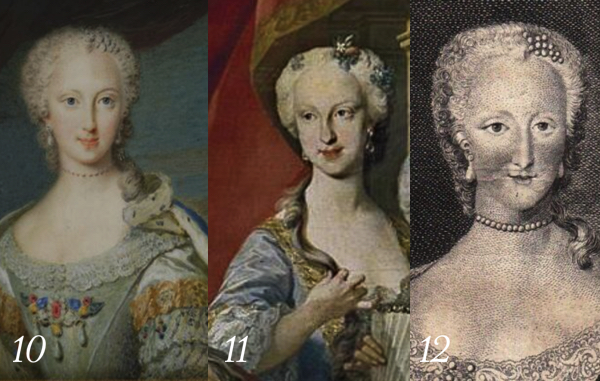


10) This miniature was painted in 1744 after the style of van Loo but not by that artist himself. The portrait was likely made in connection with the betrothal of the young couple.

11) Detail of family portrait done in 1743. Marie Thérèse Raphaëlle was depicted next to her younger sister, Maria Antonia Fernanda. Louis-Michel van Loo was also behind this particular image.

12) Engraving of the short-lived dauphine which appears to have been made from the same sketch as the miniature in number 10 - but was likely drawn by another artist as the features are slightly different.

Tuesday, 26 October 2021

Portrait Gallery: Marie Antoinette: Archduchess & Dauphine

October 16th, marked the 227th anniversary of the execution of Marie Antoinette. In honour of her memory, this post focuses on the portraits of the ill-fated young woman who would one day become queen of France - and end her days on the scaffold.

Marie Antoinette was born on 2 November 1755 and became Dauphine of France upon her marriage to Louis Auguste on 16 May 1770. When negotiating her marriage, one of her strongest, physical characteristics was her flawless skin - described as a perfect mixture of milk and roses. Finally, she would ascend the throne on 10 May 1774. 


The Archduchess (1755-1769)


1) The very first image of the new-born girl whose life would end so tragically - the artist behind it is unknown but the large eyes are remarkably similar to later portraits of her.

2) One of the lesser known portraits of the very young Marie Antoinette, this aquarelle was the work of Johann Christoph von Reinsperger. 

3) The 7-year old archduchess was painted in this blue gown with pink/blue bows and pearly white laces by Jean-Étienne Liotard in 1762. The portrait clearly shows her remarkably slim waist - even for a child of her age. It would be that very waist that would make her unwilling to wear the rigid French corsets demanded by court etiquette at Versailles.


4) Liotard had a busy year in 1762 with the imperial Austrian family. Besides the first portrait mentioned, he made an entire series of the numerous children of Maria Theresia. This particular one shows Maria Antonia and looks remarkably different to the one he made of her earlier that year.

5) A sisterly portrait depicting Marie Antoinette (aged 8-9 and wearing pink) with her sister Marie Caroline (cut out, but wearing blue). The two were good friends despite their different natures - whereas the young Antonia was pliable and amiable, Carolina was far more headstrong and independent.

6) The imperial family of Austria was depicted by Martin van Meytens in 1764-65. As one of the youngest children, Antonia can be spotted almost in the background. The portrait above is a detail of the complete painting.


7) The style of this portrait by an anonymous artist is very different than any of the other portraits made of the young archduchess. Dating back to 1767, Marie was 12 years old when she was painted in this electric blue gown. 

8) One of the most famous portraits of the young Marie Antoinette, this one was also painted in 1767. It has generally been attributed to the court painter Martin van Meytens. However, despite being widely associated with Antoinette, the portrait has been the focus of some speculation. Some point out that it looks remarkably much like one of her sisters, particularly Maria Carolina.

9) Dressed up in suitably French fashion, this was the portrait sent to Louis Auguste in 1769, to give him a likeness of the girl who was to become his wife. It was painted by Joseph Ducreux.


10) For some reason, Marie Antoinette was often depicted wearing deep blue while still living at the Viennese court. This particular portrait was finished in 1769 by Franz Xavier Wagenschön and shows the young girl occupied with one of her favourite pastimes: music. This would be one of her last portraits painted as an Austrian archduchess as she would be married shortly afterwards. 

11) Another portrait by Ducreux, the young woman looks almost like a doll with her perfect porcelain skin and large, blue eyes. 

12) A slightly earlier portrait of the archduchess by Joseph Hauzinger who painted Marie in around 1765. Note how different the style of gown is to her French counterparts - it is far more simplistic in the skirt itself.

The Dauphine (1770- May 1774)


13) Joseph Ducreux would return to paint the new dauphine in 1770, shortly after her wedding. The result was the charming portrait of a young, refined girl in delicate pink ruffles. The royal ermine has discreetly been draped over her shoulder and the golden fleur-de-lis can just be spotted over the other - clearly marking her new allegiance. 

14) The inspiration for this portrait was the one above - hence the very similar facial expression and pose. The painter was Jean-Baptiste Charpentier the Elder who completed the portrait in 1770.

15) A far more masculine portrait is this by Joseph Kranzinger who painted the dauphine in 1772. Marie Antoinette wore a riding habit of red velvet and a black tricorne hat - the female riding habits of the time were basically male attire slightly altered to fit the female body. When she arrived at Versailles, Marie Antoinette did not know how to ride which proved an obstacle in her marriage and her position at court. The French court had always had a lasting love affair with hunting and her new husband was an ardent hunter himself. Thus, in an effort to get closer to him, the young dauphine learned to ride and sent this portrait to her mother.


16) Back in far more regal attire, this 1773 portrait by Drouais shows a young woman impeccably dressed according to French fashion: high, sleek hair, diamond-encrusted choker and intricate silk gown. The luxury is not a coincidence, as she is dressed in full court costume or grand habit. Later, this would be used as a reference for a tapestry made at Gobelins in 1775. The portrait is currently in the Victoria and Albert Museum.

17) Painted at the age of 16 by Joseph Kreutzinger in 1771. It is far more ethereal than the other portraits and she seems almost ghostly. Rather interestingly, at Versailles, Marie Antoinette was dressed far more in shades of pink than in the blue of her childhood.

18) Another portrait by Drouais, this one is of the very popular allegorical type. For centuries, the kings of France (and elsewhere) had themselves painted as various deities - this particular time, Marie Antoinette is Hebe, the goddess of youth. It was commissioned by Louis XV in 1772 and marked for his study at Chantilly alongside a portrait of the Comtesse de Provence as the goddess Diana. It remained there until the revolution.