Showing posts with label poison. Show all posts

Friday, 13 September 2019

The Bloody Fall of Mademoiselle de Fontanges

At the age of 18 years, Marie Angélique de Scorailles served Madame as a lady-in-waiting at Versailles. While she was there, she caught the eye of Louis XIV and became one of his unofficial mistresses in 1679. As could be expected, Madame de Montespan was intensely displeased at this new development and it certainly did not help that Marie Angélique soon found herself with child.

However, the pregnancy did not run smoothly. By January 1680, she was prematurely delivered of a still-born son. The king was informed of her condition in the usual terms; the lady was said to have been "wounded in his service". If Marie Angélique had expected to fall back into her position as a rival to Madame de Montespan, she was sadly mistaken. As the maîtresse-en-titre had predicted, Louis' passion for her was already cooling.

The king's next action corresponded perfectly with the usual custom for dismissing a mistress. Mademoiselle de Fontanges was elevated to the rank of Duchesse de Fontanges and given a handsome pension of 80.000 livres - after all, she had been wounded in the king's "service".

The birth of her son appears to have taken a greater toll on her body than at first feared. Throughout 1680, her health became increasingly worse; during the birth it seems that she had hemorrhaged considerably and the extensive blood-loss continued to have an impact on her health. It should be remembered that this was long before blood-transfusions, so there was no way of replacing the blood she had lost in this manner. The doctors almost certainly aggravated the situation by bleeding her on several occasions. 

It was clear to everyone that something was terribly wrong with the young lady. Her previously much-admired looks faded fast - and with them, the king's affection. Her perfect complexion had become ashen and her eyes had completely lost their sparkle. She also became increasingly apathetic and complained frequently of fatigue. Furthermore, she swelled up. Her lovely face became puffy and she became quick to tears.

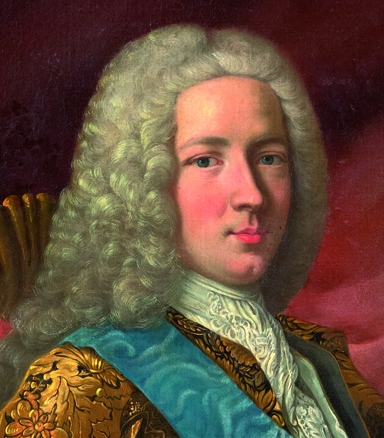
Billedresultat for mademoiselle de fontanges poison
Marie Angélique, Mademoiselle de Fontanges

When her condition did not improve, Marie Angélique decided to remove herself from Versailles and went to the Abbey de Chelles. It was said that she had chosen to retire because the king's behaviour made it clear that her time was already over. Once she was out of sight of the royal court, rumours began circulating. Some insisted that she had conceived a second child by the king and that she had gone to the abbey to give birth. 

Whether she was pregnant again is not known for certain; those in favour of the theory argued that she had given birth to another stillborn child (this time a girl) sometime in March 1681. What is known is that she contracted a high fever while at the abbey in 1681. Not long after, it became obvious that she would not survive. Louis XIV granted her request and agreed to see her at the abbey. While there, the two shared a last meeting before the king returned to Versailles - and Madame de Montespan. Marie Angélique never recovered and died on 28 June, at the age of 19 years old.

The young Duchesse de Fontanges had not even been buried, when rumours once more sprung up at court. This time they pointed a vicious finger at Madame de Montespan who was accused of having poisoned her young rival. Considering the long-lasting illness of Mademoiselle de Fontanges and the subsequent autopsy, it seems unlikely, but the Affair of the Poisons was in full swing.

Some said that the plan had been to entice Mademoiselle de Fontanges to buy a certain luxurious fabric which would have been coated with poison. Even if that plan had actually been thought of, it would not have worked. The poison would at most have resulted in a rash but would not have been fatal. It was even said that Marquise de Brinvilliers - interrogated during the Affair of the Poisons - had confessed to this plot having been hatched. However, even the Marquise admitted that she only knew of it because she had overheard fractions of a conversation between her mother and a man by the name of Romani. 

The gossipers pointed to the fact that two servants of Mademoiselle de Fontanges had been poisoned - whether that was actually the case or if they died of natural causes is unknown.

As Jacques Levron and Gérald van der Kemp asked in their book "Versailles and the Trianons": what would Madame de Montespan have gained by poisoning Mademoiselle de Fontanges?". There was no guarantee that Louis XIV would suddenly regain the former passion he had had for La Montespan. It could even be argued that Louis would have been more likely to turn from Madame de Montespan if another instance of poisoning was laid at her door.

Louis XIV declared that he would not have an autopsy performed on his former mistress. However, her family disagreed and the autopsy was carried out. The result was disappointing to the enemies of La Montespan. Her stomach was in good health and it was generally believed that poison would show in the stomach. However, her lungs were severely affected - one was said to be "full of pus". This has led later physicians to attempt a diagnosis. The most plausible is that during the delivery of her son, a part of the placenta remained in the uterus. This would result in infections which could account for the large amount of pus in her lungs. Even at the time, there were some who pointed the finger at the miscarriage rather than poison including Primi Visconti.

Unfortunately, it is not possible to conduct an investigation into the remains of Mademoiselle de Fontanges. Her remains were destroyed during the revolution.

Saturday, 13 October 2018

The Suspicious Death of Madame de Châteauroux

Marie Anne de Mailly, Duchesse de Châteaueoux's reign as Louis XV's mistress appeared to be all but over in 1744 when the king fell dangerously ill at Metz. Since religious rites demanded that the king dismiss his mistress in order to receive absolution for his sins, she was initially sent away. However, to everyone's surprise the king rallied and returned to Paris. What was even more surprising was that he broke the hitherto accepted practice of not returning to a mistress who had been formally dismissed.

By November 1744 he was back by her side and Marie Anne received an invitation to return to her former splendid state at Versailles. This sent shivers across the gilded halls of the palace where the triumphant mistress had made her fair share of enemies. Considering that she now stood in the king's good graces again it was not unlikely that she would exact her revenge on those who had worked against her. 

But then, she herself fell mortally ill. Cramps and convulsions racked her body and she was convinced that she had been poisoned. On 8 December Marie Anne died - just 13 days after returning to Versailles.

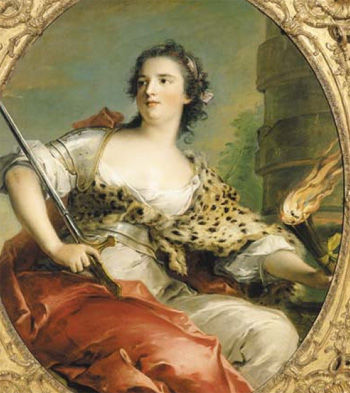
Billedresultat for duchesse de chateauroux poison
Marie Anne de Mailly

The question was whether Marie Anne's suspicions were correct - had she been poisoned?

The duchesse herself believed that she had been poisoned by her chief enemy, the Marquis de Maurepas. Their enmity went back a long while and upon returning to court Marie Anne had demanded that the king dismissed Maurepas from his duties as minister. However, Louis had refused and instead offered his beloved a chance to gloat over her enemy. The minister was duly summoned and placed before the king and his mistress where he attempted to pass their previous enmity off as misunderstandings. It did not work.

Marie Anne continued to insist that Maurepas had poisoned her either at Reims where she had indeed been taken ill and were administered medications or through a letter.

It would not have been unprecedented if the king's mistress had been killed. However, one must remember the medical practices of the day. According to the Duc de Richelieu, Marie Anne was bled no less than nine times during her illness. This undoubtedly weakened her body further. Richelieu notes that once she had died it was observed that her "blood vessels were found to be dilated and swollen with blood".

To the medical practitioners of the day such symptoms were inconclusive. Thus, they never declared that she had been poisoned - but it was not denied either. One of those who joined the now late mistress in her suspicion was Mouffle d'Angerville who described her death as a "mere act of vengeance".
To be sure, Maurepas did have his reasons for wishing to get rid of her. Not only Marie Anne attempted to remove him from his ministerial post but she had also treated him with obvious contempt. One source mentions a time when she dismissed him with a wave of the hand and the words "Off with you". These were hardly an incentive to make friends but insults does not necessarily lead to murder.


Bonnie Prince Charlie face in 1745.jpg
The marquis de Maurepas who was long accused
of having poisoned her

David Smythe - in his book "Madame de Pompadour: Mistress of France" - bluntly dismisses the claim. His theory is that she suffered from typhus. To be sure, there are some credence to this theory. Marie Anne suffered from several of the symptoms usually associated with typhus including abdominal pain, head aches and fever. More than one source note that she was delirious in some periods which can also be a symptom. Also, epidemic typhus has a tendency to appear rather suddenly. It should also be remembered that Marie Anne had followed the king to the army camp at Metz - such an environment is a perfect breeding ground for disease.


However, there is the possibility that Madame de Châteauroux's health was already on the decline. Edmond de Goncourt refers to a situation fifteen days prior to the mistress' death when she was confronted by a friend of hers who warned her about her health. Apparently, there was some concern that she did not sleep nor had any appetite; her eyes were not sparkly and they worried that she might have contracted a sort of fever. Yet, Goncourt also notes that her autopsy revealed nothing but the before-mentioned blood vessels.

It is interesting to note that even those of her friends who steadfastly held that she had met with foul play did not press for any action to be taken. Actually, few of the memoirs and correspondence of the time mentions any further considerations on her final illness. Given that she had been delirious - which even her friend Richelieu admits - when she made her claims of poison it is not unlikely that few others actually gave her suspicion credence. 

The king - at least - did not. There is nothing to suggest that Louis XV believed his mistress to have been poisoned and he had no investigation initiated. Thus, that came to an end and the suspicion remained unproven. 

Sunday, 27 May 2018

The Sudden Death of Louvois

François-Michel Le Tellier was primarily known simply by the name of his marquisate of Louvois. He served Louis XIV as Minister of War and did so with unscrupulousness and ruthlessness. Naturally, this way of carrying on is bound to result in enemies - and Louvois certainly had his share.

Louvois died suddenly on 16 July 1691; the official cause of death was considered to be apoplexy but the suddenness caused immediate speculations of poisoning. It was well-known that the marquis always had a pitcher full in his office which only fueled suspicions. Elizabeth Charlotte of the Palatinate was certain that he had indeed been poisoned and even named the culprit: his physician, Seron. According to Madame this particular doctor had confessed to poisoning his master on his own deathbed. 
Madame also mentions that some rumours had it that Madame de Maintenon were responsible. Despite the unwavering dislike of Madame for La Maintenon, she completely dismissed it. 

Others were not so quick to clear the king's mistress of the charge of murder. It was no secret that Madame de Maintenon and Louvois were hardly on good terms; on the contrary, the could easily be classed as enemies. One particular theory claimed that Louvois had convinced Louis XIV not to publicly announce his marriage to the rather low-born Maintenon. Madame de Maintenon was allegedly furious and not long after Louvois suspiciously died.


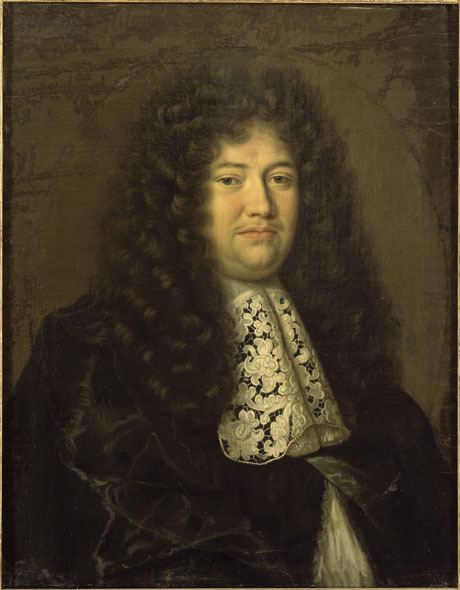
Billedresultat for louvois
Louvois

The Duc de Saint-Simon had an even more daring theory. While he agreed that the minister had definitely been poisoned he disagreed as to the culprit. Rather than pointing the finger at the deceased's doctor he pointed a great deal higher: to the king himself. Although poison was not truly the style of Louis XIV, the Sun King had been rapidly losing his regard for his former dear minister. Once he was informed of his death the king made no attempt at hiding that he did not consider it a great loss. He even counted Louvois amongst three that he had been fortunate enough to be rid of in that particular year.
However, it is unlikely that Louis XIV would actually have had him poisoned. The main reason is that he simply did not need to. As an absolute monarch the king could simply have dismissed him and exiled him further if he was completely tired of him. 

Another account has it that a Savoyard servant was arrested following Louvois' death but was quickly released on the king's express order. This particular theory was probably based more on political thought since Savoy and France's relationship was at a low.
Several reports mentions that Louis XIV cut his meeting with his minister short because the latter appeared to be quite ill. This is little help when it comes to deciding if poisoning had taken place. On one hand it could be the external signs of an already deadly disease but on the other it could be the first signs of the poison taking effect. 

There were those who contemplated if Louvois had committed suicide. His influence over the king was a shadow of what it had been and it was widely expected that the king would soon rid himself of his uncompromising minister. Perhaps the dread of becoming a virtual nobody was too much for Louvois?

As was customary, an autopsy was performed on the deceased. This took place on the 17th July and according to the Marquis de Dangeau all the doctors agreed that there was no sign of poisoning. However, not everyone agreed with this. The Duc de Saint-Simon, for one, remarked the exact opposite and affirmed that evidence of poisoning was certainly found.
Whether or not Louvois was actually poisoned will never be known for certain. It can only be remarked that it is quite ironic that the man who had control of the Chambre Ardente - which was in charge of persecuting courtiers on cases of poisoning - would himself die a suspicious death.