Showing posts with label great-events. Show all posts

Sunday, 12 June 2022

The End of an Era: The Fall of Madame de Montespan

Undoubtedly the most celebrated maitresse-en-titre of Louis XIV, Françoise-Athénais de Rochechoaurt had been the king's declared mistress since about 1666; she had since given him no less than seven children. Her relationship with the Sun King was a passionate one and despite several attempts, the couple always found their way back to each other - even the king's growing religious fervor was overcome time and time again.

So, when their relationship began unravelling in ca. 1677, the court probably expected it to be another storm that would eventually end in reconciliation. However, this time it was different. The infamous Affair of the Poisons had created an entirely new breeding ground for suspicions. Due to the nature of their relationship, the king was well-aware that his mistress would always be wary of being supplanted in his affection. So far, the charms, intelligence and beauty of La Montespan had been enough to keep his attention but the king was now persuaded to believe that she might have been involved in more occult methods. 

As the Affair of the Poisons unravelled, it quickly became clear that the royal favourite was somehow associated with the whole sordid affair. It did not take long before rumours started spreading and there was no limit as to what Madame de Montespan was accused of. 

Some said that she had used the services of the "witch" La Voisin to concoct love potions for the king in 1665 before finally succeeding in catching. Others claimed that she had prayed to the devil and had black sabbaths performed - complete with the obligatory sacrifice of an infant - to keep her lover's interest while yet others pointed to the recent death of Mademoiselle de Fontagnes. The young lady had captured the king's attention and had fallen pregnant as a result - she died after delivering the child.


Madame de Montespan


Had the affair simply been a matter of jealousy, the king could easily have overlooked it. But this was something entirely different. This concerned the very life of the king - and it did not take long before scandal mongers started whispering that Françoise-Athénais had attempted to kill the king. Despite the absurdity of this charge - after all, Madame de Montespan would lose everything if the king died - the king was alarmed. One can hardly blame him for being unnerved as the use of poison was not a by-gone weapon in his age; even the typically useless "potions" could be lethal if dangerous ingredients were added. This might not even be intentional as certain ingredients were considered harmless then but is known to be highly dangerous today.

Was there anything to suggest that Madame de Montespan actually was involved? The Lieutenant General of Police, Gabriel Nicolas de la Reynie, was presented with several witness accounts which placed numerous ladies of the court as customers of La Voisin - including Madame de Montespan. Before diving further into this particular claim it is necessary to look closer at the attitude to the occult of the time. 

While the superstitions of the Middle Ages were not nearly as strong as they had been, they were far from eliminated. Even amongst the better educated parts of society a remarkably large number believed that black magic, potions and black sabbaths were very much effective. Others saw it merely as something interesting which could be used for entertainment on a boring day; for instance, young ladies would occasionally seek out palm readers to disclose their future but never went beyond that. Either way, there is no actual evidence to suggest why Madame de Montespan went to La Voisin - or if she even did.

It is telling that the potential visits to La Voisin only became suspicious after Madame de Montespan's maid, Mademoiselle Desœillets, was noted to be a frequent visitor herself. It was therefore easy to claim that where the maid went, so too might the mistress go.

It has often been put forward that Louis XIV's own reaction shows how little merit there was to the accusations levelled at his mistress. He himself had ordered the establishment of the so-called Chambre Ardente (the court passing sentences over the Affair of the Poisons) and as such would have been presented with every finding and evidence. If he had genuinely feared for his life, he would have ended their relationship - but he did not. Instead, she kept her place for no less than another decade.

But if the king did not believe Madame de Montespan to be genuinely guilty, why then did their relationship fall apart? Here it might help to look to something as simple yet complicated as human nature. The two had been together for a long time - far longer than any of his previous liaisons. It is not unheard of that they simply fell out of love with each other. As has often been pointed out, relationships that are so passionate will almost always fade out eventually.


Louis XIV


Furthermore, there is a decided shift in character in Louis XIV at this point in his life. Up until this point, he had been somewhat carefree in his love affairs; whether it was elevating La Montespan while La Vallière was pregnant with his child or having both mistresses ride in the same carriage as his wife, his attitude towards his dalliances were typical of his age. A king was expected to have mistresses - everyone, even the queen, knew this and it was generally accepted as a fact of life. However, as he grew older, Louis became more and more prone to religious reflections. 
Throughout his entire relationship with Françoise-Athénais, the most damning accusation levelled against both of them was that of double-adultery. Of course, the church had never been fond of the king's infidelity but it had turned a blind eye when the lady in question was unconnected by marriage. For instance, both Marie Mancini and Louise de La Vallière were unmarried when they first became the king's mistress - the former apparently never even had a physical affair with him.

Madame de Montespan, however, had been married to the Marquis de Montespan in 1663 and was therefore a married woman when she became the king's mistress. While the church could always explain away the king's guilt by pointing to the divine favour which all monarchs were said to hold, the same could not be said of her. This was therefore a matter of double-adultery - a sin that would not wash off quite so quickly. As it happens, this very reasoning had been the cause of their split in 1675, which had occurred after the church refused to give her absolution and even withstood the pleading of the king. 

In 1675, the church's argument had not been enough - it seemed to be more pressing as the king grew older. 

Thus, it does not seem unlikely that a mixture of cooling passions and growing religiousness was what eventually caused the downfall of Madame de Montespan. What is more certain - and unusual - is the manner in which that downfall occurred.

Typically a jilted royal mistress would be sent off with a handsome parting gift or she would voluntarily retire to a convent. Either way, the rupture would be somewhat obvious to everyone at court. However, Madame de Montespan continued to play a part in the king's life as their relationship cooled. Their split was not one which could be traced to a dramatic final interview or specific event. Rather, it was dragged out over several years. 


Madame de Montespan with her
children, 1677


For those watching - and everyone at court certainly was - the changes were small but of immense significance. The one thing that stood out was how much time the king devoted to a new lady: Madame de Maintenon. She would often be summoned to spend their evenings in conversations while Madame de Montespan remained conspicuous by her absence. Despite her reputation for being a very devout woman, Madame de Maintenon certainly did not shy away from using the king's religious fears to her advantage. Thus, a number of contemporary courtiers remarked that she was sought for by the king because he increasingly felt a need for religious discussion. 

The otherwise always-present Madame de Montespan found herself excluded from more and more activities at court. While she was still frequently invited to the king's beloved Marly in 1686, she would soon receive a very public (figurative) slap in the face. The king was suffering from his highly unpleasant fistula which he sought to cure by taking the waters at Barèges. Naturally, wherever the king went, the court followed - but not Montespan. To her great astonishment and frustration, she was deliberately not invited to this excursion; the message could hardly have been louder. In her anger, she took her youngest son by the king - the Comte de Toulouse - and went to Paris but was stopped on the way with orders that the young boy was to accompany his father. In the end, the trip to Barèges never materialised but the humiliation was complete.

By this point in time, no one had any doubts that their relationship was as good as dead. The king had adored Françoise-Athénais for years and such a public snub would have been unthinkable just a few years ago.

Yet despite this dramatic incident, the king still did not call things off officially. While he certainly was a creature of habit, Louis XIV had never shown a reluctance to cut off people who had displeased him - it therefore seems more likely that the continuance of La Montespan at court was due to a certain respect and affection (although not love) that he must still have had for her. Furthermore, it should not be underestimated that her position as the mother of many of his children earned her some credit with him - after all, he was notoriously fond of his illegitimate children and it would have been a scandal if their mother was thrown out without a second thought, especially after so long a relationship.

These years cannot have been particularly pleasant for Madame de Montespan. Her pride was notorious and she had been accustomed to wielding immense power at court. Now, she was reduced to having to endure both the presence and influence of another woman; much like Louise de La Vallière had before her.  Whereas Françoise-Athénais would have had no problem keeping the king interested in her conversation through her wit and charm, that still required private time with him - and that was increasingly reserved for La Maintenon.

File:Portrait d'Athénaïs de Rochechouart, marquise de Montespan (1641-1707), maîtresse de Roi.jpg
Françoise-Athénais, around 1680


Françoise-Athénais was no fool; she knew that the king's affections were not what they had been and she acknowledged that her time was over. Finally, it would be her who took the step to remove herself from an increasingly awkward situation. In 1691, after 25 years as the king's official mistress, she informed Louis of her decision to leave court. It is very telling that she did not do so in person; rather, she asked the king's trusted Boussuet to deliver the message.

There is one aspect of their final separation that is worth noticing. While much have been made of Louis XIV's ever-increasing religiousness, that same development in Madame de Montespan has been somewhat overlooked. Just like her royal lover, the former favourite was getting older and she shared many of Louis' fears for her eternal soul - after all, she did not have the benefit of claiming divine favour as a redeeming factor in her adultery. Perhaps this is an indication that their relationship simply had run its course - if they still had the same passionate love for each other, their new-found sense of religion could easily have united them as they grew older. This could have been strengthened further by their common interest and genuine affection for their children. Instead, it caused them to finally end their legendary liaison.

Madame de Montespan retired to the convent of Filles de Saint-Joseph in Paris. While Louis would spent the remainder of his life with the austere Madame de Maintenon - potentially even marrying her - the mother of seven of his children spent her years with charity. She spent large sums on charitable works and had cut all contact with the court - and the king. The king appears to have shown some sign of gratitude at her taking the first step; her father was given the governorship of Paris while her brother was made Marèchal de France. As for their children, they had been legitimised and their future was therefore secure.

When she died in 1707, their relationship was a thing of the past. While their children mourned for her, the king curiously forbade them from wearing official mourning. This last act has been interpreted as spiteful by some and it certainly does have elements of pettiness. However, it cannot be said to be an indication of resentment - after all, the king had not seen his former beloved for 15 years. Meanwhile he was desperately trying to have his children by her absorbed into the legitimate lines of aristocracy - perhaps their mother was an unwelcome reminder of the fact that they were, in fact, not only illegitimate but the result of double-adultery.

Whatever the king's motives for refusing mourning was can never be known. What is more certain is that his infamous relationship with Françoise-Athénais de Rochechouart dominated a good portion of his life and brought him seven beloved children. The end of their liaison was also a turning-point in the king's personal life. The carefree and splendid years were behind him and austerity took over - it truly was the end of an era at Versailles.

Friday, 18 January 2019

Up, Up, And Away: Hot Air Balloons At Versailles

Joseph and Étienne Montgolfier had invented a whole new way of movement for otherwise land bound animals: upwards. The idea was very close to the same hot air balloons used today: a basket attached to a piece of fabric which was lifted by the use of fire. The Academie Royale des Sciences were intrigued and requested that the experiment be repeated - in front of the king, queen and court. Simon Schama estimated that 100.000 people had turned out to watch the historic event. Astronomers, scientists and foreign dignitaries stood ready as did countless servants, bourgeoises and peasants.

19 September 1783 was chosen as the critical date. Montgolfier had used fabric of a combined weight of 400 kgs and measured 18 meters x 13 meters. The design was left to a friend of his, Jean-Baptiste Réveillon, who chose to honour their sovereign. Thus, a blue background contrasted with two golden intertwining "Ls" for Louis, as well as the zodiac signs and golden suns. The contraption was placed on a platform in the courtyard and over 30 kgs of straw and wool was used to create the fire needed for the balloon to take off. 

Billedresultat for versailles hot air balloon
Illustration of the ballon taking off from the marble courtyard
- in the back, the chapel can be seen

Lifting such a weight for more than a few seconds was a feat in itself but the stakes were further raised when it was decided that the balloon would carry live cargo. Animals were considered to be ideal for the experiment and consequently an odd group of a sheep, a duck and a cockerel (although some sources claim the duck was a fox) were placed in the basket. Appropriately, the sheep was named Montauciel (the words "mont au ciel" meaning climb to the sky). Plenty of spectators were gathered and waited for the first cannon which was to go off at one in the afternoon. At this point the kindling was lit and once the fire was going the ropes were cut. The second blast was to announce the actual ascent of the balloon which took place some ten minutes after.

The undoubtedly confused animals reached 600 meters above the ground before they slowly began descending due to a tear in the balloon. That was actually a problem that the Montgolfiers had experienced before just days prior. When the basket finally hit the ground again, a full eight minutes had elapsed and the odd company had travelled three and a half km. All the animals were alive but  probably scared. A veterinarian announced that besides a small injury to the rooster's wing everyone had escaped without harm. According to some, the balloon had landed so gently that it had not even broken the limbs of the trees nearby. Louis XVI immediately made them honoured members of his royal menagerie. Others claim that it was Marie Antoinette who bestowed the name on the sheep and took it with her to the Petit Trianon. According to Frédéric Richaud, Montauchiel died there at a ripe old age.

Engraving from 1784 of Rozier's flight over Versailles

For those who had witnessed the ground-breaking achievement it was truly a marvel. Élisabeth Vigée Le Brun admitted in her memoirs that she had had tears in her eyes when she saw a balloon rise above the Tuileries in 1785.

The event sparked completely new coiffures - as basically everything did at the time. The coiffure à la Montgolfier featured a small balloon in imitation. Fans, too, were soon adorned with similar images of people frolicking in hot air balloons. Sèvres soon followed suit and manufactured porcelain with soaring balloons. Marie Antoinette was gifted a pair of chairs by the furniture maker Georges Jacob with balloons skillfully carved into the walnut tree. Others could celebrate the balloon-mania with new curtains featuring similar balloon motifs.

Later that year - on 21 November - the first man was sent up in a similar balloon. Pilâtre de Roizer took that title and performed his feat in front of the Dauphin and Louis XVI including scientists from the Academie and the visiting Benjamin Franklin.

Relateret billede
Depicting both a coiffure à la Montgolfier and a
"balloon skirt" - puffed up to match

It would not be the last time that a hot air balloon was to set off from Versailles. The materials were cheap which made it more available than otherwise. The next took off on 23 June 1784 and was named after the queen: Marie Antoinette. The name was aptly chosen considering that it was commissioned by the Princesse de Lamballe. The occasion was a visit from the king of Sweden and Rozier was once again aboard.
The Duc de Chartres also wanted to experience his world from above and ordered his own manufactured. His balloon was elongated, though, and he went up with two other men. He was not the only nobleman to risk a trip to the skies. The Marquis d'Arlandes decided that experience was the best companion and chose none other than Rozier for his flight. He did note, however, that the fire had resulted in several holes in the fabric that made up the balloon.

In 1794 the Montgolfiers' invention suffered the fate of many other brilliant inventions: it was used for war. At the Battle of Fleurus in 1794 it was used to sneak a peak on the combined British-Dutch forces.

Sunday, 3 December 2017

The Visit of Joseph II, Holy Roman Emperor

In 1777 it had been seven years since the 14-year old Archduchess Maria Antonia had married the French dauphin, Louis Auguste. Seven years and no children had come from the union. Worse yet, the marriage had not even been consummated. 

This was the year when Marie Antoinette - now queen of France for three years - would see one of her family members again. Joseph - her elder brother - was the only Austrian family member she would ever get the chance to see again. The Holy Roman Emperor had several reasons for paying his sister a visit. Partially, the imperial family in Vienna was deeply concerned about the state of its youngest daughter's behaviour. The Austrian ambassador, Count Mercy-d'Argenteau, was keeping the queen's mother, Empress Maria Theresia, intimately informed of her daughter's every movement - and he was not impressed. 

The young Marie Antoinette had come to consider the marriage bed a taboo; she could not discuss her problems with anyone and had to contend herself with everyone's interest in the subject. Thus, she turned her mind elsewhere - in her case, to her personal entertainment. This naturally led to considerable expenditure (but still not near that of Madame de Pompadour nor Louis XIV) which harmed her image. Reconciling the young couple was one major point of traveling to Versailles.


Billedresultat for joseph ii
Joseph II

Another was the emperor's own interest. He had never seen Paris nor France at all and had a desire to learn more about this European power. Furthermore, he was an emperor. Consequently, he had an interest in seeing for himself who his rival really was.

In an attempt to avoid the stiff etiquette that accompanied a visit by an emperor, Joseph decided to travel incognito. In France he would be known as the Count of Falkenstein. This allowed him to reside in an hôtel away from the palace itself. The Count of Falkenstein duly arrived in Paris in April 1777.

He immediately went about his business. On 19th April he went to Versailles where the courtiers were astonished to find that he arrived "without any pomp and almost unattended". A long meeting with his younger sister followed in which Marie Antoinette poured out all her worries about her marriage. Joseph attempted to console her and gave her a few good pieces of advice.

That same night he dined with the royal couple and Madame Élisabeth in the queen's chamber. Madame Campan was present at this dinner and described the emperor in a very positive way. According to her, the emperor "would talk much and fluently, he expressed himself in our language with facility."

However, Marie Antoinette would soon learn that her brother's visit was not all familial pleasure. One day he was invited as guest to witness her toilette where he brusquely mocked her and her ladies for their extreme use of rouge; he went so far as to compare them to the Furies. Naturally, the queen was deeply embarrassed but perhaps it hit home with her; ever since her arrival in France she had been molded into a Frenchwoman. Everything had been done to make her forget the simpler way of life in her native Austria.
While it may have been a wake-up call to the queen, the courtiers were less excited. The Austrians already had a reputation for being brusque and unrefined in France which the emperor's behaviour only seemed to confirm. 

Louis XVI was less welcoming. The young king's character made it impossible to be warm and welcoming to a complete stranger. Added to that was the fact that Joseph was a fixture of complex emotions for the monarch. On one side Joseph was his brother-in-law and despite the state of their marriage, Louis had no wish to hurt his wife. On the other side, Joseph was the head of France's historical enemy - a direct threat, especially if the marriage soured even more.
While the king of France was hesitant, the Holy Roman Emperor wasted no time in calculating how to manage the situation best. Joseph - like his sister - realized that it would only hurt his cause if he were to put pressure on Louis. Instead, Joseph adopted a calm and reasonable demeanor. And it worked. Louis began confiding in Joseph about his marriage and its problems. 

Billedresultat for marie antoinette
Marie Antoinette

Joseph then turned his attentions to the French capitol. Here, he immediately became a popular figure - his incognito was basically useless since rumours ran like wildfire. His Austrian simplicity endeared him to the Frenchmen and his natural curiosity did the rest. 

On the 9th May he returned to the royal palace where he had planned a different type of audience with his sister. Rather than acting the comforting listener he handed out a few well-placed truths. Joseph even gave Marie Antoinette a book on her responsibilities as a wife and a queen before telling her that she needed to change her attitude towards Louis. Above all, she was to make her relationship with him the greatest priority of her life. 
Louis himself was not to be idle, either. To him, Joseph advised a small surgical operation to alleviate his issues with his "private parts". However, whether such an operation actually took place is widely debated.

In total, it was noted that the emperor spent the following days with Louis: the evening of the 19th April, the 29th-30th April, the 14th May and finally on 29th May.
It is equally recorded that the private conversation about the marriage issues took place on the 14th ("private" may be saying too much) while the two of them explored the gardens of Versailles on the 29th May.

With this tedious but necessary business over with, he could amuse himself. Joseph went to the royal menagerie, to the military barracks, to the Invalides and even to a hospital for foundlings and severely sick patients.
When Joseph left France after some weeks he had made a profound impact on the marriage between the French king and queen. Noticeably, they both made a far better effort to accommodate each other. The result was clear: the marriage was consummated on 18th August 1777.

Friday, 28 July 2017

The Affair of the Diamond Necklace

The Betrayal of a Queen 
By 1785 the formerly popular Marie Antoinette had become a favourite person to hate in France. Tales of her wild behaviour and even wilder spending were grossly exaggerated; nevertheless, gossipers rarely care much for facts. The "affair of the diamond necklace" refers to a scandal which took place int that year and involved a Queen, a Cardinal and a Comtesse. 

Cardinal de Rohan had fallen afoul of Empress Maria Theresa during his tenure as ambassador to Vienna in the years 1772-74. Naturally, the Empress made sure that her royal daughter knew all about her dislike for the cardinal; utterly convinced by her mother as to the cardinal's vices Marie Antoinette, too, developed an intense dislike to him. According to her mother the cardinal had attempted to spread vile gossip about the French queen at the Viennese court. When the cardinal returned to Versailles in 1774 he suddenly faced an abysmal future. Although he was endowed with a red hat and a prestigious office he was also very well aware that his position at court could be reversed. This seemed especially likely with the queen being his decided enemy.


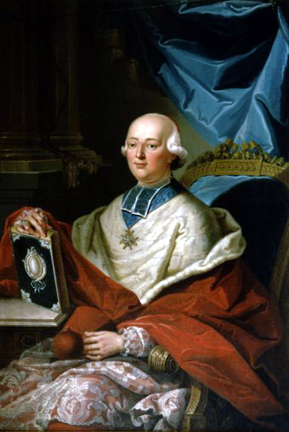
Cardinal de Rohan

Consequently, he set out to regain favour with the queen consort. In his pursuit hereof he sought the help of a certain Comtesse de La Motte. Her actual name was Jeanne de Valois-Saint-Rémy and the title? Well, she had simply bestowed it on herself in an attempt to get ahead in the world. Jeanne was actually a descendant of Henri II and as such had a certain claim to be counted amongst the aristocracy.

In 1782 the infamous necklace was created. Böhmer and Bassenge - crown jewellers - had designed the extremely lavish necklace. No less than 650 diamonds were set in the necklace which weighed 2600 carats. The price was staggering. When the jewellers presented the necklace to Louis XVI its price had already been reduced but still stood at 1,6 million livres. Both Louis XVI and Marie Antoinette were unwilling to spent such an exorbitant amount of money and turned it down.


Relateret billede
A replica of the infamous necklace - the original being
broken down before the revolution 

Meanwhile, lurking in the shadows at court, the Comtesse de La Motte saw an opportunity in the necklace. She had already convinced the cardinal that her and the queen were close friends. Therefore, she now convinced the cardinal to go to the Queen's Grove in the palace garden on the night of 11 August 1784. The cardinal duly went and was convinced that he was to meet the queen incognito. To be sure, he did meet a woman hiding in the shadows - but it was not Marie Antoinette. Little known to the cardinal the woman was an imposter who masqueraded as the queen. This imposter was in fact a prostitute by the name of Marie-Nicole Le Guay; she had been discovered by none other than the Comte de La Motte. He had remarked how similar she looked to the queen which undoubtedly inspired a few thoughts. From her place in the shadows she assured the cardinal that his place at court would be redeemed.

The comtesse had furthermore convinced de Rohan that he would enhance his chances of returning to the queen's good graces if he bought the necklace on her behalf. This she finally succeeded in on 29 January. She had assured him that the queen really desired the necklace but did not have the nerve to buy it with her popularity already in the dumps. The real treachery - if it had not already played out - came when the queen's signature was forged and put to a document which agreed both to the price and the cardinal as her go-between.


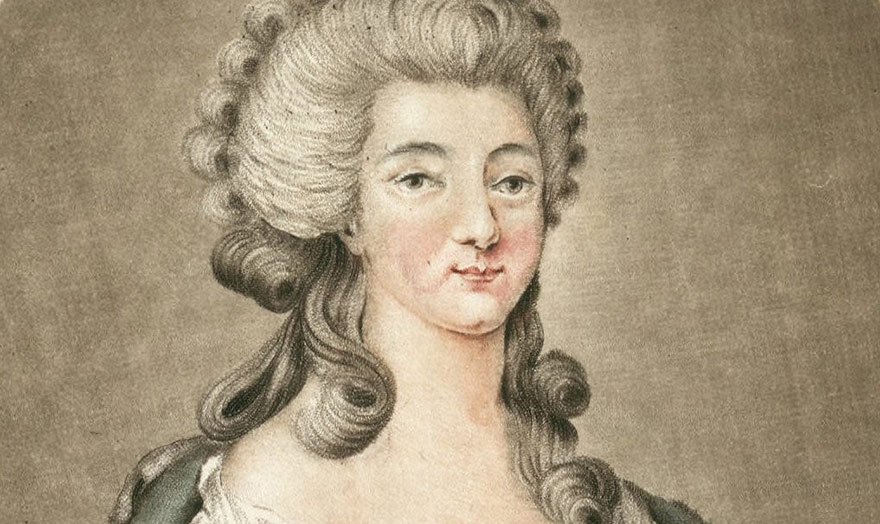
The Comtesse de La Motte

Cardinal de Rohan wasted no time and immediately turned to the jewellers; these asked no questions since they were pleased to finally have a buyer. On 1 February 1785 the infamous necklace was handed over to the cardinal's possession. Böhmer - never doubting that the queen was his actual client - sent her a letter on 12 July. Understandably, poor Marie Antoinette was utterly confused when she received it since she had no knowledge of the affair nor the transaction. Thinking that it was merely a stunt to once again push the necklace on her, she destroyed the letter. When he heard nothing from the queen he turned to Madame Campan and requested an answer to when he might receive the remainder of the money.
The queen was complexed and demanded an explanation of the jeweller. He told the queen everything about his deal with Cardinal de Rohan.

Not surprisingly, both the king and queen were outraged that such a deception was carried out in their names. On 15 August the cardinal was arrested by the king's guards in the Hall of Mirrors. He was transported to the Bastille. In Marie Antoinette's point of view the scheme was not unlike what could be expected from a character such as the cardinal. After all, she had been warned by her trusted mother. However, the Parlement de Paris was not as willing to condemn the cardinal. In May 1785 they acquitted him.
Although he escaped a prison spell, the Cardinal de Rohan was finished at court. The king stripped him of all his offices and sent him into exile.

The queen was livid. It certainly did nothing to ease her disappointment and rage that the public welcomed the cardinal's sentence. It was considered to be a victory over the hated queen - never mind the matter of guilt.


Marie Antoinette

During his incarceration the cardinal had not hesitated to give away his accomplice, the Comtesse de La Motte. She was promptly arrested. Her trial ended differently than the cardinal's had and was far more scandalous. In April 1786 she admitted that she had paid Le Guay to masquerade as the queen but she insisted that she had only done it as an act of revenge. The Comtesse attempted to convince the court that the cardinal had continually pressed her to intercede on his behalf with the queen. Furthermore, she claimed that she and the cardinal were lovers - as can be expected the cardinal completely denied it. 
The court found her guilty and she was branded with a large "V" (for Voleuse = thief) as well as flogged. Originally, she had been sentenced to life in Salpêtrière Prison in Paris. That should have been the end of that but this story had another twist. On 5 June 1787 she managed to escape and fled to England. Here, she published her memoirs which ultimately aims at defaming Marie Antoinette. Her life would be cut unexpectedly short when she died from a fall in 1791 - two years before the queen.

Surprisingly, Marie-Nicole Le Guay was also acquitted. Even the Comtesse de La Motte admitted that the hired lady was immensely stupid; the comtesse claimed that she had not even realized that she was impersonating the queen. Following their interrogation of Le Guay the court believed her.

As for the Comte de La Motte he had been sentenced in absentia to life as a galley slave. Luckily for him, he had already left France and managed to escape any punishment at all. The forger, Réteaux, was permanently exiled from France. 


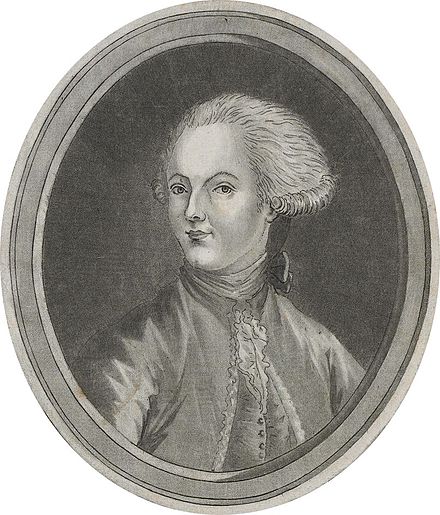
The Comte de La Motte

It should have been clear that the queen had been innocent of any wrongdoing in the scheme. This did not play well with the image her enemies had been so successful in spreading, though. Although the court cases were watched with eagerness by both Versailles and Paris neither seemed to quite acquit the queen. The queen was well on her way to becoming the most hated woman in France and this merely added fuel to the fire. 
Marie Antoinette herself could do nothing. The Parisians were determined to make a villain of her and even such a clear-cut case of fraud was twisted against the queen. In light of this it can hardly be wondered at that Marie Antoinette continued to habour a deep resentment towards the cardinal and the comtesse.

The damage had been done to Her Majesty's reputation. Thomas Carlyle was quite right when he wrote that "the odium of the Diamond Necklace embittered all the Queen's future life, and followed her to the very steps of the guillotine". 

What happened to the necklace?
When the necklace was delivered on that first day of February 1785 it was brought to the house of the Comte and Comtesse de La Motte. Here, it was put into the care of a man whom the jewellers believed to be a valet of the queen's. He was, however, a man by the name of Rétaux - the very same man who had forged the queen's signature.
From its brief stay in the Comte's household it was shipped posthaste to London and Amsterdam where it was broken up. The value of the necklace itself was still dazzling but due to its infamy it would be too easy to recognize. The Comtesse even had the nerve to wear some of the larger diamonds in earrings which she sported at court. 

Tuesday, 20 December 2016

Reception of the Siamese Ambassador

In 1686 the King of Siam (Thailand today) sent his ambassador on his second visit to the court of France. The object of the visit was to form an "eternal alliance" between the two nations. Ambassadorial visits were not uncommon in Europe but it was rare that such exotic countries visited. As such it was a perfect occasion to demonstrate French power and prestige.

The ambassadors - of which there were three - were officially received by the King and his court on 1 September. They were accompanied by four gentlemen and two secretaries besides their private servants. They were fetched by the Marèchal de La Feuillade and rode in the carriages of the King and the Dauphine from their residence in Paris.

Once the carriages arrived at the courtyard of Versailles the ambassadors were met with by the sight of armed French and Swiss guards. From there they would proceed to the Ambassador's Staircase where they washed (a custom in Siam) and donned their "pyramid shaped" hats. These hats were adorned with rubies and thin leaves of gold.

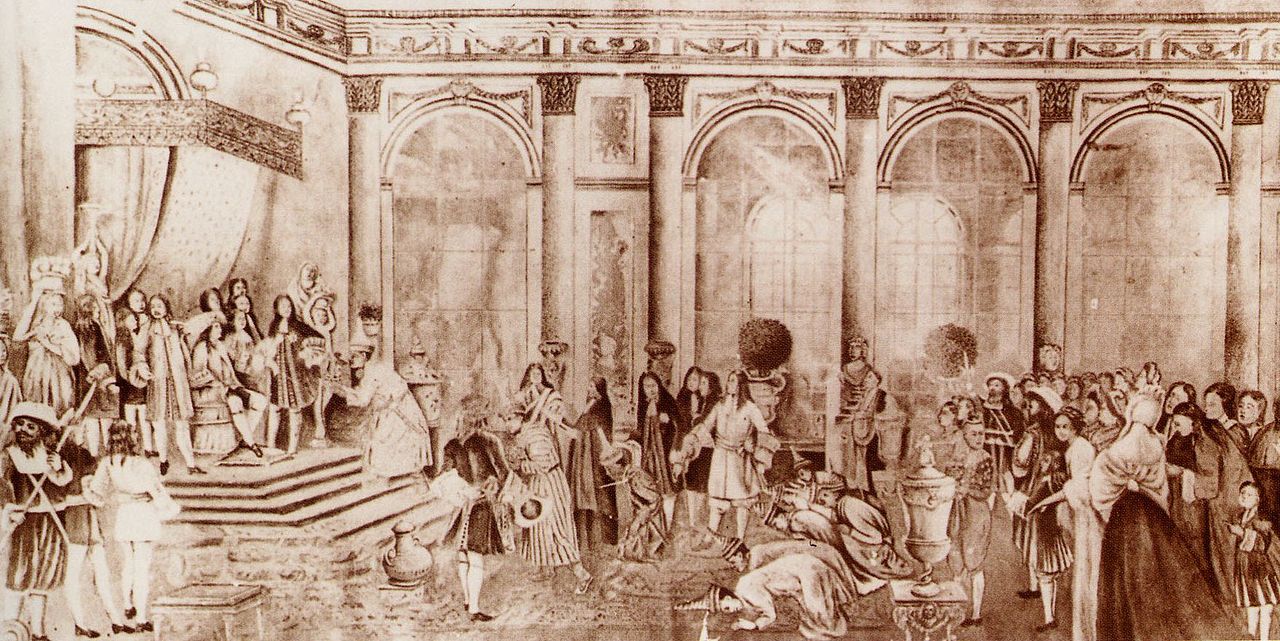
Louis XIV enthroned before the ambassadors


The ambassadors were led through the King's Grand Apartment and to the Hall of Mirrors. Here they faced an intimidating spectacle. On the far end of the Hall of Mirrors were the throne raised on a dais with Louis XIV's silver furniture on display. The dais was adorned with a Persian carpet while a golden canopy backed the throne; the canopy were embroidered with gold and silver threads in delicate floral patterns. The steps of the dais were flanked by silver candelabras.

The King remained sitting on his throne while the ambassadors made their slow process towards the throne; they stopped three times to bow. The King was not alone though; standing nearest to him were his descendants including his legitimised sons.

1500 aristocrats lined the halls of Versailles in their finest clothes and their most expensive jewels. The King himself was splendidly dressed. According to the Marquis de Sourches he was wearing "a coat of cloth-of-gold, laced with diamonds". Despite his glorious appearance the King's health was not as good as it used to be. He had recently undergone a surgery for a fistula. Actually, this surgery was the reason for the delay in the reception of the ambassadors; they had arrived in France already on 18 June.

Billedresultat for ambassade siam versailles
This sketch clearly shows the layout of the reception

When the three ambassadors reached the throne they threw themselves on the ground; it was custom in Siam at the time never to look a sovereign in the eye. Louis XIV graciously allowed them to raise their eyes and stand before him. The Abbé de Lyon acted as interpreter; the Marquis de Dangeau noted that the ambassadors only moved from their place in front of dais once: when they handed the letter from their King to Louis XIV. Even then they only stepped on the first step to the dais. The Marquis also noted that while the three ambassadors had all removed their hats out of respect the King kept his on - he only lifted it a few times. The audience being over the ambassadors walked back the same way the had come - backwards, so as to not turn their backs on the King.

The ambassadors were then treated by the King to a tour of his palace and its gardens. Following the tour one of the ambassadors exclaimed that he had hitherto known three wonders: Man, God and Paradise but now he knew a fourth: Versailles.

During the following days the ambassadors paid visits to the Grand Dauphin as well as other members of the royal family. One of these visits took them to Saint-Cloud where they were received by Philippe, Duc d'Orléans and Madame. However, they were not permitted to visit the Dauphine since she had recently given birth and was still in confinement.


Siamese envoys at Versailles.jpg


It was custom to exchange gifts which was not ignored on this occasion. The ambassador brought exotic goods such as tortoise shell, woven fabrics, 1500 pieces of porcelain and pieces of lacquer furniture. The latter would become immensely popular in the following century. The King was even presented with two cannons which would be confiscated during the revolution to use in the storm of the Bastille. And then of course something that needed no translation: gold.

The ambassadors were deeply impressed with France and particularly the splendour of the court. No less than 4264 pieces of mirror was ordered to decorate the Siamese King's palace. As was 160 cannons, telescopes, glasses and two globes inscribed in Thai.

The ambassadors were not the only ones on a mission. Louis XIV had only recently concluded his war with the Netherlands and although the two powers were officially at peace they still kept an eye on each other. At the time the Netherlands made fortunes on trade with the Far East - trade that Louis XIV was eager to get his share off. So, the products ordered by the ambassadors were a part of an attempt to increase French trade with the Siamese King.

Not only trade was the object of the Sun King. Military support, too, were vital to the French King's foreign policies. However, the result was not quite as expected. Just two years later the Siamese King was overthrown and replaced by a man who closed all trade with westerners - except for the Dutch.

Wednesday, 11 November 2015

The Wedding of Louis XV and Marie Leszczynska

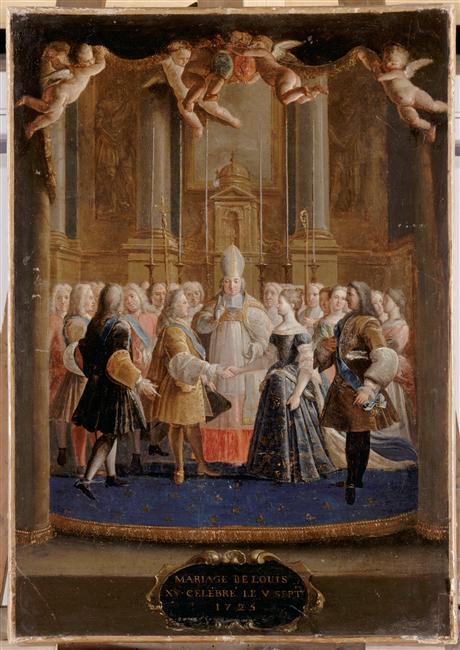
The wedding took place on Wednesday 5 September 1725 but not at Versailles which had been abandoned since the death of Louis XIV. Instead, the ceremony took place in the chapel at the Château of Fontainebleau - it would be the only royal wedding conducted there.

The twenty-two year old bride arrived at half past nine and was quickly settled into the Queen's apartments. The King was at this time already in his own apartments where a minor army of gentlemen prepared him for the ceremony.

Marie Leszczynska's wedding gown was so heavily adorned with jewels that she nearly fainted. Over this magnificent gown was a purple velvet robe with golden fleurs-de-lis and was lined with ermine. The gown's train in itself were ten metres long! The Queen's hair was elaborately done up and pinned with a magnificent fleur-de-lis of diamonds.

Having been properly dressed the Queen was escorted to the King's cabinet where they met for the first time - the King's entire entourage was ready and waiting.
The fifteen year old Louis XV wore a suit of rich gold brocade with a hat with a plush white feather and large diamond.

Wedding of Louis XV and Marie Leszczynska

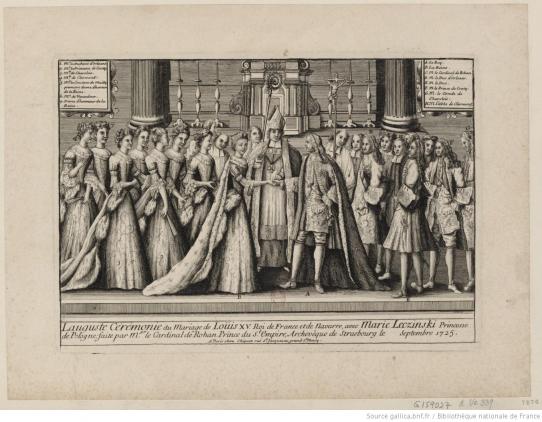
The ceremony was to take place in the chapel built by Francis I. The couple's arrival was heralded by trumpets and drums and the two walked past row on row of the infamous Hundred Swiss Guards. Knights of the Order of Saint-Esprit marched into the chapel in lines of two followed by the Great Officers of the Households: Comte de Charolais, Comte de Clermont and Prince de Conti.

The royal couple was positively surrounded by people - most of whom Marie Lezczynska had never seen before. Behind the Queen was the Marèchal de Villeroy, the Duc de La Rochefoucauld and the Duc de Mortemart. In front of her (leading her to the altar) was the Duc d'Orlèans and the Duc de Bourbon as well as the Marquis de Nangis, the Comte de Tesse and the Duc de Noailles. The Queen's train was carried by the Duchesse de Bourbon, the Princesse de Conti and Mademoiselle de Charolais. The Duchesse d'Orlèans followed immediately behind the Queen and she was in turn followed by Mademoiselle de Clermont and Mademoiselle de La Roche-sur-Yon. The rest of the Queen's train was made up by the Queen's ladies-in-waiting, maids of honour and Princesses of the Blood.

Etching of the wedding

The King was announced by two officers of his House and the captain of the Hundred Swiss.

The chapel's upper balconies were hung with blue velvet embroidered with the royal arms of France while the rows of benches were covered in purple velvet with golden fleurs-de-lis. The choir produced their beautiful tones on Persian carpets; the front row was reserved for the highest ladies and lords of France as well as Officers of Saint-Esprit.
The heralds carrying the royal arms stepped to the bottom of the steps leading to the altar. Louis XV and Marie Leszczynska knelt on two cushions for the ceremony. While the two were being escorted onto their pillows the courtiers took their places on the church benches - each was meticulously calculated according to the guest's rank.

The acts of wedding now held in Strasbourg which happens to be the stage of
the proxy wedding

When the two had exchanged rings the symbolic act of handing each a candle was performed. The King received his from the Duc d'Orlèans while his wife, the Duchesse, handed one to the Queen on a satin pillow. Both the Duc and Duchesse kissed the rings of their newly wedded sovereigns. This particular act would seem odd but it was a signal of precedence at the time. The symbolic candles held by the King and Queen represented the submission of the crown to the church.

While the orchestra played a Te Deum the royal marriage contract was signed; a brief prayer for the King was said and then everyone took the same stands as the procession that led the couple into the chapel. From there on, they were escorted to the King's apartments were the celebrations were to begin.

Sunday, 15 March 2015

The Fall of Fouquet

Nicolas Foquet had been Minister of Finance since 1653 and had actually managed to turn the utterly confusing state of affairs into something positive. During his "rule" as Minister of Finance he competed with Mazarin as to whom might be considered the most powerful man in France - after the King, of course. But the higher you climb, the harder you fall and the fall of Fouquet shook the French aristocracy to its' core.

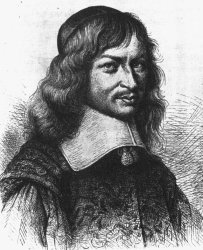
Fouquet
Nicolas Fouquet was nothing if not ambitious and when Mazarin died in 1661 there was nothing standing in the way of Fouquet being named head of government. Nothing save Louis XIV. The Sun King might have had his usages of Fouquet but it was the man's very ambition that unsettled the King. Louis XIV had always been wary of courtiers who rose above themselves and with Mazarin's death the time had come to cool Fouquet's ambitions. Instead of making Fouquet head of government Louis took the mantle himself.

While Louis himself undoubtedly had his own suspicions regarding Fouquet, there were plenty of courtiers willing to add their voices to choir. Colbert was quite likely one of them.

One would think that a man with Fouquet's intelligence would suspect that something was amiss but rather than stepping back Fouquet upped his game. After being turned down as head of government, Fouquet decided that he might as well show that he was still a man to be reckoned with. First, it should be said that Fouquet was a man of immense wealth. One of the things he did that definitely brought attention to him was to buy the port of Belle-Île-en-Mer. That would in itself not be considered odd if it had not been for the fact that he fortified the port. This gave him literally a save harbour in case the King turned against him.


Secondly, he turned to his estate of Vaux-le-Vicomte. He lavished funds on his home and brought in hitherto rather unknown artists such as Louis le Vau and Charles le Brun. For his gardens he hired André le Nôtre. Their combined effort transformed Vaux-le-Vicomte into the most splendid château of its' day.

Fouquet's fate was sealed in August 1661 (although it is very likely that his demise was already happening) when the court and Louis XIV was invited to the newly-finished Vaux-le-Vicomte. There, Fouquet gave a show of such lavish entertainment (complete with fireworks) that would be remembered as one of the finest celebrations in 17th century France. But Louis XIV was far from pleased. The young King was furious at being outdone in the art of magnificence and the awe of his courtiers only furthered the King's wrath.

Arrest of Fouquet
There was a problem though. Louis XIV was still a young monarch - at 22 years - and not only was Fouquet very wealthy, he also controlled the tax collectors. If they turned against the King the income needed to run not only the court but the very country would be threatened. Still, Louis would not allow this to go on. Consequently, a plot was drawn up to ensure Foquet's downfall.

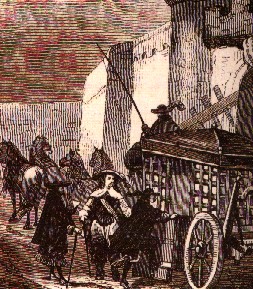
The first move was to trick Fouquet into selling his office as procurer général (the head of the tax collectors, among others) which efficiently removed the protection Fouquet had so far had. Then the King announced that he would visit Nantes and when the King went somewhere, so did his councillors. Upon leaving the council room, Fouquet was arrested by the infamous d'Artagnan and taken away on 5 September.


There was to be a trial if the case should even hope to be accepted by the public. But had the public known how that trial was carried out much might have been different. In total, the trial dragged out for three years and during it there was no legal course that could not be overturned. The courtiers were shocked to learn how far Louis XIV was willing to go to assure Fouquet's downfall and some even dared to speak out. Colbert tried to prevent case acts from reaching the public but it had little effect since they were printed in the Netherlands after all. It had no effect.


The trial

No doubt the King had wished for Fouquet to be sentenced to death but instead he was banished. Louis XIV was utterly disappointed and changed the sentence to imprisonment for life. In December 1664 Fouquet was transferred to the fortress of Pignerol. It was said that his cell bordered on that of the Man in the Iron Mask.

Fouquet remained in Pignerol until his death which was reported in 1680.


Saturday, 7 February 2015

Wedding of the Duc de Bourgogne & Marie Adélaïde of Savoy

The peace treaty between France and Savoy following the War of the League of Augsburg included a marriage between Louis XIV's grandson and the eldest daughter of the Duke of Savoy.

The couple met at the first time on 4th November when the Princesse de Savoy was greeted by Louis XIV, the Grand Dauphin and the Duc de Bourgogne.

Leading up to the wedding itself Louis XIV gave several balls in honour of the union. The King had told his court that he desired fêtes to rival those of Versailles in the King's prime (with other words, of course). Immediately, the courtiers went scurrying off to secure the most extravagant court attires. Gold and silver was sold out at the most popular tailors of the court and no one thought much of the whole cost of it all. Louis XIV even came to somewhat regret his previous demand for luxury as he was noted to have remarked how he failed to understand how gentlemen would be so foolish as to ruin themselves for gowns and waist-coats. Still, the King was not exempt from the extravagance. He himself chose the embroidery of the new Duchesse de Bourgogne.

The balls took place in the Hall of Mirrors. On the way from the carriages to the château the glittering courtiers were admired by a huge crowd of Parisians who had come to witness the show of splendour.


The wedding ceremony

On 7th December 1697 the wedding took place in the chapel at Versailles. The Duc de Bourgogne was 14 years old while his bride was just 11. The courtiers assembled in the Duc's apartment where they followed him on to the Princesse. Together, the two made their way into the chapel.

Following the wedding ceremony and feast came the usual bedding-ceremony. The Duchesse (whose title was now changed) was taken to her bedchamber where she was undressed by the court ladies. The Duc was likewise changing in another room. The couple had the extraordinary honour to be handed their chemises by the exiled King and Queen of England.


MARIAGE DE MONSEIG.¦R¦ LE DUC DE BOURGOGNE AVEC MARIE ADELAIDE PRINCESSE DE SAUOYE dans la Chapelle de Versailles - le Septiême de Decembre 1697 : [estampe] - 1
Drawing of the ceremony

Everything went as planned and the bride and groom was ceremoniously put to bed together in front of the whole court. However, there were no disappointed murmurs when the marriage was not consummated. Actually, the Duc de Bourgogne had received direct orders from his grandfather to wait with the consummation until the marriage was at least two years old. Therefore, it was not to the King's pleasure that Monseigneur lingered a quarter of an hour after the departure of the rest of the court during which time he persuaded the Duc to kiss the Duchesse on the chin. Outraged, the Duchesse de Lude told the King who reprimanded his heir; it was the King's express order that the Duc was "not to kiss as much as the tip of the Duchesse's finger" until the two years had passed.

Fig. 20 : « La cérémonie du mariage de Monseigr le duc de Bourgogne avec Me la princesse de Savoye dans la chapelle de Versailles le 7 décembre 1697 », gravure anonyme publiée chez Nicolas Arnoult. Paris, Bibliothèque nationale de France, Estampes et photographie, collection Hennin, no 6378.


When the bridegroom had spent just about fifteen minutes with his wife he got up, bid her good-night and went to the antechamber where he dressed himself.

The following evening (a Sunday) offered another display of court celebration when the courtiers assembled in the apartment of the new Duchesse de Bourgogne. The Duchesses were given leave to sit in their huge gowns while the gentlemen - no less sparkling - stood behind them. At six o'clock the King arrived and led the courtiers from the Duchesse's rooms to a room near the chapel (perhaps the Hercules Salon?) where they enjoyed music and refreshments.


The Wednesday of the following week saw another ball in the Hall of Mirrors which was to be far less enjoyable than the previous ones. There was such a throng of people that, according to Saint-Simon, even Monsieur was knocked about. People pushed in everywhere and the considerable size of the fine dresses made it all the worse. Refreshments were served at 9 o'clock and the dinner at half past ten. Only the Princesses of the Blood and the royal family was allowed to join these festivities.

Having learned from the previous evening the next night was not nearly as crowded. It began at 7 o'clock and once again the courtiers were seen in completely new outfits. The King - and his courtiers - all agreed that it was far more agreeable in this fashion.

A visit to the Grand Trianon took up the next few days where there was gambling with the King and Queen of England. No doubt, the Duchesse de Bourgogne had been given the most superb welcome she could ever have imagined.

Sunday, 29 December 2013

The Pontcallec Conspiracy

The Pontcallec Conspiracy was the second conspiracy against Philippe, Duc d'Orlèans who was the Regent during Louis XV's childhood and took place between 1718-20. Following the death of the Sun King France was in heavy debt due to many expensive wars which cause the Regent to summon the Estates Generale since especially the region of Brittany was unhappy about the taxation and had refused to pay more. Eventually the proposal that the greatest part of the nobility - that were already living in poverty since you could call yourself a nobleman by proving a noble ancestry - should pay more in taxes was declined.

On this background the Pontcallec Conspiracy took form. In the end it would be an injustice done to the Duc de Maine that would spark events. The Duc had been given leave to use his prerogatives by the will of Louis XIV but now was forced to accept that he could not. Suddenly, the Duc de Maine found himself on the side of those slighted by the Regent and shortly after rumours had it that he was planning to gather troops. Meanwhile the Marquis de Pontcallec was joined by the Comte de Noyan at the former's fortress where they planned the conspiracy against the Regent. But the these prominent names were not the only ones to set into action. An official list were drawn up by hundreds of minor nobles in Brittany and stated their grievances to the Regent. Not long afterwards the conspiring noblemen saw the opportunity of gaining a powerful ally when France and Spain declared war upon each other (the War of the Quadruple Alliance); immediately a messenger was sent to the Spanish minister in France.

However, everything had not gone unnoticed and in December 1718 the Duc and Duchesse de Maine were both arrested. This did not scare off the Marquis de Pontcallec who continued his recruitment of not only soldiers but also other noblemen. Fearing that he would also be arrested he gathered 200 supporters but no royal guards came to take him away. By July 1719 the situation was considered potentially dangerous enough to inform the Regent himself. For the conspirators good news came when the Spanish offered their support to throw over Philippe, Duc d'Orlèans and replace him with either the Spanish King Philip V or even the Duc de Maine himself.

Plaque commemorating the Pontcallec Conspiracy

The operation took a leap from being secretive to openly opposing the taxation when royal employees were sent to collect taxes and were met by peasants led by Rohan de Pouldu who forced the royal men back. That was the last drop for the Regent. 15.000 soldiers were sent out under Pierre de Montesquiou and entered Rennes. The entire plot was revealed when a conspirator was arrested and confessed everything. It all happened too fast for the Marquis de Pontcallec who never managed to arrange his defences - and that was it. Even the 2000 soldiers sent by the Spanish had to realize that there was little they could do against the 15.000 royal French men. In the end the Marquis de Pontcallec was betrayed and arrested four days after Christmas eve 1719.
Philippe, Duc d'Orlèans established a special Board of Justice at Nantes simply to try those implicated in the conspiracy. Considering that it was the second conspiracy against him something had to be done - the first conspiracy had ended in a pardon for all involved. In total 23 men were tried (16 in absentia since they had fled) and of the remaining seven men four was condemned to death. These were: the Marquis de Pontcallec and the noblemen Montlouis, Du Couëdic and Talhouët. They were all beheaded immediately after the sentence.

After the trial most of France was shocked at how severe the consequences had been for the conspirators (perhaps in light of the previous convictions?). However, it was not just the minor nobles who had learned a lesson. The extra taxation was dropped and all the land and money that had been confiscated was given back. However, those who had fled was not allowed to return to France till after 10 years.

Tuesday, 10 September 2013

The Ball of the Yew Trees

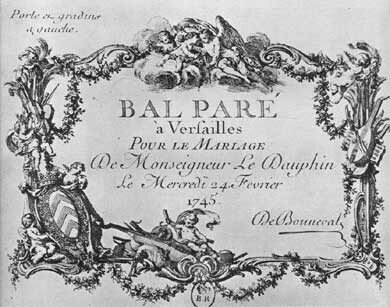
The Ball of the Yew Trees was a great event in two ways. First of all it was the celebration of the marriage between the Dauphin Louis and Maria Thérèse of Spain. Secondly, it was during this ball that Louis XV met a woman who completely swept him away: Jeanne Antoinette Poisson or Madame de Pompadour. They had met previously but this was Jeanne Antoinette's first court ball so all eyes were on her.

The ball was held between the 25.-26. February 1745 in the Hall of Mirrors at Versailles. It was a magnificent ball made a tat strange by the fact that many of the guests wore masks. The guards had been told to stop people entering to check that they were actually of the nobility by the quick removal of the mask. The common people flooded to Versailles as well because the admittance to the ball was free - the crowds in the courtyards had to make way for the hundreds of elaborately decorated carriages that pulled up beginning at 11 o'clock at night. Some 600 people sat on the floor in and around the Oeil de Bouef waiting for the dances to begin. Others waited in the Salon of Hercules. It is estimated that 15.000 people attended the ball all in all.

Large tables were lined up for the guests' sake; since this event occurred during Lent there was served no meat but fish, fruit pyramids, sweets and of course liqueur.
At one point the great doors were opened and Queen Marie Leszczynska appeared dressed in an amazing white court gown glittering with pearls - it is said that the Queen wore two magnificent diamonds in her hair: the Sancy and the Regent. She was not accompanied by the King but by the Dauphin and new Dauphin both of whom were dressed up as a shepherd and shepherdess. Soon the main event was to take place which has given the ball its name.

Eight men suddenly appeared, all dressed up as yew trees and the King was certainly among them. It was Louis XV himself who had come up with the idea because he enjoyed the opportunity to astonish his courtiers and also eyed an opportunity to mingle incognito. Most ladies of the court turned their attention towards these "wooden" men, all in hope that they might become his next mistress. But their efforts were all in vain because the King had already noticed a lady whom he had seen before though never at court and she was far more interesting to him than the many Duchesses, Comtesses, Marquises etc. At one point one of the yew trees drew away from the crowd and headed towards the young Jeanne Antoinette Poison. It was of course the King and he spent the entire ball with the woman who would become his closest friend and advisor.
The ball ended at half past eight the following morning.

Billedresultat for ball of the yew trees
Charles-Nicholas Cochin the Younger

One of the few invitation that actually were sent out

Charles-Nicolas Cochin the younger
The Costumed Ball Held at Versailles on February 24, 1745
Pen and black ink, gray wash, watercolor, and white gouache highlights
H. 0.74 m; L. 0.53 m
Inv. 25251
Paris, Musée du Louvre, Department of Prints and Drawings
Another work by Charles-Nicholas Cochin the Younger

Thursday, 22 August 2013

The Sun Finally Sets

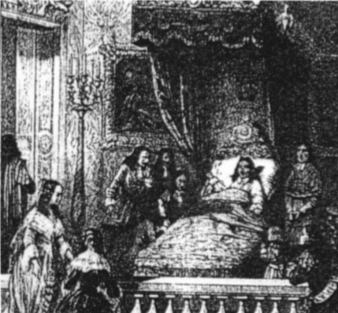
In 1715 Louis XIV was an old man and it began to show. By August 10 the King was at the small château Marly where he was out hunting. As he returned the King suddenly felt a sharp pain in his leg and the doctor was immediately called for. Dr. Fagon quickly made the diagnosis of sciatica. But the situation changed when black spots appeared on the same leg not long after; this was an obvious sign of gangrene.

Louis XIV suffered from senile gangrene which is very painful and is caused by the collapse of the small arteries' walls which prevents enough blood to circulate. Louis XIV was a monarch to the bone. He refused to take to his bed immediately and insisted on continuing performing his state affairs. Ironically, it was on the King's name day - 25 August - that the ageing King could no longer conceal the pains and remained within his own bedchamber. The doctors could inform him (and the court) that the gangrene had spread to the bones. The King was visited by the 5-year old Dauphin who would soon become Louis XV. During this visit Louis XIV told his heir to keep France in peace for "it is the ruin of peoples!"

Everyone had expected him to pass away shortly after but the King lingered. The King himself knew that his time was running out and asked one of his doctors how much time he had left. The doctor replied that they could hope he would life until Wednesday - it was a Monday. For a short period around 29 August Louis did feel better but it was short-lived. At some point around this time he turned to the weeping courtiers present in his room and said:
"Did you imagine that I was immortal?"
Some of the courtiers must have been tempted to draw that conclusion for Louis XIV had reigned longer than any other French King and with his 72 years on the throne The King went into a sleep-like coma that would last until 8.15 in the morning of 1 September just four days before his 77th birthday. Rumour has it that a clock in his apartments stopped at the exact moment of his death. The King had died, the Sun had finally set.

Shortly afterwards the shout of "the King is dead!" sounded through the halls of Versailles. It was the end of an era dominated by the will-power of Louis XIV. Now his body lay on display for eight whole days in the Mercury Salon for the court to pay their final respects. In the end his body was buried in the Basilica of Saint Denis in the heart of Paris.


File:Tombe Louis XIV Basilique St Denis.JPG
Tomb of Louis XIV

Wednesday, 21 August 2013

The Series of Deaths 1711-12

A genuine tragedy hit the French house of Bourbon between 1711 and 1712 when no less than four members of the family suddenly died - to make it even worse they were at the top of the succession. It was all due to one of the most dreaded and untreatable illnesses in Europe at the time: smallpox.

Louis le Grand Dauphin
It all began in April 1711 when Louis, le Grand Dauphin (son of the reigning Louis XIV) suddenly contracted smallpox at the Château de Meudon and died. This made his son, the Duc de Bougogne, Dauphin and all seemed manageable again. But while the court was heading towards Fontainebleau the new Dauphine Marie Adélaïde became feverish and soon the dreaded diagnose was declared: smallpox. The Dauphine was immediately bled (it was the common way of "healing" illnesses) and given emetics but little did it help. She died on 23 February 1712 at just 26 years old.

The Duc de Bougogne had genuinely loved his wife and was devastated at her death. By now the fear of infection (it was almost impossible not to catch it given the hygiene) had spread and the court hastily moved on to the Château de Marly. But the worst had already occurred and the Duc de Bougogne also fell ill with smallpox. He had contracted the illness because he refused to leave his wife's side in her last moments and was now to pay the ultimate price. Now he himself was the patient and just six days later he would also be dead. The couple was buried together at the Basilisk de Saint Denis.

The now dead Duc de Bougogne and Marie Adélaïde had two sons: the Duc de Bretagne (Brittany) and the Duc d'Anjou. The epidemic was not over yet. Both boys were baptised immediately for fear that they may die before having been accepted into the realm of God. And once more the worst fears of the court were confirmed: both boys had contracted the illness. The eldest son - and recently declared Dauphin of France - the Duc de Bretagne was bled but in vain. He died on 8 March 1712 just a month after his parents. Now there was only the infant the Duc d'Anjou left. What on earth was that saved this little boy from sharing the same fate of his family?

Mignard - Madame de Ventadour.jpg
Madame de Ventadour
The question is not what but who. The Duc d'Anjou - or Dauphin as he would now be known - was under the care of Madame de Ventadour. When it was discovered that the young siblings shared the decease of their parents she did not hesitate and isolated the young boy in her chambers. She would nurse him herself  alongside three other nurses and even forbade the doctors to bleed him when they had rushed to "save" the life of the heir to the throne. Thanks to Madame de Ventadour's sharp instinct the little Duc d'Anjou survived the smallpox epidemic that had claimed the life of his entire close family. He would live on to become Louis XV - all because of his governess.

And if you wonder what happened to Madame de Ventadour, she continued as the young Dauphin's governess till 1717.

Sunday, 18 August 2013

The Court Moves to Versailles

Louis XIV moved between his many residences on a frequent basis but in time he decided to settle at one palace and then visit others occasionally. The great move was finalized when the King himself moved to Versailles on 6 May 1682.

Actually, this was another one of the clever moves meant to keep the ever-conspiring courtiers in check. The thing is that when the King moved to Versailles he created the very stage for his power. Every courtier who wanted to make a career had to go to Versailles to see the King and at the same time the King could keep a constant eye on his courtiers. Also, Louis XIV demanded that every courtiers of a noticeable rank had to spent a certain amount of time at Versailles - this prevented them from establishing another power centre that could rival his own. No less than 5.000 aristocrats moved into Versailles which was the largest château in France at the time.
There was another reason as to why Louis XIV transferred his court from the Louvre to Versailles: security. Louis XIV had always been suspicious of the Parisians and worried that they would endanger his position as an absolute monarch (considering what happened to Louis XVI, he had a point...). So, now he was just far enough outside Paris to be alerted in time if something were to happen but could still visit his capital if he wished to do so. With the King the government was also moved to Versailles where the official offices of state would also be established.

Of course it should be said that Louis XIV did not build Versailles from scratch. The palace had been a favoured hunting lodge of the King who had to enlarge it many times over (in total four campaigns were begun over time to make room for the rising number of courtiers) to make room both for the large number of courtiers but also the underline the sublime architecture and richness of the crown.

When the palace was completed Louis XIV had succeeded in his original plan: to become the centre of power, the sun of the French power universe.

Engraving of Versailles, 1682


File:Etching of the Palace of Versailles in circa 1680 by Adam Perelle.png
Etching of the palace as seen from the garden, around the time when the court moved there

Tuesday, 11 June 2013

The Death of the Lost King of France

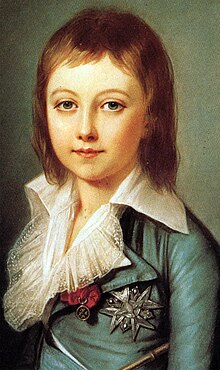
Louis Charles (the second son of Louis XVI and Marie Antoinette) had followed his parents when they were taken from Versailles to Paris by an angry mob in October 1789. When Louis XVI was executed on January 21, 1793, Louis Charles had become King Louis XVII automatically. At this time he was just eight years old. So far the little boy had stayed from his mother and his aunt but this was to change.

Louis Charles in 1792
On July 3, 1793 Louis Charles was suddenly removed from his mother and taken to a windowless room in the Temple prison. Antoine Simon was appointed care-taker of the precious prisoner. Antoine Simon was determined to raise the child in such a manner that he would forget his royal inheritance and in this way not want to take the throne. During his imprisonment the little King was pressured on several occasions until he finally told his interrogators what they wanted to hear: that his mother, Marie Antoinette, had molested him sexually. These accusations were used against the dethroned Queen at her trial - of course the accusations were not true. But his mother was send to the guillotine nonetheless and Louis Charles had become an orphan.

His prison cell (still barricaded) was filthy and as a consequence hereof Louis Charles fell ill. Louis Charles was alone for most of the time until a man with the name of Barras entered the cell on July 27, 1794. Barras would report that he had found the child severely neglected but Louis Charles himself never said anything about his treatment; it is quite possible that he was too afraid to do so. In 1795 (on June 8) he died of tuberculosis - alone in his dark cell.When the Bourbon dynasty was restored a lot of the documents of the Temple prison was destroyed which mean that we have very little written evidence of what actually happened to Louis Charles while he was imprisoned on his own.
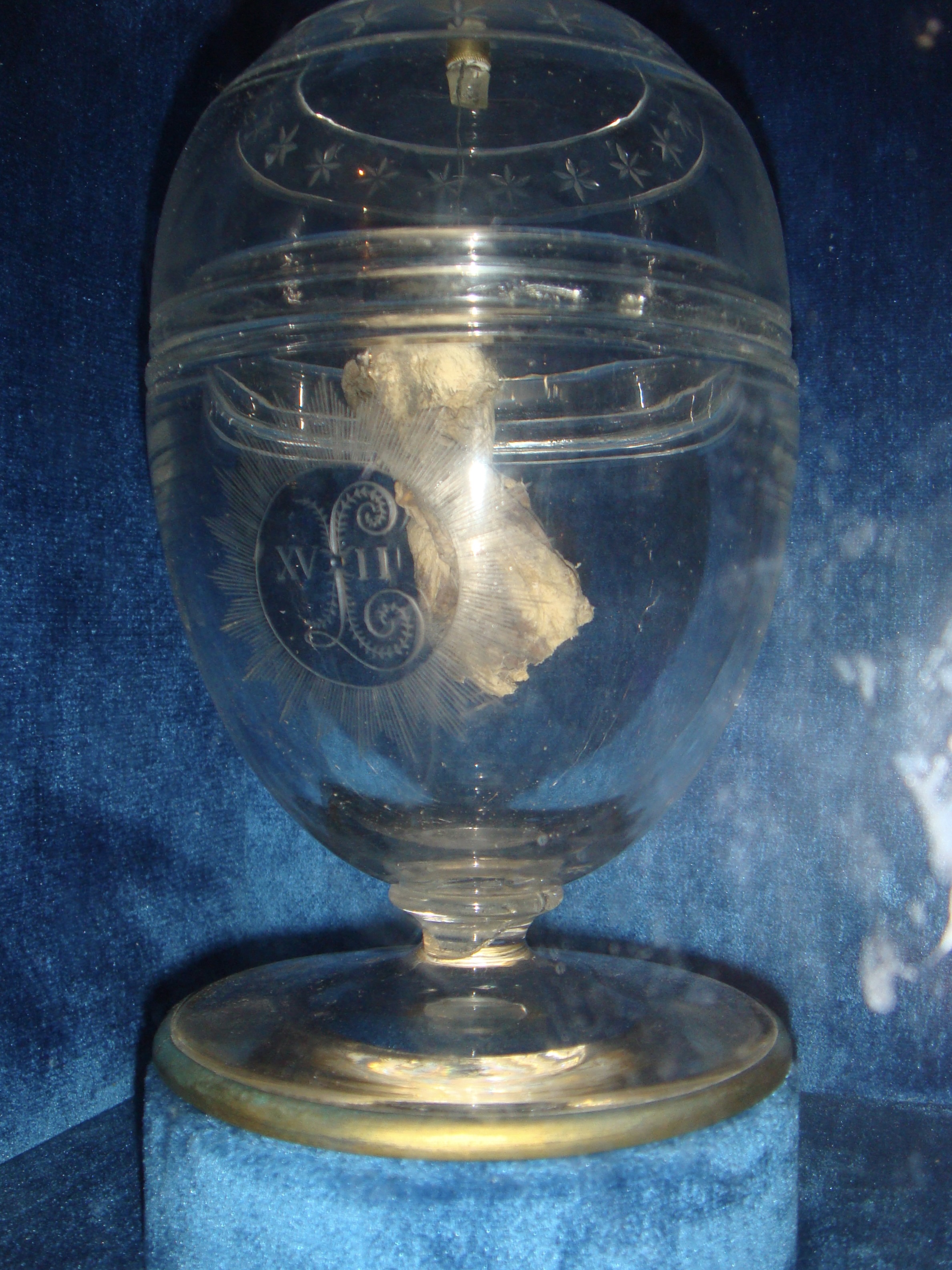
Originally, the body of the ten-year old King of France was buried in the cemetery of Ste. Marguerite. Recent research has revealed that the little boy who was reburied in Saint-Denis was indeed the son of Marie Antoinette; the identification was made with DNA from the child's heart.

Depictions of Louis Charles' imprisonment


The heart of Louis Charles - it was from here
that DNA was taken
Interrogation of Louis Charles 
"The Dauphin in the Temple"
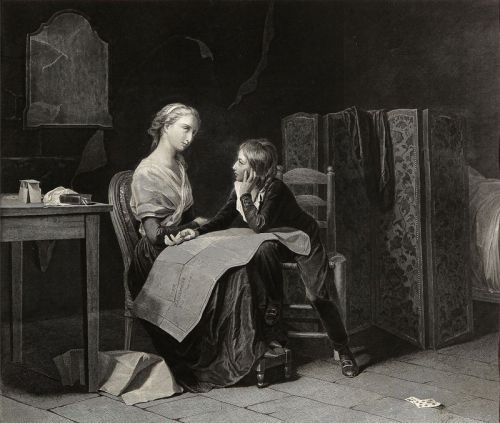
Louis Charles and Marie Thérèse (probably their last meeting)