Showing posts with label perfumed-court. Show all posts

Wednesday, 17 March 2021

Eau de la Reine d'Hongrie

The so-called "elixir" of eau de la Reine d'Hongrie was known to the English as Hungary Water. The name is derived from the woman for whom it was first made: Elizabeth of Hungary. Legend has it that a hermit offered the queen a vial in 1370 - this would be the first alcohol-based perfume. Allegedly, the new wonder-water preserved the queen's beauty. From there, it was transported via Hungarian merchants throughout Europe.

Its dominant notes were rosemary but later lavender would be added - some would even add a bit of sage or thyme. The latter two were described in the recipe for the concoction by Simon Barbe. He would also advocate adding the plant alkanet which rendered the water a delicate purple. Besides the alcohol, it would be distilled with rosemary water.

Rather than being considered merely as a perfume, it was also believed to have strong medicinal powers. For example, it was thought to be ideal as a replacement for smelling-salts. As is usually the case for such concoctions, its medicinal purposes were considered to be wide-ranging. The Princesse d'Epinoy held such high hopes on her Hungary Water that she is said to have asked her son to bring her some, as she was feeling very unwell. Whether he did or not is unclear but she would die shortly after from apoplexy. 

In the next century, Fargeon prescribed the perfume as a soothing agent for Marie Antoinette when she expecting her first child. She suffered under the intense heat of the summer and used the water to help her relax before going to bed. Fargeon was not the first to use it in this manner, though. Almost 70 years prior - specifically on 29 July 1720 - the Regent of France (Philippe II d'Orléans) had been seized with what appears to have been a panic attack during a council meeting. However, as Mathieu Marais relate, he was restored to his senses after having been given the famed elixir.

Sébastien Matte la Faveur described the production process of Hungary Water in detail in his "Pratique de Chymie" of 1671. Naturally, he was amongst those who sung the medicinal praises of the water. He proclaimed that it was well-known to be a cure for all illnesses related to cold, including gout and tremors. It was also claimed to work against jaundice and even heart palpitations. 
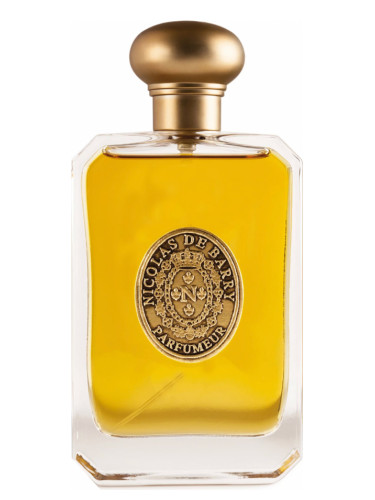

Eau De La Reine De Hongrie Maison Nicolas de Barry for women
A modern bottle of Hungary
Water by Nicolas de Berry


The production appears to have been a lengthy process. Faveur dedicated at least 3 days just for the initial distillation of rosemary and Barbe advocated that the finished product was to be left exposed to sunlight for a whole month.

It is therefore not surprising that eau de la Reine d'Hongrie would be a stable amongst the French aristocracy. When the Duc de Saint-Simon described the rigours of the winter of 1709 he specifically mention that it was cold enough indoors to freeze even the Hungarian Water. Later, it would be given as a gift from Empress Maria Theresia to Madame de Pompadour upon the alliance between France and the Austrian Empire in 1756 - quite a fitting gift, since Maria Theresia was Queen of Hungary. Nor was the present unappreciated, as the royal mistress was noted to rub her temples with it.

Madame de Maintenon had declared it to be her favourite and had it distributed to her young wards in the Saint-Cyr institute. Likewise, Madame de Sévigné swore by it.

The eau de la Reine d'Hongrie appears to have universally favoured - both men and women had it and it remained a stable within aristocratic society throughout the 18th century even when it received competition from eau de Cologne. Besides its suggested benefits, it was naturally used as a perfume, too. It is still being used today - for instance, the exclusive perfumer Nicolas de Barry carries it in its original form. 

Monday, 9 September 2019

The Perfumes of Versailles

Previously, I made a post about the favourite scents of Louis XVI's court but I wanted to expand a bit on that subject. These are therefore popular scents throughout the reigns of all three kings at Versailles and what they were made from.

Aqua Angeli 
Agarwood, nutmeg, cloves, storax, benzoin and rose water

Aqua Mirabilis or Eau de Cologne
Neroli, bergamot, lavender, rosemary, grape spirit 

Celestial Water or Aqua Coloestis 
Cinnamon, lemon peel, sandalwood, gith, zedoary and calamus  

Eau de Câpres
Solely made from buds of the Caper tree

Billedresultat for 18th century perfume bottles
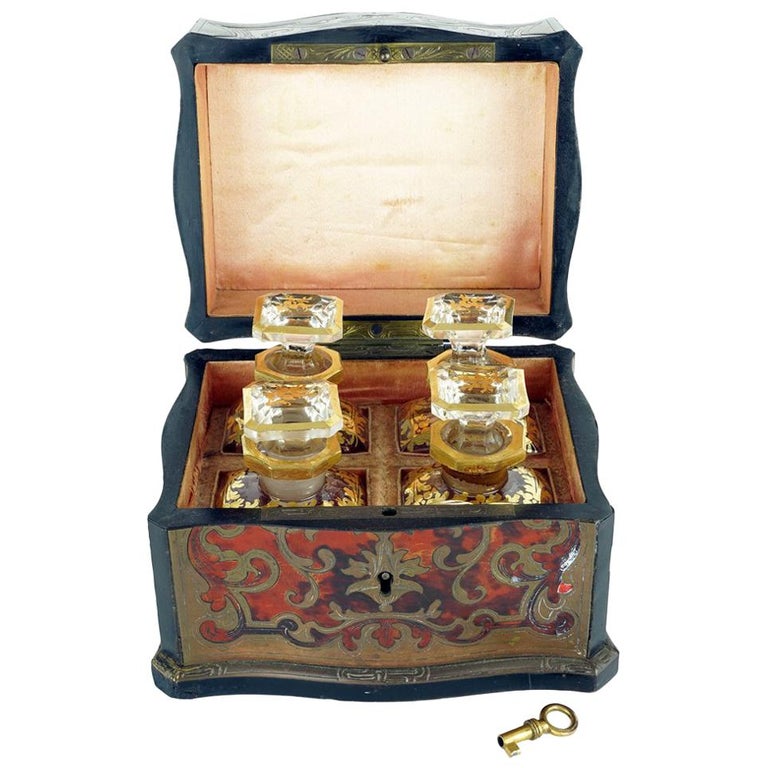
18th century set of four perfume bottles

Eau de Chypre
This was a term which covered a lot of different variants. One consisted of jasmine, neroli, white rose, Angelica, nutmeg and iris

Eau aux Herbes de Montpellier
Not necessarily a perfume but a toilette water with a scent of thyme

Eau de La Reine d'Hongrie
Rosemary, marjoram, pennyroyal, lemon, lavender, bergamot, jasmine, amber and orris

Eau à la Maréchale
Iris, rosewood, benzoin, eau d'ange, nutmeg, bark from a lemon tree, orange, jasmine, marjoram, coriander, lavender, rose 

Eau de Mélisse
Several different recipes were used in the 18th century. One consisted of nutmeg, cinnamon, clove, coriander, lemon and Melissa leaves which would be steeped in white wine and "eau de vie". Another called for Melissa, lemon, Angelica, nutmeg, coriander, clove and cinnamon. This was used more as a tonic rather than a perfume. 

Eau de Mille Fleurs
Lavender, lemon, cassis, orange, rose, geranium, jasmine, orange blossom, orris root, violet, vanilla, vetiver, ambrette seed - the name was not completely off!

Eau de Portugal
Neroli, orange, bergamot, lemon, geranium and benzoe


Relateret billede
Perfume bottles c. 1750

Eau du Roi
Was centered around orange blossom

Huile de Venus
Iris, sandalwood and rose

Jardin Secret
Cardamom, bergamot, jasmine, sandalwood, vanilla, patchouli, rose, incense, amber and tonka bean.

Parfum du Trianon
Rose, orange blossom, lavender, violet, jasmine, iris, galbanum, jonquil, tuberose, cedar wood, sandalwood, amber, vanilla and musk

Sillage de la Reine
Tuberose, jasmine, iris, cedar, orange blossom and sandalwood 

Friday, 6 September 2019

Scented Gloves

Perfume always played a part in the court life of Versailles and as the 18th century progressed, new techniques emerged to add individualized scents to items of clothing. At the court of Louis XVI, one particular favourite item to subject to such a treatment was the glove. The craze for perfumed gloves was not new - it had been fashionable for at least two hundred years. In France, Catherine de Medici was credited with making the items fashionable. 

The Marquis de Frangipani, a courtier of Louis XIII, was said to have been the first to apply scented grease to gloves so the scent would last longer. Others quickly caught on and the commodity spread like wildfire. To the joy of the perfumer-glove maker, gloves were a unisex item of clothing. 

French silk gloves, 1700-1725

In the age Louis XIV, the glove-maker was often a perfumer as well. An illustration of just how close these two spheres had grown is shown by the fact that Louis XIV granted the so-called gantiers-perfumiers (glove- and perfumer) a charter in 1656. The range in prices depicts both the quality of the gloves and of the perfume used. Louis' own perfumer, Martial, sold his precious gloves for 30 sous which was exorbitant prices - in comparison, gloves scented with jasmine were just 5 sous. During the reign of the Sun King, strong scents were generally preferred - and not to everyone's delight. Madame (Elizabeth-Charlotte) wrote to her aunt Sophia of Hannover:

"Madame, had I not been able to stand perfumes, I should long since be dead, for when I am ill, Monsieur comes to me with scented Spanish gloves!"

Even the severe Madame de Maintenon was taken in by the love of perfumed gloves. According to Madame, she also chose jessamine for her gloves. However, the fascination with perfumed gloves came with certain suspicions in the 17th century. More than once was a person suspected to have died from poisoned, scented gloves and they were considered to be dangerous to those of delicate health. Cardinal Dubois, for one, wonders if the Grande Dauphine had succumbed to a wound sustained during childbirth or because the "Princesse de Conti had approached her with perfumed gloves".


Billedresultat for 18th century gloves pastel
French gloves from 1750

Louis XV - himself a fan of perfumes - imposed a tax on French-made, scented, leather gloves in 1759. The result was that perfumed gloves once again became a luxury only available to the wealthy upper classes. Another consequence was that the 1760's saw a definite low in the use of those very items which was only revived with Louis XVI. 

The tax serves to show that the production of perfumed gloves had now entered the French market. Prior to this, scented gloves were imported from either Italy or Spain - just look at Monsieur's Spanish gloves that made such an impression on Madame that she wrote to her friends about them.

Marie Antoinette's personal perfumer - Jean-Louis Fargeon - gained the attention of Marie Antoinette by presenting her with a pair of scented gloves. The perfume he chose for these kidskin gloves was a mixture of hyacinths, violets, musk jonquils and carnation. One particular aspect that undoubtedly attracted Marie Antoinette was the choice of lovely pastel colours. White had long been the colour of choice for the aristocracy's gloves but the Queen of Fashion preferred the softer tones - conveniently, they would match her dresses.

costumist-gloves-2.jpg
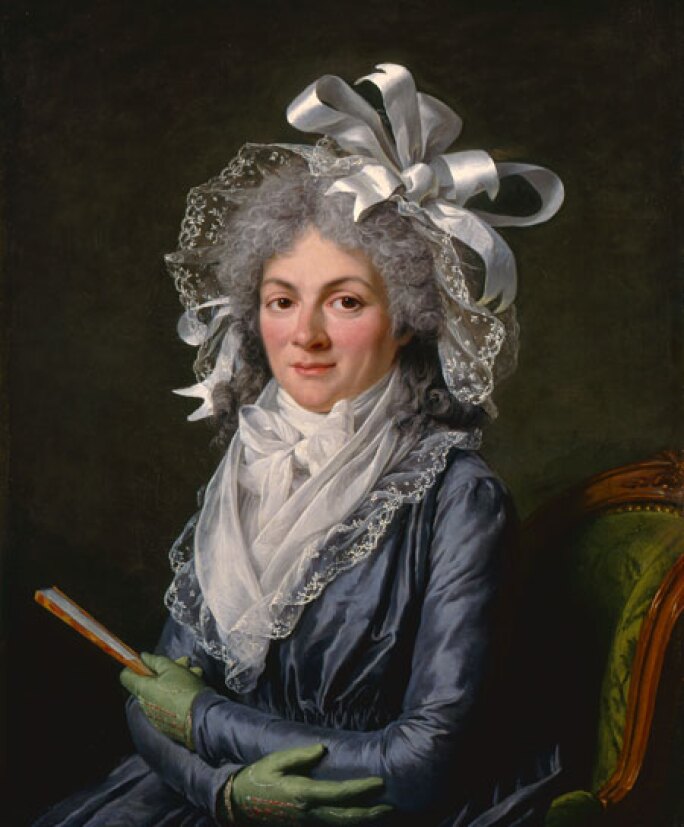
Madame de Genlis wearing green gloves -
scented, perhaps?

Élisabeth de Feydeau gives a very good description of how kidskin glove would be infused with perfume. The gloves would be placed in case between two layers of the chosen flowers. After eight days, Fargeon would retrieve the gloves and add a special touch. Rather than creating simply gloves that had a lovely scent, he wanted to go the extra mile. Therefore, the gloves were prepared with a mixture of rose water, white wax and sweet almond oil. The result was that the hands would be moistened and protected while worn. Unsurprisingly, Marie Antoinette was delighted with the invention and ordered several pairs to be given as presents.

By the late 18th century, scented gloves were a common feature in most ladies' wardrobe. Madame du Barry even received a pair from the King of Sweden as a Christmas present. The style had clearly changed from the time of Louis XIV. Whereas gloves had then been heavily embroidered and adorned with laces or even gemstones, the court of Louis XVI preferred simplicity.

Tuesday, 5 December 2017

A Perfumer's Dream: Favourite Scents of Louis XVI's Court

It is not for nothing that Versailles was referred to as "the perfumed court" -  ever since the court moved there in 1682 the halls and salons was flooded with the sensual notes of perfume. While Louis XIV preferred the strong scents of flowers - orange blossom being a favourite - perfume developed over the 18th century. By the time of Louis XVI and Marie Antoinette the trade had developed into an art.
As it is today, everyone had their own preferences. The difference from most people today and the courtiers at Versailles is that the French elite had perfume made specifically after their own preferences in scents. Few people understood the delicate art of perfume as well as the royal perfumer, Jean-Louis Fargeon. He was made perfumer to Louis XVI and his court which gave him direct access to the royal family. The perfumes he made for them were inspired by the individual person and their moods.

Other influential perfumers of the time included François Houbigant who was under the patronage of the Duchesse de Charost - he was a direct rival of Fargeon's when it came to the queen's favour.    The perfumery of Houbigant still exists and boasts that Marie Antoinette wore three vials of their perfume on her way to the guillotine for strength. Furthermore, there were Vigier who had served the court of Louis XV and Jean-Marie Farina who invented the still famous Eau de Cologne. 

Some of the more famous perfumes of that age are as follows.

Eau de Cypre Composée 
The celebrated perfumer was first introduced to Madame du Barry around 1773; the royal mistress at first wanted something to preserve the shade of her hair and soon became infatuated with Fargeon's perfumes as well. 
To her he brought a vial of eau de cypre composée which was made of jasmine, rose, iris, angelica and orange blossom topped off by no more than three nutmegs and thirty drops of amber. Madame du Barry was in ecstasy about it.

According to Antoine Hornet - who published his book on perfumes and their distillations in 1788 - the best way of preparing this perfume is to go lightly with the amber since it "offends" the noses of most people.


Eau d'Ange
Unlike some of these other scents, the eau d'Ange was universally applicable. It could be used as a base for other perfumes and could be used in baths. In the latter part of the 18th century it was believed to keep the skin white - thus signalling the desired status symbol of a skin not tainted by working in the fields. Marie Antoinette used it to preserve her much-celebrated complexion. 

Fargeon's version included iris, rosewood, benzoin, sandalwood, calamus aromaticus and storax. 

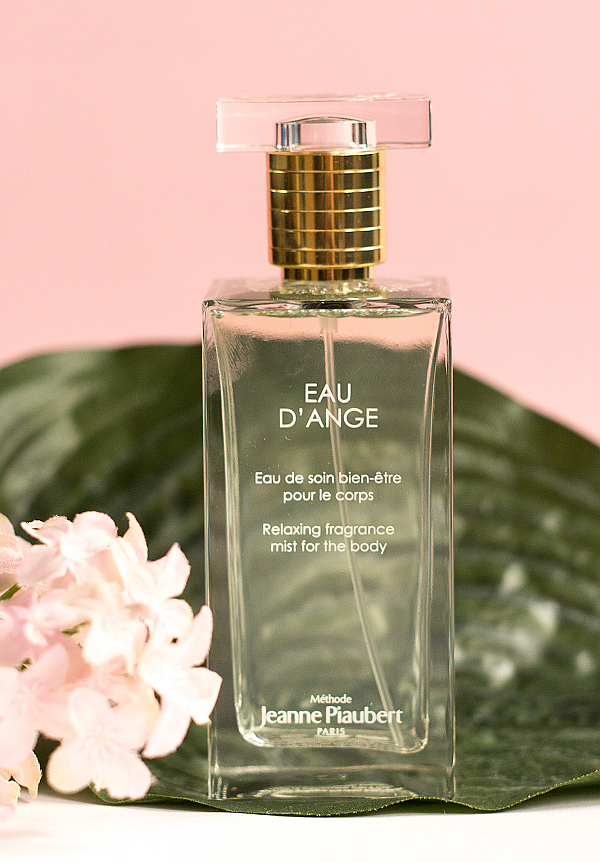
The Parisian brand Jeanne Piaubert still carries the eau d'Ange in their assortment.


Billedresultat for eau d'ange
The modern version by Jeanne Piaubert


Eau de Mille Fleurs 
This perfume has roots as far back as 1686 when Nicolas de Blégny published his works on the secrets of perfumery. The name could easily give rise to expectations of a strong floral scent but it is really rather heavier. Consisting of rose, benzoin, marjoram and musk it often had a base of eau d'Ange. Blégny was also convinced that the concoction could remedy certain physical disorders.

The types of flowers used could depend on the client; some wished to add lavender while others wanted orange blossom. Samuel Frederick Gray's book of 1831 mentions jasmine, essence of lavender, orange blossom and essence of bergamot as key ingredients. Perhaps this is where the name originates from - the possibility of adding any flower possible?


Eau d'Houbigant
The second oldest perfumery in France the House of Houbigant launched this particularly popular perfume not long after the ascension of Louis XVI to the throne. It consisted solely of flowers which gave it a sensual but light aroma. The founder advertised his new creation with the following words:
"It is to the beauty of the face what the morning dew is to the flowers; it refreshes and stimulates the skin while imbuing it with exquisite smoothness..."

Jean-François Houbigant - the creator of
this perfume

Eau du Roi 
Although the orange blossom was not the centre of a perfume until the reign of Louis XV it was definitely on the radar of the French court before that. Throughout his life Louis XIV would prefer this scent to any other - even in his later years when he could hardly stand any perfume he still found it soothing.


Eau de Mélisse
A blend of lemon, cinnamon, angelica, cloves and coriander; Fargeon gave it to Marie Antoinette to soothe her. It was not a new mixture. Charles V is rumoured to have used it and Richelieu always kept a vial of it on him - it was also referred to as eau de Carmelites since it was produced by Carmelite nuns for centuries. 


Eau de La Reine d'Hongrie 
The perfume was originally made for Elizabeth of Poland, Queen of Hungary in 1370. It was made from rosemary macerated in alcohol. Later bergamot, lavender, jasmine and amber were added. It was immensely popular at the French court. Madame de Maintenon and Madame de Sévigné both used it habitually.
Not only was it popular as a perfume but was also considered to have medical propensities - rheumatism amongst others. When Louis XIV was struck with sharp pains in his leg in 1675 he was administered several medicaments - including eau de La Reine d'Hongrie. It was given again in September 1678 when a bout of rheumatism plagued him.


Parfum du Trianon 
Created by Fargeon following an audience with Marie Antoinette at her private retreat. The dominant note was rose but added orange blossom, essentials oils of lemon and bergamot, lavender, galbanum, iris, violet, a bit of jasmine, jonquil and tuberose. Inspired by the lanes of the Petit Trianon he added cedar and sandalwood; amber and musk was chosen as a counteragent to the flowers. Finally, he added a little vanilla as a reference to her Austrian childhood.

Marie Antoinette was infatuated with the perfume. As a sign of favour she granted him access to her grande toilette where he would meet new clients.


Billedresultat for petit trianon lane versailles
The back of Petit Trianon where Fargeon was met by the
queen


Eau à la Marèchale
Named for the Marèchale d'Aumont, this perfume remained a favourite even when the monarchy fell. It was rich in everything: iris, rosewood, benzoin, eau d'ange, nutmeg, cloves, bark from a lemon tree, oranges, jasmine, coriander, marjoram, lavender, roses etc. Popularly said, it had so many scents that it was hard to define it by a single note.


Eau aux Herbes de Montpellier
This perfume's primary note was thyme and it was used for cleansing one's face. Marie Antoinette was given it for her nightly washing.


If you are interested in learning more about Fargeon and his relationship with not only Marie Antoinette but her court, I strongly recommend Elisabeth de Feydeau's book: "A Scented Palace: the Secret History of Marie Antoinette's Perfumer".