
In 1678 Madame de Montespan gave birth to her seventh child by Louis XIV. Françoise-Athénaïs had reached her 38th birthday and had been the king’s maitresse en titre for no less than thirteen years. Her reign had been long – longer than most women could manage – and for the time being all seemed quite normal. Yet, the year marked not just the birth of her final child but also the beginning of the end for the glittering mistress.
On the surface, everything seemed normal. The king still spent hours every day with Athénaïs but before long people started noticing that he did not stay the night. Shortly after, it was widely noted that the two had seemingly ceased their intimate relationship. Traditionally this shift has been blamed largely on Athénaïs’ change in figure. Having had nine children in total, a family history of weight issues and an intense fondness for rich food, Athénaïs physical appearance had changed quite drastically. While still being a remarkably beautiful woman, her body was (understandably) not the same.
 |
| Madame de Montespan at the height of her influence |
Meanwhile, the king who otherwise adored routine was beginning to shift his attentions and priorities. The tempests that had accompanied his relationship with Athénaïs for years had lost some of their charm. After all, the king was aging, too. The shift was subtle. While Louis XIV could certainly exhibit a streak of cold-heartedness and a definite selfishness, he was also a gentleman to the bone. The woman he had loved passionately for years was not to be thrown out the door – yet Athénaïs’s deroute became increasingly obvious.
It has been argued that the Affair of the Poisons hastened her downfall but there is little to suggest that to be the case. For instance, Louis would never have allowed her to remain anywhere near him if he genuinely thought that she had tried to either poison or seduce him with dangerous potions or powders. The mere fact that she remained at court for over a decade after the Affair of the Poisons at the very least heavily indicates his reassurance on that part.
While he continued to spend his obligatory minimum of two hours with her, it seemed more routine than outward passion. Likewise, Athénaïs continued to plan the season’s social calendar and retained her status as the star of the court. Later, though, the hours became gradually shorter and shorter.
As early as 1680, Athénaïs received what could be seen as an initial parting gift. It was customary for kings to end their relationships with a maitresse en titre with a suitably grand gift - a gesture of former intimacy. Athénaïs received the rights of a duchess but without the title which could not be granted to her due to her husband. The Marquis de Montespan had openly and scandalously objected to his wife's affair with the king and Louis was fervently opposed to rewarding such behaviour with a dukedom. As Athénaïs, a married woman, could not be made a duchess with also conferring the rank on her husband, she had to make do with the pomp surrounding it. Likewise, she was made Superintendant of the Queen's Household which was the highest position attainable for women at court.
Then, in 1684, the king decided to expand his own apartment which he did by simply absorbing the sumptuous space hitherto occupied by Athénaïs. In compensation, she was offered the luxurious Appartement des Bains on the ground floor where they had spent hours together privately. To the uninitiated, it was not exactly a punishment but to the courtiers, it was a clear sign that something was afoot. At Versailles, the closer you were housed to the monarch himself, the higher in favour you were – and Athénaïs had just been moved down a floor. If that was not enough, the king’s new mistress, Madame de Maintenon, did not hesitate to hammer home the point. The Appartement des Bains had been connected to the king’s private apartment via a private staircase. That was until Madame de Maintenon took advantage of the king’s convalescence after his surgery to have the staircase permanently bricked up.
On a grander scale, the fall of Athénaïs was blatantly obvious. Her influence amongst the courtiers had long rested entirely on the devotion of Louis XIV. While Athénaïs herself belonged to one of the most prestigious aristocratic families at court, she still relied on the king’s favour to wield the influence she had enjoyed. With that fading, she now had to seek a new avenue which cannot have been anything but humiliating. As it happens, Athénaïs had to apply to the king’s new mistress, Madame de Maintenon. For instance, it was to Maintenon that Athénaïs had to make a request on behalf of her son in 1685 to join the dauphin’s household. That same year, Athénaïs had to endure yet another reminder of her replacement. Much like poor queen Marie Thérèse had been forced to endure previously, Athénaïs had to share a carriage with both the king and Madame de Maintenon while hunting in the autumn of 1685.
To a modern observer it seems quite odd that the king would insist on such an arrangement but to Louis XIV, it was the natural order of things. The king knew full well that his relationships would eventually fade and a new one would begin - the ladies he involved himself with knew it too. Thus, he did not exactly see it as a punishment but rather the way of the world. If anything, Louis had done the same thing once before. Then, it had been Athénaïs who was on the ascendancy and Louise de La Vallière who had to swallow the bitterness of being replaced. Yet, this was nonetheless slightly different. Louise de La Vallière had never truly found peace in her role as royal mistress. Her religious scruples eventually led her to literally flee the court only for the king - strongly displeased - to bring her back. Only a few years later was she permitted to finally join the convent she had escaped to. That episode greatly hurt the king's pride which could not abide being the one to be abandoned. But this time, the slighted mistress wanted to stay and the power lay entirely with the king.
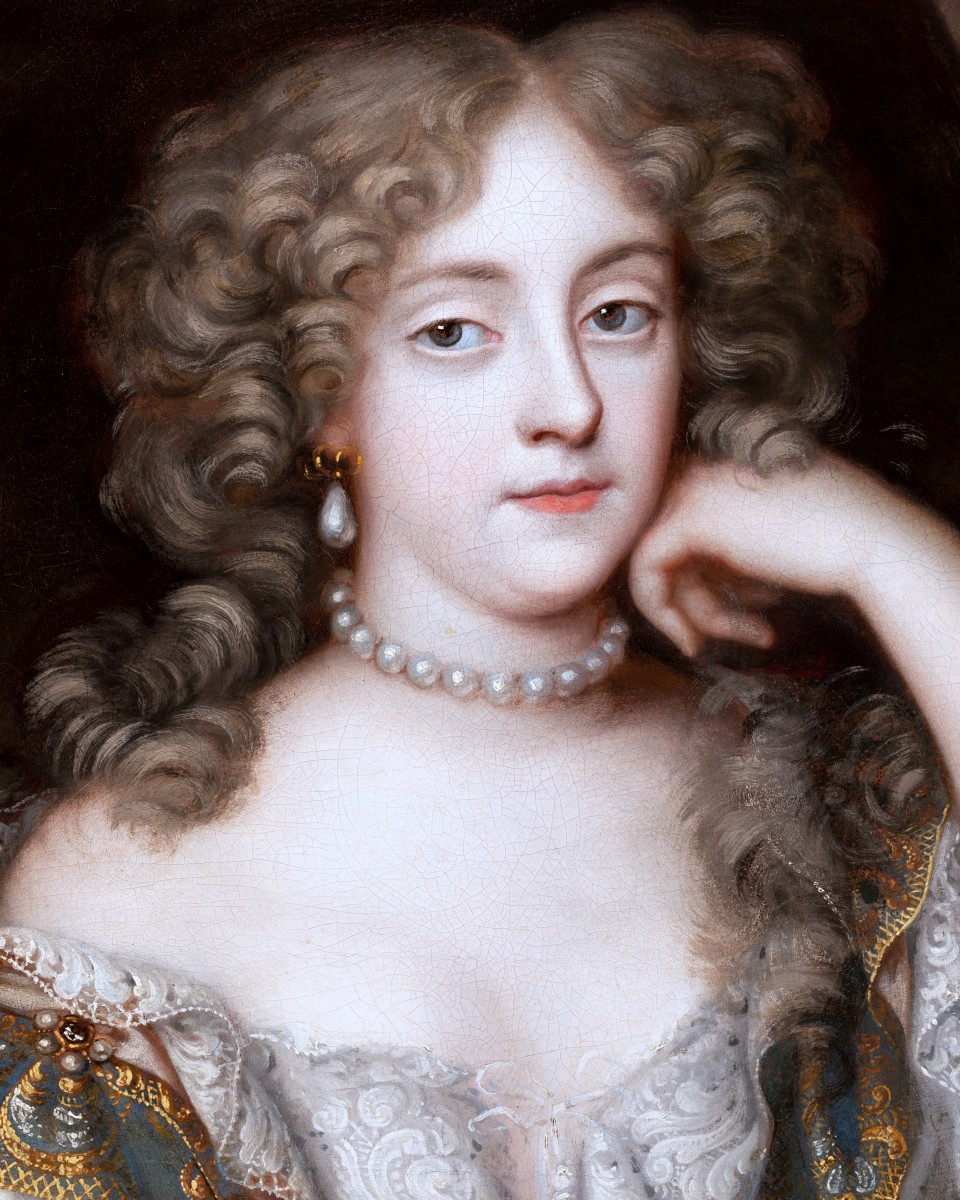 |
| Athénaïs, ca 1670 |
By 1686, Athénaïs presence was no longer necessary for the king. Just the year before, she had had one of her greatest triumphs when her daughter, Louise Françoise, was married to the Prince de Condé who was one of the king’s own cousins. Thus, she had established her daughter firmly in the royal family for good. It would create a precedent which ensured that all her children by Louis were firmly integrated into court society long after their mother’s final dismissal. Perhaps Voltaire was correct when he referred to it as her “last great triumph” at the French court.
It would certainly seem so, for the following year she was omitted from the party invited to accompany the king on his trip to Barèges to take the waters for his fistula. Allegedly, she fainted from sheer anger when she heard. At this point, she cannot have been unaware that she would likely not regain her former position, but this was a step too far, too publicly. If she had had any doubts, her relegation to one of the ordinary apartments while the king’s court visited Fontainebleau that year should have cemented her new role.
The ascendancy of Madame de Maintenon was too obvious to deny and Athénaïs was no fool. By 1691, she finally decided that time was up. Athénaïs retired to a convent and only visited court a few times afterwards.

