Showing posts with label cook-book. Show all posts

Tuesday, 22 July 2025

Pepper: The Sun King's Lasting Addition to the Dinner Table

The timeless classic of setting a table with both salt and pepper originated with none other than Louis XIV. Salt had always been somewhat easily accessible - to all classes of society - but pepper was far more exotic and therefore more expensive. Thus, it quickly became a status symbol - but how did the Sun King and his court treat the now so commonplace spice?


French cuisine was already ahead of the curve and the royal cooks had every chance to experiment with new recipes. However, Louis XIV preferred to have his food only slightly seasoned which is where the combination of salt and pepper came in. Salt compliments most (if not all) dishes and was therefore already a stable for most. Pepper, with its subtle but delicious taste, quickly became a favourite of the French king. And so it spread - as it happens, it is thanks to Louis XIV that salt and pepper are now the most commonplace pairing on any dinner table. 

As for Louis XIV, the combination remained on his table until his death. By 1709, he was still recorded as being particularly fond of seasoning his dishes - including salads - with certain herbs and salt and pepper. They remained at Versailles, too, where a page of Louis XVI would later describe how the king and queen's salt and pepper were served on silver-gilt trays. 


A Journey into the Medical Record of Louis XIV by Yigal Liberant
Louis XIV


Pepper was expensive. It had to be imported from Asia but fortunately - for the majority of Europe - it was one of the few spices that the Dutch did not have a monopoly on importing. This could have had an impact on how widespread the use of pepper became as more countries could import - the French themselves certainly did as did the Dutch (naturally), the Danish, many of the German States, the English, the Swedish etc. It certainly had an influence on the price which fell continually throughout Louis XIV's reign. 

Besides the delicious food combinations, pepper was also believed to have certain medicinal properties. By the 17th century, the king's own pharmacist recommended rubbing pepper oil on the perineum to assist a gentleman who might need help in the bedroom. One can only wonder if the king ever tried that...


Thursday, 18 October 2018

Dark, Delicious Chocolate

Chocolate became a part of French court life before Louis XIV was even born; his mother - Anne of Austria - hailed from Spain whose colonies in South America had already introduced Europe to chocolate. 

Like her mother-in-law, Queen Marie Thérèse was also passionately fond of chocolate. She drank it as often as possible; Elizabeth-Charlotte of the Palatinate wondered whether the queen's bad teeth were due to her excessive use of chocolate. Madame herself never indulged in the same taste since she claimed that her system did not digest "these exotic drugs" (including coffee) very well.
The very exotic nature of chocolate also led to it getting a somewhat mixed reputation. On one side it was said to be beneficial to one's health but others claimed it to be a major health risk. While Madame de Sévigné acknowledged that chocolate was in fashion in the 1670's she certainly had her reservations. In a rather memorable moment she relayed the story of the Marquise de Coëtlogon who gave birth to a black baby - the cause was based on chocolate. Despite the more obvious reasons for why the infant may not resemble to husband it was noted that the poor child died shortly afterwards - perhaps it was ill or had not gotten enough oxygen.

Billedresultat for louis xiv chocolatiere
A chocolatière from 1707

One of the other risks associated with chocolate related to the theory of the bodily humours. This well-known theory (that I will not go into further depth in here) led the doctors to fear that excessive intake of chocolate could change a person's natural "humour". To those born with a "hot humour" this could be dangerous but some born with a "cold humour" could use it to their benefit. Madame de Pompadour's libido was notoriously low and she used chocolate in an attempt to seem more passionate - not necessarily in a sexual manner. This led her companion - Madame du Hausset - to remonstrate with her mistress that it might be dangerous to her health. 

Louis XV certainly did not need encouraging when it came to drinking chocolate. He loved the drink and would often enjoy making it for himself in his private apartments.

The chocolate of Louis XIV's reign was much richer and heavier than the store-bought products we are used to today. Louis XIV quickly noticed that it had the ability to "trick" the appetite and the Sun King was not the only one who took note of this. Philippe II d'Orléans would - according to his mother - often drink a cup of chocolate rather than having a meal since he believed that one vast meal a day was sufficient. 
The Spanish tradition had it that chocolate could be mixed with chili and as the 18th century went on other spices were added too. Vanilla, cinnamon and even cloves were favourites; others added orange blossom, sugar or sweet almonds.
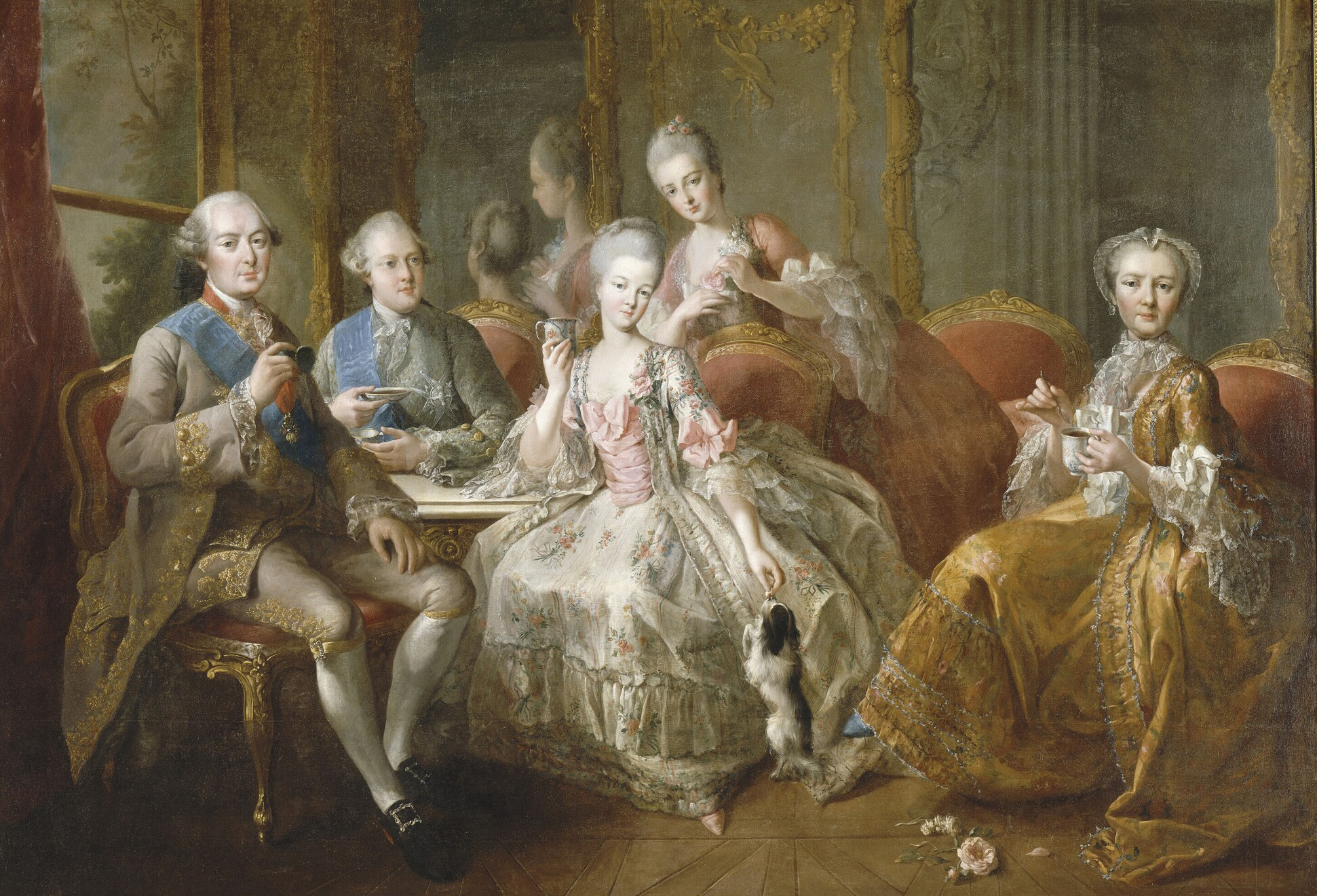

Relateret billede
One of the more famous paintings of the time including chocolate
- the Duc de Penthièvre and his family.
In the very centre is the Princesse de Lamballe who married Penthièvre's
only son.

Despite that chocolate was not a completely new concept at Versailles it was nevertheless popular - and exotic. As such it was dutifully served at the appartements thrice a week along with pineapples, peaches and other exotic wares. Therefore, it is hardly surprising that chocolate was a privilege reserved for the upperclass. This did not change throughout the remnants of the French ancien regime - in comparison it was available to those of fewer means in London.

As an exotic ware it did not take long before the rich beverage was linked to life's more sensual pleasures. Plenty of rumours and gossip has arisen when it comes to the use of chocolate in this manner. Both Madame de Pompadour and Madame du Barry were said to use chocolate in their intimate life with Louis XV; the former because she was said to have been a "cold fish" and the other because she allegedly had an "insatiable lust". Neither are exactly to the women's credit and whether they are true can only be guessed at. It is, however, typical of the slander at the time to target women's sexuality and especially the king's mistresses (for obvious reasons).

When Marie Antoinette set sails towards France she brought her own chocolate-maker with her; he was duly given the official title of "Chocolate-maker to the Queen" with an annual wage. The Austrian-born queen had grown up in a court where chocolate was often consumed for breakfast. This trend had spread across the courts of Europe and she could continue the habit there.

Billedresultat for louis xvi chocolatiere
The chocolatière from the set  given to Marie
Leszczynska by her husband

As chocolate was embraced in the higher echelons of society it gave rise to a new line of luxury items. One of the best preserved from the age of Versailles was Louis XV's gift to Marie Leszczynska following the birth of their son. She received a full service which accommodated all the "exotic drugs": coffee, tea - and chocolate. In the previous century, Louis XIV, Marie Thérèse and the Grand Dauphin had each received "chocolatières" from the king of Siam. According to the Mercure Galante Philip d'Orléans had entered two chocolatières in the prizes for a lottery he held in July 1689. One was of porcelain and the other of silver - the pair was won by a Madame de Maré.

Initially, the sale of chocolate was monopolized. Louis XIV gave David Chaliou the right to sell chocolate in France. During the 18th century the increase of production in colonies - as a result of the slave trade - meant that cocoa beans were more available. However, this did not mean that the French commoners suddenly had free access to the delicious drink. It remained a reserve for the wealthy. According to Massimo Montanari it was not until the 1770's that chocolate became a part of a downright industry.
Wendy Sutherland reports that the first chocolate house in France was opened in 1675. Presumably, this café was linked to Chaliou since his monopoly only ran out in 1693. After that the chocolate market opened up for other entrepreneurs.

Friday, 5 October 2018

Pineapple: The King of Fruits

The exotic pineapple - named "king of the fruits" - found its way to the French court during the reign of Louis XIV. As it happens, Madame de Maintenon had tasted the fruit during her childhood in Martinique where her father had relocated following his release from prison. According to her, the pineapple tasted like a mixture of melon and an apricot.
It would not be surprising if it was on her suggestion that the had the plant cultivated at Choisy-le-Roi in 1702. However, according to Tonelli and Gallouin, the cultivation proved too costly so it was quickly scrapped. It should be said that this was not the first time that Louis XIV's gardens had yielded such fine specimens. In 1642 one of the first French pineapple was grown by Jean-Baptiste La Quintinie but he never succeeded in producing more than one. 

One story has it that when Louis XIV was first presented with a pineapple, he was so eager to taste it that he bit straight through and hurt his upper lip quite badly. True or not remains speculative though.


Relateret billede


By 1690 Louis XIV had concluded a new treaty with Charles II of Spain; the result was that the island of Hispaniola was transferred to French ownership and renamed to Saint-Domingue (today it is Haiti). This proved to be another possibility to bring the pineapple to France. When the king sent Charles Plumier to examine the flora of his new possession, Plumier returned with several specimens - including pineapples.
The problem was partly that the seedlings had a hard time surviving the journey back to France; once they arrived the colder weather quickly killed off those that survived. The few that did manage the journey were put to exquisite use in the king's kitchens. The weekly appartements often featured ices and sorbets - another feat of engineering - and pineapples were soon added to the flavours.

The French gardeners struggled with the pineapple but did not give up. Finally, on 28 December 1733, the gardeners of Versailles were successful and presented Louis XV with two perfect pineapples. Quickly, it became one of the king's favourite fruits and a new hot-house was promptly erected. According to Eugene Walter the king spent 1000 francs a year on that hot-house alone. Actually, the plants that produced that pineapple later provided samples which were sent as diplomatic gifts. 

As the 18th century passed it was not just the king of France who had the opportunity to cultivate the delicious yellow fruit. According to Louis-Sébastien Mercier (writing in 1782) pineapples were grown by the Duc de Bouillon whose passion for them exceeded even Louis XV's. Mercier claimed that no less than 4000 pots were reserved solely for growing pineapples. 


Billedresultat for 18th century pineapple
"Ananas" by Oudry


The botanists of the time continued to be fascinated with the "king of fruits". During Louis XVI's reign, Jean-Baptiste Oudry produced a series of botanical illustrations - including one of the pineapple. Marie Antoinette chose to hang that particular one above the door in her Cabinet of the Meridian. Some time during Louis XV's reign the cultivation of pineapples at Choisy-le-Roi had been taken up again and this continued right up till the dawn of the revolution. At this point, the gardener (a man by the name of Edi) was considered to be the foremost specialist on pineapples.

Saturday, 5 May 2018

Eating the French Way: Service à la Française

Service à la Française could easily be said to be a sort of buffet; most guests were standing and each composed their own plate according to their own tastes. Naturally, it would not be a truly French type of eating if there was no structure at all.

The dishes were brought in, in three services. First, the fish and the soups were served. Secondly, roasts and accompanying side-dishes. Finally, fruits and desserts would round up the dinner.

It was an excellent way of displaying the monarch's wealth. Louis XIV, for example, could boast of serving ices in the heat of summer; quite a feat in days without refrigeration. Likewise, exotic fruits showcased the king's far-reaching power. Pineapples were grown in the royal green-houses along with other delicacies not naturally found in France. 

At Versailles the department responsible for the king's meals (called the Maison de Bouche) were in charge of supplying the delicious dishes. However, the nature of how the food was laid out meant that servants were not needed to supply each guest with new food. Instead, the king's servants primary functions were to bring out the food and remove the dirty dishes. Glasses - once used - were placed on a table and would be taken to be cleaned. It should also be noted that the servants who were there were all male - females were not permitted to serve the royal table.

Billedresultat for service à la française
A perfect example of the symmetry of
the French service

As the Ancien Regime rolled on the service à la Française developed too. Once the fork had become a standard in royal dinners - which took quite a while since Louis XIV considered it too Italian - it was customary to place them neatly by the side of the plate. Also, forks normally had three teeth not four.
The setting itself was a perfect mirror of the love of symmetry that was so dominant in the baroque era. Thus, the dishes were set out in complete symmetry. Taste was, of course, an important aspect but the look of the dishes were almost equally important. Each dish was often elaborately displayed and flower displays often finished off the setting.

The service itself was outstanding. Silver and gold plates were wrought in more and more elaborate patterns. The heavy silverware of Louis XIV was mixed with more delicate porcelain during Louis XV's reign. Porcelain had the added advantage of keeping the dishes heated a little while longer. This was typically how dinner was laid out on the occasion of the appartements. 

Thursday, 24 November 2016

Icy Pleasures

With no means of keeping food and sweets cooled down - except for digging into the ground - it was considered a sign of the King's power that he could serve ices during mid-summer.

The trend for serving flavoured ice originated in Italy and was brought from there to Versailles courtesy of a man by the name of Audiger. He had been sent to Genoa in the 1660's by Louis XIV to "intercept" recipes for liqueurs; that he did but he also brought back not only the idea of eating delicious ices but also the techniques to produce them.

The ices were flavoured by fruits, spices - even musk. Louis XIV immediately recognised the sophistication it would display if he could treat his courtiers to such a delicious "snack" at balls or soirees. Consequently, he had two ice houses built at Versailles in 1664 which kept the court supplied. These ice houses were enormous. Each one could contain up to 1.120 cubic metres of ice! During the coldest months the ice was naturally easier to come by - and keep frozen - and the Lake of the Swiss Guards provided plenty of ice for the ice houses. The ice formed on the lake would be transported by workers who would crush the ice with pick axes making it easier to transport.

Another illustration detail from Emy’s ‘'Art de Bien Faire Les Glaces d 'Office’ (1768), referring to the cups as ‘Goblets à glace’ © http://gallica.bnf.fr
This is how ices were served

Soon serving ices became a court favourite. At balls tall ice pyramids were served with fresh fruits and exotic spices. During the summer picnics beverages were often served in goblet made of ice (however unpractical that was).

As it happens, Louis XIV even included ices as a refreshment in his book "The Way to Present the Gardens of Versailles"; in this book he lays out a route which includes a stop at Marais where ices would be served which was also the case at the Three Fountains. The Duc de Saint-Simon mentions that the King even had ices served during his visits at the front - to the amazement of his soldiers.

Billedresultat for ice pail 18th century
Ice-pail from Sèvres, 1778

However, the enjoyment of ice soon spread to the rest of the French population and by 1700 it was widely sold. Some merchants found it irresistible to charge more than reasonably for their exotic wares which led to an edict from Louis XIV forbidding such high prices in 1701.

Two types of ices were enjoyed in the century of Louis XIV. One was made from frozen fruit pulp which the gardens of Versailles provided plenty of material for. Thus, courtiers could enjoy ices made from pineapple, apricot, orange, lemon etc. The other kind of ice was made from cream - what we even today call ice cream.

Billedresultat for versailles ice cream
Marie Antoinette's ice-house at Petit Trianon

Louis XVI made it a habit to host dinners every Tuesday at which the guests would regularly be treated to a dessert of ice cream. By this time ice was usually found on the dining table in specially created ice pails - Sèvres often included one in their deliveries to the court. Actually, the production of such ice-pails were begun in the reign of Louis XV who sent one of the first to Empress Maria Theresia in 1758.

The Empress' daughter, Marie Antoinette, had a taste for ice as well and made sure to include a small ice house of her own close to Petit Trianon. Over the years it fell into disrepair but was restored in the 1990's.

Saturday, 27 June 2015

Tasty Potato Croquettes


From the table of Louis XVI

Ingredients (6 people):

2 pounds of potatoes
2 tablespoons butter
1/4 tablespoon white pepper
1/4 tablespoon nutmeg
½ cup of grated Parmesan
1 teaspoon of parsley
½-1 teaspoon salt
2 eggs
Flour
Bread crumbs

How-to:

1. Peel the potatoes and cut them into four pieces. Put in cold, salted water and bring it to a boil

2. Once cooked, smash the potatoes on a pan with butter - low heat!

3. When the potato-purée is smooth add the nutmeg, salt, white pepper, Parmesan and an egg yolk. Mix thoroughly and cool off.

4.  Once you can safely touch them, roll the potatoes into croquettes. Roll in flour, then a beated egg and finally bread crumbs. 

5. Use a pan to fry the croquettes but do not deep fry them! Add parsley if needed.

Wednesday, 23 July 2014

Precious Pear Pie


From the table of Louis XIV

Ingredients (for 6 people)

375 g shortcrust pastry

1.5 kg pears
150 g caster sugar
30 g pine nuts
60 g raisins
1 organic lemon
4 pinches of ground cinnamon
1 egg yolk


How-To:
1. Flour a work surface and divide the pastry dough in half: one for the bottom crust, the other for the top.
Prepare the filling. Soak the raisins in lukewarm water. Carefully wash and brush the lemon before peeling it with a paring knife as thinly as possible. Chop into small pieces and boil twice. 

2. Drain and add to a syrup you will have prepared in a small saucepan from 50 g of sugar and 10 cl of water. Gently boil for around 10 minutes until obtaining a still-fluid mixture containing the lemon peel. Meanwhile, peel the pears and cut them into small pieces. Put the pears, pine nuts, drained raisins, candied lemon peel, remaining sugar and cinnamon in a large bowl, mix well and leave to rest for 15 minutes.

3. Preheat the oven to 200°C. Place half the pastry dough in a pie dish and fill with the pear mixture. Cover with the other half of the dough, sealing the edges and brushing with the egg yolk diluted in tablespoon of water. Make a hole in the centre, keeping it open with small cardboard funnel.

4.Bake 1 hour, checking from time to time. When the top is golden brown, you can loosely cover it with aluminium to keep it from burning. Serve warm or cool.