Showing posts with label education. Show all posts

Wednesday, 6 April 2022

The Incomplete Education of Louis XVI

In 1760, the young Louis Auguste held the title of Duc de Berry and was third in line to the throne of France - at this point in time, few expected that he would one day become Louis XVI, as both his father and his elder brother stood to inherit before him. At the age of 6, the Duc de La Vauguyon was appointed as the governor of the young prince - a choice that the pupil himself would later come to deeply resent.


As a royal prince, his education was widespread and largely dictated by his father, Louis Ferdinand: religious studies, latin, geography, history, chemistry, mathematics, physics and astronomy were amongst the fields covered. Later, he would add English to his list of languages. The young Louis appeared to have had a natural talent for especially geography - a subject he would devote many hours to as an adult. During his lessons, he would draw up detailed maps of Versailles and its surroundings. Likewise, he seems to have had a firm grasp on the otherwise labyrinthine system of finances which can be seen from his numerous attempts at financial reform in the late 1780's.

Rather unusually, both the Dauphin and Dauphine took an active part in their sons' education. Twice a week, Louis Auguste and his brothers would be taken to their mother's apartments where they would be heard in the lessons of the week. This must have been somewhat awe-inspiring for a naturally timid boy, especially considering that both his younger brothers were more self-confident.
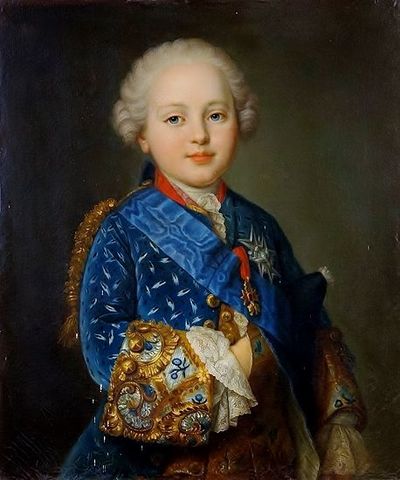

Louis XVI while Duc de Berry


La Vauguyon often tasked his pupil with writing smaller treatises on rather dry, but important subjects. The first of these had the lengthy title: "Moral and political maxims drawn from Télemarque concerning the science of kings and the happiness of peoples". Ironically, Télemarque had been the main character in a book published by Fénelon in 1699 which had subsequently been banned by Louis XIV for being too outspoken in its criticism of the absolute monarchy. Yet it was chosen by La Vauguyon for the Sun King's successor.


The Duc de Bourgogne, died unexpectedly in 1761 and his father followed him to the grave just four years later. This left the eleven-year old Louis Auguste as the new dauphin. From a purely educational viewpoint, the change had an immediate impact on his lessons. Added to the curriculum of courtly and scholarly virtues was now the awe-inspiring lessons in kingship.

On La Vauguyon's urging, Moreau and Berthier drew up no less than 35 "reflections" on the meaning of kingship. These were then drilled into the head of the king-to-be over a period of three years. It is a testament to Louis' memory skills that even La Vauguyon was impressed with how well he understood the reflections. These reflection gives a clear insight into the values distilled into the young man. Amongst them were the doctrine that a good king's sole purpose was to make his people happy and virtuous; likewise, he was to refrain from bloodshed - both at home and in war - unless absolutely unavoidable. This was not merely an education in how to subdue and discipline his people - it was a lesson in ruling with compassion and justice.


One particular aspect of Louis' education appears to have had a profound effect on him. By nature, Louis Auguste was shy and preferred to keep to himself. This characteristic can only have been furthered by the instruction from his confessor, Abbé Soldini, to "never let people read your mind". Likewise, he was taught that as king, it was vital that he did not become too open with his surroundings. Given such instructions it is hardly a wonder that the adult-Louis would have seen little reason to break off his natural reserve.


Antoine de Quélen de Stuer de Caussade
The Duc de La Vauguyon


Religion had an intense influence on the dauphin's education. Both his parents belonged to the Dévot party and most of his tutors were chosen accordingly. Thus, his education would be heavily influenced by religious dogmas.

One thing that stands out from the manner in which Louis Auguste was educated is that he was rarely urged to reach his own decisions. The teaching methods employed by La Vauguyon focused primarily on learning to repeat back what had been taught; there does not seem to have been much - if any - room for actual reflection on the subjects. In those few cases in which the pupil was expected to think about the subject at hand, there would usually be a correct answer. Thus, it appears that emphasis instead was placed on drawing inspiration from or downright reciting others; this could very well have contributed to Louis' later infamous characteristic of indecisiveness. After all, if a pupil is never taught to independently process a situation or concept and reach their own conclusions in childhood, how can they they be expected to do so later on?

The most influential figure during this period in his life was the Duc de La Vauguyon. The education he passed on to his royal pupil famously centered on four virtues: piety, goodness, firmness and justice. Initially these seem to be sound principles to instill in a young prince. However, La Vauguyon himself did not quite live up to one of them in particular: goodness.

The Comtesse de Boigne would later say of Louis XVI that the king had claimed to only habour a feeling of hatred towards one man: La Vauguyon. Whether that was ever actually uttered by the king is impossible to know. What is more certain is that La Vauguyon believed in the old-fashioned type of teaching which included a good deal of discipline and strictness.


Interestingly, considering his avid passion for it, hunting was not included at all in his father's plan for Louis' education. It was not until his death that Louis XV gave his permission for his grandson to begin riding lessons. At this point he was 13 years old. The exercise proved to be an immense help to the dauphin. It strengthened him physically and allowed him a respite from the constraints and pressure placed upon him.
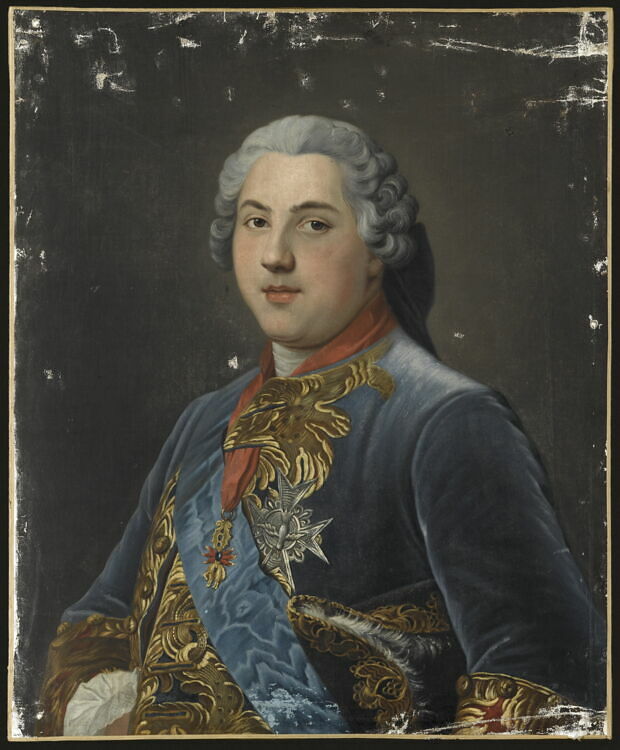

Louis Ferdinand - Louis XVI's father
who heavily influenced his sons'
education


One thing appears to have been remarkably absent from his education considering his status: military strategies. Unlike most of the noblemen's sons whom he interacted with, he had never been to either the École Militaire or the Invalides. Combined with his utter lack of martial aspirations, it is little wonder that Louis XVI never became known as a military commander.

In a similar vein of thought, very little attention appears to have been devoted to the inner workings of the state apparatus. Considering that he was to exercise complete control over the French government, La Vauguyon does not seem to have introduced him to the finer workings of bureaucracy. Likewise, there appears to have been no focus on current challenges faced by France.$ When he ascended the throne in 1774, the harsh regimen of La Vauguyon had imbued the new king with a well-read mind, but had failed to provide him with the tools necessary to rule as an absolute monarch. 


It was not until around 1770, that Louis XV became personally invested in his grandson's education. From then on, he would instruct him himself in various subjects. By this point, Louis Auguste appears to have become a young man with ideas of his own as to how France could be governed. The future king's analytical mind enjoyed the exercise of drawing up various reforms to improve his nation; when he ascended the throne, he would attempt to enact them but largely unsuccessfully. His ideas might have worked had they come a few decades earlier. But by the 1770's and 1780's, France was too divided between the firm adherents of the ancient regime and the followers of the newer Enlightenment. Wherever the new king turned, he seemed to be met with rock solid resistance and a fierce refusal from both sides to even attempt to cooperate. As a result, the king would be plagued by self-doubt and change his mind numerous times.

The times were changing when Louis Auguste received his education and it was very much reflected in it. On one hand, the pupil was taught about the absolute power he was to yield and the god-given right he had to do so. One the other, the Enlightenment was sneaking in with thoughts on liberty, equality and a humanity. It is hardly surprising, then, that Louis XVI would struggle his entire life with the keen balancing act of being an absolute monarch with the virtues of a child of the Enlightenment. Sadly, in the end, it proved to be two doctrines too far removed to be compatible. 

Monday, 16 September 2019

The Education of Mesdames

Despite being the daughters of the king of France, the education afforded to Mesdames varied greatly. The eldest daughters of the king - Louise Élisabeth, Henriette and Adélaïde - were given a thorough education at court but as the birth of one princess succeeded another, it became necessary to reevaluate the situation. Financial concerns eventually prompted Louis XV to send his four youngest daughters - Victoire, Sophie, Thérèse (died at the age of 8) and Louise - to the Abbey of Fontevrault. 

Of all the king's daughters, Madame Adélaïde was the one who was the most eager to learn. She threw herself enthusiastically into her musical education and acquired the ability to play on a large variety of instruments "from the horn to the Jew's harp". She certainly had the opportunity to excel in that area; Beaumarchais was appointed as her music teacher. Besides French, she was taught Italian. 

Billedresultat for daughters of louis xv
Madame Adélaïde, whose wish to learn was the greatest


At Fontevraud, the education of the royal children was apparently not considered too much of a priority. Madame Campan relates that Madame Louise could not recite the alphabet at the age of 12 and that she had only really learned to read after her return to court. However, there was certainly a degree of exaggeration to Madame Louise's claim. Casimir Stryienski points to the fact that documents exists from their time at the abbey which appears to have at least been signed by Madame Louise. Nevertheless, there is quite a leap from being able to write ones own name to being completely literate.

The complete lack of devotion to the young ladies' education was typical of the time. Most people - royal and commoner alike - believed that females did not require the same level of education as their male counterparts. Instead, they were to focus on more courtly virtues such as dancing, good manners, hunting and religious studies. Cardinal Fénelon - one of Louis XV's closest advisors - openly shared this view which can only have contributed to the neglectful education of the royal daughters. This point of view is clearly illustrated in the small entourage that was dispatched to the benefit of Mesdames. It only included a doctor, a music teacher and a dancing master. Consequently, the arts of dancing and music were the only ones that the three surviving princesses were said to have been properly instructed in.

The nuns at Fontevrault were probably not able to provide what was lacking in their charges' education. Their lives focused on religious devotion and as such - including their being females - they were not given extensive educations themselves.

Once they were all back at Versailles, Victoire, Sophie and Louise endeavoured to correct their faulty education. Luckily for them, their brother - Dauphin Louis Ferdinand - was more than willing to share his extensive knowledge with them. According to Madame Campan, the three spent hours and hours improving themselves and succeeded. Before long, they could all write French without mistakes which was not necessarily a given for a woman of the nobility. More subjects were added to their self-imposed syllabus: Italian (probably aided by Adélaïde), history, mathematics, some sciences and even English!

It is certainly to the credit of Mesdames that they wished - and did - improve themselves. Their fellow courtiers definitely noticed their initial lack of instruction. With biting irony, the Marquis d’Argenson recalled that the princesses had gone to Fontevrault where they "received their excellent education".

Madame Louise, who may have exaggerated her own
illiteracy

Once Mesdames had mastered the art of reading, they found it to be a true passion. When they were given the Château de Bellevue, they established an impressive library there which counted several thousand volumes in different languages. The inventory of Madame Adélaïde's personal books was drawn up in 1786 and accounted for over 5000 books.

It has been argued that Mesdames opposed Madame de Pompadour, not only due to the moral aspects of her relations with their father but also because she was a very well-educated woman. It is definitely  not unlikely that the royal Mesdames felt something of an inferiority complex when faced with a bourgeoisie woman who - besides her social standing - had received a far better education than they.

Sunday, 14 April 2019

The Failed Education of the Grand Dauphin

The turbulent childhood of Louis XIV made him determined to provide his son and heir with the best education possible. Jacques Bénigne Boussuet was appointed as Louis, le Grand Dauphin's tutor; the Grand Dauphin's education would be decided by him as well as his governor, the Duc de Montausier. However, before they took over, the basic education was formed by Louis' preceptor, Périgny.

Unlike what might be imagined, Louis was not alone in the school-room. Four boys of the highest ranking families were chosen to partake in his lessons with Périgny. They were taught the basics of writing and reading. Périgny - in his capacity as the Grand Dauphin's preceptor - focused heavily on the moral education of his pupil. For this purpose, he used the legendary fables by La Fontaine to highlight moral problems. He also began the Grand Dauphin's lessons in French and Latin. Louis appears to have enjoyed his lessons by Périgny but they were not to last. Périgny died in 1670 and Boussuet took his place.


Louis, le Grand Dauphin

The plan devised for his new education included a wide array of subjects: geography, history, philosophy,  classical literature, rhetoric, logic, anatomy and physics. Besides these were the more courtly pursuits of drawing, riding and dancing. But there was one more aspect that was necessary for a future king: lessons in warfare, jurisprudence and the day-to-day functions of government.

As for his political education, Louis XIV took that into his own hands. He wrote the book "Memoires pour l'instruction du Dauphin" which was meant to guide the Grand Dauphin when he ascended the throne. However, nothing else was done to further the young boy's political acumen. Even when he became older and could have benefited from listening in on his father and his advisors, the Grand Dauphin was barred entry into the Council Chamber. 

Louis was born with a natural desire for learning but his teachers were terribly ill-suited. The young boy would have benefited from a less rigid educational style - like his own sons would receive - but both Boussuet and Montausier were of the old school. They attempted to cram as much knowledge into Louis in as short a time as possible - and would mercilessly berate him if he made mistakes. The consequence was that Louis became terrified of new knowledge and avoided it at all costs. 

Boussuet himself stated that the education of the future king was very much a "public affair". Therefore, he dedicated the vast majority of his time to this goal. Unfortunately, his pupil did not have the same pedantic nature. Louis had an indolent streak which would only get more pronounced as he grew older. 


Boussuet


Nevertheless, Louis had the very best materials available for his personal use. France had some of the best cartographers of the time and the maps dedicated to the Dauphin were some of the best and most interestingly decorated. Montausier is generally credited with assembling the Delphine collection of classical works specifically for Louis' education - hence the name.

The Grand Dauphin's studies were divided into three parts throughout the day. The first was between 9 o'clock in the morning and 11.30. The second began at half past one and continued until supper only interrupted by quick playtimes such as fishing. Finally, after supper the third study period began which lasted a few hours. The Grand Dauphin would then have a little time before being put to bed. This schedule was the same - even on Sundays - and was only interrupted for major ceremonial events.

In a typical lesson, Boussuet would read and explain a text or a subject which the Dauphin was then to write down in French - what he remembered anyways. This was then to be translated into Latin. Louis' education would be officially terminated when he was married in 1680 - at the age of 19.