Showing posts with label trials. Show all posts

Monday, 22 January 2024

The Aftermath: The Men who Killed the King

21 January 1793 - the day cemented in history as the execution date of Louis XVI. The king's execution had had a remarkably short prelude; from his arrest on 13 August 1792 the king was still kept prisoner after the official abolition of the monarchy on 21 September 1792. The king was read his indictment on 11 December 1792 although the conclusion of the trial was already apparent - the king himself informed his counsel that he was prepared to die for the good of his country.

Considering that the king was already found guilty of colluding with invading, foreign powers, the question remained - what to do with the former king, now merely called citizen Capet?


That question was put to the 721 deputies. As predicted by Louis XVI, none of them had voted for his acquittal. A total of 693 deputies cast their votes while 23 abstained from voting at all. Most devastating to the king was the involvement of his own cousin - the Duc d'Orléans - who voted for the king's death. Sadly, the king's death was determined by just a single vote.

Several of the men who resisted the death penalty made eloquent responses in which they vehemently refused to act as judge or acknowledge the deputies' right to do so. As they rightly argued, they were not created as a court of law and as such had no authority to sentence anyone to death. Others made their vote of death dependent on certain events, such as invasion of foreign powers.

The vote took place on 15 January 1793; the following day, the deputies once again met to decide whether the king was to be reprieved from his sentence. The suggestion was rejected and five days later the 38-year old king was beheaded.

Besides the Duc d'Orléans, the assembly included several other noblemen, albeit of far lesser status than the king's own cousin. Amongst these were:


Jean Pierre André Amar - voted for execution

From a minor noble family from Dauphiné, his family had been in the lower ranks of the noblesse de robe


Paul de Barras, Vicomte de Barras - voted for execution

He had served in the American Independence War and was not a fervent anti-monarchist before the revolution but was somewhat radicalized during the late 1780s - early 1790s


Aubin Bigorie du Chambon - voted for execution

Another member of the noblesse de robe, he would himself be assassinated on 20 November 1793


Antoine Bonnier d'Alco 

Also a member of the noblesse de robe, he shared the fate of Chambon; Antoine was assassinated in 1799


Jean Dyzès, Comte d'Arène - voted for execution

Having bought the barony of Samadet, he was eventually made Comte d'Arène although his primary occupation was as a lawyer at the parliament of Navarre


Antoine Joseph Marie d'Espinassy de Fontanelle - voted for execution

From a very old but provincial aristocratic family, he served in the military but was eventually accused of leaving his post without leave


Louis-Michel Lepeletier de Saint-Fargeau - voted for execution

Descending from a long line of magistrates, he was also a noblesse de robe, even owning a large château in Paris. He was confronted by an old bodyguard of the king's who requested if he had voted for the death of the king. Upon answering in the affirmative, the bodyguard stabbed him to death.


Antoine de Mailly, Marquis de Châteaurenaud - voted for execution

His family had been raised to the marquisate by Louis XV and he himself would seek out Voltaire - he became his secretary before becoming a member of the parliament 


Ironically, several of these men also faced their own demise on the scaffold:

  • Louis-Philippe, Duc d'Orléans - beheaded on the very same scaffold that he sent his cousin to
  • Charles Jean Marie Barbaroux, guillotined on 25 June 1794
  • Claude Basire, guillotined on 5 April 1794
  • Jacquirs Boilleau d'Ausson, guillotined on 31 October 1793
  • Pierre Bourbotte, guillotined on 17 June 1795
  • Jean-Baptiste Boyer-Fonfrède, guillotined on 31 October 1793
  • Jean-Baptiste Carrier, guillotined on 16 December 1794
  • François Chabot (former cleric), guillotined on 5 April 1794
  • Georges Couthon, guillotined on 28 July 1794
  • Joseph-Marie Cusset, shot on 10 October 1796
  • George Jacques Danton, guillotined on 5 April 1794
  • Jean-François Delacroix, guillotined on 5 April 1794
  • Camille Desmoulins, guillotined on 5 April 1794
  • Jean Duprat, guillotined on 31 October 1793
  • Jean-Michel Duroy, guillotined on 17 June 1795
  • Marc-Antoine Huguet, shot on 9 October 1796
  • François Joseph Antoine de Hell, guillotined on 22 April 1794
  • Élie Guadet, guillotined on 19 June 1794
  • Armand Gensonné, guillotined on 31 October 1793
  • Jean-Bertrand Féraud, massacred on 20 May 1795
  • Fabre d'Églantine, guillotined 5 April 1794
  • Claude Javogues, shot on 10 October 1796
  • Charles-Nicolas Osselin, guillotined on 26 June 1794
  • Pierre Philippeaux, guillotined on 5 April 1794
  • Maximilien de Robespierre, guillotined on 28 July 1794
  • Louis Antoine de Saint-Just, guillotined on 28 July 1794
  • Pierre-Amable de Soubrany, guillotined on 17 June 1795
  • Pierre Victurnien Vergniaud, guillotined on 31 October 1793
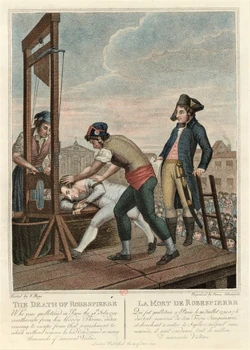
Max Robespierre | Made up Characters Wiki | Fandom
Execution of Robespierre


Other fates of the men involved included:
  • François Buzot - committed suicide in 1794. He would likely have been guillotined if he had not taken his own life first.
  • Étienne Nicolas de Calon - became mayor of Saint-Leu-la Fôret. He was a very old man at that point, as he had served Louis XV as a general; he had also voted for the execution of Louis XVI.
  • Jean-François Delmars - died in 1798 (at 47 years old) after having been committed to a mental institute.
  • Ernest Dominique François Joseph Duquesnoy - also committed suicide in 1795. He had just been found guilty and was sentenced to the guillotine.
  • Thomas-Augustin de Gasparin - died of gangrene in November 1793
  • Joseph-Pierre-Marie Fayau - was arrested but finally released in the grand amnesty in 1795. He returned to his native village where he was initially elected to a minor post before having his election overturned. He then died at just 33. 
  • Claude Dominique Côme Fabre - despite being a lawyer by trade, he was involved in the attacks on the French from the Catalonian coast. He was killed in battle and his widow awarded a pension by Robespierre 
  • Philippe-François-Joseph Le Bas - remained a loyal follower of Robespierre, even after his downfall. Committed suicide on 28 July 1794.
  • Jean-Paul Marat - assassinated by Marie Anne Charlotte Cordray d'Armont, an aristocrat with a vengeance 
  • Jérôme Pétion de Villeneuve - found himself with the tables turned when he was accused of wrongdoing following the insurrection of 2 June 1793. He fled the capital but was recaptured which prompted him to commit suicide.


There are clear indications that the men above were subjected to downright threats in the effort to force a verdict of guilty and punishment of execution. Several of those who refrained from sentencing clearly mention the "menacing" they experienced as well as the "tricks" employed; including perhaps physical threats (at least one referred to the threat of weapons). Louis XVI was seemingly quite right in assuming that his fate was already decided.

Thursday, 3 November 2022

The Queen's Trial: Charges Against Marie Antoinette

The trial against queen Marie Antoinette began on 14 October 1793; few, if any, had any reason to think that the sentence was not a foregone conclusion. In the preamble to the charges, the prosecutor referred to the ci-devant queen as the scourge of French people and proceeded to spew insults at her. The trial itself was a farce. The former queen and her lawyers were given less than 24 hours to prepare their defense - but what was she actually accused of?

The legitimacy of the trial itself was almost non-existent - consequently, it is not surprising that the charges laid against the accused was an odd mixture of actual, punishable offenses and gossip. Much of what was laid against her had already been circulating in the gutter press for years; but now, they were being used as a weapon in the legal system.


Marie Antoinette at the time of her trial

Financial treason

From the very beginning of her time in France, her very foreignness was considered deeply suspicious by both the courtiers and the commoners of France. The situation was completely paradoxical and entirely out of Marie Antoinette's own control; she was chosen as a bride for Louis XVI exactly because she was an Austrian archduchess yet her birthplace was continuously held against her.

Thus, the family relations of the now dethroned queen was considered to be grounds for charges of high treason. She was accused of forwarding several millions of livres from the royal treasury to her brother, Emperor Joseph II of Austria. She was also accused of spying on behalf of her brother, thus sending him intimate secrets of the French government. It was considered evidence that she had a frequent correspondence with her brother.

It says a lot that when the former Minister for War, Latour Dupin, was called on to testify he not only claimed to have no knowledge of the queen interfering with the king's politics but gave such vague answers when pressed that the prosecution had nothing further to go on. For instance, he was questioned as to whether the queen had continuously pressured the king for withdrawals from the royal treasury which he never confirmed. 


Massacre at Champs de Mars

This particular accusation was based on the massacre of Champs de Mars which occurred on 17 July 1791. It had just been decreed that Louis XVI would retain his throne but as a constitutional monarch which led to a massive demonstration on the field of Champs de Mars. About 50.000 people turned up and quickly descended into chaos. Two men had been accused of lurking about the ladies which led to them being hanged; immediately, the mayor of Paris, Jean Sylvain Bailly, declared martial law. Ironically, Bailly would later be executed for having acted with the queen to cause the massacre.

With the situation rapidly getting out of control, someone in the crowd fired a weapon. In response, the Marquis de Lafayette ordered his troops in the National Guard to use their weapons to regain calm. Some guardsmen fired their weapons directly into the crowd. As a result, some 50 people were killed. Lafayette further failed to calm the crowd as it returned to Paris.

But where was Marie Antoinette in this incident? No where near, in fact. She was imprisoned following the unsuccessful attempt at escaping to Varennes earlier that year. Yet, two years later, that very incident was laid at her door.

The argumentation resembled that used in the witch trials centuries before. It was claimed by Pierre Joseph Terrason, that when she was led back to the Tuileries after their escape attempt, the queen gave the surrounding guardsmen such an evil glance "which suggested to me the idea that she would certainly take revenge". As Terrason and the prosecutor argued, the following incident at Champs de Mars was a direct result of this "evil eye" being cast by the queen.

The official accusation directly state that she supposedly gave orders to the Marquis de Lafayette to open fire on the demonstrators; not only did he have no orders to do so, she could not have given any as she was not there.


Starvation

It is no secret that the people of France were in dire straits. Poverty was increasing and harvests were ever unreliable. Marie Antoinette was accused of actively causing her people to starve. There was no evidence to support such an accusation. In fact, occasional hunger was not uncommon during most of the 18th century. This was due to the fact that the majority of the population relied on the crops produced in agriculture. A poor harvest - or worse, several in a row - could ultimately result in outbursts of famine. 

In the official accusation against her, the prosecutor claimed that when the Widow Capet had arrived in Paris in 1789, there had been "plenty of everything" - hardly corresponding to the cries of the market women who had marched on Versailles. It was said that Marie Antoinette had used unnamed agents who worked in the capital to ensure that no one could get anything to eat.

Marie Antoinette at her trial by
François de la Roche

Encouraging an invasion

This charge was the only one which a semi-competent lawyer might have hoped to build their case around. It was said that the queen had actively invited foreign armies into France to help her and herself back on the French throne.

Earlier that year, she had written that only "foreign powers are the only ones who can save us now" - in the extremely tense atmosphere in Paris, such a letter would have been tantamount to high treason. Yet, she was never involved with any plan to hire foreign armies into France, let alone allow them to use violence against the common frenchmen. She knew full well that she had no influence over her brother, Leopold who had taken the throne of Austria-Hungary. In fairness, the two had never met and to him she remained a distant aunt. As she wrote herself, "my influence over him is non-existent" - even if she had wanted to, she could not pressured him into invading France. 

She was also accused of supplying foreign armies with the intimate details of the newly established republican army. It does not appear to have occurred to anyone that Marie Antoinette would have been the last person to know of such things, as the army was the creation of the new regime and not that of her late husband.


Plotting to kill the Duc d'Orléans

The king's cousin, the Duc d'Orléans, had voted for the death of Louis XVI earlier that year. Having allied himself with the revolutionary cause, he had allowed his wealth and properties to be used as a "head-quarter" for pamphlets, verses and rumours in the press. Styling himself Philippe Égalité, he thus represented a figurehead of a prince sympathising with the revolution; few would have guessed at the time that he, too, would end on the scaffold.

Philippe was therefore a popular figure in the capital. A woman by the name of Rene Mallet had worked as a maid at Versailles and claimed that she had overheard the queen talking of having the Duc d'Orléans assassinated. She even made the ludicrous claim that Marie Antoinette herself carried around two loaded pistols so that she might do the honours herself.


The queen pleading her case

Orgies

The queen had been the subject of numerous sexual accusations over the years. From lesbian affairs with her friends to numerous extramarital affairs, there was little she was not accused of. It seems absurd that a court of law would take any charge of the like into consideration; but, alas, that is what happened. As the leading lady of Versailles, Marie Antoinette was accused of personally organising orgies within the gilded halls of Versailles.

This was a continuation of the seemingly never-ending attacks on her moral character. It should be kept in mind that female sexuality was considered to be non-existent at the time. Any woman who exhibited preferences (of any kind) was considered to be unnatural or assuming a masculine role. Thus, the odd fixation on this particular subject was not funded on a mistrust of her personal preferences but rather making her appear abnormal, even disturbingly so.

It should be noted that the official list of charges confused "orgies" and "festivals" - it even uses them synonymously. The prosecutor referred to the fête held by the king and queen for the Swiss Guards in the mid-summer of 1789 during which the royal couple's health had been toasted. Despite it being before the march on Versailles of October, it was still considered treason that a tricolor rosette had been "trampled underfoot" - if that happened, that is.


Incest

Of all the accusations levelled against Marie Antoinette, the most vile was undoubtedly the one meant to dehumanise her the most: incest. She was accused of having sexually abused her own son, Louis Charles. The young boy, who had been removed from his mother, had even been used by his captors to incriminate his own mother. The story goes that his handler, a man by the name of Simon, caught the seven-year old masturbating and asked him who had taught him that. The little boy allegedly replied that his mother had; this led to a further interrogation during which the boy is supposed to have revealed a full violation committed by his mother who had sworn him to secrecy.

Louis Charles also implicated his aunt, Madame Élisabeth. He (allegedly) claimed that the two women had enjoyed watching him play with himself. It was the sole charge which Marie Antoinette did not reply to when interrogated. When pressured, she simply replied that she could not reply to a charge which nature itself found both impossible and abhorrent. She then applied to the women present in the courtroom who sided entirely with her - that was completely unexpected. The women present were not her friends; on the contrary, they would be cheering her execution a few days later. That alone goes to show that most realised this was a disturbing claim against a woman whose fate was already sealed.


And what of Louis Charles? For one, he was seven years old and had been separated from everyone he knew. His father had been executed, he had been literally torn from his mother's arms and he was not even allowed to see his sister. Considering the general mistreatment he suffered from his captors - which would eventually contribute to his death - it is far from unlikely that he either never made such accusations or did so because he was urged to do it. A child of seven cannot be said to understand the implications of what he was asked about; if there he did utter anything of the sort, it seems far more likely that he had finally found a subject which he would not be punished for talking about.

Several sources have pointed to the fact that Louis Charles was actively coached and encouraged by Hébert and his gaoler during this time.