Showing posts with label rivalries. Show all posts

Monday, 29 April 2019

The Duc de Vendôme vs. The Duchesse de Bourgogne

Louis Joseph de Vendôme had proved himself as a very capable military leader prior to 1709. However, the campaign of that year saw him share command with the young Duc de Bourgogne, the king's grandson. The two did not get along very well; together they failed to prevent the French military defeat at the battle of Oudenarde. 

While the young Bourgogne was away at war, his wife, Marie Adélaide of Savoy, was kept well aware of her husband's difficulties with the Duc de Vendôme. Consequently, she came to loathe Vendôme. Marie Adélaide could not influence events on the battlefield but she was in a supreme position to damage the Duc de Vendôme's position at court. Louis XIV absolutely doted on his granddaughter-in-law and she could use that affection to undermine her husband's rival.

The way in which the Duchesse de Bourgogne handled the situation was a masterpiece of skillful maneuvering within the structure of the court of Versailles.

The winter break of 1708 that followed the disaster at Oudenarde, saw both the Duc de Bourgogne and the Duc de Vendôme return to Versailles. Prior to the latter's return, the seeds for his downfall had already been laid. Even though Louis XIV received his defeated general warmly enough, there was still a sense that something was about to happen. The first obvious sign came when the Duc de Vendôme offered a general invitation to his estate of d'Anet. However, those around him excused themselves which had not happened hitherto. Still, Louis Joseph went to the château d'Anet where he sojourned over the winter before returning to Versailles. Once he returned to Marly and the king's side, it was noted that the Duc de Vendôme failed to pay his respects to the Duchesse de Bourgogne who was officially the highest-ranking woman at court.

Billedresultat for duc de vendome
Louis Joseph, Duc de Vendôme

Being invited to the private estates of Marly and Meudon was an immense privilege and one which  the Duc de Vendôme had enjoyed for years. The Duc de Saint-Simon gives us an insight into a situation in which the young Duchesse de Bourgogne used her influence to thwart the Duc de Vendôme. The Grand Dauphin were playing brelan with both the Duc and Duchesse de Bourgogne at Marly one evening and requested a fifth player. For this purpose, he sent for Louis Joseph. Marie Adélaide immediately implored her father-in-law not to make her play with Vendôme as it was already a trial to her to be in the same room. The Grand Dauphin obliged and filled the seat with someone else - however, no one informed the Duc de Vendôme. Once he arrived, he found his seat taken and had to make the embarrassing walk back through the room.

According to Saint-Simon, the Duchesse de Bourgogne sought to further prevent the Duc de Vendôme from being in her presence. She turned to Madame de Maintenon - also an enemy of Louis Joseph - who in turn asked Louis XIV to omit the Duc from their visits to Marly. By this time, several squabbles over military failures (not just with Bourgogne) had made Louis tired of Vendôme and he agreed. The message was delivered to Louis Joseph by a valet.

As could be expected, the Duc de Vendôme was furious at this snub. Yet, he knew that the Grand Dauphin was still a friend to him. Although being barred from Marly was a humiliation, he could try to safe face by spending more time with the heir to throne. His open invitation to Meudon also proved to be an opportunity to get back at Marie Adélaide.
The Duchesse de Bourgogne almost always visited her father-in-law while he was at Meudon. Knowing that the master of Meudon was the Grand Dauphin - and not the king - Louis Joseph made sure to be present as often as possible. Etiquette demanded that he presented himself to both his host and the Duchesse de Bourgogne. Consequently, he could irritate her by showing that while she had managed to ban him from Marly, she had not done so from Meudon - yet.

One day, the Grand Dauphin was at Meudon with the Duc de Vendôme when the king, Madame de Maintenon and Marie Adélaide paid him a visit. Louis Joseph took the opportunity to "present himself" to the king and his granddaughter-in-law. Apparently, Marie Adélaide did not expect him to be there and she turned her head away - a great insult. Despite this, the Duc de Vendôme tried his luck again that same evening by approaching Marie Adélaide but with the same result. As a result, he turned on his heel and left the room.

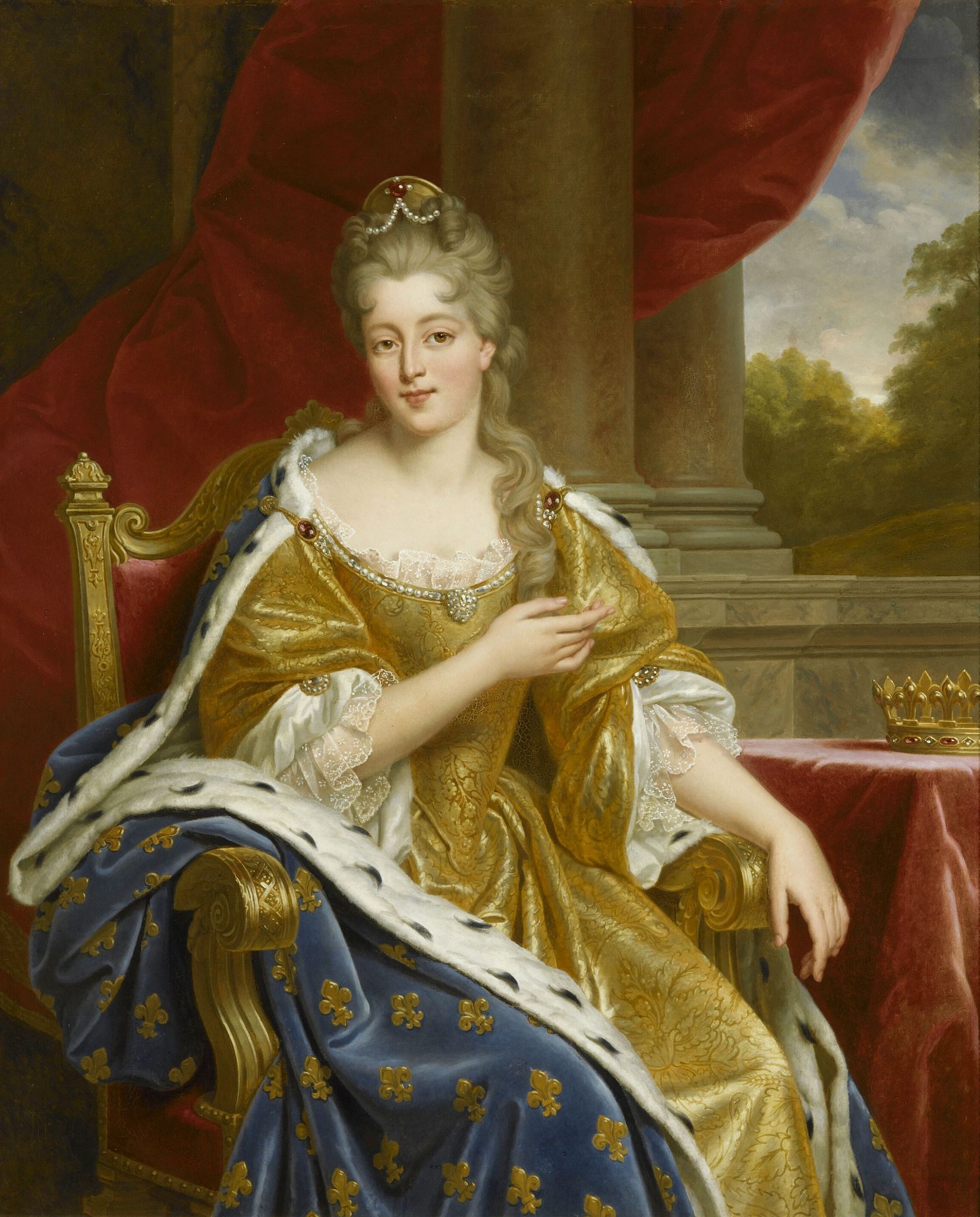
Marie Adélaïde of Savoy as depicted circa 1697 (wearing Fleur-de-lis as Duchess of Burgundy) by a member of the École Française.jpg
Marie Adélaide of Savoy


Marie Adélaide took advantage of his absence and complained to both the king and Madame de Maintenon. She appealed to both the hierarchy and the affection of the king. She pointed out that while the king had respected her discomfort and barred Vendôme from his private retreat, the Grand Dauphin had not done so.

Naturally - considering they were literally under the same roof - the Duc de Vendôme heard of this and immediately went to the Grand Dauphin. He complained that he was being prosecuted by the Duchesse de Bourgogne. He received little reassurance from his friend who would at most say that he could continue to visit Meudon but he must avoid the Duchesse while she was still at odds with him.

The very next day, the final blow was delivered by the Duc d'Antin. He had been sent from Versailles (where the king and his entourage had returned to) to inform Louis Joseph that the king had asked the Grand Dauphin to no longer admit Louis Joseph. In an absolute fury, Louis Joseph up and left Meudon immediately.

And that - as it happened - turned out to be the end of the Duc de Vendôme's career as a courtier. Understandably, he made himself scarce and even refrained from returning to Versailles. He was shunned by those who feared a similar fate and he would die three years later - ironically, the same year as the Duchesse de Bourgogne.

Friday, 22 June 2018

Olympe Mancini vs. Louise de La Vallière

The dispute between Olympe Mancini, Comtesse de Soissons and Louise de La Vallière could be traced back to a plot on the former's behalf that happened to backfire. Olympe herself had been a mistress to Louis XIV but - to her great chagrin - had never managed to take the title of maîtresse-en-titre. Olympe had then allied herself with Henrietta of England, wife of Philippe, Duc d'Orléans. Rumour had to that the king and his sister-in-law were throwing glances at each other which deeply disturbed Anne of Austria. In a ploy to distract the queen mother from this relationship (which was likely not physical at all) Henrietta and Olympe placed three young women in the king's path: including La Vallière.

The plan was that one of these ladies would serve as a smoke-screen while Henrietta and Louis could continue their friendship. But something went wrong and Louis fell in love with the decoy. Olympe was furious; Louise had taken the very place that she had hoped to finally claim as her own. From the moment when Louise became the king's mistress she had made an enemy for life. 

Billedresultat for louise de la valliere
Louise de La Vallière

For Olympe it was a massive blow. She had always had a mind for intrigue and had quickly secured the prestigious post of superintendent of the queen's household for herself. This had given her considerable access to the king and it is not to be said what their relationship could have become if La Vallière had not "interrupted" them. 
Olympe set about finding new allies and did not have to search for long. The Comte de Guiche - a notorious womanizer (and "manizer") - had previously attempted to add Louise de La Vallière to his list of conquests but she had refused him. His ego was wounded and for this he sought revenge. Another was the Marquis de Vardes who - like Olympe - had a natural taste for intrigues.

The plan was to destroy the atmosphere of secrecy which had hitherto shielded the royal romance. The thing was that while the whole court knew about the king's first official mistress there was one very central person who did not: his queen. Marie Thérèse had lived a very sheltered life since she arrived at the court of France and was not included in her court's more private sphere. While she was not unaware of her husband's wandering eye per se she did not know that they had fixed themselves quite so steadfastly on another woman. 

Olympe and her clique hoped that by informed the queen of her husband's mistress it would create such discord that the affair would simply die out. The means of delivering such news was via an anonymous letter. H. Joel Williams claims that Olympe had gone so far as to steal a letter from the queen's mother in order to copy her handwriting. This would ensure that the letter reached the right recipient. Naturally, it was written in Spanish since the new queen of France did not master the French language. 
However, it failed. Rather than reaching the queen it ended up in the hands of one of her companions. Donna Molina had accompanied her mistress to France and was very close to the queen. She was also aware that the queen's father had been ill for some time and opened the letter to prepare her mistress for any ill tidings. When she read it she immediately sent it to the last person the conspirators could have wished to see it: the king. 


Billedresultat for olympe mancini
Olympe Mancini

The plan had been a failure but Olympe was not one to be deterred. Instead, she came up with a new plan. If a new, beautiful woman could replace herself in the king's affection then surely another woman could do the same to La Valliére?

An ideal opportunity presented itself. Louise de La Vallière would be spending the summer at Chantilly whereas Louis XIV received the exiled-Queen of England at Saint-Germain and spent the time with Henrietta. It was a perfect chance since Louis was quickly looking for something to entertain himself with. 

Mademoiselle de La Motte-Houdancourt was a fille d'honneur to the queen and managed to catch the king's eye. What the king did not know was that the young mademoiselle was being used as a tool by Olympe Mancini. Olympe instructed the young woman to refrain from giving in to the king immediately and it worked. It should be said that Mademoiselle de La Motte-Houdancourt was not an innocent pawn; she had plenty of ambition and had dismissed a suitor in the shape of a Comte when the king came knocking. This plan seemed to work a great deal better than the previous one had. Mademoiselle de La Motte-Houdancourt was all but ready to give in when she delivered her one and only condition - as demanded by the Comtesse de Soissons: that Louise de La Vallière was to retire. 

At first the king was somewhat hesitant but Olympe Mancini realized that the strategy of denying the king his wishes had worked quite well so far. This prompted her to convince her protégée to hold on just a bit longer. It almost worked - almost.

Just when it seemed that the king was about to cave in and dismiss his mistress it all came crashing down. It would seem that neither the Comtesse de Soissons nor the Comte de Guiche or the Marquis de Vardes had taken the queen mother into account. Anne of Austria kept a close eye on her son and was not pleased with what was going on. She distrusted the young Mademoiselle de La Motte-Houdancourt and recognized her stark ambition; in contrast Louise de La Vallière was at least not greedy.

Guy Armand de Gramont.jpg
The Comte de Guiche

Anne of Austria had her servants keep taps on the Comtesse de Soissons and her entourage and it paid off. A letter was apparently intercepted in which it became quite clear that the real architect behind the whole affair was Olympe. According to some sources the letters from Mademoiselle de La Motte-Houdancourt were not even written by her; they had been copied by a friend of Olympe's. The king was furious. He had been publicly led by the "nose" and immediately abandoned the would-be mistress, La Motte-Houdancourt.

Somehow, Olympe Mancini escaped the royal wrath in this round but she had lost all chance of ever getting the king back. As if that was not bad enough, just three years later the king found out that she as well as Vardes and Guiche had been behind the letter to the queen. As can well be imagined the king's perception of Olympe was not good. It was about to turn a great deal more dire for the Comtesse de Soissons.

By 1679 she faced a new challenge. The Chambre Ardente - the court set up to tackle the epidemic of poisoning at court - charged her with attempting to poison Louise de La Vallière. The result was an exile to Spain.

In the neither can really be said to have won. Louise de La Vallière had never had any personal grudge against Olympe but nevertheless found herself the target of a potentially lethal rivalry. While Olympe's attempts at dethroning La Vallière were unsuccessful, La Vallière's fate was not particularly good either. She would continue to struggle with her religious beliefs and how her behavior went directly against it. Further, she was soon to be replaced by Madame de Montespan whom she would be obliged to wait upon. 

Sunday, 16 July 2017

Madame de Pompadour & the Prince de Conti

The animosity between Jeanne-Antoinette de Poisson and Louis Francois de Bourbon began from the moment that Madame de Pompadour was introduced as royal mistress. 

The first real "sting" came about quite without intent. Madame de Pompadour frequently put on small theatrical performances in the king's private apartment to divert the melancholic king. The thing was that only fifteen people could be admitted due to the room's size. In 1747 - when these plays were well under way - the Prince de Conti was amongst those excluded from the parties. This prince was particularly proud of his Bourbon-blood; the thought of not merely being excluded but being excluded by a bourgeoisie was intolerable.

This matter of rank was most likely what really turned the Prince de Conti against Madame de Pompadour. During her first time at court in 1745 the marquise had been able to charm everyone - except Conti. To him it was not an issue that she was the king's mistress (after all there had to be one); the sore spot was that she was not born a noblewoman.


Prince de Conti

From this point on their relationship went downhill fast. Before, Louis Francois had been a close associate of Louis XV; the king would refer to him as his favourite cousin. The Prince's dislike of the mistress was not unknown but still somewhat contained. That would come to change. 
Gradually, this changed and Conti naturally placed the blame with Pompadour. However, the Prince de Conti was not adverse to slander himself. He was one of the few who worked in the Secret du Roi which handled extremely confidential cases; he took great advantage of the marquise's being barred from there to attempt to turn Louis XV against her.

These secret meetings was a cause of great annoyance to the royal mistress. It certainly did nothing to ease the relationship with the Prince de Conti; every time she saw him coming and going from the king's chamber with a mysterious air it stung.

Louis XV's disinterestedness in such squabbles hardly made tensions any lighter. In 1752 Madame de Pompadour was granted a tabouret and the honours of the court. This included a formal presentation to the royal family - although they had all known each other for years. For some unknown reason, Louis chose none other than the Princesse de Conti to make the presentation. She had also been the one to present Jeanne-Antoinette in 1745; her husband's dislike of the new-comer apparently did not spread.

One of the greatest clashes between the two played out against the background of the Seven Years' War. As a Prince of the Blood and a favourite of Louis XV it was assumed that Conti would be given sole responsibility for the French army in Flanders. However, he instead had to share command with the Marèchal de Saxe. The two men quarreled constantly and both sought prime command. 
When the Comte de Stainville - a follower of Conti - arrived at Versailles on 4th August 1746 to deliver the news of the fall of Charleroi, the question of command arose again. Madame de Pompadour made it clear that she favoured the Marèchale. In fear for his career the Prince de Conti immediately left his post and returned to Versailles. Here he found little obvious grounds for concern. Louis XV was as smiling as always and the two remained closeted for hours.


Madame de Pompadour

The great finale came in 1756. With an increasing coldness from his royal cousin's side, the Prince de Conti became a threat to the monarchy itself. In an attempt to gather support from the Parlements as well as the Prosestants he suddenly posed a threat to Louis XV's throne. This was the final drop for their friendship. The Prince was stripped of his position in the Secret du Roi with the marquise's backing.

When Damiens attempted to assassinate the king in 1757 Madame de Pompadour cast suspicious eyes on her long-time rival. Although she could not prove a connection it was not completely unlikely. Through all their years of in-fighting the two rivals had continually opposed the other's political aspirations. The marquise prevented the prince from getting the promotions he desired, and the prince in turn did his utmost to destroy her reputation.

Following this year the Prince de Conti was not very welcome at Versailles. His hatred of Madame de Pompadour - and probably hers for him - was at an all-time high. He would continue to spread demeaning verses and caricatures; in 1760 he saw a chance of denying the maitresse a wish. She had cast longing eyes at the vineyard of La Romanée. Promptly, the Prince de Conti laid down twice the estimated worth of the vineyard. To mark his acquisition he added his name to it making it La Romanée-Conti. Today, the vineyard produces the most expensive wine in the world.


The vineyard bought by Conti

The conflict with Madame de Pompadour had cost the Prince de Conti dearly. He could have had a chance of becoming king of Poland but it is speculated that she had a hand in tipping the scales against him. However, this is only guesswork. 

When Madame de Pompadour died in 1764 the Prince de Conti was still in disgrace. He may have outlived his rival but her death did not bring about a return to favour. Instead, Conti outlived Louis XV too and died in Paris in 1776.

Thursday, 2 February 2017

Cardinal Fleury and Madame de Prie

The rivalry between Cardinal Fleury and Madame de Prie took place within the uppermost halls of power. It could be argued that Cardinal Fleury's actual rival was Madame d Prie's lover, the Duc de Bourbon, since it was he who took the official beating. However, the Duc de Bourbon was completely under the sway of his mistress during his tenure as Prime Minister and from the memoirs of the time it would seem that the Cardinal had no real issue with the Duc. Madame de Prie, though, was another matter.

Cardinal Fleury was appointed as tutor to Louis XV when he was still only a child in 1715. Throughout the regency the relationship between the boy-king and his tutor grew stronger and the Cardinal was widely known to exercise a great deal of influence over his protege. When the Regent died in 1723 Louis XV was technically of age and as such could rule by himself had he wished so. However, since the King was still young and inexperienced it was thought better to appoint a Prime Minister - this had been the case before Louis XIV began his absolute rule.


Cardinal de Fleury by Rigaud.jpg
Cardinal Fleury

At first it was generally anticipated that Cardinal Fleury would take advantage of his close relationship with the King but the court was soon to learn of its mistake. Being already an elderly man of seventy years the Cardinal declined the position for himself but he was eager to preserve his influence with the King. He appointed Louis Henri de Bourbon-Condé, Duc de Bourbon but the appointment was rather more due to habit than personal preferment. It was traditionally a Prince of the Blood - or a Cardinal - who held the position and as the eldest Prince of the Blood the Duc was appointed.

As the Duc de Bourbon's official mistress Madame de Prie suddenly found herself in a position where she could have immense power. She certainly did not intend to let the opportunity pass her by and over the next months it was a widely known fact that she was mistress. It should be noted that she was not completely blind to the influence exerted by the Cardinal over his pupil. She especially resented that the Cardinal had conditioned granting the post of Prime Minister to the Duc de Bourbon on that he would never discuss state affairs with Louis XV without the Cardinal's being there. To effectively lessen the influence wielded by the Cardinal she attempted to remove this condition.

In December 1725 she attempted to cut the bond between them by staging a coup. To achieve her end Madame de Prie ruthlessly played upon the new Queen Marie Leszczynska. The Queen was tricked into playing a part (Louis XV felt immensely betrayed and never let her into politics again); the Duc de Bourbon would entreat the Queen to call for the King - who was with Fleury at the time. Louis XV duly arrived at his wife's apartment where he found the Duc de Bourbon. In this manner Madame de Prie managed to keep the three closeted together without the Cardinal.
However, Fleury knew well how to manage such an attack on his power. Previously he had found that Louis XV needed him by his side and by depriving him of that the Cardinal could avoid being barred from power. Writing a note stating that he would never return to court he left for the convent of Issy; it was only the next night that the note was actually given to the King who immediately became distraught.


Madame de Prie

In the end the Duc de Bourbon could not convince the King that he could indeed do without the Cardinal and the victorious Fleury could return. Now that he was back and as much in power as ever Cardinal Fleury set out to remove Madame de Prie.
The only way that Madame de Prie could be removed was to sack her lover. This was not something that Fleury was eager to do, though, and he repeatedly asked the Prime Minister to leave his mistress. This never worked. Madame de Prie herself was actually not at Versailles at the point - having chosen to spent some time in the country when Fleury returned - but she sensed the danger and returned like a whirlwind. Louis XV was not ready to formally dismiss the formidable Madame de Prie and she remained at court longer than Fleury would have liked. Feeling confident since she had not been sent away by the King Madame de Prie retook her place as uncrowned Prime Minister. Fleury urged the King to act upon this encroachment of power and he finally consented.

Consequently, the Duc de Bourbon would receive a frosty note from his master that he was deprived of his post and was to go into exile immediately. Likewise, Madame de Prie was sent from court to spend her exile in northern France. This would be the last Versailles would see of her; Madame de Prie committed suicide the next year.

Saturday, 9 April 2016

Elizabeth Charlotte d'Orléans and Madame de Maintenon

Elizabeth Charlotte of the Palatinate had been established as Madame at the French court for some years when Madame de Maintenon suddenly usurped Madame de Montespan's place as royal favourite. To the courtiers this change marked the beginning of a gloomy time at court with no entertainment and little to do other than attending Mass. To Elizabeth Charlotte it was a catastrophe; she had never liked the strict and austere governess and was loath to see her rise so high.

It is mainly through her letters and memoirs that one finds Elizabeth Charlotte's honest opinion on the King's last mistress. Describing her mainly as "the old woman" the Duchesse d'Orléans does not shy away from naming her adversary even harsher terms - "the piece of filth" is another reoccurring name. On one occasion Liselotte (as Elizabeth Charlotte was nicknamed) writes on the death of an acquaintance that she would have been far more pleased if it had been Madame de Maintenon who had gone.

Madame de Maintenon

Madame de Maintenon herself was not any fonder of the King's sister-in-law. Whenever the royal family went to Marly she made sure that Elizabeth Charlotte never received an invitation to walks around the grounds with the King. This trick of keeping the King away from was one generally used by Madame de Maintenon. Whereas Louis XIV had hitherto liked his sister-in-law for her brash and honest ways his attitude towards her drastically changed for the worse when Madame de Maintenon came along.

One particular incident which permanently ensured that the two would never see eye to eye was the marriage of Elizabeth Charlotte's son. The German-born Liselotte was a very proud woman and knew what was due to both herself and her offspring. Consequently, when it was rumoured that the King intended to marry her son to one of his bastards, Mademoiselle de Blois, she was furious. Madame de Maintenon had always supported the King's illegitimate children and continued to do so in this case. It soon was obvious that the King's favourite was a great supporter of the match which nothing seemed to be able to prevent. In the end the marriage did take place but Elizabeth Charlotte never forgot or forgave Madame de Maintenon for her role in the matter.

Elizabeth Charlotte, Duchesse d'Orléans

Another thing that rubbed Elizabeth Charlotte the wrong way was the social standing of Madame de Maintenon. Liselotte was convinced - as was the general world-view - that the ranks were separated for a reason and for royalty to marry beneath themselves was an utter disgrace.

It has been suggested that Elizabeth Charlotte was in love with Louis XIV which could be another reason for her dislike of the favourite. However, there is little to suggest that Elizabeth Charlotte actually was in love with the King.

After the death of Elizabeth Charlotte's husband, the Duc d'Orléans, there was an attempt at a reconciliation between the two. Different sources varies as to exactly who initiated the meeting but nonetheless it was to happen. The meeting took place in the apartment of Elizabeth Charlotte where the two both sat down in the presence of Madame de Ventadour who witnessed the whole exchange. The interview went back and fourth and in the end the two agreed to forget the past and be friends from there on - however, it is unlikely that they became close.
 

Monday, 26 October 2015

The Duchesse de Bourbon and the Duchesse d'Orléans

It was easy enough to find rivals at Versailles with countless factions and families betraying each other for minor favours. That is why it would seem quite odd that some of the fiercest rivals would be within the same family - unless there is a specific reason.

For an illegitimate child it was impossible to know exactly where you stood at court. There was no title to inherit and no official pedigree to lure in possible suitors. That was especially true for the King's illegitimate children. Two of his children by Madame de Montespan became fierce rivals already from their early adolescents and their competition ended only with their deaths.

Louise Françoise

Louise Françoise de Bourbon and Françoise Marie de Bourbon were both born on the wrong side of the sheet. Luckily for them their father was Louis XIV and he was determined to see all of his children succeed.
The two sisters' rivalry began with one of the most important alliances a young noblewoman could make: marriage. As the eldest, Louise Françoise was married off first at the age of 11; her bridegroom was Louis de Bourbon, Prince de Condé and later Duc de Bourbon. So far so good. Louise Françoise and Françoise Marie's relationship might have been a whole lot better had not Louis XIV decided to shock his court. Despite being a younger sister Françoise Marie was married to one of the most eligible bachelors at court: Philippe II d'Orlèans. As the son of the King's own brother he would one day become Regent.

To sum up Louise Françoise became the Duchesse de Bourbon and Françoise Marie became Duchesse d'Orlèans.

Daughters of Louis XIV and Madame de Montespan,Louise Francoise Princesse de Conde  the elder daughter is on the right with Francoise Marie Duchesse dOrleans on the left:
Louise Françoise (left) and Françoise Marie (right)

The latest match also meant that besides wounded pride there was a whole new sting of "insults" to Louise Françoise. First of all, their august father handed Françoise Marie a dowry twice the size of what had accompanied Louise Françoise into her marriage. Second, Françoise Marie now out-ranked her elder sister which meant that she took precedence at court.
To add salt to the wound it was well-known that Françoise Marie was Louis XIV's favourite daughter.

When Louise Françoise's father-in-law died in 1709 she stood to become First Princess of the Blood due to her marriage. However, the title was transferred from the House of Condé to that of Orlèans - in other words to Françoise Marie! Even though the latter never actually styled herself as Madame la Princesse it was a thorn in the side of Louise Françoise.

Françoise Marie as Duchesse d'Orlèans

Several years later another nail in the coffin of their relationship was firmly in place. Charles, Duc de Berry (son of the Grand Dauphin) was still unmarried and quite the catch. For a while it was rumoured - and practically expected - that he would marry the daughter of Louise Françoise. However, Françoise Marie quickly stepped in and snatched Charles up as a bridegroom of her own daughter!

As if the lucky star of Françoise Marie had not blinded Louise Françoise enough worse was yet to come. When Louis XIV died in 1715 Philippe II d'Orlèans was made Regent - consequently Françoise Marie was now the highest-ranking woman in France which was the closest thing to being Queen anyone could come.

Saturday, 24 October 2015

Madame de Montespan and Isabelle de Ludres

No one challenges the King's mistress. Few rules were as clear as this one but occasionally someone would forget it.

Even though the King already had his official maitresse-en-titre this was no reason as to now have more casual liaisons once in a while. Since a relationship with the source of power itself could be very advantageous it is no wonder that the then reigning mistress Madame de Montespan was eager to keep any potential rivals at bay.


Madame de Montespan

Isabelle de Ludres was one such rival. Her affair with Louis XIV began in 1675 but it not to be a threat to Madame de Montespan. By all appearances Louis XIV made it very clear that the affair was to remain a secret - perhaps the immense temper of his favourite was a deciding factor in that.

However, Isabelle de Ludres simply could not resist the temptation and quickly spread the news of their affair. That would have been a nuisance at best but Isabelle made her final mistake when she publicly declared that the King loved her more than Madame de Montespan.

Isabelle de Ludres

Angered by such arrogance Louis XIV sent her packing in 1678. While Madame de Montespan continued her reign as royal favourite for some years to come Isabelle de Ludres first went to a convent and was eventually given a marquisate. But her dreams of ever replacing Madame de Montespan as royal favourite was thoroughly crushed.

Marie Antoinette and Madame du Barry

One of the most infamous rivalries of Versailles is undoubtedly that of the then Dauphine Marie Antoinette and the King's maitresse-en-titre Madame du Barry.

The rivalry was brought on due to several circumstances. When Marie Antoinette arrived at Versailles she had no knowledge of how common it was for Kings and Emperors to take mistresses. Her own father had had several but she never saw or heard of them so she left Austria without any idea of that sort of relationship. Once established at Versailles it is easy to understand why the first shock at the favourite's actual relationship with the King was strengthened. Eager to please her husband Marie Antoinette immediately caught on to Louis Auguste's immense dislike of Madame du Barry; a dislike shared by his aunts whom Marie Antoinette saw every day.
From Madame du Barry's point of view pride certainly had the lion's share of her side in the conflict. Also, though eagerly engaged in politics Madame du Barry seemed to be unable to understand that the woman she was so openly against would one day become Queen.

Marie Antoinette at the time of her wedding -
this portrait was actually sent to Louis XV for
his approval of her as Dauphine 

In the days following the wedding of Marie Antoinette and Louis Auguste several theatrical performances had been ordered by Louis XV. As the King's undisputed favourite Madame du Barry was guaranteed some of the best seats for her and her attendants. However, when the Comtesse arrived a couple of ladies-in-waiting - including the Duchesse de Grammont who happened to be the sister of the Duc de Choiseul - to the Dauphine had taken their seats and refused to budge. As if this was not bad enough the ladies insulted the royal favourite as well. Understandably upset at such a treatment Madame du Barry went straight to the King who - for once - took action and exiled the Duchesse de Grammont.
Whether Marie Antoinette knew of the particulars concerning her lady-in-waiting's disgrace is unknown but she was aware that it was Madame du Barry who had cost her a companion. This hardly improved their relationship.

This triumph of Madame du Barry was soon turned into one of Marie Antoinette. When that same Duchesse's health deteriorated rapidly it soon became clear that she needed the expertise of the Parisian doctors. However, Madame du Barry was unable to let go of the grudge she held towards the Duchesse and would have prevented her receiving the necessary treatment if she could. But Marie Antoinette cleverly appealed to Louis XV's sentiments when she remarked that besides the injustice and unkindness such a situation would create it would be a great unhappiness to herself if one of her household was to die while still in disgrace with the King. That did the trick and the Duchesse de Grammont returned to Paris.

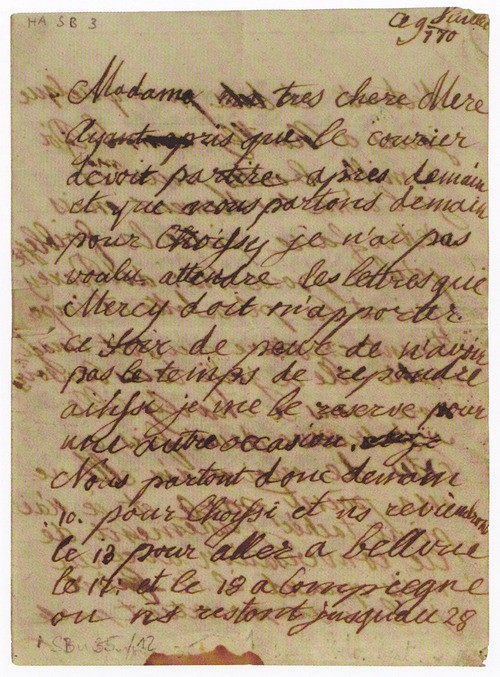
Letter of Marie Antoinette to her mother Empress Maria Theresia
of 9 July 1770 in which Marie Antoinette describes Madame du
Barry as the stupidest creature she ever met

Some time later the faction which Madame du Barry was a fervent supporter of (the d'Aiguillon faction) finally succeeded in having the Duc de Choiseul dismissed. Marie Antoinette was devastated. It had been the Duc de Choiseul who had brought about the union between France and Austria and to the young (and lonely) Marie Antoinette he was the only political friend she had. Madame du Barry made no attempt at hiding that she had indeed been instrumental in bringing about the minister's fall.

As it was quickly apparent to Madame du Barry that she would not become a friend of the Dauphine she apparently decided to simply stop trying. Despite her otherwise calm nature Madame du Barry was often heard mocking and insulting the Dauphine even in the presence of the King. These cutting remarks might have been ignored by the Dauphine - who due to the utter lack of secrecy at court knew all about them - had they not touched a nerve. Madame du Barry often commented on the unconsummated state of the Dauphine's marriage which struck at the heart of Marie Antoinette's personal problems.

Detail of Marie Antoinette playing the harp during one of those balls that
Madame du Barry was barred from

So far Marie Antoinette had excluded the royal favourite from her private balls. Since these soirées were not only socially delightful but an honour Madame du Barry soon complained to the King. Louis XV approached the Dauphine who delicately said that she could hardly invite the Comtesse since the King's daughters (Mesdames Tantes) were always invited. Everyone knew of Mesdames Tantes' strong dislike of their father's newest mistress and since Louis was ever frightful of creating embarrassment he agreed with the Dauphine.


A rather scandalous episode occurred one afternoon while Marie Antoinette and the Princesse de Lamballe was taking the air in one of the inner courtyards. The two ladies narrowly avoided being hit by the contents of a chamberpot being emptied from the attic-apartment of Madame du Barry. While there can be little doubt that Madame du Barry herself did not do it and that the serving girl who did probably did not see the two, it still made plenty of good gossip.

Madame du Barry
Empress Maria Theresia of Austria was very well aware of her daughter's feud with the King's mistress and she was not pleased. Since Marie Antoinette's marriage was still unconsummated the young Dauphine was in a dangerous position; non-consummation was a valid reason to annul a marriage. To the Empress it was vital that Marie Antoinette did not make her position worse by insulting the King and she continuously demanded that Marie Antoinette ended her silent treatment. With the formidable letters from her mother as well as the constant pressure from the Austrian ambassador Marie Antoinette finally caved in.
On 1 January 1772 she made the following remark to the Comtesse:
"There are a lot of people today at Versailles"

This remark was short enough in itself but it was all that was needed. Being made in full public it was a triumph for the Comtesse who was not allowed to address the Dauphine herself. Ambassador Mercy-Argenteau was quick to praise Marie Antoinette but she made it very clear that she would never talk to her again.
Nonetheless, the King was pleased and for a short while Marie Antoinette received a short break in the stinging letters from her mother.

The rivalry officially came to a close in 1774 when Louis Auguste became Louis XVI and Marie Antoinette became Queen. One of the first acts of Louis XVI was to exile the former favourite from court and ordered her to spend time in a nunnery. Madame du Barry was never allowed back to court.

In a stroke of tragic irony both Marie Antoinette and Madame du Barry would end their lives by the guillotine.