Showing posts with label hygiene. Show all posts

Thursday, 5 July 2018

Courses, Terms, Flows: Menstruation in the 18th Century

To modern women the concept of a period can be irritating, painful and uncomfortable but we do have the advantage of modern sanitary pads or tampons. But what did the women of Versailles do; as a reader quite rightly pointed out: they wore no underwear! Or, rather, they wore no panties. Another thing we have is a far greater understanding of hygiene and the human body - particularly the female.

The doctors of the time still relied on the teaching of the humours of the body. It was considered common knowledge that women were prone to "hysteria" which was often thought to be a cause of the "female emotions". Thus, doctors considered the period to be nature's own way of attempting to right the wrong by letting out some of all that excess blood. After all, the same doctors had no hesitation when it came to tapping their patients for large quantities of blood. As it happens the prevailing perception was that a man could enjoy the "health benefits" of a period if he was blood-let.
There were doctors who claimed that the monthly flow actually protected a woman's health. In the 18th century doctors were baffled as to why women seemed to be less likely to fall victim of a sexually transmitted "pox". Eventually, they concluded that viruses could be carried out of a woman's body via her menstruation blood.

Relateret billede
A woman cleaning her nether parts -
probably very much needed during those days

Interestingly, there seemed to have been a clear distinction between the perception of the period as a bodily function and the blood itself. As mentioned, it was considered healthy for a woman to bleed - it was even in accordance with divine order. The blood was a whole other matter. For centuries period blood was seen not only as foul but almost dangerous. One of the more extreme superstitions was that a woman's period blood could spawn nothing less than a demon. Others were that if a woman came into contact with another woman's blood she would miscarry; a dog would instantly lose its mind.

It should be said that by the early 18th century such theories were widely disregarded. One such dissenter was John Marten whose book of 1708 strongly rejected such nonsense as "ridiculous and foolish fancies" and that they had no "foundation of truth or reason to support them".

The humoral theory also led to the belief that a woman's menstrual flow was directly affected by a wide array of external and internal factors. These included the more logical ones like the woman's age or general health but also covered the more abstracts ones such as her temper. Dancing - for one - was considered to possess the power to either spontaneously spark the flow or make it heavier.
One thing that was understood was that no all women bleed the same. The doctors were rather perplexed by this and it made it even more difficult to predict for the individual woman.

What makes this particular subject difficult to examine is the taboo and often twisted perceptions that had been dodging the female flow for centuries. Most people today would agree that a woman's period is her own business and not necessarily something openly discussed or asked about - but the majority of the Western world no longer links a woman's period to downright superstitious happenings or divine punishment. 
Billedresultat for 18th century chemise
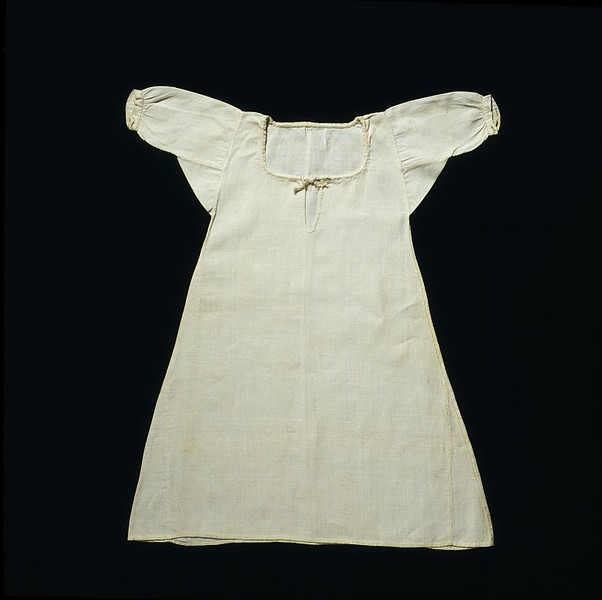
With white chemises such as this one even minor bleeding
would easily show

The idea of using fabric to absorb the liquid occurred early on. We know that ancient Egyptians used a sort of papyrus and the tip was apparently handed down through generations of women - and developed. By the 18th century French women would often take a piece of linen and dip it in vinegar. As it happens the women of Versailles would never experience anything similar to a commercially produced sanitary pad - these only appeared around 1880.
The taboo of a female menstruation was further enhanced by being connected to the only area of medicine that was largely left to women: midwifery. It was not until the 18th century that men began taking a closer interest in what exactly happened. 

However, not all women used sanitary pads. For instance, the women of the peasantry rarely had something as luxurious as meat or food products high on iron. Especially during the winter when their diets became even more restricted it was not uncommon for women to cease menstruating. The same could be said for nuns who lived particularly cloistered lives and whose religious way of life often brought a meagre diet with it. 
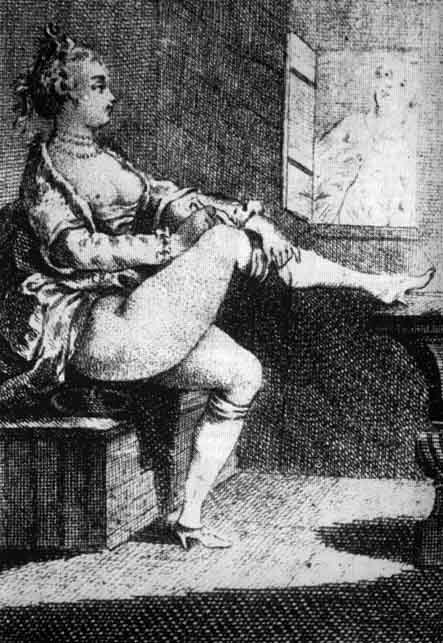
Unlike today, there seems to have been an understanding that a woman whose flow was light could go without the linen. A book on midwifery by Pierre Dionis from 1719 compares these women to "those who are forced to use Linen-Cloths". Likewise, it was not unusual for women to bleed on their chemises; one can only imagine how hard it was not to considering the aforementioned lack of panties.

Billedresultat for menstruation 18th century
An 18th century woman whose raised skirt
clearly shows the lack of any type of
panties

As it happens, it was not only the blood that caused some head-scratching; the accompanying odour was a bit of a conundrum in itself. Some sources claims that the very scent of a woman's period acted as an aphrodisiac while others mentions how women would wear nice-smelling herbs to overshadow the scent.

For the women of Versailles the period was a beast with two heads. On one side it was a subject not to be talked of, something similar to a secret between women that men did their best to pretend not to know about. On the other it was vital to the hierarchy and succession. The queen and dauphine's sheets offered obvious signs of whether an heir could be expected - or whether the regal lady had failed in her dynastic duty. Undoubtedly, the high-quality sheets of Marie Antoinette caused her a great deal of pain until the birth of her first child. The tell-tale signs would often figure in her letters to her mother and with an increasing guilty tone. Maria Theresia demanded that all her daughters provided her with a detailed account of their "Générale" which must have been unpleasant in itself.

Marie Antoinette suffered from another period-related nuisance that many women throughout history can recognize. Her menstruations were extremely irregular. By 1779 the queen contracted measles in the spring and experienced a lapse of no less than four months where nothing happened. The courtiers may have held their breaths but as the young queen herself admitted there was no reason for it. 

Irregular periods are quite common and the doctors of the age attempted to "promote the woman's course". Chamomile, mugwort and artemisia were thought to open the floodgates in the 17th century. In an age before pregnancy tests the unexpected pauses must have caused quite a few pregnancy scares or eventually disappointed hopes. In Marie Antoinette's case it luckily turned out to be nothing serious although her position suffered a great deal during her seven years of childlessness. 

Saturday, 29 July 2017

Flushing Toilets at Versailles

While Versailles was a palace of splendour it was also one of rather crude facilities. I have previously posted about this subject but thought I would elaborate a bit.

During the reign of Louis XIV the world was still relying on chamber pots; the toilet invented for Elizabeth I appears to have been temporarily forgotten. The toilets used by Louis XIV's courtiers would be little more than a chamber pot placed within a wooden box with a padded seat - and naturally a hole in the middle. It was necessary to manually empty the chamberpot after each use.

Yet, Versailles was inhabited in the age of enlightenment and was not completely unaware of the progress being made in the outside world. As early as 1710 Le Blond presented a modernised version of the closet stool. Whereas the task of emptying the royal closet stool had hitherto fallen to an unlucky servant there were signs of improvement.

Relateret billede
Design by Blondel - his works was later published in
the 1770's

Le Blond's version - the word "toilet" was still not applied - looked like the previous closet stools. The porcelain chamber pot was placed within a copper fixture. The novelty lay in the flushing. By the turn of faucet water would gush to the chamber pot thus clearing it of its contents. The water would come from a "tank" positioned above the stool itself. This was not all, though. If a second faucet was turned a small ray of water would spray up-wards - creating the effect of a basic bidet. 

This was a decided turning point. Naturally, the more well-off people of France saw the necessity for acquiring one for themselves. In 1728 it was already pronounced to be old-fashioned to use a closet stool rather than an "easy chair". The Regent, Philippe II d'Orléans, had one installed in his private retreat of Saint-Cloud.
Blondel was not alone in advancing these new "easy chairs". Another inventor, Neufforge, came up with a very similar contraption. They had one thing in common, though: both recommended that their inventions be placed in a room of their own. Previously, a bathroom had been for just that: bathing. A chamber pot would be found in the bedchamber where it was also used. Now, the idea was that such bodily functions were performed in private. 

The Regent was not the only one at court who rushed to install an "easy chair" in their private homes. The Grand Dauphin gave his orders for one to be installed at Meudon while the Duchesse de Bourbon (his half-sister) had one installed in her Hôtel de Bourbon. But what of Versailles itself.

Billedresultat for versailles toilet
The toilet Madame de Pompadour had to
make due with before her own was installed

When Louis XIV died in 1715 Versailles was temporarily abandoned. Although the aged king had died of gangrene it was custom for the court to remove itself to other royal residences while the palace was being cleaned up. Since the new king was a child of five the actual French court assembled around the Regent.
Louis XV as an adult was no less appreciative of the new advances in personal hygiene - and privacy. In 1738 he remodelled the king's apartment and installed a flush toilet in its own separate room. This new convenience was placed on a floor of marble and was surrounded by wooden walls. To accommodate the new pipes needed for the flushing the walls were opened and fitted out.

Billedresultat for versailles lavatory
Marie Antoinette's flush toilet
Madame de Pompadour caused quite an outcry when she insisted on having her own flush toilet installed in 1749. She had originally been denied permission to break open the walls of her apartment; consequently she had used an invention by Pierre II Migeon. It did not feature the desired flush but was made of mahogany which had certain odour-absorbing qualities. The mistress was not to wait for long, tough. In 1752 her apartment was slightly remodelled which made room for a new flush toilet; it was later updated in 1756.

Despite the advances made on the area it was not available to everyone at court. The majority of courtiers living at Versailles still continued to use the good, old chamber pot. Some could not afford the new luxury while others simply did not have the room for one in their apartment. In 1789 there existed nine flushing toilets at Versailles, the majority belonging to the royal family.

Monday, 30 January 2017

Keeping Warm: Heating at Versailles

Royal palaces by their sheer size were impossible to properly heat up and the rather primitive heat sources did not help matters. Despite being occupied both during the Grand Siècle and the Enlightenment the heating available to the peak of French society was the same as it was for the poorest peasants - and had been since before the middle ages.

The only true way of heating a room was by an open fireplace. However, with the size of the apartments and little to none isolation the beautiful fireplaces did not do much. This was partially why Louis XV decided to change his bedroom from the grand, airy room of his predecessor to a smaller one which was easier to heat. He had actually in 1758 requested a ceramic stove to be installed in the bedroom of Louis XIV but was met with opposition from Ange-Jacques Gabriel who worried about the design being compromised.


Billedresultat for versailles palace fire
Detail of the cast iron fire-back in the Salon of Hercules 


The winter of 1708/1709 would go down in history as one of the coldest winters in memory. Even the sturdy Madame complained that "never in the memory of man has it been so cold". That winter people fell like flies in both country and city and the royal court was not immune either. It became so cold that the water inside the crystal flagons froze completely which caused their ornate vessels to burst. That unrelenting cold would continue for three weeks straight only to return twice in February and in March.
Another anecdote from that terribly cold winter was when a courtier reminisced of a dinner party given by the Duc de Villeroy. Bottles were brought in from a rather warmer kitchen but on their way to the dining room the cold had had such an impact that when the delicious drops were poured ice came with it.

The often inadequate fireplaces had another side-effect: they smoked. If the King's fireplaces could be smoky then just imagine what the small fireplaces in the minor apartments was like. On occasion the smoke issuing from the fireplaces was so bad that the inhabitants were driven out of their apartments - others completely gave up on trying to have their own fire.


Billedresultat for versailles palace stove
The white ceramic stove in Madame du Barry's bathroom


The odd thing is that it actually became possible to avoid such terribly cold living conditions. In 1713 new ways of heating had already been developed but they were never installed on a grander scale in the royal palaces. The only obvious thing that changed was the decor of the heating source. Towards the end of Louis XV's reign it was modern to have stoves decorated with porcelain tiles; such a one was found in Madame du Barry's apartment.
A page of Louis XVI remembered fondly a ball given by Marie Antoinette had taken care of the guests' every concern. The rooms allocated for the festivities were fitted with "heating pipes" to keep the guests from shivering but these does not appear to have been a permanent fixture.

With the draughty rooms and poorly heated rooms it is no wonder that people often caught colds or pneumonia.

Saturday, 19 November 2016

A Queen's Cleanliness: Marie Antoinette's Bathing Habits

Marie Antoinette was one of the somewhat rising number of people who firmly believed in regular bathing to improve personal hygiene. This was a remnant of her childhood in Austria where her mother, Empress Maria Theresia, had instilled the importance of personal hygiene in her many children. Back then the bath was usually followed by a harsh scrubbing with a cloth but this was thought inappropriate for a Queen.

The Queen's bathing routine was different than what most people today would recognise.
The bathtub was usually rolled into her bathroom by her servants and filled with water. Rather than being completely naked the Queen always wore a full-length linen gown. The gown was of English linen and buttoned up to the neck. The linen was not as much for hygienic purposes as it was for her own sake. Not even when bathing Marie Antoinette could be allowed to be alone and by dressing herself in even a sheer gown was somewhat a shield against the constantly watching eyes.

Relateret billede
The restored bathroom as it was during Marie Antoinette's time

Once she emerged from the bath the First Lady of the Bedchamber shielded her body with a sheet which was then thrown over the Queen's shoulders. It was then used to dry her after which she changed into an open chemise and further dressed in a robe and slippers.

Marie Antoinette enjoyed added perfume to her baths; when she chose to bathe in the morning she would usually have breakfast served on a tray. Besides perfume it is said that the Queen used a special herbal blend containing thyme, marjoram and coarse salt. This rather Spartan mixture was once in a while exchanged for a more suitable blend from the perfumer, Fargeon. He had been approached by the Queen who asked for something for her bath. In response he came up with sachets filled with sweet almonds, pine nuts, marsh mallow root and lily bulb.

Billedresultat for marie antoinette bath
Bathtub said to have been Marie Antoinette's - either way this is the type
she would have used (including linens)

The baths of Marie Antoinette are simplistic in their design with tiled floors and inlaid taps supplying both hot and cold water. The floor was slightly sloped to make it easier for the servants to empty the water after use.

Sadly, even such an innocent thing as taking a bath was used against Marie Antoinette once her popularity began to wane. Suddenly, her habit of taking regular baths was thought too "German" for a Queen of France - her Austrian heritage was frequently used against her. Eventually, the more lewd rumours began circulating; vicious tongues spread the rumour that the Queen often received her male guests while naked in her bathtub. None of this was true - anyone who knows the slightest thing about Marie Antoinette knows that - but nevertheless it was gladly gossiped about.