Wednesday, 16 July 2014

The Queen's Household

The Queen's household (in French La Maison de La Reine) counted not just servants but a large number of noblewomen. The positions of the Queen's ladies were highly coveted by every noble family who desired to place a woman of their kin as close as possible to the Queen; though the French Queen had no political power she did have direct access to the King. But - as always with Versailles - there was a strict hierarchy within the group of the Queen's ladies, each position was rewarded according to rank. The evolution of the Queen's household followed that of the King but remained significantly smaller throughout the 17th and 18th century. These are the places in the Queen's household in their proper ranking:

Ladies of the Bedchamber

Here is a clear image of how the Queen's household developed by year and number of people in service - this is just for the reign of Louis XIV:

1663 - 443 people
1674 - 562 people
1683 - 609 people

As stated the Queen's household was far greater than just the ladies surrounding the Queen. Here are some of the other posts in the Queen's household:

Ecclesiastic Officers
Superintendent of Finances
Knights
Doctors, Surgeons and Apothecaries
The Queen's Musicians
The Queen's Gendarmes  
The Queen's Guards
The Queen's Light Cavalry
Stables of the Queen
Male-servants and Controllers
Quartermasters
Tire-Women
Valet of the Wardrobe

Tuesday, 15 July 2014

The Dormeuse

The dormeuse started out as a humble night cap and was one style available for all classes of society; you may also have heard of it under the name of "baigneuse" (bathing cap). For a noblewoman it was only to use at relaxed occasions but never at a ball or other formal event. White was the most common colour for the main part of the dormeuse but it would normally be trimmed with a colourful ribbon preferably of silk. It became very popular in the 1770's in France probably in the same wave that brought the begèret (straw hat) to court as the idealised lives of shepherds were all the rage at this point.
Sometimes the dormeuse was tied underneath the chin with straps attached to the crown of the cap; this crown would be rather close-fitted to the head but avoided a too tight look with the large ruffles.


The dormeuse above is a perfect example of how the edge of the cap was often decorated with a ribbon or pattern that stood out compared to the others - notice the small squares.


The Fichu

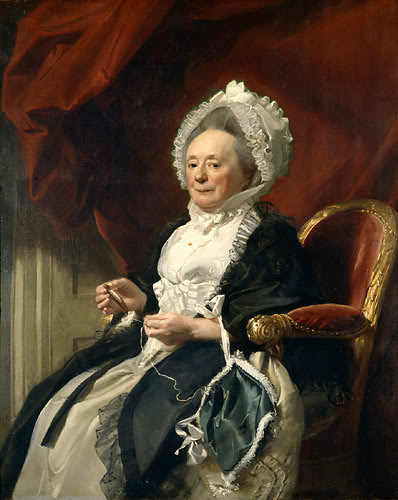
The fichu was a shawl-like piece of fabric worn over the shoulders and the neckline of a woman's dress. The two flaps of the fabric crossed at the breast of the bodice and was fastened at the lower part of the back. It was quite common either to have a fichu made of lace or decorated it with brooches. The style became especially popular in the 1770-80's France but originated in England. Also, it was a popular style among elderly ladies of the court. As always a few portraits of lovely ladies demonstrating the fashion:


Countess Spencer


The Bergère

The bergère was a straw-hat - also known as a milkmaid's hat - which was originally used as a masquerade accessory for courtiers who wanted to go as shepherd/shepherdess (it literally means "shepherdess") but later evolved into an accessory that was compatible with a fashionable woman's wardrobe. The hat was usually decorated with flowers or silk ribbons.
It was especially popular during the middle of the 18th century where it was unthinkable for a gentlewoman to go outside without some sort of hat or bonnet to protect her complexion. It is possible that the hat was named after Madame Bergeret who was painted with a large straw hat by François Boucher. The bergère had a shallow crown and a wide-set brim which made it tip either down in front of the wearer's face or the back of her head.


Madame Bergeret

Madame Vigée Le Brun - fashionable as always - even chose to paint herself wearing a bergèret decorated with real flowers, a feather and a ribbon:


Here are some other examples of the straw hat:


Here is one covered in silk


The Banyan

The banyan was a an informal piece of men's clothing. It was a loose-fitting robe which would be worn at home probably in the morning or evening when one could expect not to receive visitors. It was usually worn over a waistcoat and breeches. Occasionally, these were made of the same material.

A fitted banyan, 
1750-60

Having the banyan quilted throughout was a common design.

1740


It was common for a banyan to be made of a very colourful fabric; the banyan was a product of the Eastern-influence - it compares to a kimono - which was quite in fashion at the time. As it happens the word "banyan" is an anglicised version of the Gujerati (Indian) word for "trader".

Actually, they became so popular that it was acceptable for men in the latter part of the 18th century to be painted wearing a banyan instead of the more formal court suits. The banyan had a dominating collar as well as long sleeves.


oldrags:

Men’s banyan, 1730’s
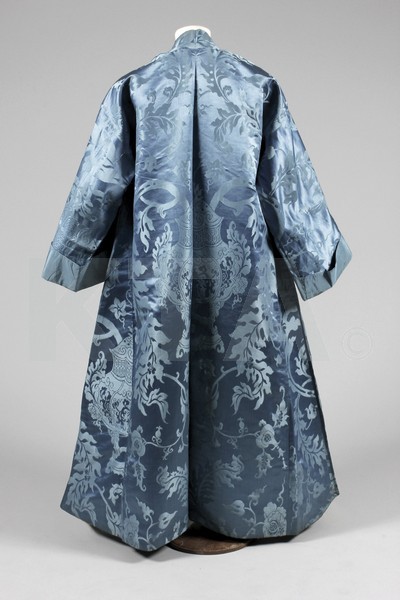
Back and front of a beautifully preserved banyan

The gorgeous example above is French and was created between 1730-40 and is made of Chinese brocade silk - expensive stuff. Not all were of that expensive a material; some were of simpler wool.

It was not uncommon for a banyan to be sewn in such a way that it could be worn with either side out. Usually, the banyan would be sewn in Europe with fabrics imported from the Far East but some were sewn before shipping. The banyan could be fashioned in several ways. One is depicted in the blue banyan above where it simply hangs in a kimono-like style while another was tied with ribbons or fastened with buttons. Some were double-lined for warmth while others were intended for summer use and as such were lighter. The fabrics, too, varied according to season. In the cold winter climate silk, wool and velvet were preferred while a summer-banyan was more likely to be made of calico or a like fabric.

Here worn over waistcoat and breeches,
1720, France

The kimono-typed banyan usually reached the floor while those that were more fitted only reached about knee-length. One of the most convenient aspects of a banyan were the pockets. Rather than having pockets of its own it was usually cut in such a way that the wearer could reach directly into the pockets of his breeches - the space also allowed space for a sword hilt.


As worn in portraits:


Dr. Charles Chauncey wears a banyan, an Asian-inspired garment generally worn as a sort of loungewear and rather frequently adopted by scholars and scientists. Note theloose fit and lack of a shoulder seam.:
Dr, Charles Chauncey
Mozart by Duplessis
Unknown gentleman

ALEXANDER STEWART, father of the 1st Marquess of Londonderry:
Alexander Stewart

Jean-Baptiste Santerre, Portrait of Nicolas Boileau-Despréaux, c. before 1711:
Nicolas Boileau-Despréaux

Béatrix de Choiseul-Stainville, Duchesse de Gramont

Roslin_GramontBéatrix de Choiseul-Stainville was born in 1730 as the daughter of the Marquis François-Joseph de Choiseul and Marie-Louise Bassompierre; her brother was the Minister Choiseul who would eventually essentially pave the way for Marie Antoinette's arrival at court.

Monday, 14 July 2014

Trivia

When you are dealing with a palace and a court as great as Versailles there is bound to be some fun facts that you may or may not have heard of.

Did you know ..
  • Marie Antoinette brought her own chocolate maker with her when she arrived at Versailles
  • Christmas presents were not a "thing" at Versailles; instead presents were exchanged on New Year's Eve when the King and his closest family could really shower their loved ones in lavish presents
  • When Marie Antoinette took over St. Cloud as a mean of saving money - it would have been far more expensive to have a so-called governor - she was widely opposed by especially the more traditional members of court since the Queen of France was not supposed to own properties in her own name
  • When a bride had to be found for Louis XV a list of 99 eligible princesses were drawn up together with their pros and cons 
  • Madame de Pompadour's emblem was dominated by fish - a reference to her bourgeois-name of Jeanne de Poissons literally meaning "fish" 
  • It is true that Louis XIV did not like Paris nor the Parisians. During his childhood he experienced how the city rose up against him and his mother, Anne of Austria, alongside some high-standing nobles - he would never forget nor forgive the betrayal.
  • The safety at Versailles was next to non-existing. Anyone, as long as they were decently dressed, could enter the palace and roam about at their own will
  • Louis XVI was the first King of France in about 200 years who did NOT take a mistress
  • Louis XIV was infamous for his enormous appetite and he could eat surprisingly much food. During the autopsy of the King it was discovered that the King not only had an unusually large stomach but also intestines twice as big as a regular man.
  • The total cost of Versailles is estimated to have been 116.438.892 livres or 1.285.456,000 pounds in today's money
  • The Chapel took 28 years to complete
  • There are 1250 fireplaces and 67 staircases