Saturday, 21 September 2013

Metallic Majesty

Jason Schwartzman portrays Louis XVI in "Marie Antoinette" in which he wears this costume in several scenes. The most dominating feature is the metallic blue coat and the matching trousers. The colour is enough in itself which could be why there is no embroidery on the coat as is
custom. Large baby blue buttons dominates the inner seam instead. The coat is lined with what appears to be white silk or satin. Also, the lace at the end of the sleeves are not as dominating as in other costumes worn by Louis.
In the dinner scene (top photos to the left) he is wearing the royal blue sash but has chosen to discard of it in the more private settings of a gaming night with his brothers, sisters-in-law and wife. The waist-coat makes a nice contrast to the sharp blue colour with its cream-coloured base and golden embroideries. The waist-coat is cut in a manner to make the lace at the neck really come to its' own right. I love the little detail with the pocket watch on the second last photo. On both the top and the bottom photo (two different scenes, by the way) the King is wearing a pendant in the star-shape of an order. The white enamelled star is hanging from a ribbon which matches the royal blue sash perfectly.


Friday, 20 September 2013

Coronation Gown

Another one of Kirsten Dunst's gowns from Marie Antoinette (2006) - there were over 60 so prepare for many more.
The dress itself is sewn in white satin which has been used for both the bodice, the sleeves, the petticoat and the skirt. The sleeves ends in champagne coloured tulle pinned with a large bow on each arm - of course the gloves are of white satin too. If you look closely at the bows you will see that they are made of striped fabric and not just plan coloured satin. The bodice is elaborately decorated with a flowery motif consisting of golden paliettes. The edge of the bodice and the neckline has been trimmed with the same champagne tulle as the sleeves. This decoration has been applied to the skirt as well and all the way down the golden flowers glitters only interrupted by the large bows - all edged with tulle.


Friendship, Romance or Dependency?

It was commonplace to hear rumours about homosexual relationships among the courtiers even when the court was in exile after the revolution.

Marie Joséphine of Savoy, who had married the Comte de Provence and thus became the sister-in-law of Louis XVI, had a very intimate relationship with one of her ladies-in-waiting Marguerite de Gourbillon. Whether it was actually a lesbian is unknown, perhaps it was just gossip like the case with Marie Antoinette and the Princesse de Lamballe. Nevertheless, the Comte de Provence was far from pleased about this relationship and demanded that his brother, the King, had Madame de Gourbillon be removed from his wife's service. Apparently, the Comte was of the opinion that his wife was being completely dominated by her lady-in-waiting. In the end he was successful when Marguerite de Gourbillon was exiled to Lille in 1789.

Marie Joséphine

When the court went into exile the two friends met up again in Marie Joséphine's home country of Savoy. In 1799 the would-be Queen of France had to leave for Mitau where a wedding was to take place and her husband wanted her there too (the wedding was that of Marie Thérèse, daughter of the beheaded King and Queen). There was one little demand though: Madame de Gourbillon could not go with her. Apparently, Marie Joséphine was not pleased with this and wrote directly to the Russian Tzar for permission to take her friend with her, since Mitau was Russian territory. When no answer ever came the two simply set off together anyway. However, their journey was dramatically stopped upon arrival at Mitau and Marguerite de Gourbillon was pulled out of the carriage. This was not the scandal in question, though there has already been a few!

Marie Joséphine must have been a will-strong woman and she certainly would not take that sort of behaviour. When she was finally admitted to court she publicly refused to change out of her travelling gown until her friend was allowed to rejoin her company. Nor would she stay in her exquisite rooms. The Tzar was not pleased about this and plainly refused to grant her her wishes, so Marie Joséphine tried a different tactic. She then refused to leave her rooms where she was alone with a bottle of liqueur! The scandal was huge and everyone talked about it. After all she was the first in line to be the future Queen of France. Madame de Gourbillon was not allowed to stay with her friend but she did manage to convince the Tzar to sent the Comte away from Russia which happened in 1801.

It has been suggested that it was Marguerite de Gourbillon who had encourage Marie Joséphine to begin drinking which was then the reason for why the Comte would not approve of their friendship. One thing is for sure: their friendship was deep and perhaps Marie Joséphine was dependent on her friend who would even follow the Comte and Comtesse to England.

Twenty-Four Rays

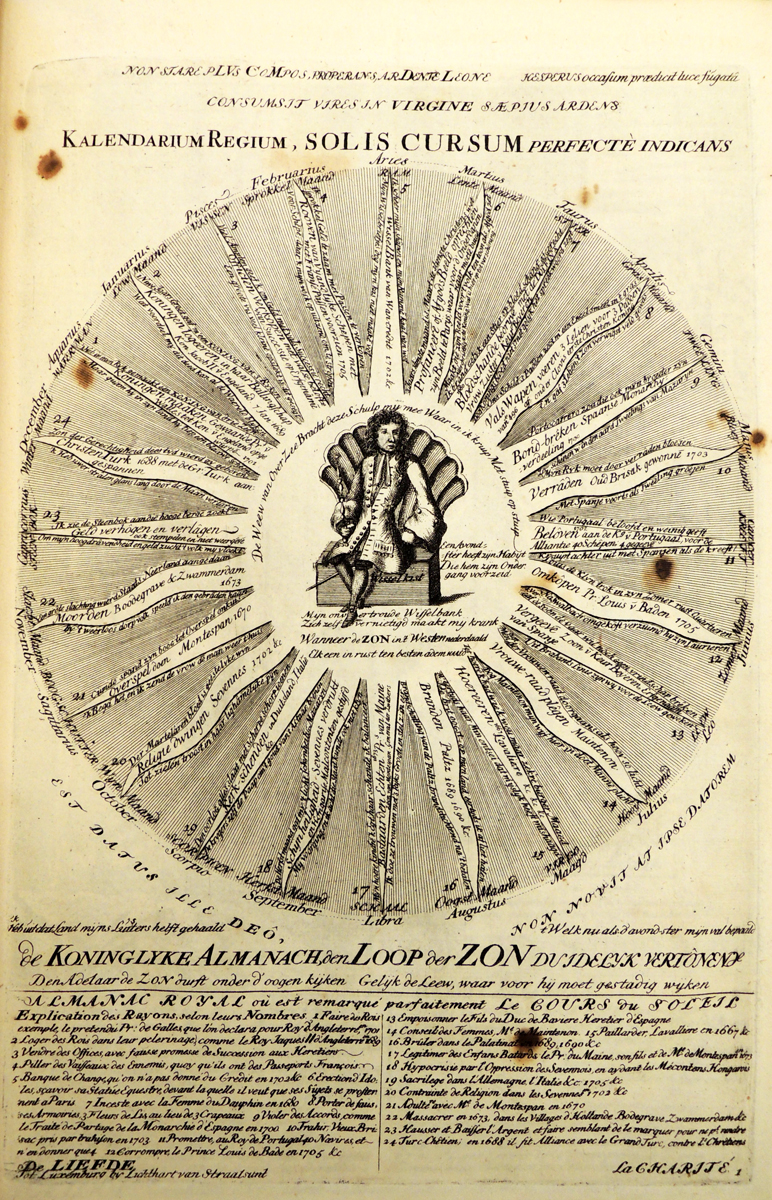
http://blogs.princeton.edu/graphicarts/images/almanac%20royal3.jpg

The sun above (which is believed to be published by the Dutchman Carel Allard) takes advantage of the King's personal emblem, the sun, but not quite in the way that Louis XIV had imagined. The King is centred in the middle from where 24 sun rays shine out - each one is stating a crime committed by the King. The pamphlet is Dutch but was also translated into French; it was published after the War of the Spanish Succession which France had taken part of.

High and Mighty on Heels - Men's Shoes

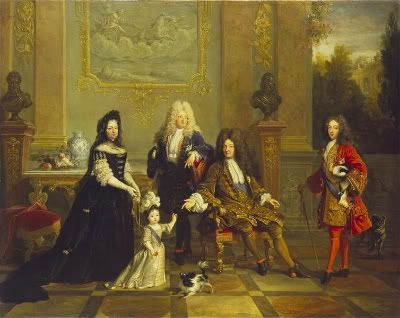
Originally, high heels were made for men and was especially popular at the court of Louis XIV who himself adored the style. He actually had a special type of high heels named after him (the Louis heel) which concave on the heel itself to create an elegant curve. And since Louis loved extravagance his heels were the best of the best. Often towering over five inches above the ground the heels themselves were often decorated with detailed battle scenes! The King made it clear to his court that he was to have the highest heels and no one could wear any as much as a millimetre taller than his.
Red heels were considered especially attractive and Louis XIV quickly made his mark here too. It was only the King himself and those who were in high standing with him who were allowed to wear red heels. One of the reasons for why red was so special was that it was very expensive to colour something that perfect red tone - thus red heels became a symbol of prestige. However, the King's fondness of high heels were not because he was particularly short. On the contrary Louis XIV was considered slightly taller than average height with his 1 meter and 75 centimetres (5,9 inches).

All kind of materials were used for the shoes for example silk, brightly coloured leather and brocades. One thing that remained constant through Louis XIV and Louis XV's reigns was the dominating large buckles on men's shoes. These were either silver or gold and could be very intricately decorated. It was very common to use gemstones - both genuine and look-a likes - to decorate the buckles further. Such a look-a like could be rhinestones which (as the name indicates) were brought to Paris from the Rhine and was a kind of crystals. Paste was also used for decorations despite that we would never consider it very extravagant. However, at the time it was considered just as beautiful because the paste jewels would sparkle especially much when hit by light - also they could be fashioned in all kind of shapes. Samuel Pepys wrote in his diary on 22 January 1660: "This day I began to put buckles on my shoes." The buckles were considered important enough to be sold separate from the shoe itself - the idea was that the buckle was to be used for more than one pair of shoes. Normally buckles would be delivered in special caskets, just like jewellery! It was in the 1720's that the buckles became larger than normally and their period of glory would be between 1760-1780.


Close-up of Louis XIV in his state robes - notice the red heels!


Shoe buckles, late 18th century, French, metal, rhinestone
Made in France in the latter part of the 18th century


Wednesday, 18 September 2013

The Pompadour Hair Style

You can probably guess who this one is named after, so I am just going to leave it at that. It was popular among both men and women and even made a comeback in the 20th century. The style is simply achieved by making the hair stand up and sway slightly out from the forehead. The hair on each side of the head is pinned up and gathered with the hair of the Pompadour itself. At the court of Versailles it was popular to use bear grease to make the hairdo stay in place. Often ornaments were used to decorate the hairstyle like diamonds or flowers.
It was quite normal to have your hair curled behind the head but the hairdo in the front was tall but still simpler than most hairdos found at Versailles.


This is a very small version of it

The Fontange Hairstyle

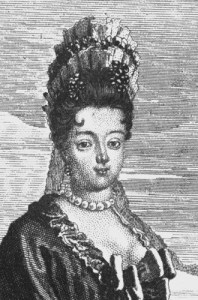
This particular hairstyle was named after one of Louis XIV's mistresses, the Duchesse de Fontagne. It is also known as the "frelange". It became popular in the 1680's and was in fashion both in France and in England. Like every other element in fashion this evolved from the moment it became popular. At first it was merely a simply arrangement of curls at the top of the head gathered by ribbons (anyone who has ever tried to tie their hair with ribbons know of difficult this is). The story goes that Madame de Fontange was out hunting when her hairdo was suddenly ruined and since loose hair was not permitted she quickly gathered her hair with a ribbon from her dress.
Later it became taller and far more elaborate curling were all the rage. To make the hairdo even higher the hair was often tied around a wire "cap" placed on top of the head and often false curls were added - sometimes made of horsehair. Also, it was custom to wear a trimmed linen cap with this hairdo which consequently also became known as the "Fontange". Actually you might say that this is the similar endeavour to create as high a hair silhouette as possible just like Marie Antoinette would do a century later. There was an annoying problem with this fashion however. As the height of the hair grew it became more and more difficult to keep the pile of hair stable and it would often slide off to one side. This resulted in an extreme use of starch and even more wire to keep it in place.

One of the "sub-categories" of this fashion was the Fontange à la Sultane where a veil would be worn from the great height of the hair. Some women had two curly locks hanging on each side of the head.

Queen Mary II of England
Head03
This is a fontange à la sultane
Fontange of 1713

Different variations