Tuesday, 25 July 2017

Governesses of the Children of France

A high-ranking lady was entrusted with the care of the precious Children of France - that being the children of the monarch. Naturally, this was considered to be an important task. The woman chosen would have close contact to the royal children and as such could be a source of influence. Consequently, it was vital to choose with care.

Francoise de Lansac
Governess to Louis XIV and Philippe d'Orléans

Married to Artus de Saint Gelais. She died in 1657 when her charges were 19 and 17 years respectively.


Louise de Prie, Duchesse de Codona
Governess to the children of Louis XIV from 1661 to 1672
Governess to the children of the Grand Dauphin from 1682 to 1691

Married to Philippe de La Mothe-Houdancourt, Duc de Codona 

Louise de Prie


Francoise d'Aubigné, Marquise de Maintenon
Governess to the children of Louis XIV and Madame de Montespan from 1669 to 1682

She would live with her charges in a house bought by Madame de Montespan in the Rue de Vaugirad; here the royal mistress installed the future royal mistress with servants and a large income. The Marquise was officially instated as governess of the royal children on 20 December 1673 when the children were legitimised. Due to her good work with his children, Louis XIV awarded her the enormous sum of 200.000 livres.

Married to Paul Scarron
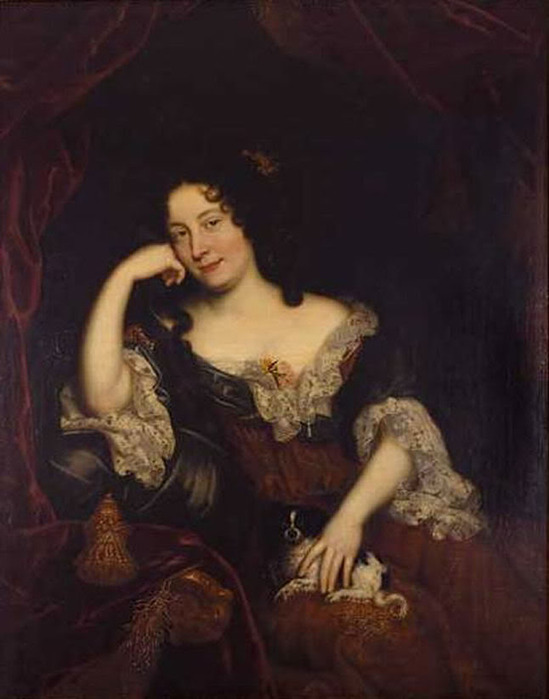
Madame de Maintenon


Marie Isabelle Gabrielle Angélique de La Mothe-Houdancourt, Duchesse de La Ferté-Senneterre
Governess to the children of the Duc and Duchesse de Bourgogne from 1709-1710

Married to Henri Francois de Saint-Nectaire

The Duchesse de La Ferté-Senneterre with her two charges


Charlotte de La Mothe-Houdancourt, Marquise de Ventadour
Governess to the children of the Duc and Duchesse de Bourgogne from 1710
Governess to the children of Louis XV from 1727-1735

The marquise is directly responsible for Louis XV surviving the epidemic that killed his parents and older brother. She knew that the doctors had purged and bled her eldest charge to death and in attempt to protect the youngest she barricaded herself in her apartment. Here, she nursed the little boy back to health. Louis XV continued to be immensely fond of his governess even when he was fully grown.

Married to Louis Charles de Lévis
She was the daughter of Louise de Prie

Mignard - Madame de Ventadour.jpg
Marquise de Ventadour
Marie Isabelle de Rohan, Duchesse de Tallard
Governess to the children of Louis XV 
Governess to the children of Louis Ferdinand 

She was genuinely beloved her charges who mourned her deeply when she died in 1754. She had also been responsible for the care of Louis Ferdinand's children. Ironically, she would never have children of her own.

Granddaughter of Madame de Ventadour and married to Joseph d'Hostun de La Baume


Marie Louise de Rohan, Comtesse de Marsan
Governess to the children of Louis Ferdinand and Marie Josèphe de Saxe

She had also briefly taken her aunt's position as governess to Louis XV's children although they were not in need of a governess for much longer by 1754. Her decided favourite was the Comte de Provence; he would refer to her as ma petite chère amie.
She greatly opposed the marriage between Louis XVI and Marie Antoinette - the latter's dislike of etiquette prompted the Comtesse to resign.

Niece of the Duchesse de Tallard and married to Gaston Jean Baptiste de Lorraine


Victoire de Rohan, Princesse de Guéméné
Governess to the children of Louis XVI and Marie Antoinette from 1776-82

She succeeded her aunt, the Comtesse de Marsan. Unlike her aunt the Princesse became a close friend of Marie Antoinette. She is the only governess who was forced to resign in 1782 due to a scandalous family debt of no less than 33 million livres. 

She was married to Henri Louis, Prince de Guéméné

Princesse de Guéméné with Madame Royale


Yolande de Polastron, Duchesse de Polignac 
Governess to the children of Louis XVI and Marie Antoinette from 1782-89

Her appointment to the post of royal governess caused quite a scandal; she was not considered to possess the necessary pedigree to fulfil her charge. Her friendship with the queen became weaker as Yolande tried to push through politicians whom Marie Antoinette hated.

Married to Jules de Polignac
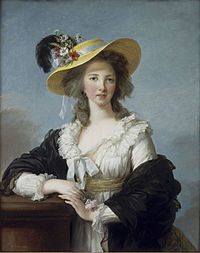

Duchess de Polignac.jpg
Duchesse de Polignac


Louise Elisabeth du Croÿ, Marquise de Tourzel
Governess to the children of Louis XVI and Marie Antoinette from 1789-92

She accompanied the royal family as they were imprisoned; when the monarchy was dissolved in 1792 she was separated from the royal family. She survived the revolution and was rewarded by Charles X with the title of Duchesse

Marquise de Tourzel

Monday, 24 July 2017

Ridiculous Fashions: Caricatures of Grand Wigs

The tall wigs towering high above the head and adorned with everything imaginable remains on of the things we associate the 18th century with. Today, we look at these hairstyles with a mixture of wonder and ridicule. But even when the fashions were at their height they were certainly not accepted by everyone. Caricatures spread like wildfire of highborn ladies wearing wigs too tall to keep under control; naturally, these were particularly popular amongst the lower classes. 

Billedresultat for 18th century hair caricature


Wigs were often adorned with everything from flowers to small boats and birdcages. This may very well have been the inspiration for this caricature. The gentleman to the far right seem to regret his decision of pocking the wig when an array of items come tumbling down at him.
While it is completely true that ladies occasionally had to crouch down in their carriages (as seen below) to fit it is doubtful that they ever needed someone to hold their do's up with a stick!


1776, English


Fashion generally came from France which this caricature clearly shows. The "French Lady" in London gives the gentleman a good fright when she suddenly emerges in what can only be described as a monstrous contraption. Notice how even the animals flee!

Billedresultat for 18th century hair caricature


"Lady All-Top" must have a remarkably strong neck and quite a headache! Notice that her coiffure is larger than she is - even her plumes.


Billedresultat for 18th century hair caricature


Here is another lady who needs to bend her knee so as to not ruin her expensive hairdo. This particular caricature is French and most likely refers to a court lady - notice the intertwined double "L"s which adorned the king's gates. Perhaps she is going to a court ball?


Billedresultat for 18eme siecle coiffure caricature


The court wigs generally reached their peak in the 1770's but was not completely gone by the end of the 1780's. This caricature attempts to explain how a proper coiffure was to be made; apparently one needed to erect a scaffold which would then be removed. The hairdresser is all but compared to a carpenter; the hairpins and accessories are scattered around him like tools - and in case that point was not made clear there is a painting of a bridge in the background. 


Billedresultat for 18eme siecle coiffure caricature


Oh, the dangers of fashion! This unfortunate lady seems to have walked a little too close to the chandelier and has consequently caught on fire. The only redeeming thing seems to be that she is not aware of her new "enlightened" state. After all, there is quite a bit of hair to burn through before the scalp is reached. Behind her and her companion, servants are desperately trying to quench the flames.

Relateret billede


This is a rather late caricature considering that - at least in France - the high coiffures had not been worn since the fall of the monarchy. Nevertheless, the image is quite clear.

1797


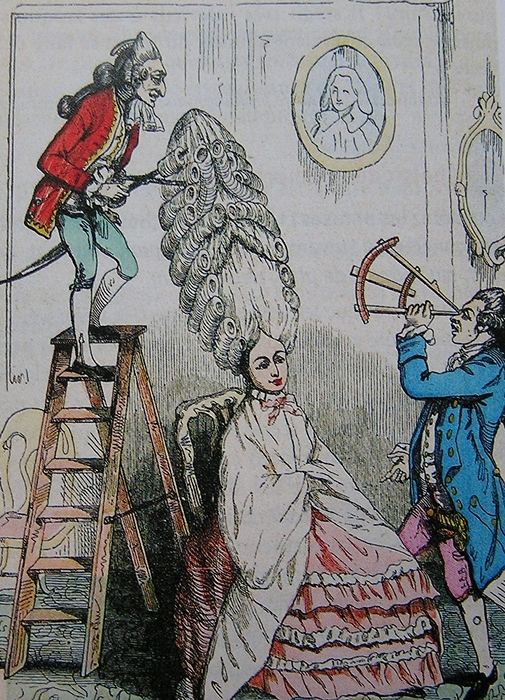
Height is the essence here. The coiffeur needs a ladder to complete his masterpiece while the other gentleman (the assistant?) checks the angle using a sextant. Meanwhile, the lady looks rather pleased with her fashionable hairdo. One thing that stands out in this one is the white shawl draped over the lady's shoulder to protect her gown. It could be that the coiffeur is using heated curlers to make those perfect curls?
Billedresultat for 18eme siecle coiffure caricature


Ladies were not the sole target for these ridiculing cartoons. Gentlemen, too, could find themselves in the same situation; as was the case here. "Baron du Caprice" has styled his hair so tall that he can only get in by having the door made taller - apparently he never considered bending his knees as the ladies above...


Billedresultat for 18eme siecle coiffure caricature

Sunday, 23 July 2017

The Greatcoat

The greatcoat was chosen by some men as a replacement for the cloak in the 18th century - more specifically around 1750. After this point it was considered too old-fashioned and cloaks were then associated with soldiers or other specific professions (and funerals). For instance, some livery uniforms counted a greatcoat.

The greatcoat was worn out of doors and over the suit; much like the coats we know today. A typical greatcoat was made from heavy, thick materials which provided both warmth and could stand some use. Also, the cuffs and collar could be turned up as a protection against foul weather. This made it perfect for traveling in. 

Gentelman's Greatcoat 1780's France
Back of a French greatcoat, 1780's

As it was intended to be able to bear the bumps and bruises that came with 18th century traveling it was often made of wool. Often, the pockets were quite deep so as to make it possible for the wearer t to keep papers or even food nearby. Little decoration was added to it due to its practical purpose. One thing which all greatcoats had in common was their colour: they were always grey. 

The king's wardrobe contained several pieces of outerwear. His greatcoats were of wool for the winter and of a lighter fabric for the summer. The greatcoat would be sewn with silk cross which was less expensive and far more solid than the silk threads used for the suits.

Relateret billede
Being from 1811 this one is a bit late
but is still like the ones used in the previous
century

The greatcoat reached just below the knee and ended around the calf. It was bulky - a far cry from the otherwise tailored suits seen at court. However, a bulkier coat allowed for the wearer to wear several layers underneath. Unquestionably, this was a welcome article of clothing during the colder months.
Four side panels made up the main part of the coat. Seams ran beneath the arms and down the middle of the back.

As can be imagined with such a purpose it was not confined to the upper classes. Although, the people at the bottom of society could not afford a specifically made greatcoat, it was used by the bourgeoisie as well.
The traditional greatcoat actually continued to be a part of most countries' military uniforms all the way up to the 1930's. It was then widely discarded as being too impractical. 

Billedresultat for portrait greatcoat
English Captain Thomas Coram, 1740 - the English
were more often portrayed in their greatcoats than
the French

Thursday, 20 July 2017

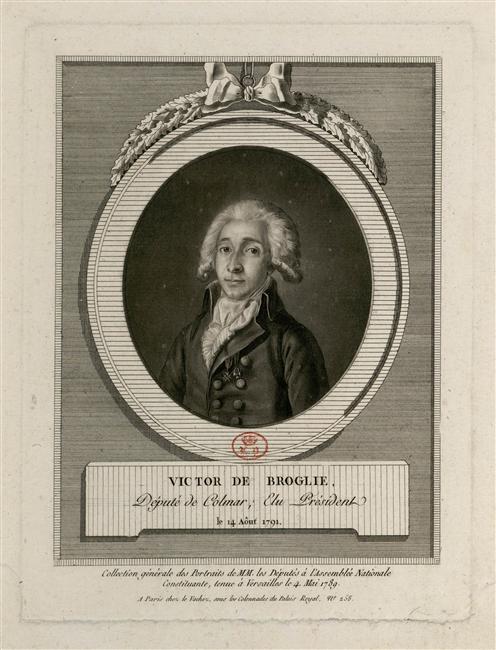
Charles Louis Victor de Broglie, Prince de Broglie

Charles Louis Victor de Broglie was born on 22 September 1756 as the son of the Victor-Francois, Duc de Broglie and Louise Crozat. His father had had a successful career in the military where he had distinguished himself in the Seven Years' War. Charles was to follow in his father's footsteps.

On his father's orders he is enrolled in the infantry regiment of Limousin. Here, he quickly rose through the ranks. Charles started out as sous-lieutenant then became captain and so on; before his 25th birthday he had already been made colonel of a regiment from Aunis. On 3 February 1776 he was married off to Sophie de Rosen-Kleinropp - her father was a cavalry officer and Marquis de Trainel.

In 1781 his first child would be born; it was a girl who was named Amélie. The next year brought another daughter and another in 1784. In 1785 his wife gave birth to the couple's only son: Achille Léon.

Charles Louis Victor

Shortly after the king had need of the Prince de Broglie's military talents again. This time he was sent across the pond to fight in the American war of independence. He would return to France in 1788 where he was awarded with new titles including colonel of the Bourbannais regiment.
By then the revolution was near by. Charles was sympathetic to the cause of the Third Estate - the people. He was chosen as deputy of the nobility to the States-General. In this function he would predominantly vote for the Left. This was the case in 1789 when he voted in favour of granting all citizens the opportunity of serving in the law or the military.

His revolutionary career went further when he was made Secretary of the Assembly in 1790. However, trouble was brewing and in these dangerous times few people could be safe. When he dissolved the Legion of Aspe riots broke out in Toulouse. 
His father had emigrated and was charged by the revolutionary tribunals with conspiracy with the enemy. Charles tried his hardest to fight his father's case but received little encouragement from the father himself. 

He reached the peak of his political career when he was elected President of the Constituent Assembly in 1791. However, his sympathy with the people did not mean that he simply accepted every new turn against the monarchy. His presidency lasted only four months until he resigned. Instead, he requested to be sent back to the front where his talents were more pronounced. 

Being decorated with the rank of Field Marshal he was sent to the Rhine to serve under Luckner. However, at home things were heating up. Charles had never intended for the revolution to cost the life of the monarch but Louis XVI was in serious danger. Upon learning that the king had been criminally charged Charles immediately resigned his post. He returned to France where he took up residence in Bourbonne-les-Bains.
From here he kept up a correspondence with the President of the Legislative Assembly. From his letters it is clear that Charles still supported the ideals behind the revolution but had doubts as to its means. These doubts would prove fatal to the decorated war hero.

As President

Shortly afterwards, Charles was arrested and place in the prison of Langres. This spell in prison lasted only a short while before he was released again. Despite the growing danger he opted to remain in France. The king and queen had been executed that same year. This decision would eventually lead the way to another arrest. This time there was no mercy for the formerly esteemed friend of the people. On 26 June 1794 the Prince de Broglie was placed before the Revolutionary Tribunal; he was sentenced to death.

From his prison cell he wrote to his wife and asked her not to confuse the revolution with the "many monsters she has produced". This last letter of his gives a perfect insight into his political thoughts and allegiances:
Without despising or disdaining the Ancien Regime, any attempt to reestablish it seems to me childish. I belong to the new society with heart and conviction and I sincerely believed in its infinite progress. While detesting the revolutionary state, the disorders it entails and the crimes which defile it, I regarded the French Revolution as an inevitable and salutary crisis.

Charles Louis Victor de Broglie was executed by guillotine the following day: 27th July 1794.

Madame & Monsieur

Prince & Princesse


Marie Thérèse Louise of Savoy, Princesse de Lamballe

Élisabeth Thérèse de Lorraine, Princesse d'Epinoy

Victoire Armande Josèphe de Rohan, Princesse de Guéméné

Anne Victoire of Hesse-Rotenburg, Princesse de Soubise

Bathilde d'Orléans, Princesse de Condé

Anne de Rohan-Chabot, Princesse de Soubise


Louis August II de Bourbon, Prince de Dombes

Armand de Bourbon-Condé, Prince de Conti

Charles Louis Victor de Broglie, Prince de Broglie

Charles Juste de Beauvau, Prince de Craon

Duc & Duchesse


Marquis & Marquise


Comte & Comtesse


The Beauty of La Montespan

Francoise-Athénaïs, Marquise de Montespan is even today renowned for her beauty. Already during the early years of her marriage when she served as a lady-in-waiting to the Duchesse d'Orléans she was known as a "great beauty".

Her portraits shows the ideal female form of the time: a voluptuous body with the curves so desired at the time. Antonia Fraser tells us that she had large blue eyes and long, auburn curls that fell about her shoulders. Those beautiful eyes were made even more so by the infamous "esprit de Mortemart" - the elegant wit of her ancestral house.

However, it was not merely her appearance that charmed those around her. Madame de Montespan was equipped with a cutting wit and a natural grace to her movements. Especially her hands were admired; as was the way she carried herself. A mixture of dignity and alluring appeal drew in anybody she wished.
Confidence was definitely key with the Marquise. She held immense pride in her heritage and was well aware that she was beautiful. So were her contemporaries. Madame de La Fayette claimed that la Montespan possessed no less than a "flawless beauty" while Madame de Sevigné's letters are full of praise. Elizabeth-Charlotte, Duchesse d'Orléans was no great friend of Madame de Montespan; nevertheless, she admitted that she had "beautiful hair, fine arms, shapely hands, a very pretty mouth and a winning smile".


Madame de Montespan

As is almost always the case the court praise was connected with the king's opinion. During her height of beauty there were no end to verses singing her praises. Loret made one of the most famous ones which describes her as a "charming miracle... this divine paradise of the eyes". If Montespan had not been vain before her affair with Louis she would certainly have been pushed towards vanity eventually.
To the Duc d'Enghien it was hardly surprising that the king fell for her. According to him she certainly deserved it since "no one could have more spirit or beauty than she".

One of the ways in which her beauty stood out best was in deshabille; one of the most famous portraits of her is painted in this state.

The magnificent Marquise in her
famous deshabille

Such beauty could hardly last forever. Montespan was immensely fond of food which - combined with seven consecutive pregnancies - left their toll on her body. All through her life Francoise-Athénaïs would struggle with her weight. Over the years the curvaceous body became larger and larger. In the end she was downright fat. Even so, the picky Duc de Saint-Simon (who only met her in the last part of her reign) admitted that she was indeed very beautiful.
Madame de Maintenon was quick to pick up on this added weight (it could hardly be overlooked); the "old dame" found her weight gain astonishing. 

In her last years Madame found her suddenly far less appealing than before. The Princess Palatine compared the retired favourite's skin to paper that had been folded again and again. However, no one else mentions such excessive wrinkles so perhaps a tinge of jealousy still haunted Madame? Even when her liaison with Louis was definitely over Montespan still retained a certain air of mystery and allure which fascinated her surroundings.

Sunday, 16 July 2017

Madame de Pompadour & the Prince de Conti

The animosity between Jeanne-Antoinette de Poisson and Louis Francois de Bourbon began from the moment that Madame de Pompadour was introduced as royal mistress. 

The first real "sting" came about quite without intent. Madame de Pompadour frequently put on small theatrical performances in the king's private apartment to divert the melancholic king. The thing was that only fifteen people could be admitted due to the room's size. In 1747 - when these plays were well under way - the Prince de Conti was amongst those excluded from the parties. This prince was particularly proud of his Bourbon-blood; the thought of not merely being excluded but being excluded by a bourgeoisie was intolerable.

This matter of rank was most likely what really turned the Prince de Conti against Madame de Pompadour. During her first time at court in 1745 the marquise had been able to charm everyone - except Conti. To him it was not an issue that she was the king's mistress (after all there had to be one); the sore spot was that she was not born a noblewoman.


Prince de Conti

From this point on their relationship went downhill fast. Before, Louis Francois had been a close associate of Louis XV; the king would refer to him as his favourite cousin. The Prince's dislike of the mistress was not unknown but still somewhat contained. That would come to change. 
Gradually, this changed and Conti naturally placed the blame with Pompadour. However, the Prince de Conti was not adverse to slander himself. He was one of the few who worked in the Secret du Roi which handled extremely confidential cases; he took great advantage of the marquise's being barred from there to attempt to turn Louis XV against her.

These secret meetings was a cause of great annoyance to the royal mistress. It certainly did nothing to ease the relationship with the Prince de Conti; every time she saw him coming and going from the king's chamber with a mysterious air it stung.

Louis XV's disinterestedness in such squabbles hardly made tensions any lighter. In 1752 Madame de Pompadour was granted a tabouret and the honours of the court. This included a formal presentation to the royal family - although they had all known each other for years. For some unknown reason, Louis chose none other than the Princesse de Conti to make the presentation. She had also been the one to present Jeanne-Antoinette in 1745; her husband's dislike of the new-comer apparently did not spread.

One of the greatest clashes between the two played out against the background of the Seven Years' War. As a Prince of the Blood and a favourite of Louis XV it was assumed that Conti would be given sole responsibility for the French army in Flanders. However, he instead had to share command with the Marèchal de Saxe. The two men quarreled constantly and both sought prime command. 
When the Comte de Stainville - a follower of Conti - arrived at Versailles on 4th August 1746 to deliver the news of the fall of Charleroi, the question of command arose again. Madame de Pompadour made it clear that she favoured the Marèchale. In fear for his career the Prince de Conti immediately left his post and returned to Versailles. Here he found little obvious grounds for concern. Louis XV was as smiling as always and the two remained closeted for hours.


Madame de Pompadour

The great finale came in 1756. With an increasing coldness from his royal cousin's side, the Prince de Conti became a threat to the monarchy itself. In an attempt to gather support from the Parlements as well as the Prosestants he suddenly posed a threat to Louis XV's throne. This was the final drop for their friendship. The Prince was stripped of his position in the Secret du Roi with the marquise's backing.

When Damiens attempted to assassinate the king in 1757 Madame de Pompadour cast suspicious eyes on her long-time rival. Although she could not prove a connection it was not completely unlikely. Through all their years of in-fighting the two rivals had continually opposed the other's political aspirations. The marquise prevented the prince from getting the promotions he desired, and the prince in turn did his utmost to destroy her reputation.

Following this year the Prince de Conti was not very welcome at Versailles. His hatred of Madame de Pompadour - and probably hers for him - was at an all-time high. He would continue to spread demeaning verses and caricatures; in 1760 he saw a chance of denying the maitresse a wish. She had cast longing eyes at the vineyard of La Romanée. Promptly, the Prince de Conti laid down twice the estimated worth of the vineyard. To mark his acquisition he added his name to it making it La Romanée-Conti. Today, the vineyard produces the most expensive wine in the world.


The vineyard bought by Conti

The conflict with Madame de Pompadour had cost the Prince de Conti dearly. He could have had a chance of becoming king of Poland but it is speculated that she had a hand in tipping the scales against him. However, this is only guesswork. 

When Madame de Pompadour died in 1764 the Prince de Conti was still in disgrace. He may have outlived his rival but her death did not bring about a return to favour. Instead, Conti outlived Louis XV too and died in Paris in 1776.