|
|
|
||||||
|
|
|
||||||
|
|
|
||||||
|
|
|
||||||
|
|
|
||||||
|
|
|
||||||
|
|
|
||||||
|
|
|
||||||
|
|
|||||||

Saturday, 10 January 2015
Banyans


Louis Auguste de Bourbon, Prince de Dombes
 Louis Auguste de Bourbon (not to be confused with Louis XVI) was born on 4 March 1700 to the Duc du Maine (also a Louis Auguste) and Louise Bénédicte de Bourbon. As such he was the grandson of Louis XIV and his mistress Madame de Montespan. Fortunately for him, his father had been legitimized. The title of Prince de Dombes was given to him immediately upon birth.
From the very beginning of his life it became obvious that Louis Auguste possessed great tactical skills which rendered him an ideal soldier. His military career took off early for him. In 1710 - when Louis Auguste was only 10 yeas old - he was given the title of Colonel General of Swiss Guards. At the age of 16 Louis Auguste was sent to fight under the Prince of Savoy in the war between Austria and Turkey. It need hardly be said that he seemed to have found his right environment despite his young age. During the years to come he would also participate in the War of the Polish Succession and the War of the Austrian Succession.
Despite being the fourth child born to his parents he had the advantage of being the only surviving male which meant that he was the heir of his father. Usually, noble parents did not have a very close relationship with their children but that was not the case with the Duc du Maine and Louis Auguste. Their relationship was not only a close and happy one but also an enduring one. It does not seem that they ever fell seriously out with each other. In 1736 the Duc du Maine died to Louis Auguste's great despair.
By then Louis Auguste seemed a good match. Wealthy, directly related to the King and remarked for his military success meant that several courtiers set their eyes on him as potential match for their daughters. Among these were the powerful Duc d'Orlèans whose daughter Charlotte Aglaé was suggested; as was Louise Anne de Bourbon who as the niece of the Duc du Maine was his first cousin. But it never came to be. Like most of his siblings Louis Auguste never married and never had an heir.
 Still, the titles seemed to rain on him. The year that saw his father's death also saw his rewarding of the title of Comte d'Eu and the year after he became the Governor of Languedoc. His mother was determined to see her son further distinguished so she bestowed the title of Prince d'Anet and Comte de Dreux on him as well as several estates. Three years later she died.
It could be assumed that such a man would relish life at Louis XV's court but that was not the case. He rarely ever came there unless his duties called on him. Instead he spent his time at his estate, the Château d'Anet. Here he enjoyed embellishing his estate and even managed to invent a hydraulic system to water the extensive gardens. Whenever he was not at d'Arnet he could be found hunting at the Château d'Eu.
Even though he stayed clear of the intrigues of the court, Louis Auguste must have had a serious row with someone. On 1 October 1755 he went to Fontainebleau with the intention of fighting a duel. He lost and died at the age of 55 years old.
Friday, 26 December 2014
Hôtel d'Aumont
The Hôtel d'Aumont served as the main seat of the Ducs d'Aumont from 1656 when it was purchased by the then Duc d'Aumont. D'Aumont summoned some of the greatest artists of the time to complete the décor including François Mansart, Charles Le Brun and Simon Voet. Even André Le Nôtre was hired to carry out a French garden.
The Hôtel was given a make-over in the early 18th century. In the end the Hôtel only remained in the d'Aumont-family's possession for exactly one century. It was sold in 1756 by the fourth Duc d'Aumont who had gotten the Hôtel through his marriage to Louise-Marie- Augustin d'Aumont. The following owners were not as prestigious as the d'Aumonts. Pierre Terray was the owner until 1795; he held several positions at court but was not himself a nobleman.
Today it is a property of the City of Paris which uses it as an administrative unit.
 |
| View from the first floor |
 |
| Ground Floor |
Tuesday, 23 December 2014
Blue Service of Louis XV
Strongly influenced by his mistress, Madame de Pompadour, Louis XV placed an order of a full dinner service at the Sèvres factories in 1751.


The set was delivered in intervals, the first arriving at Versailles in December 1753 and again in December 1755. In 1757 a few more items arrived. In total no less than 1.749 pieces were created for this collection! The accompanying bill is matches the enormous amount of items and in the an astonishing 82.272 livres!
In 1757 the King sold a part of the collection to his courtiers but kept the lion's share for himself and his family. Among the courtiers there was a great desire to possess such a piece not only because it came from the King but because it was the first time such a blue colour was used on porcelain.

For this order - unlike anything ever experienced at Sèvres so far - a new colour was invented. Eventually, the artists drew their inspiration from the ceilings of Versailles. When André Le Nôtre painted these he had the background painted in a deep sky-blue which had become known as the "bleu celeste" (heavenly blue) or "le bleu de roi" (the King's blue).
Louis XV had the service installed at the château de Vincennes.

The service was first put into use at a dinner party on 4 February 1754. The Duc de Cröy described the scene as such:
Jean-Claude Duplessis had a hand in the shape and design of many of the pieces. Louis XV much appreciated his contribution and made him the King's goldsmith a few years later in 1758. The service was so popular with the King and his family that it remained in use until the end of the Ancien regime. Today, some pieces can be found in the porcelain dining room while others have been sold off at auction to private collectors.
In 1757 the King sold a part of the collection to his courtiers but kept the lion's share for himself and his family. Among the courtiers there was a great desire to possess such a piece not only because it came from the King but because it was the first time such a blue colour was used on porcelain.
Louis XV had the service installed at the château de Vincennes.
The service was first put into use at a dinner party on 4 February 1754. The Duc de Cröy described the scene as such:
"The King made us unpack his beautiful blue, white, and gold service from Vincennes, which had just arrived from Paris, where it had been exhibited for the connoisseurs to admire. This is one of the first masterpieces of this new porcelain factory which is to surpass Meissen."
Jean-Claude Duplessis had a hand in the shape and design of many of the pieces. Louis XV much appreciated his contribution and made him the King's goldsmith a few years later in 1758. The service was so popular with the King and his family that it remained in use until the end of the Ancien regime. Today, some pieces can be found in the porcelain dining room while others have been sold off at auction to private collectors.
Saturday, 13 December 2014
Plans Of The First Floor: Louis XIV
Recently, I came across a wonderful floor plan which shows how the apartments of Versailles' first floor were divided. Notice how the present private apartments of both the King and Queen are not existing at this point; actually, it would be Louis XV who added them in an attempt to escape the curious eyes of the courtiers.

The Turquoise Section: The King's Grand Apartment
A. The War Salon
B. The Salon of Apollo
C. The Salon of Mercury
D. The Salon of Mars
E. Tribune of Musicians
F. The Salon of Diana
G. The Salon of Venus
H. The Salon of Abundance
I. The Salon of Hercules
The Pink Section: The Queen's Grand Apartment
A. The Peace Salon
B. The Queen's Bedchamber
C. Grand Cabinet of the Queen
D. Antechamber of the Queen
E. Hall of the Queen's Guards
F. Grand Hall of the Guards
The Green Section: Cardinal de Fleury's Apartment
The Purple Section: Duc de La Rouchefoucauld's Apartment
The Yellow Section: Madame de Maintenon's Apartment
The Pale Blue Section: M. de Noailles' Apartment
The Coral Section: Bureau of the Domain of Versailles
The Orange Section: The King's Confessor's Apartment
The Grey Section: Salons
The Sky-blue Section: Bathrooms
The Indigo Section: Cabinets
The White Sections:
A. Pavilion d'Orlèans
B. Staircase of the Princes
C. Passage
D. Staircase
E. The Marble Staircase
F. Vestibule of the Marble Staircase
G. Hall of the King's Guard
H. Antechamber
I. Aeil-de-Baeuf or the King's Grand Antechamber
J. The Hall of Mirrors
K. Bedchamber of Louis XIV
L. Cabinet of Louis XIV
M. Cabinet of Wigs
N. Billiard Room
O. Cabinet of Agates
P. Cabinet of Jewels
Q. The Oval Salon
R. The Small Gallery
S. The Ambassador's Staircase
T. The Cabinet of Medals
U. Vestibule to the Chapel
V. The Chapel
Wednesday, 10 December 2014
The Court Appartements
Louis XIV might have kept his court well-entertained but since there could not be balls and masquerades every week something else was invented in the intervals. The Appartements - so called because they were generally held in the Grand Apartments - were evening gatherings were there would be plenty of refreshments lined up on silver plates. Dancing and the music were also offered as well as card games. The Court Appartements were held during the winter season.
Usually, the Appartements would be held two-three times every week. These soirées were not dependent on whether the King was there or not; they would go ahead as planned even if he decided not to attend. And for those courtiers who thought it a waste of time to be there when the King was not, they were wrong. In his later years Louis XIV preferred to spent the evenings quietly with Madame de Maintenon but it pleased the King greatly to hear that the Appartements were still well attended.
The food served would be served all at once, like a buffet. Everyone could take what they wanted and consequently, the courtiers carried their own knife and spoon with them. The more fashionable would use the newly invented fork (fresh in from Italy) but the King was known to frown upon this new invention. There were desserts as well which mostly consisted of fruits - both fresh and sugared - and another Italian speciality: ices. Sorbets were becoming popular and as it was desirable for the King to show that he, too, could manage to serve ice cold treats (in an age without freezers) were in on it.
There is a lovely series of engravings which gives a hint as to what happened in each room; the series span from 1694-98:
Drinks would be served in another room and would range from the usual wine and liquor to the exotic coffee and teas. Fruits juices were provided in an array of colours; they would usually be flavoured with herbs, spices and nuts.
Actually, each salon in the Grand Apartment had its own purpose during these entertainments (I also mention this on my post on the Grand Apartment). The Salon de Venus was a buffet room where the delicious dishes were elaborately displayed on large tables. The Salon de Mercure was filled with small tables at which different games were played and often at high stakes while the Salon de Diane was reserved for games at billiard. The Salon de Mars was reserved for ballroom dancing while the Salon d'Apollon was for music and theatricals.
The Court Appartements should not be mistaken for the private Appartement which would be far more limited in numbers and a lot more intimate.
 |
| A buffet of an Appartement in 1696. This would have been the Salon de Venus |
Usually, the Appartements would be held two-three times every week. These soirées were not dependent on whether the King was there or not; they would go ahead as planned even if he decided not to attend. And for those courtiers who thought it a waste of time to be there when the King was not, they were wrong. In his later years Louis XIV preferred to spent the evenings quietly with Madame de Maintenon but it pleased the King greatly to hear that the Appartements were still well attended.
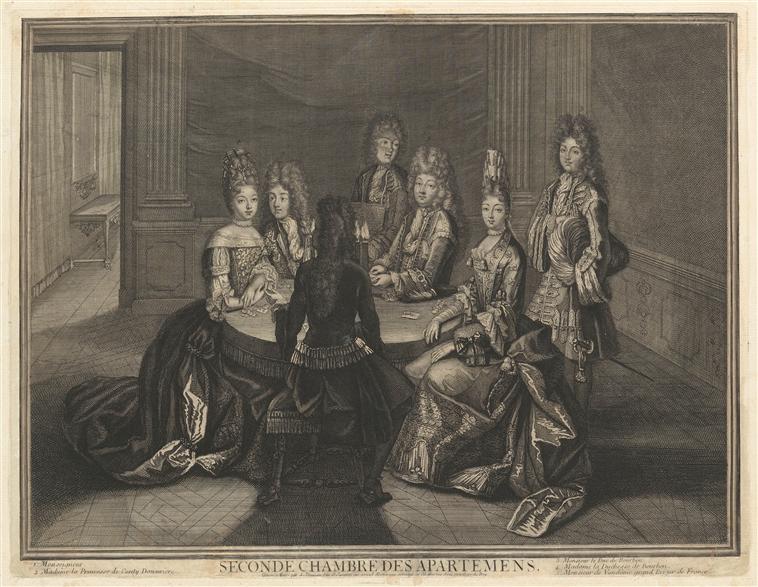 |
| The gambling sessions |
There is a lovely series of engravings which gives a hint as to what happened in each room; the series span from 1694-98:
 |
| Theatrical performances in the Salon d'Apollon |
Drinks would be served in another room and would range from the usual wine and liquor to the exotic coffee and teas. Fruits juices were provided in an array of colours; they would usually be flavoured with herbs, spices and nuts.
Actually, each salon in the Grand Apartment had its own purpose during these entertainments (I also mention this on my post on the Grand Apartment). The Salon de Venus was a buffet room where the delicious dishes were elaborately displayed on large tables. The Salon de Mercure was filled with small tables at which different games were played and often at high stakes while the Salon de Diane was reserved for games at billiard. The Salon de Mars was reserved for ballroom dancing while the Salon d'Apollon was for music and theatricals.
The Court Appartements should not be mistaken for the private Appartement which would be far more limited in numbers and a lot more intimate.
 |
| Billiard games in the Salon de Diane |
Desk of the Queen's House
Jean-Henri Riesener created this writing table for Marie Antoinette's rooms in her own private retreat. Thanks to the stamped number "84" we know that the table was intended for the Queen's House in her hamlet. The design is a mixture of classical straight lines and the gilded flowers so beloved by the Queen.


It is not possible to place furnitures in the Queen's House any longer so the table has been moved to the largest room of the Queen's private apartment. Originally, there were also four corner tables in the Queen's House, all produced by Riesener.


Subscribe to:
Posts (Atom)