Saturday, 27 August 2022

The Disastrous Marriage of the Prince and Princesse de Conti

On 9 July 1713 a prestigious marriage took place at Versailles; the bridegroom was a prince of the blood, Louis Armand II, Prince de Conti, while the young bride was Mademoiselle de Bourbon. The young lady's full name was Louise Élisabeth de Bourbon who happened to be the granddaughter of Louis XIV and Madame de Montespan.


Initially, the marriage went on much as usual for the time. The couple did not spent much time together and quickly struck up extramarital affairs. For one, the new Princesse de Conti was known to have taken the Marquis de La Fare as her lover - known that is, to all except her husband. It was not until the Prince de Conti fell seriously ill with smallpox in 1716 that he caught wind of the affair. Despite the notoriously contagious disease, the prince was nursed by his wife herself. As a result, she would also contract the disease but luckily survived.


It is unknown exactly when - or how - the Prince de Conti caught wind of his wife's adultery but when he did he was furious. Taking full advantage of the rights given to him as a husband by the law, he beat her to such an extend that she had to seek medical help - not once, but twice. 

Despite his anger at her betrayal, it turned out that the Prince was little better than the Princesse, as he had several mistresses of his own. Louis had even attempted to complain to the Regent but had been informed that such matters were between husband and wife.


Portrait of Louise Élisabeth de Bourbon (1693-1775), Princess of Conti by Pierre Gobert.jpg
Louise Élisabeth

Naturally, after such violent outbursts, the Princesse was not eager to remain with her husband and moved to the Palais-Bourbon which was owned by her mother. At some point around this period, Louise Élisabeth found out that she was pregnant which only reignited tensions between the couple. When she was seven months pregnant her husband paid a surprise visit to her and discovered that she had the company of Comte de Saxe. Even though it was an ordinary social call, the Comte de Saxe's reputation with women made Louis furious once again. 

Louis denied that he was the father of the child while his wife insisted that he most certainly was. Yet, it would seem that the words were exchanged in a fit of anger as he was soon before said to have thrown himself at his wife's feet to ask for forgiveness. Despite his contrition, she refused to return to the Hôtel de Conti - even after he sent an official summons to her, asking her to give birth in his hotel. Perhaps her refusal was due to his previous abuse - or perhaps she wished to avoid his new mistress, Mademoiselle de La Porte.

After a while though, the Princesse returned to her husband's roof. It was there that Louise Élisabeth gave birth to a healthy son on 13 August 1717; having thereby produced an heir, she sought to escape her deeply stormy marriage.


Drawing of Louis Armand de Bourbon (1695-1727) as Prince of Conti.png
Louis Armand

In April 1722, the Princesse de Conti formally submitted her request for separation to the Prèmiere Chambre des Requêtes with a further request of 60.000 livres in allowance while the trial lasted. In return, the Prince de Conti insisted that she removed herself to a convent of her choosing and offered 6.000 livres in silver. It would appear that the Princesse had argued for a separation on the basis of threats, physical injuries, treating her "like a lackey" etc. On his end, the prince merely argued that he had increased her allowance and bought her diamonds worth 100.000 livres. 

The court reduced her allowance to 20.000 livres and she consequently went to the convent of the Port-Royal in the faubourg of Saint-Jacques.


On 17 June 1722 the court decided in favour of the Prince de Conti and thus refused the Princesse her request for a separation. The judges decided that she could remain at the Port-Royal for six months but afterwards she was obliged to return to her husband. Amongst the arguments of the court one in particular perfectly captures the conditions imposed on the nobility during the ancien régime: as a princess of the blood the Princesse de Conti could not easily be removed from her husband because she might still deliver heirs to the crown. After all, the couple had only a single surviving son (their first having died in 1717 and their third shortly after her request for divorce) and child mortality was rampant. So, Louise Élisabeth's position as a childbearing princess of the blood outweighed the domestic abuse she experienced at the hands of her husband. 

As could well be expected, the Prince de Conti was very well pleased with the decision. To reward his attorney, the prince gifted him a carriage and two horses worth 4.500 livres. 


Cloister of the Port-Royal where Louise
Élisabeth sought refuge

While her husband was celebrating his victory, Louise Élisabeth was reluctant to leave the convent of the Port-Royal. It was not until the Cardinal Noailles requested an audience with her that she received any guests. Once she had met him in the convent's parlour, he motioned to the door and in came the Prince de Conti, her mother and her two children. They attempted to convince her to return to her husband but she refused - or as Barbier put it "she was being very stubborn about it". One could readily imagine that her reluctance was only heightened when her husband made it clear that he would like more heirs to be certain of his legacy.

Thus, she remained in the convent for the time being. After a year, the prince realised that he was not able to retrieve her with words so he consented to letting her remain at the convent for 4-6 years. However, that meant remain within the convent - he had made remarks that if he saw her outside the convent he would take her back to the Hôtel de Conti whether she wanted to go or not. His threats became ever more increasing as she was noted to be leaving the convent frequently to go visit her brothers. Once again, the Prince de Conti turned to the Regent to complain of this behaviour but was met with indifference. At the time being she was being protected by a cachet du Roi which the prince swore to respect.

Yet, he seemed to have been frustrated by her continued refusal to return of her own accord. When he was heard threatening to kidnap her from the convent - and set it on fire - the king posted a guard by her side. According to some sources that guard counted no less than two sergeants and 50 guardsmen who remained on their watch at all times. Being thus prevented from forcibly "regaining" his wife, Louis withdrew -  but not before having complained to the king himself.


As it happened, the king turned out to be providing the Princesse de Conti with more than guards. Having had her request for her allowance drastically reduced, she had applied to the king for a supplement to her income. He granted her 6.000 livres per month in addition to what she already received.


The Hôtel de Conti in Paris

For quite some time the situation remained the same until the Princesse de Conti unexpectedly sent for her husband on 13-14 April 1725. Whatever happened between them can only be known to them - yet the result surprised everyone. After their discussion, Louise Élisabeth left the convent and returned to the Hôtel de Conti with her husband. From there, she would later be sent to the Château d'Isle-Adam. It was not until she conceived their fifth child that she was permitted to return to Paris for her confinement.


It seems quite clear that their relationship would have continued to be entirely dysfunctional if it had not been for the unexpected death of the Prince de Conti. The year after the birth of their fifth child - a daughter - Louis became seriously ill and died at the age of just 31.

The death of her husband left Louise Élisabeth in a remarkably comfortable situation. Of the five children she had borne two remained alive: Louis François (the new Prince de Conti) and Louise Henriette. She could exercise considerable influence over both her children's lives without the threat of physical or emotional violence from her husband. Meanwhile, she enjoyed a very high rank at court as well as a considerable fortune which left her free to do as she pleased. Unsurprisingly, she never remarried and died on 27 May 1775 - 48 years after her husband.

Monday, 22 August 2022

The Princes Étrangers

One of the most ambiguous ranks at court was that of prince étranger or foreign prince. Hierarchically, they followed immediately behind the legitimate royal family. The rule of thumb was that a prince étranger only had precedence over a member of the royal family if that member was an illegitimate child of the king - however, if the member had been officially recognised the prince étranger ranked below them.


The problems arose when it came to the French peerage. Generally, the Parlament de Paris was reluctant to make a firm stance and it consequently became unclear exactly who had precedence. Naturally, this led to countless squabbles and infighting between the families. Unlike the dukes, the prince étranger had no right to have his legal cases heard by his peers in the Parlament de Paris, unless they also held a French peerage. It became a sore spot for years to come and one that Louis XIV himself had to weigh in on on numerous occasions - for once, the dukes were not willing to submit to the king's order.

In certain specific cases, it would seem that the prince étranger outranked the duke. For instance, while a duchess was infamously entitled to her tabouret, the same could not be said for the duke's sisters or daughters. In contrast, a prince étranger could proudly watch his wife, sisters and daughters take a seat in the chair. 

Yet, the prince étranger was entirely dependent on the king as much as the duke was. While certain privileges were immediately granted as a matter of right, other more contested rights were entirely depending on whether the king gave his permission or not.


Those categorised as princes étrangère usually fell under one of three categories: 

  1. They descended from a younger branch of a foreign, ruling house - this meant that their relatives were the rulers of a foreign state but because they were born from a younger member of that family they had no hope of gaining that throne
  2. They ruled their own, small principality - in this case it was traditionally added that the family must have made the French court a "second home"; they had to have stayed there for extended periods
  3. They were descendants from either a foreign throne but through the female line or from a dynasty that was formerly sovereigns 

With that many conditions, it is hardly surprising that only six families qualified as being princes étranger at Versailles during Louis XIV:

House of Rohan

As the descendants of the former dukes of Brittany, the Rohan-family could rightly claim to be the descendants of a former sovereign family - or could they? Historically, there has been quite a lot of debate as to whether the Rohan-family truly did descend from the sovereigns of Brittany, as little evidence can be found for it.

Yet, the family was determined to achieve the rank of prince étranger and focused the bulk of their increasing power at court on just that. Besides numerous marriages to other families of this rank, they would raise their lands into distinct principalities - for instance Soubise or Guéméné - and used their close links to both Louis XV and Louis XVI to achieve their goal. For instance, they managed to fill the post of governess to the Children of France which meant that it was a Rohan who raised both Louis XVI and his children - until the Prince de Guéméné had to withdraw from court due to bankruptcy. 

House of Guise

As a younger branch of the House of Lorraine, the Guise-family had played a significant role in French politics in the 16th century. They continued marrying across various borders which left a family tree that spanned wide and made inheritances a nightmare - on a more practical level, it also made Louis XIV suspicious of them as they had relations at the court of Vienna.

The last Guise - Marie de Lorraine - died in 1688 after which their substantial titles, lands and benefits were divided amongst her many heirs, including the Princesse de Condé.


House of La Tour d'Auvergne

Officially recognised as princes étrangers in 1652, it was not until 1678 that the Duc de La Tour d'Auvergne could finally claim physical possession of his own dukedom, that of Bouillon. They therefore fell under the second category above.

They had originally thrown their lot with Mazarin during the Fronde which earned them numerous substantial rewards in both lands and titles. Their status was largely derived from the ownership of the Dukedom of Bouillon as well as the principality of Sedan. 


House of Grimaldi

As the ruling family of Monaco, the family of Grimaldi also qualified as princes étrangère by the second category. Acknowledged as princes étrangers by Louis XIV in 1688, the relationship between France and the small principality had been forged during Louis XIII. Placing his duchy under French protection, the then-reigning Duc de Monaco served the French king on the battlefield, thus cementing a firm and mutually beneficial relationship.

House of La Trémoïlle 

The descendants of the then-deposed kings of Naples (the Trastámara-family), the family could trace their ancestry to Charlotte of Aragon, the daughter of the King Frederick of Naples. The family laid claim to the principality of Taranto which was held by the Duc de Thouars - and he had been confirmed as a prince étranger in 1651. 

While the family did not succeed in taking the title from the Ducs de Thouars, they did manage to get officially recognised as foreign princes in 1621 by Louis XIII. They would continue to contest their rights well into the 18th century.

House of Savoy-Carignano

The younger line of the Savoyard royal family, the House of Savoy-Carignano had a somewhat troubled history with the French crown during the reigns of Louis XIII and Louis XIV. When the young Eugene-Maurice came of age and offered his services in the army to Louis XIV, he was refused due to his mother's fall from grace which led him to serve the Holy Roman Emperor - he would become one of the greatest generals of his age.

This goes to show the level of distrust often shown to these quasi-French families whose loyalties could easily be spread over both national borders and across family lines.


With such a complicated place on the hierarchical ladder it is hardly surprising that the etiquette and privileges accorded to these foreign princes were highly contested. Through the age of Versailles, the foreign princes would be in constant battle with the dukes and peers when it came to which class could claim which privileges. While the foreign princes made several attempts at gaining the upper hand they never succeeded at establishing themselves above the dukes. 

At court, a prince étranger was entitled to specific status symbols such as keeping their hats on during the king's audiences and being addressed as "Royal Highness" - in a more obscure twist, they also held the coveted honour of being betrothed in the king's own cabinet.

Wednesday, 27 July 2022

The Squabble for the Guise Fortune

The house of Guise had made itself infamous throughout the 16th century; the house had divided itself into several branches, the eldest of which was headed by the Duc de Guise. However, in 1688, the Ducs de Guise died out with the death of Marie de Lorraine, Duchesse de Guise. 


The reigning ducal couple of Guise was Charles de Lorraine and his wife Henriette Catherine de Joyeuse. The couple had had ten children of which seven were boys - few had probably expected the family to find itself extinct within a generation. Yet, two of their sons died in infancy, one entered the church while the other four died unexpectedly young at the respective ages of 27, 19, 33 and 24. Ironically, the eldest was the son who entered the church and thus fathered no children. As for the daughters, one died in infancy, another entered a nunnery - and then there was Marie.


1656 enngraving of Marie of Lorraine, Duchess of Guise (Balthazar Moncornet).jpg
Marie de Lorraine, Duchesse de 
Guise


Marie de Lorraine was unmarried and thus childless. She had won the guardianship over her nephew, Louis, who was the only surviving male heir to the house of Guise. However, the young boy died in 1675 which left Marie as the sole survivor of the Guise-family.

As the last Guise, Marie enjoyed the benefits of an enormous fortune including several duchies and their numerous incomes. By the late 1680's, Marie was in her early seventies and knew that she had to make a decision as to who would inherit her. When Marie de Lorraine died on 3 March 1688, her last will and testament revealed that she had deliberately attempted to exclude her niece, the Grande Mademoiselle, from inheriting - and so, the legal drama began.

Besides the Grande Mademoiselle, there were two other major players claiming their share of the inheritance. One was Leopold, Duc de Lorraine and another was Anne Henriette, Princesse de Condé. 


The Will

Marie herself had favoured leaving all to Charles Leopold, father of Leopold, and the then-reigning. Duc de Lorraine. However, Charles Leopold died in 1690 before the case was settled at court which meant that Leopold was left to fight for his inheritance. The case might have ended there if there had not been a minor thing to consider: the will of the king. Louis XIV was far from pleased at having such a large fortune - and a duchy on his border - going to a man who served the Holy Roman Emperor as a general. Thus, the Sun King protested the will and sent it to the Parlament de Paris.


As for her hôtel in Paris - lavishly updated by Marie - she left it to a rather surprising recipient: Charles François de Stainville,  Comte de Couvonges. By her own will, Marie had chosen the Hôtel-Dieu in Paris (a charitable hospital) as the executor of her testament - she also left them a hefty sum of 53.000 livres.


One might wonder exactly why this particular will and testament was so vital. For one, the house of Guise had a very large fortune as well as considerable land possessions. However, that was not all at stake. For one, the owner of the duchy of Guise was entitled to having their lawsuits decided by either the king's own council or by their own peers at the Parlament. Furthermore, there was the question of the rank of prince étrangère which in itself gave the incumbent certain privileges such as keeping one's hat on when with ambassadors, sitting with the queen and direct access to the king. Consequently, the will was a matter of vital importance to courtiers who could only hope for advancement from the king himself. 

The Claims

Anne Henriette of Bavaria was amongst those who happily agreed with the king's decision. She had married the Prince de Condé. She based her claim on her great-grandfather Charles of Lorraine (another one!), Duc de Mayenne. He had married Henriette of Savoy with whom he had had Catherine de Lorraine who in turn went on to marry Charles Gonzaga, Duke of Mantua. Their youngest daughter was Anne-Marie who was married off to the Count of Simmern with whom she had Anne Henriette, Princesse de Condé. Another daughter was Bénédicte of the Palatinate who joined her claim to that of her sister.

Thus, Anne's claim rested already on the link through her mother and grandmother. However, there was another potential connection. Anne-Marie had fallen in love with Henri II de Guise, Duc de Guise, and even claimed to have married him - however, Henri denied it and she was packed off to her German husband.


Leopold de Lorraine's claim went back the furthest and was based entirely on the fact that he was the next male in line. His great-great-great-great-great grandfather was René II de Lorraine who fathered two separate lines: Antoine (Duc de Lorraine) and Claude (Duc de Guise). He was therefore a distant cousin to Marie de Lorraine.


Portrait en pied de Léopold Ier Duc de Lorraine.jpg
Leopold de Lorraine


The Grande Mademoiselle asserted her claim through her grandmother, Henriette Catherine de Joyeuse, whose first marriage had been to the Duc de Montpensier. It was their union that produced Marie de Bourbon who would marry Gaston d'Orléans and give birth to the Grande Mademoiselle. Consequently, the Grande Mademoiselle's claim was entirely through the female line.


While these three were the most illustrious claimants, they were by no means the only ones. Amongst those who turned up at the Hôtel-Dieu to press their claims were Béatrix de Lorraine, the Prince d'Harcourt, Élisabeth de Lorraine, the Prince de Lillebonne and the Prince de Commercy.


In summary, two distinct families within the house of Bourbon contested the will: the Bourbon-Condé (through Anne Henriette and Bénédicte) and the Bourbon-Montpensier (through the Grande Mademoiselle).

Yet, there was one person who was conspicuous by their absence: the Duc d'Elbeuf. He was technically the next male in line, so it would seem odd that he did not press his own claim. Liesbeth Geevers and Mirella Marini has pointed to the fact that the dukedom of Guise would bestow a peerage on the recipient but the Duc d'Elbeuf was already a peer in his own right. It therefore made no sense to go through an expensive and likely drawn-out legal battle to obtain what he already possessed. 


Anne Marie Louise d'Orléans, Duchess of Montpensier, La Grande Mademoiselle - Versailles MV 3476.jpg
La Grande Mademoiselle


The Decision

By order of the king, the Parisian Parlament examined the last will and testament of Marie de Lorraine for a month and a half. They reached their final decision on 26 April 1688. Considering the king's clear opinion on the matter, their decision did not come as much of a surprise: it was completely overturned, thus stripping the Comte de Couvonges of his dues.

Consequently, the titles were divided between these two women. The principality of Joinville (title: Prince de Joinville) went to the Grande Mademoiselle, the duchy of Guise (title: Duc de Guise) to Anne Henriette while the Duc d'Elbeuf (another Lorraine) got the Duchy of Joyeuse.


The Arguments

The case of the Duchesse de Guise's will is a complex one due primarily to the intricate familial links between several aristocratic houses across various borders. When all was said and done, the Parlament rested their decision on the piece of legislation known as the Droit d'Aubaine.

Amongst others, the Droit d'Aubaine made it impossible for French estates to be left to people who had been born on foreign soil - unless they had been naturalised. This immediately excluded several of the would-be pretenders to the duchies and principalities in hand:

Leopold's father, Charles V of Lorraine, was born in Vienna but was naturalised as a Frenchman in the 1650's - however Leopold himself had never been naturalised. He could therefore not inherit either the duchies or the principalities, much to the delight of Louis XIV.

Another potential candidate, the Prince de Salm, based his claim on the very same basis as both Anne Henriette and Bénédicte. His mother had been their elder sister, Louise-Marie, who had died before the Duchesse de Guise. However, by virtue of his being the son of the eldest daughter, he was a likely candidate to inherit. But to his great misfortune - in this case at least - he had not been born in Paris like his mother but in Aachen. Furthermore, he was not even residing in France but in Vienna. He therefore made just as unpalatable an heir to Louis XIV as Leopold. Luckily for Louis, the Droit d'Aubaine also excluded him.

Even then, there were two other people who could have pressed their claims: the Duke of Mantua (through Charles de Lorraine, Duc de Mayenne) and his immediate heir Archduchess Eleonora Maria. The Duke of Mantua had no sons and Eleonora was his niece. As they had both descended from a male "higher up" in the family tree, both the Duke of Mantua and the Archduchess might have laid claim to the titles if they had not been born foreigners. The Duke of Mantua had been born in his own duchy while Eleonora was born in Regensburg.

Consequently, the Parlament de Paris concluded that the most senior natural heir to the Duchesse de Guise was Anne Henriette, Princesse de Condé by marriage.


Anne de Bavière, princesse de Condé - Versailles MV 3555.jpg
Anne Henriette - the overall
winner of the case


Monday, 25 July 2022

Robes à la Levantine & à la Lévite

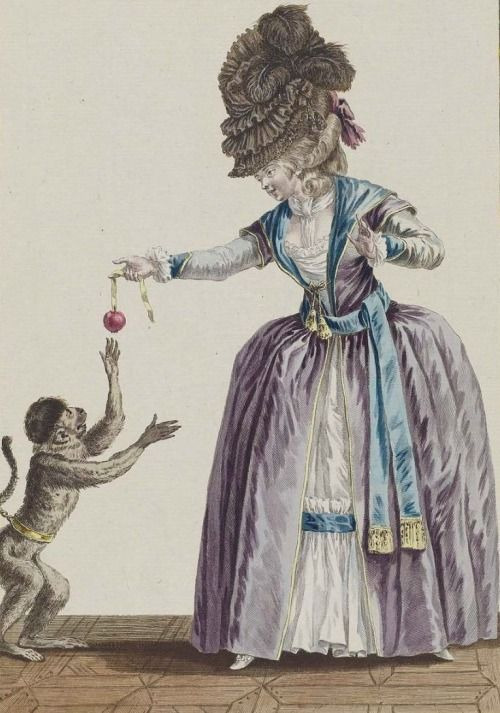
Robe à la Levantine

Despite its name, the robe à la Levantine is not a gown in itself like a robe à la Française or à l'Anglaise. Instead, it is a sleeveless - or short-sleeved - robe which was worn over a usually gown with long sleeves which would pass through the sleeves of the Levantine.  Compared to the very tight-fitted gowns usually worn by French aristocrats the robe à la Levantine was loose and was fitted at the back with somewhat loose pleating. Typically, it would be hemmed with fur, particularly ermine.

The robe à la Levantine was amongst the styles which became popular with the trend for "turquerie" or Turkish fashions. According to the Galerie des Modes et Costumes of 1779, the robe à la Levantine was the invention of Sarrazier who served as a costumier to the Princes of the Blood. 


The example given by the 1779
edition of the Galerie des 
Modes

It is easy to mistake the robe à la Levantine for a robe à la Reine - the latter is the name of a loose-fitting robe worn by Marie Antoinette during her first pregnancy. The lack of tightness around the waist made it a far more comfortable alternative to the rigid whalebone-supported court gowns; it is therefore not surprising that many women at court were pleased to adopt this new, exotic trend. While few ladies would venture beyond their own threshold, it suited just fine for a quiet day at home.

As the gown opened in the front, it became necessary to have something to fasten it with. Usually, this was done with a simple pin but a brooch might serve as well.


Robe à la Lévite

Popularly said to be inspired by Racine's "Athalie" in which the choir wore similar gowns to the robe à la Lévite. Like the Levantine, the Lévite was opened in the front but was often worn with a belt or rather a sash tied loosely into a fashionable knot. Besides the belt, it was also fastened with bows or buttons - always placed above the waist. It also sported a large collar, typically accentuated with a fichu.


Robe à la Lévite - note the belt and the
somewhat loose-fitted waist


Another aspect which connected the Levantine with the Lévite was the sheer comfort. As the gown was not meant to be worn with a stiff corset, it became far more preferable. Initially, the gown was ankle-length but it eventually developed a train. Unlike the Levantine, the Lévite had full sleeves extending down to the wrists but were not nearly as snug as the usual court gowns.


Marie Antoinette was very fond of this type of gown and had worn it during her first pregnancy in 1778; by 1782, they made up a third of her substantial wardrobe. 


Tumblr media
Se how the bodice is held together


While the queen was celebrated for making the gown fashionable, the Vicomtesse de Jaucourt caused quite a stir of her own in 1781 when she appeared in the Luxembourg garden in a Lévite with a new twist: a so-called "monkey's tail" which apparently intended to raise the gown a little. Its name was derived from the long, twisted train. It was said to have caused such a stir that the Swiss Guards belonging to the Comte de Provence had to ask her to leave.

Saturday, 23 July 2022

Foreign Influences: Turkey

The allure of the Ottoman Empire had already taken hold of the European courts during the 17th century and would continue on-and-off until the fall of Versailles. By the reign of Louis XVI, it was at its height. At court, the exotic style was called "turquerie" - and it influenced everything from fashion to interior design.


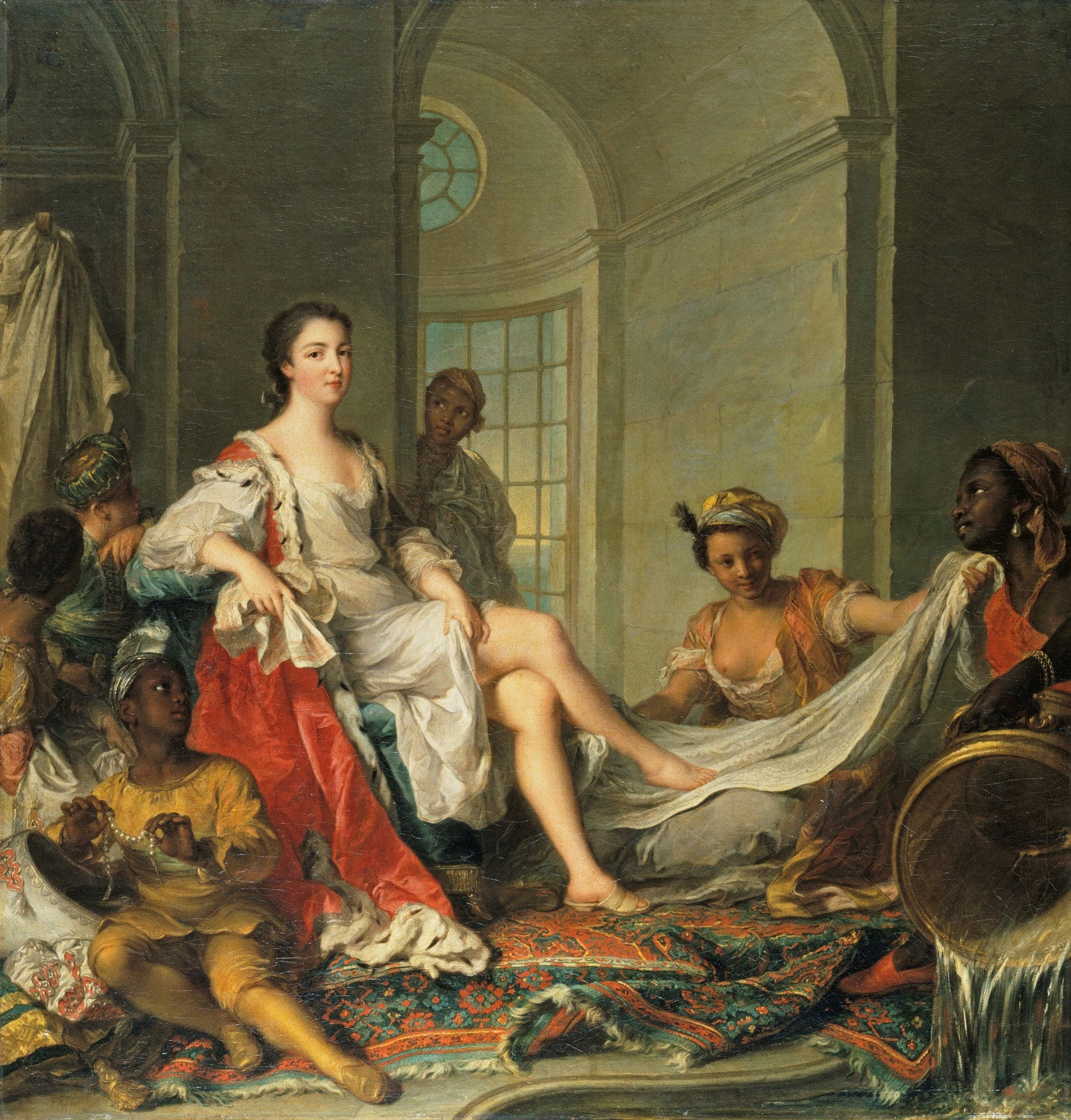
Mademoiselle de Clermont, 1723


The French court's interest was already piqued in 1669 when Sultan Süleyman Agha Müteferrika's envoy arrived in Paris. Although the visit was hardly a diplomatic success - the French refused to acknowledge the Turks as proper ambassadors and the Turks were unwilling to show the demanded adoration of the king - but the fascination with the Ottoman Empire caught hold. Besides several instances of portraits à la Turque, the envoys also brought popular trends to court: coffee and tobacco.


The Ottomans had long been a inspiration for the creatives mind at court - although not always positively. Molière's "Le Bourgeois Gentilhomme" had clear Oriental inspirations,  Racine's "Bajazet" of 1672 took place within a harem while Mozart's L'Enlèvement au sérail" dealt with a couple of Westerners sold to "Pacha Selim"; later Salieri's "Tarare" took Paris by storm. Unsurprisingly, many of the plays, books or operas which included Ottomans often depicted them in a negative (on occasion even rather racist) manner. The contemporary Western society viewed the Ottoman Empire with a mixture of fascination, contempt and fear. The incredible luxury of the sultan's court, the exotic finery and goods imported from his lands and the foreign customs all intrigued the courtiers. Yet, it had not been long since the sultan's armies had massed outside of Vienna and his military prowess remained a constant threat. Finally, there were certain stereotypes which seem to have had a firm hold on the Western courts. Many considered the Turks to be more wildly passionate, less scrupulous and prone to deceit - such prejudices were bound to spill into popular culture such as operas.


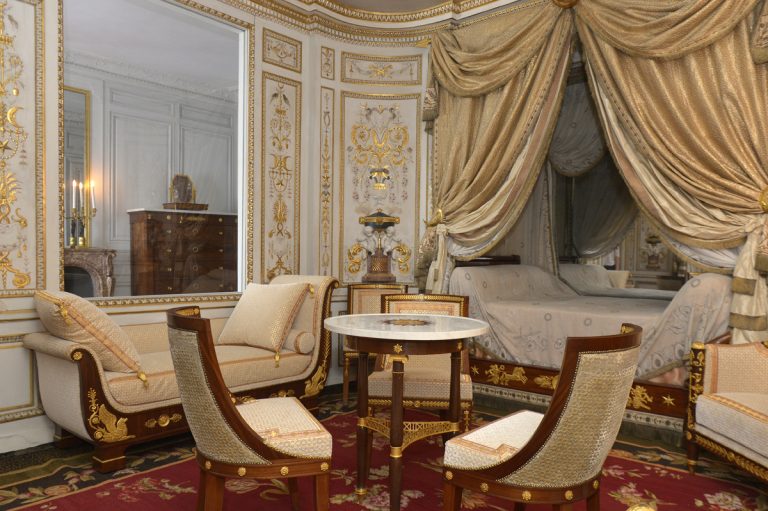
Aucune description de photo disponible.
Reconstruction of the Comte d'Artois'
boudoir 

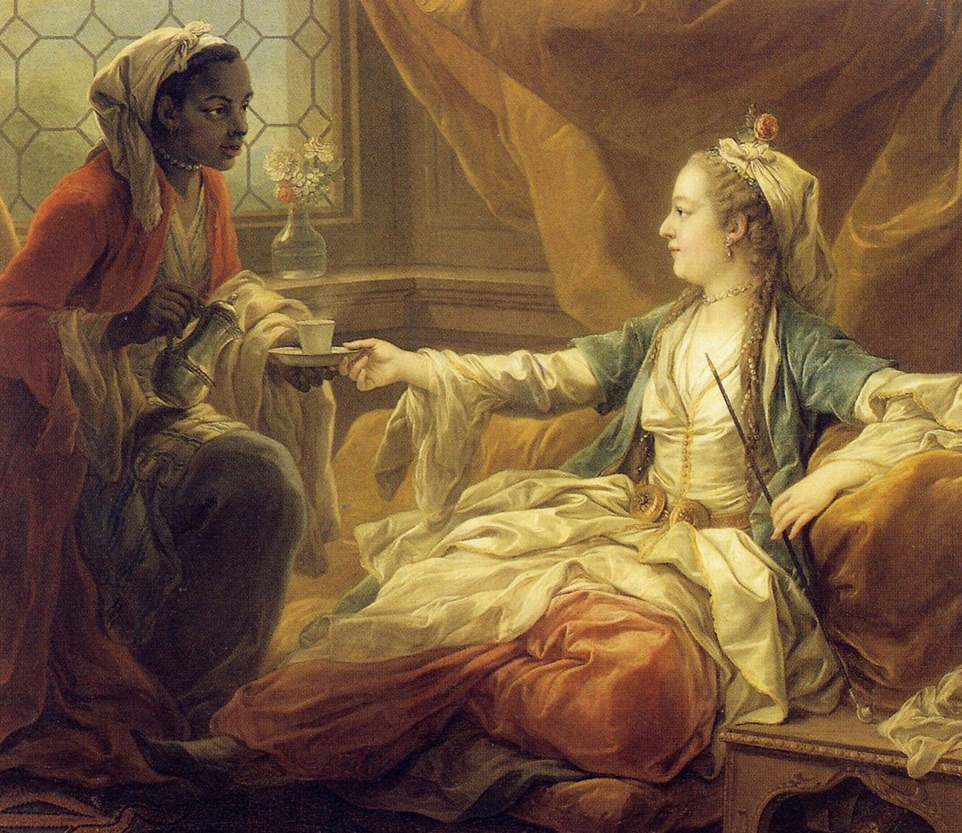
Madame de Pompadour - who is otherwise best known for her delicate rococo style - appears to have indulged in the fashion for "turquerie". Besides owning several pairs of so-called harem-trousers, she also had herself painted as a sultana. Furthermore, Madame de Pompadour ordered several paintings with Turkish motifs for her apartments at the Château de Bellevue.

Such portraits usually entailed turbans and kaftans for the strikingly pale gentlemen and layers upon layers of various colourful fabrics loosely draped for the ladies. The fashion thus contracted sharply with the tightly laced bodices of the gentlewomen at court - and also illustrates the common belief that Turks were more free in their bedroom manners.


Daughter of the Earl of Carlisle

The fascination with the seemingly unending riches of the Orient also provided inspiration for the merchant providers to the court. Of these, the most infamous was Rose Bertin whose couture-shop "Le Grand Mogol" pandered to the rich and powerful while exotic silks could be bought at the similarly titled "Au Grand Turc". The dresses à la Turque were as colourful as could possibly be and often included a loosely draped belt in a contrasting colour. One of the main selling points was how comfortable these more loose-fitting gowns were compared to the rigid robes à la Française with their unbending whalebone corsets. In total, three different types of gowns were introduced as a by-product of the mania for turquerie: robe à la Turque, robe à la Sultana and robe à la Levantine. All were loose-fitting, all were colourful - and all were popular.


Lady wearing a robe à la Levantine,
1775

At masked balls, it became fashionable to wear dresses à la Turque and others emulated Madame de Pompadour's Turkish inspired portraits. Interestingly, the celebrated drawing by Cochin of the Ball of the Yew Trees (the masked ball celebrating the dauphin's marriage in 1745) clearly show two guests dressed as Ottomans. Courtiers would attempt to make their costumes as accurate as possible; luckily for those without first-hand experience of the Near East, books were at hand to help out. A courtier preparing for a ball might consult the Recueil Ferriol by the Comte de Ferriol which depicted no less than 100 different outfits worn by different social classes.


Madame de Pompadour as a Sultana by Charles-
André van Loo


By the mid-1750's and onwards, the siege of Vienna was long forgotten by the French courtiers and the fashion with everything à la Turque tended to focus more on fashion and interior design than politically charged plays.

During the 1770's and 1780's it became fashionable to decorate entire rooms in the "Turkish style". The Comte d'Artois was one who was very taken with the style. He had boudoirs installed in 1774-75 at Versailles itself, no less than three ensuite rooms in the south wing. Today, the designs chosen for such rooms would probably be seen as stereotypes. Of the surviving wall panels images such as crescent moons, men in turbans and harems were the focal points.

Marie Antoinette herself followed the footsteps of her brother-in-law and had a Turkish boudoir installed at Fontainebleau in 1777 (it was restored in its entirety in 2015). She purchased several plaques with "Turkish" motifs from 1774 until 1782; even Louis XVI bought some as late as 1787. It says something of the popularity of having a boudoir in this particular style that the otherwise sombre Madame Élisabeth also had one installed in her own estate.


Boudoir turc du château de Fontainebleau restauré grâce au mécénat
The restored boudoir de Turc at Fontainebleau
- it now stands as Marie Antoinette designed it


Surprisingly, especially considering the extravagance involved, the taste for turqurie survived the turmoil of the revolution.

Friday, 22 July 2022

Marly: The Sun King's Retreat

While work was ongoing on Versailles, the Sun King set his sight on a far smaller - but far more exclusive - retreat for himself and his nearest and dearest. The plot chosen was located to the north of Versailles' park; as such, it was a secluded place, ideal for more intimate outings.


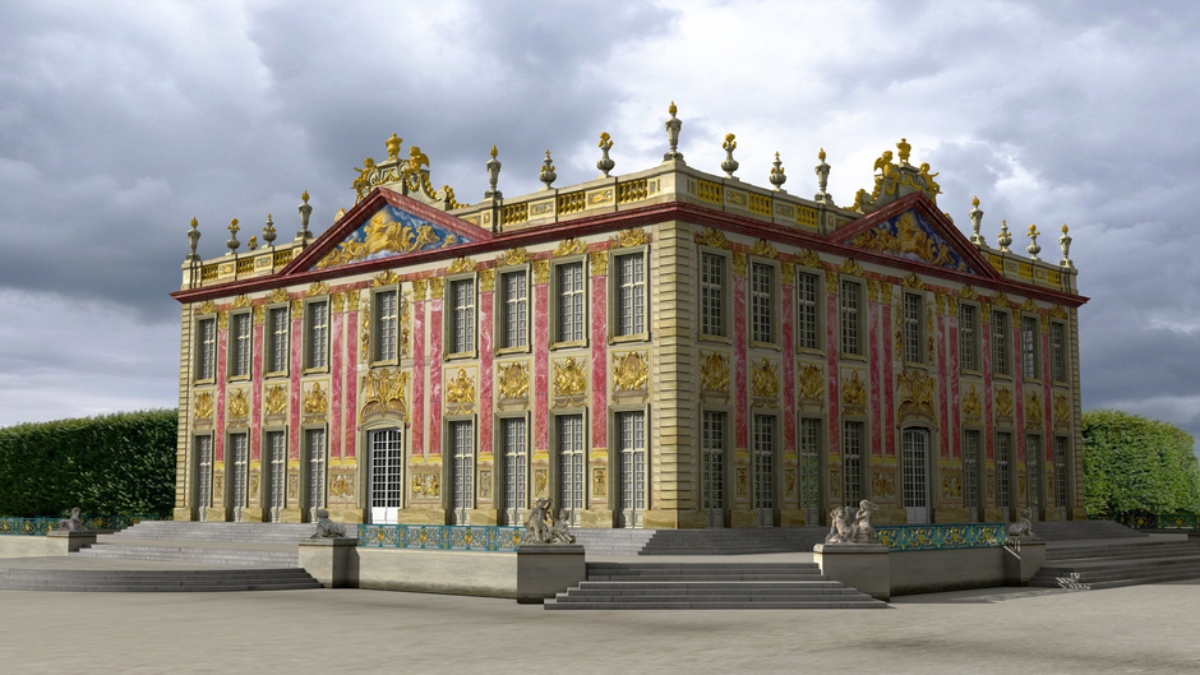
The idea was to create a space where only the king, chosen members of his family and favoured courtiers could indulge in a few days of respite from the throng of courtiers, commoners and soldiers usually found at court. Begun on 22 March 1679, the estate was the result of the cooperation between Mansart and Le Brun; their idea was to divide the château itself in a rather unusual way. Rather than having a single large palace to house all the guests, the building plan was split up. At the very centre would be the royal pavilion flanked on both sides by a total of 12 smaller pavilions (6 on each side) intended to provide housing for the chosen courtiers. The result was that the royal family lived together as a family in way that was simply not possible at Versailles.


View of the royal pavilion at the centre
with the combined 12 smaller ones for invited
guests

In true form, the pavilions were immediately dedicated to characters whose presence was already found in abundance at Versailles: Apollo (for the king's own pavilion), Hercules and Thetis as well Victory, Fame and Abundance. 

As is clear from the painting above, the masterplan behind the king's new pleasure ground required water - and lots of it. However much like Versailles, the design chosen required a lot of water. Luckily for Marly, it had more natural sources than Versailles and would eventually supply water for the fountains of the palace. This meant that a complicated hydraulic system had to be invented, installed and tested before the château could finally inaugurated. It took five whole years for that process but the fountains successfully sprouted in 1684 with the king standing by to watch. As the fountains filled with water, so the earth was filled with flowers. Immense quantities of flowers were grown and transported to the parterres of Marly. John Dixon Hunt and Michel Conan illustrated how no less than 24 % of the flowers grown for the royal estates of Versailles went to Marly. 

These two gentlemen has even provided us with the specific numbers of flowers concerned (see their book Tradition and Innovation in French Garden Art); amongst the deliveries to Marly, narcissi were by far the most dominant flower. 144.850 of them went to Marly along with 144 cases of tulips, 1.100 Spanish carnations, 1.075 irises etc. Like the greenhouses of Versailles, Marly's gardens were later chosen for the king's gardeners to grow especially rare and beautiful flowers.

Yet, it was not until 1686 - four years after the court moved to Versailles - that the buildings were finally finished enough to allow for the king to stay there. The wait was worth it: the pavilions and their lush gardens created a wonderful arena for the king to withdraw a bit from his own court. 


Château de Marly-le-Roi reconstitution en 3D
Reconstruction of the king's pavilion
( (c) Aristéas)


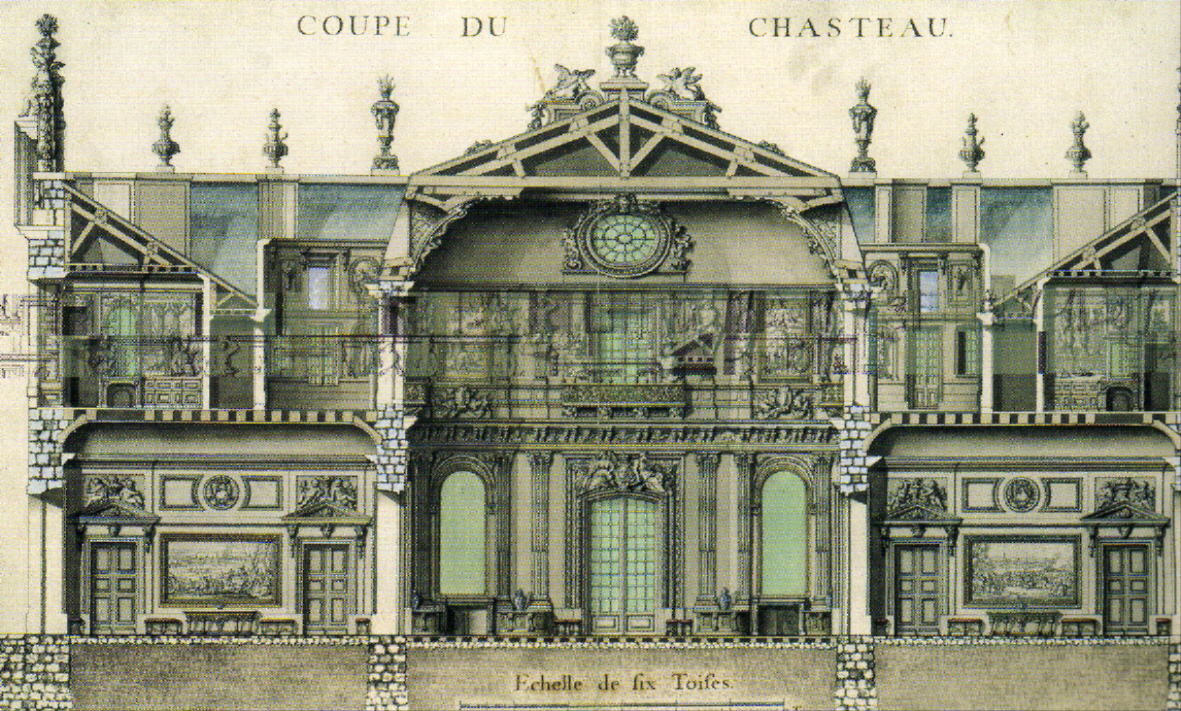
The king's pavilion - recreated above - had four large apartments on the ground floor reserved for four people: the king, the queen, Monsieur and Madame. Each apartment was accorded its own colour scheme and was associated with a season; the king's was red for the summer, the queen's was green for the spring while Monsieur's apartment was orange for autumn and Madame's blue for winter. At the very centre was a large octagonal salon built in the "Italian" style. It was likely this particular salon which formed the center piece for the numerous entertainments and gambling nights.


Floor plan of the king's pavilion


As can be seen from the floor plan above, the royal family were not the only ones to occupy the king's own pavilion. The first floor - left plan - was divided into a series of smaller apartments. Interestingly, the plan above indicate that Monsieur had been moved to the first floor while his apartment had been taken over by the Duchesse de Berry; meanwhile the queen's apartment was often lend out to the Grand Dauphin. Amongst those of the court who were given apartments on the first floor were the Duchesse du Lude, the Princesse de Conti, the Captain of the Bodyguard and several ladies of the court.

Note that the apartments on the ground floor was separated by salons of the same size - these were called Salons des Seigneurs and one housed a large billiard table.

In a rather ironic twist, Marly was meant to be a hunting château - located close to the hunting lodge-turned-palace of Versailles. The dense forests of the royal park ensured that game was plentiful and to ease the royal pastime, horses were moved there permanently. As the years went by the king - and his court - grew older. This required a few alterations such as wide paths through the park which allowed them to follow the hunt either in carriages.

Unlike the court at Versailles, Marly was a closed world. Only those invited especially by the king was allowed to reside there. But how to know if one was invited? In the true spirit of Versailles, even this became a ritual. For the gentlemen, they would approach the king after a hunt and simply ask "Sire, Marly?" - if the king approved, they were invited. If not, they were mortified. After a while, though, the king became tired of the constant questions. Instead, a list of the invited was drawn up by the king's trusted Bontemps and hung for all to see. It was generally a given that if a lady had been invited, she was entitled to bring her husband with her. 


Coupe du pavillon du roi à Marly.
View of the royal pavilion


Life at Marly was generally more relaxed than at court, although etiquette still reigned. However, to a regular at Versailles, it must have seemed down-right extraordinary. For instance, gentlemen were allowed to keep their hats on and everyone could sit down to gamble. Likewise, gentlemen were allowed to dine in the same room as the king - at Versailles the only man to ever be granted the honour of sharing the king's table was his brother. At Marly, the king ate at one table with the ladies while his son and grandsons entertained at other tables with the gentlemen. Several of the princesses were caught smoking pipes which the Swiss guards had provided them - after a thorough reprimand from their royal father that did not happen again. 

Quiet gambling evenings, theatrical performances and promenades made up the more usual entertainment, interspersed with the rarer - but absolutely sublime - fêtes. One thing that stood out in particular about the festivities held at Marly was their sheer extravagance. Exotic themes mingled with more rural inspired tableaux as decorations and costumes changed; some would be considered less than politically correct today such as "Chinamen" or the Ottoman Sultans. 


Plan of the park of Marly (the king's 
pavilion is the red square in the centre)


While the entertainment was splendid, there appear to have been some complaints about the living conditions. For one, the pavilions were almost inhabitable in winter due to the complete lack of insulation.  Yet the almost unrestricted closeness to the king enjoyed by those invited made up for such things. In all, the estate is estimated to have cost about 4,5 million livres. Marly became quite an expense for the royal treasury. Unlike at Versailles, the king picked up the bill for everyone involved - the guests were truly guests.

Even at Marly, the cares of state could not wait. While initially the château was intended only a pleasure house, a council chamber was soon made. During the War of the League of Augsburg, the king was kept regularly updated while staying there. The closeness to Versailles meant that sending a message would not take too long.


Courtiers were enchanted with the place; for one, the second Madame opined that Marly was much superior to Versailles. Undoubtedly, the increased relaxation and decreased number of people had a certain influence on that. Louis XIV himself never lost interest with his retreat. Throughout his life he would continue to make adjustments, embellish where he could and alter the things he no longer liked. By the end of his record-breaking reign, the Sun King spent a third of his time there.

Sadly, his enthusiasm for Marly was not shared by his successors. Neither Louis XV nor Louis XVI were enamoured with the place and let it largely go to waste. After the revolution, few of the buildings would remain and none of the magic that once reigned there.

Monday, 18 July 2022

The Terrible Household Management of the Princesse de Guéméné

Victoire-Armande-Josèphe de Rohan became the Princesse de Guéméné when she married her cousin, Henri-Louis-Marie de Rohan in 1761. As a member of the powerful Rohan-family, she was bound to lead a life at the very top of society. It was therefore not surprising when Victoire was given the prestigious post of governess to the children of France. As it happens, that precious charge had been in her family for generations as she counted amongst her relatives Madame de Ventadour (governess of Louis XV) and the Comtesse de Marsan (governess of Louis XVI).


The governess of the children of France (that is, the children of the king) was the most influential position available for women since the oppression of that of Surintendante of the Queen's Household. Besides a healthy wage the post was a goldmine for various benefits; her apartment was spacious and luxurious, she was entitled to a pension as well as the necessities provided for the children once these were changed for new ones - the latter was a very lucrative benefit, as these "necessities" included everything from linen to silverware. 


Having been appointed in 1776, the Princesse de Guéméné expected to remain in her post until her death; due to the importance of the task assigned to the royal governess, it was one of the few posts at court of which the incumbent could not be dismissed. However, behind the scenes, the personal finances of the Prince and Princesse de Guéméné were abysmal - even considering the standards of their time. By 1782 the couple was left with no other choice but to declare bankruptcy when their debts reached a staggering 33.000.000 livres.

To complete the humiliation, the bankruptcy forced Victoire to resign from her post and retire from court entirely. Once a successor had been found - the Duchesse de Polignac - it became clear exactly how mismanaged the Princesse de Guéméné's tenure had been.


Victoire Armande de Rohan madame la princesse de Guéméné.jpg
Princesse de Guéméné


The household of the children of France was in utter disarray during the years 1776-82. The Princesse de Guéméné had no sense of economy and did nothing to restrict the expenditure of the household. In contrast, the household was hemorrhaging money in the six years she was in charge. It should be remembered that during her time as governess, she only had one child to look after: Madame Royale. It was not until 1781 that the dauphin was born. Therefore, the expenses ought to have been significantly lower than her predecessor, Madame de Marsan, who had had no less than five royal children to attend to: Louis XVI, the Comtes de Provence and d'Artois and Mesdames Clotilde and Élisabeth. Yet, the difference in the two households' expenditure could not have been more different.

During Madame de Marsan, the annual expenditure amounted to 100-200.000 livres. However, the Princesse de Guéméné managed to spend no less than 299.253 livres in 1779 - for Madame Royale alone! The situation became downright ridiculous when that sum rose to a staggering 539.334 livres in 1781.


Understandably, such clear financial abuse led to suspicions of deliberate abuse. Consequently a report was drawn up to clarify to the king exactly how the Princesse de Guéméné had managed his children's household. The auditor (an anonymous man) concluded that Victoire was not guilty of deliberate fraud or embezzlement. While thus cleared of criminal charges, the auditor also made it abundantly clear that her management had been disastrous. 

As an example, each royal child was given a so-called "layette" which consisted of all the necessities the child might need including and was replaced every few years. As mentioned above, it was the prerogative of the royal governess to retain whatever she wanted from the discarded layette. The auditor lamented that for some unknown reason, the Princesse de Guéméné had spent no less than five times more on Madame Royale's layette than what was usual. As stated by the unknown (but clearly exasperated) man 234.795 livres had been "thrown out the window for nothing".


Madame de Guéméné with 
Madame Royale on her lap - 
the girl's parents are represented by a bust
and a portrait respectively


The king himself does not appear to have blamed Victoire for the dismal finances either. Instead, he believed that she had gained no financial advantage from her mismanagement but had been the subject of abuse and exploitation from those around her. 

She certainly had plenty of opportunity to abuse her position. As the governess, she ordered new supplies for her charges and needed only the approval of the king himself, with the Secretary of State for the King's Household as her intermediary. As she was responsible for hiring staff for the household, it was indeed possible that she might have received a gratuity of sorts; considering that buying and selling offices were the norm, it is not unlikely.


Yet, despite the glaringly obvious explosion in expenses, few of her contemporaries appear to have truly considered it to be the fruit of malicious intent. For one, the bankruptcy of her and her husband had been caused by speculation on his behalf (and his acquaintance Marchand) - not her's. Likewise, she was generally described as a remarkably honest woman which would not correspond well with an embezzler. Even if she had siphoned money it clearly had done little to nothing to ease her own financial situation. 

As a person, Victoire might have been both honest and kind but she was undeniable deeply irresponsible when it came to her finances. While she might not have had the same amount of control over their finances  as her husband, she certainly showed no restraint in her personal expenditure. Besides owing 60.000 livres to her shoemaker alone, the Princesse de Guéméné was also had an immense gambling problem. She has been discredited with introducing Marie Antoinette to gambling for high stakes and would herself continue to place astronomical bets until the very last minute before their public declaration of bankruptcy. It does not seem that remarkable then that she would have had such difficulties managing the finances of the royal children.


Victoire in the later 1780's


While the financial aspect of her (mis)management of the children's household undoubtedly drew the most attention, the governess does not appear to have been quite up to par on her other duties. As governess to the most important children at court it was her responsibility to maintain a constant vigilance near them. Yet, when a lower-ranking servant accidentally left a sharp piece of glass in the dauphin's food, Victoire not only failed to notice but even attempted to cover up the whole affair afterwards. As a consequence, the much-prayed-for infant came dangerously close to dying in infancy. 

It says a good deal of the society at Versailles that the financial mismanagement would occasion little surprise but the carelessness of the governess caused outrage. Finances were tough for most families at court so few people could truly claim to be debt free. However, the heir to the throne - and one who had been long in the making - was entirely different. It was around him that the courtiers expected to focus their lives when he should come of age; he represented the future of the monarchy - and the nobles themselves - and the idea that he should nearly die needlessly was unacceptable.

Despite her good intentions, it would seem that the Princesse de Guéméné was entirely unsuitable for the task bestowed upon her.


The court and public at large naturally pointed a finger at the Guéméné-couple themselves but in a sadly all too familiar twist, one other person became the designated scapegoat for their ultimate bankruptcy: Marie Antoinette.

The enemies of the beleaguered queen were quick to argue that she herself had "encouraged" the couple's ludicrous spending by attending their soirées - it was argued that by doing so, she led them to host others despite not being able to afford it. The queen was also singled about - amongst a large group of people - as a party to their ferocious gambling parties. Others complained that she had not acted with sufficient decorum in the handling of the resignation of her children's governess. Few of these critics recognised that the king and queen granted the former governess an astounding pension of 60.000 livres which was large even for her former position. Unfortunately for Marie Antoinette, she had already become the go-to scapegoat for misfortune.


As for Victoire and her husband, they retired to a palace provided by her father, Charles de Rohan. During the revolution, she fled to Austria and then Bohemia where she settled permanently - her family remained there for 125 years.