Monday, 24 September 2018

Anne Henriette Julie of Bavaria

Anne Henriette Julie was born on 13 March 1648 and was destined from birth to make an advantageous marriage. Her aunt (on her mother's side) was the Queen of Poland while her father was the Prince Palatine. That she would eventually be married off to a Frenchman was not surprising; her mother had been a resident of Paris for a good portion of her life.

The bridegroom chosen for the 15-year old Anne was the sole male heir to the Grande Condé: Henri Jules de Bourbon-Condé. The French royal family attended their wedding ceremony at the Louvre in December 1663. Upon her marriage Anne assumed the title of Duchesse d'Enghien; when her father-in-law died she would become the Princesse de Condé or Madame la Princesse. 
Anne's marriage may have been prestigious in title but would not be an easy one. Her husband had inherited a streak of madness from his mother; today we know that he suffered from the mental illness clinical lycanthropy. This meant that he would suffer violent hallucinations - on occasion, he would direct that violence towards Anne.

Anne de Bavière par Gobert.jpg
Anne by Pierre Robert

Despite being beaten by her husband - even in the presence of other people at times - Anne understood that his temper was not due to a "bad" personality. Although mental illness was not understood quite as well at the time, she did what she could to ease his sufferings. This was quickly noticed by the surrounding courtiers who recognized a genuine caring soul in Anne.
Her husband's illness did not prevent him from fulfilling his dynastic duties. Anne fell pregnant for the first time in 1666; she would have a total of ten children. Sadly, the Condés were not immune to the dangers facing infants and they lost half of theirs. 

Perhaps it was due to the loss of so many of her children that she took a careful interest in their lives. When her daughter, Louise Bénédicte, fell out with her husband, the Duc du Maine, Anne brought her daughter to see her husband in an attempt to reconcile them.

She would - like her mother - reside in Paris in the Petit Luxembourg. Actually, the current Rue Palatine is named after her. She also held the Château de Raincy in her own name. According to the Duc de Saint-Simon one of her most constant companions was an unnamed dwarf. However, Saint-Simon does not leave us with a very flattering image of Madame la Princesse. He described her as ugly, foolish but virtuous. According to him no one really considered her to be important and she herself had no interest in furthering her standing at court - instead, she focused on god. 
Although fashion did not take up much of her time Julien Scavini attributes the parasol's entry into fashion to Anne.

As for her looks, Saint-Simon might not have been kind to her but no one else described her as ugly. The portrait of her by Pierre Gobert at the age of 22 shows a young woman with curly, thick dark hair, equally dark eyes and a thick lower lip. Of course, the artist may have added something as a compliment but if the portrait is somewhat accurate, the description of Saint-Simon is far off. 


While Duchesse d'Enghien

It was thanks to Anne's mother that she would soon be joined at the French court by another Princess Palatine: Elizabeth Charlotte. As it happens, Anne and Elizabeth Charlotte were first cousins. The appear to have had a good relationship. Elizabeth Charlotte described her cousin as the only one in the house of Bourbon-Condé much worth anything. Madame attributed this to the portion of German blood in her cousin's veins.

Anne inherited the title of Princess d'Arches when the male line died out in 1708. Loss was not uncommon for Anne; she had already lost five children in their infancy and would lose her husband in 1709. A year later, the new Prince de Condé - her son - died as well. Over the years Anne would see the demise of another child: the Duchesse de Vendôme. Anne herself died on 23 February 1723 in Paris.

Saturday, 22 September 2018

House of d'Estrées

Originating from the region of Boulonnais at the very northern edge of France, the family first really made their advance at court with Gabrielle d'Estrées. The infamously beautiful Gabrielle caught the eye of Henri IV and became his mistress. Through their liaison her family was showered with riches and favours. The original family of d'Estrées separated into three branches: the seigneurs of Boulant, the Marquises de Cæuvres (and Ducs d'Estrées) and the Comtes (later Ducs) d'Estrées. The former branch died out in the male line in the 16th century. Therefore, only the latter two branches are explored beneath - however notice that the third patriarch is numbered as the fourth; that is because the last holder of the seigneurship of Boulant was Antoine III.

Marquis de Cæuvres and Duc d'Estrées 


1. François Annibal I d'Estrées and (I) Marie de Béthune, (II) Anne Habert de Montmort, (III) Gabrielle de Longueval

François Annibal was originally destined for a life in the church but began a military career instead when his elder brother died. Until then the patriarch of the family was known as the Marquis de Cæuvres but Louis XIV had the family elevated to the title of Duc d'Estrées. Furthermore, he was granted governorship of Soissons, Laon and Île-de-France. François died at the ripe age of 98 (!) on 5 May 1670.

Marie Béthune had married François Annibal in 1622 and had three children by him. However, she died suddenly at the age of just 26 years in 1628. Their children were:


  • François Annibal, Duc d'Estrées
  • Jean, Comte - later Duc - d'Estrées
  • César d'Estrées, Cardinal


Anne Habert had been married once before to Charles de Thémines when she married François Annibal. She died at Nanteuil in 1661 but before that she had two children by her second husband:


  • Louis d'Estrées, Marquis d'Estrées (courtesy title)
  • Christine d'Estrées, Comtesse de Lillebonne

Gabrielle was married to François Annibal in 1663 and died in 1687 - however, she had no children.


2. François Annibal II d'Estrées and Catherine de Lauzières-Thémine 

Besides the titles he inherited from his father François Annibal II was made ambassador extraordinary to Rome. As it happens this is where he died of apoplexy; in his honour pope Innocent XI treated his corpse with the honours usually reserved for princes. His body was transferred to France and buried next to his father.

Catherine married François II in 1647 and had three children by him:

  • François III d'Estrées, Duc d'Estrées
  • Louis Charles d'Estrées, Marquis de Thémines
  • Jean d'Estrées,  Duc and Archbishop of Laon


3. François Annibal III d'Estrées and (I) Madeleine de Lionne, (II) Madeleine Diane Bautru

François Annibal III added a knighthood of the Order of the King to his already impressive list of titles as well as Master of Cavalry Camp.

Madeleine was the daughter of a minister of state and married to François Annibal III in February 1670. Apparently, her behaviour earned her somewhat of a reputation. She died in 1684 The couple had five children:

  • Louis Armand d'Estrées, Duc d'Estrées
  • Constance Léonore d'Estrées, Comtesse d'Ampus
  • Marie Yolande d'Estrées
  • Felicité Perpétue d'Estrées, nun
  • Louise Hélène d'Estrées, nun
Madeleine Diane was the daughter of the Marquis de Vaubrun; she was twenty years younger than François Annibal when the two married in 1688. She outlived her husband by 55 years! The couple had three children:
  • César François Annibal d'Estrées, Comte de Nanteuil
  • Diane Françoise Thérèse d'Estrées
  • Marie Madeleine d'Estrées


4. Louis-Armand d'Estrées and Diane Mazarini-Mancini

Louis-Armand was further granted the governorships of Noyon, Domme and Soissonais.

Diane was related to cardinal Mazarin and married Louis-Armand in 1707. However, the couple had no children and both died relatively young.

Comte d'Estrées and Duc d'Estrées 

5. Jean II d'Estrées and Marie Marguerite Morin 

Jean was the second son of François Annibal d'Estrées and Marie de Béthune; he was granted the titles of Comte d'Estrées, Comte de Nanteul le Haudouin and Comte de Tourpes amongst others. He was also made a knight of the Order of the King and Viceroy of New France.

Marie Marguerite was the eldest daughter of a secretary of state; she married Jean in 1658. She found herself the enemy of Madame de Coulanges, a friend of Madame de Sévigné, because the two disagreed on whether the play "Esther" was any good. The couple had six children:


  • Victor Marie d'Estrées, Duc d'Estrées
  • Jean d'Estrées, Abbé de Villeneuve
  • Jean César d'Estrées
  • Marie Anne d'Estrées, nun
  • Marie Anne Catherine d'Estrées, Marquise de Courtanvaux
  • Elisabeth Rosalie d'Estrées


6. Victor Marie d'Estrées and Lucie Félicité de Noailles

Victor Marie was virtually showered in titles. Besides the dukedom of d'Estrées, he was a Grandee of Spain, Duc de Cæuvres, held seven seigneurships, Viceroy of New France, knight of the Order of the King etc. etc. He was even chosen by Louis XIV as a member of the regency council and led the council of the Navy. He certainly had seen his fair share of fighting; he partook in the campaigns of Holland, the League of Augsburg and the War of the Spanish Succession.
Victor was also an avid art collector and amassed quite an impressive collection. Such a rounded man was bound to attract some attention; when Peter I of Russia visited Paris in 1717 he made it a point to seek out the famous Vice-Admiral.

Lucie Félicité was married to Victor Marie by contract in 1698. The couple had no children.

Victor Marie d'Estrées
Victor Marie 


When Victor Marie and Lucie Félicité had no children the title went to Louis Charles César de Le Tellier. His mother was Marie Anne d'Estrées, daughter of Jean II d'Estrées.


Titles held by the family:
Duc d'Estrées
Duc de Cæuvres
Duc and Archbishop of Laon
Marquis de Thémines
Marquis de Cardaillac
Comte d'Estrées
Comte de Nanteuil le Haudouin
Comte de Tourpes
Vicomte de Soissons
Vicomte de Pierrefonds
Baron de Gourdon-Labouriane
Baron de Boulonnais


Interesting facts:

  • Jean d'Estrées, bishop of Villeneuve was made ambassador to Spain when he accompanied Cardinal d'Estrées (his uncle) there in 1701
  • Marie Yolande d'Estrées died just two months after her marriage to a captain 
  • A great deal of the family were buried in the convent of Feuillants in Soissons
  • Father Anselm claimed that François Annibal I had had an illegitimate child whom he later legitimized 
  • Jean d'Estrées, bishop of Laon was raised a companion to Louis XIV


Family portraits:


Billedresultat for François Annibal III d'Estrées
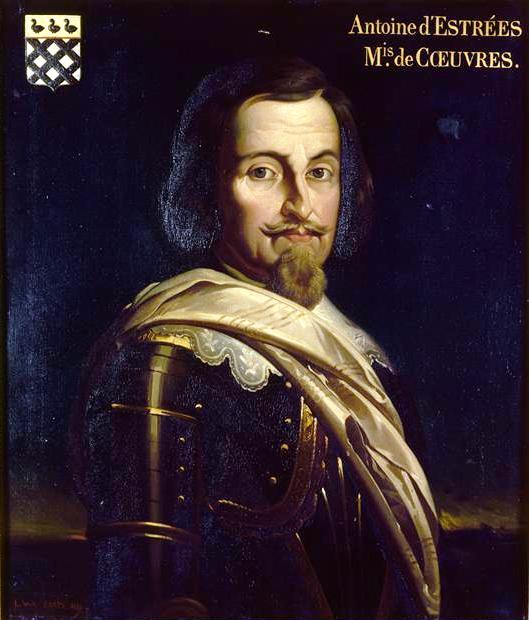
Antoine d'Estrées - the founder of the first ducal
branch

Jean d'estrées abbé de conches bm 116 par Randon.jpg
Jean d'Estrées, bishop of Laon


The Frailty of Madame de Pompadour

Although Madame de Pompadour cemented her position as the most influential of Louis XV's mistresses, her health was far from strong. Such frailty might have gone somewhat unnoticed if she had not been catapulted into the all-seeing court of Versailles.

One of her most constant complaints was that of migraines. On more than one occasion her head-aches became so severe that she had to retire from her beloved performances in her theatre. Such an incident occurred when the company were about to perform "Le Merchant"; she had to refrain from taking her part and it took her well over a month to be fully herself again. Apparently, these bouts were both frequent and well-known; a letter from her friend the Comtesse de Baschi of 1760 asked of the Marquise what she spent her days doing - when not suffering from migraines or bad company. 

These attacks of migraine did lessen in either frequency or intensity as she grew older; one time at Choisy she experienced such a horrible migraine that according to her attendants, she did not know where she was.

Relateret billede
Madame de Pompadour

Furthermore, the position as the king's mistress naturally enough raises some expectations of illegitimate children. But those who foresaw another Madame de Montespan were sadly mistaken. Through her life, Jeanne-Antoinette had only two living child: a boy and a girl who died in their childhoods. As she grew more secure in her position she could afford to eschew the king's more intimate advances but before that she, too, had to fulfil the more essential part of being a mistress - with the consequences that entailed.
Her problems had become evident already in 1741 when she became pregnant for the first time (by her husband, mind you). She quickly experienced bouts of fever but managed to cure them with plentiful quantities of quinine. 

Once she became the king's mistress her pre-natal problems returned. Twice she suffered miscarriages  - in 1746 and 1749 - but it is likely that she had more than these. For instance, the Duc de Luynes (a friend of hers) attributed a migraine as the result of another miscarriage; however, he lists it as her third.

As if these two were not damaging enough to her health, the Marquise appeared to have suffered from anaemia too. This was unfortunate in itself but even more so considering that the go-to cure for most doctors when it came to complaints such as a headache was to bleed the patient.
Several sources - including Emile Campardon - mentions that she suffered from a heart condition. Unfortunately, given the limited knowledge of that particular type of disease in the 18th century it is hard to say exactly what this entailed.

It is only natural that a person suffers bouts of ill-health throughout their life but what is interesting in Madame de Pompadour's case, is that these minor illnesses were often described as "fevers". It should be mentioned that the doctors of the day were more liberal with the word than we are today, so it can often be hard to know what exactly ailed the Marquise. What is more certain is the effect of these small periods spent in the sickroom. Since Jeanne-Antoinette and Louis' relationship ceased to be physical rather early on she relied on her talent for dispelling the king's natural melancholy. However, if she was ordered to remain in bed she obviously could not do so - but someone else might. The stress and fear that she might lose her position seems to have done its share to damage her health even further. 

Billedresultat for docteur de quesnay
François Quesnay, Madame de Pompadour's
doctor. He was ennobled for his continuous
services to the king's dear friend

Although the king did have other mistresses during his liaison with La Pompadour, it was still her company he sought. The king became so dependent on her that his need for her would occasionally outweigh his consideration for her health. The Marquis d'Argenson - who did not believe Madame de Pompadour was always really sick - tells of a time when the court was at Choisy and the maitresse-en-tître did not join the company due to illness. When the king asked if her absence was due to fever he was answered in the negative and immediately ordered her to come down - she did.

More than one of her contemporaries - both friends and foes - argued that she had sacrificed her health for her station. While her natural talents for amusing the king were plain for all to see, they took their toll on her bodily well-being. The thing was that Louis XV suffered from a rather melancholy temper which sometimes descended into downright depression. It was a full-time job keeping him distracted and thus in a better mood. Full-time and exhausting. To name a few, Madame de Pompadour had to stay up very late with theatricals, dinners or coach-rides and be up again early to resume a full day of often physically draining exercises. The lack of rest did little to alleviate her complaints.

In her final years, her ill-health had done away with most of her formerly famous beauty. Only her eyes was still widely held to be very beautiful. Her position was still intact though which was largely due to the dependency the king had on her. So, she might have fatally weakened her health - but she retained her position to the end.

No autopsy was performed on her body following her death in 1764 which might otherwise have given an insight into why she suffered so continuously. 

"Caca du Dauphin"

The 1770's and 1780's saw the emergence of ever more shades of colours and each had to have a fetching name. One of the more bizarre colours was "caca dauphin" - to put it politely, the shade took its inspiration from the colour of the newly born dauphin's soiled diapers. Believe it or not it did become quite the rage for a while.

The magazine on fashion, Toilette des Dames, attested to the colour's popularity despite its vulgar name: "the colour adorned all the ornaments and this word - that I recall today with repugnance - was on the lips of all the fashionable ladies."

Some attribute the original spreading of the colour as a fashion statement to the Marquise de Senteur who had allegedly been present at the changing of the little prince's linen when she spotted the "distinct" tone. Apparently, in an effort to spark a trend, she appeared in a satin gown of the same  yellowish-brown shade! Others claim that the term was coined by Rose Bertin, the haute couture provider to many a fashionable lady.
For a while the shade became the colour to dress new-born boys in - one can only wonder how long that lasted.

A floral print on top of
"caca du Dauphin"

It was not just ladies and infants who became attracted to the rather grotesque colour; gentlemen joined in as well. The 1874 "Musée Historique du Costume" refers to a man's silk suit in the colour of "caca dauphin" from the age of Louis XVI. According to the book by Gustave Desnoiresterres on Louis-Sébastien Mercier, the dramatist, Mercier, ordered a silk suit of the same hue from his tailor although he appears to have had some reservations as to whether he actually liked it. But, as he said,: "I do not want to depart from the slightest nuance of the prevailing fashions in either Paris or Versailles...". Apparently, he planned to wear it at the opera and expected a good reaction from his fellow on-lookers.

When a baroness was introduced at court she had ordered a new gown for the vital occasion; the soon-to-be courtier had ordered silk from Lyon in the caca-shade which was combined with a moss green. Some went even further and ordered new curtains in celebration of the newborn.

Once the revolution began such colours - and all others referring to the ancien regime - were very much out of fashion. Instead, those elderly ladies who still dared to show up in their dresses of that shade found themselves likened to "dead leaves".

Friday, 14 September 2018

A Match For Madame Seconde

Madame Henriette - also known as Madame Seconde - had partaken in her twin sister's wedding celebrations in 1739 and for a while it was expected that Henriette would follow her sister down the aisle. However, the match envisioned for Henriette was one of the heart rather than a political match. 

Madame Henriette and Louis-Philippe I, Duc de Chartres had developed warm feelings for one another. By November 1739 the Marquis d'Argenson noted in his journal that a "determined effort was made to marry le Duc de Chartres to Madame Henriette." According to d'Argenson, Louis XV - Henriette's father - was initially inclined to let the match take place. 

It was noted that the following spring the young Louis-Philippe was invited to accompany the king for his beloved hunts. During one of these outings the would-be bridegroom approached the king and brought up the matter. According to Imbert de Saint-Armand the Duc de Chartres had a good reason to hope for a positive outcome; in the author's words the Duc d'Orléans (the father of Chartres) had already been given an affirmative. 
Nevertheless, the king clapped Louis-Philippe's hand and declined. Why the apparently sudden change?

Madame Anne-Henriette de France, The Fire, by Jean-Marc Nattier, detail, 1751, oil on canvas - Museu de Arte de São Paulo - DSC07181.jpg
Henriette

One theory is that the king feared the rising power of the Orléans-family. By 1739 the king had only one son and child mortality was still a risk. Louis XV himself barely survived the epidemic that killed off his father, mother and older brother. Should his heir die without issue the crown would go to the House of Orléans. By linking his daughter to the heir to that house it would only strengthen their claim to the throne.
There was also the matter of the Spanish Bourbon branch to be considered. France had already dealt their southern neighbours a harsh blow when the Infanta Mariana Victoria was sent back to Spain and Louis XV married Marie Leszczynska instead. Should the dauphin die without a male heir two families would be the most likely to succeed to the French throne: the Spanish Bourbons and the Orléans. If Louis XV agreed to marry off his own daughter to a young man who might become king of France it would seem that he was throwing his support behind the Orléans-family. Considering the snub already endured that would surely have soured relations further.

More than one courtier pointed the finger at the Cardinal de Fleury. Louis XV had almost infinite trust in his close advisor and a great majority at court believed that it was the Cardinal who had managed to convince the king of the evils of the match.

The couple was devastated but had little to do but resign themselves. Louis Philippe joined his father in the military campaign in Germany while Henriette threw herself into more feminine pursuits - such as music.

Billedresultat for Louis Philippe I, Duke of Orléans
Louis Philippe

In 1743 Cardinal Fleury died which might have raised the hopes of the two separated lovers. However, Louis XV's mind appears to have been made up for no new consideration was given to the match. Instead, the Duc d'Orléans found another suitable bride for his on. Louis-Philippe was married off to Louise Henriette de Bourbon, daughter of the Prince de Conti. In a cruel twist of events, Henriette's status meant that she had to be present at the wedding ceremony. Her bravado was noticed by those around her; allegedly she kept a smile despite everyone knowing how unhappy she was.

As time went on no similar match was made for Henriette. The king had considered several candidates for his daughter including the Duke of Savoy and even the Habsburg Emperor. But in the end none of the prospective marriages ever materialized.
When Henriette fell ill in 1752 it was believed by the more romantic at court that her constitution had been severely weakened by a broken heart. Whatever the cause, her health was certainly not good. Henriette died that year at the age of just 24 years.

Sunday, 26 August 2018

The Princesse de Condé's Mental State

Claire-Clémence de Maillé-Brézé's lot in life had not been a fortunate one. Although she was born privileged she was married at the tender age of 13 to Louis II de Bourbon-Condé who despised her. He would continually bully and abuse her over the course of their marriage; he even went so far as to accuse of her having had several affairs which - in that day and age - justified his locking her away.

Nevertheless, she remained loyal to her husband but never came to return her civility. As the years droned on it became clear that all was not right with the Princesse de Condé's mental health. 

By 1664 there is some evidence to suggest that her mental health was failing. A letter from her husband - who was away from the family estate - demanded that his secretary keep him informed of any new "transports"..
It was noted that she was never at court except for when her rank absolutely demanded it. Furthermore, both her husband and her son "seemed embarrassed" if asked about how she was.

One account states that Claire-Clémence suffered from violent hallucinations. One of these was that she was made of glass which caused her to shriek with fright when approached - apparently, she feared that she would break. 
These appeared to have worsened once she was all but imprisoned by her husband. It is not unlikely that the years of marital disappointments had taken its toll and once she was installed in her fortress her conditioned worsened. She would begin to hallucinate that her husband was a monster who sought to bury her alive or kill her. Theoretically speaking he had already buried her alive in a social sense since he barred her from not only court but general company or a free life. It was noted that she was so rarely from her fortress that society began to "forget her".


Billedresultat for claire clemence de maillé-brézé
Claire-Clémence

Her fear of her husband became so great at times that she was convinced he was trying to poison her. She would often refuse to eat if the dish had been sent back to the kitchens since she feared that something could have been done to it.

There is another aspect that should be considered. The dislike of her husband was evident and following a close relationship with a valet it is possible that he saw the opportunity to get rid of her. Her son did nothing to aid her which could explain why the both of them seemed "embarrassed" when asked about her. Then again, it is equally likely that she was insane. Insanity was often considered to be shameful to a family in those days so it is possible that the immensely proud Grand Condé was ashamed.

Interestingly enough, her mental issues seems to have been hereditary - this definitely supports the theory that she did indeed have mental issues. Several of her children and grandchildren - most notably her son, Henri Jules, were plagued by similar mental issues. If we take a look at her own parents her mother was for quite a while considered to be "eccentric" which eventually became madness. 

Louis II de Bourbon-Condé, Prince de Condé

The boy who would become known as the Grand Condé was born on 8 September 1621 into the elite of French society. Once he became old enough he was sent to Bourges where his education was entrusted to the Jesuits. Here, in the midst of France, he was given the best education possible. He would later enroll in the Royal Academy in Paris.

Louis began his official duties at the age of seventeen when he acted as governor of Burgundy since his father absent. He would also soon have his first experience with love; the young Duc d'Enghien (as he was titled before his father's death) fell in love with Marthe Poussard, Mademoiselle du Vigean. Sadly for Louis, the object of his interest was not quite so grand a match as was expected and his father intervened. Instead, Louis was made to marry Claire-Clémence de Maillé-Brézé who was just thirteen years old at the time. Despite the protests of Louis the couple was married and he joined the army soon afterwards.

While in the army it soon became clear that he had a natural talent for warfare. When the Thirty Years' War broke out, Louis was put in charge of the French troops in northern France. This meant that he would be face-to-face with experienced Spanish generals and one of the finest armies in Europe. However, Louis' military genius shone through on 19 May 1643 when the Battle of Rocroi was fought. With a decisive victory the 21-year old Louis began his string of military successes which saw him making a triumphant entry into Paris.

On the homefront things were less idyllic. The match had not been one of love and would continue to be strained at best. Nevertheless, the couple managed to have three children to carry on the family line. The thought of Mademoiselle du Vigean had never quite left him and once his wife's uncle (Cardinal Richelieu) died he attempted to have his marriage annulled. His request was denied and he was forced to finally give up his sweetheart in 1647 when she entered a Carmelite nunnery. 

Billedresultat for grand condé portrait
Louis at Rocroi

Although he lost the battle of his love-life, his military career was far more promising. By 1644 the king once again had need of his prowess and sent him to Germany where he would join forces with Turenne. One after another he took strategically important fortresses and could spent the winter period in Paris with ease. Louis was seriously wounded in the Battle of Nördlingen but recovered to the relief of both his country and his king. He would go on to take Philippsburg and was left in charge of the Duc d'Orléans' troops the following year which enabled him to take Dunkirk as well.

That same year - 1646 - saw him elevated from Duc d'Enghien to Prince de Condé with the death of his father. By this time the atmosphere at the French court was under serious strain. Anne of Austria and in particular Cardinal Mazarin was worried at the immense influence he had - especially since his military renown made him popular amongst both the people and the soldiers. With Louis XIV still only a child it was feared that he might try to overthrow the child-king. Despite attempts to lessen his popularity his victory at Lens only further raised his star.

The Fronde was soon in full action and Anne of Austria managed to secure the services of the Grand Condé. Once again he proved that even with insufficient forces he could achieve considerable victories. When peace was finally declared at Rueil he was set to become a bright star at court.

However, Louis' personality was not likely to recommend him to the courtiers and he made few - if any - friends. The result was that he became estranged from the Louvre and found himself in icy water with Anne of Austria. The Regent was not unaware of the danger he still posed and had him arrested along with the Prince de Conti on 18 January 1650. Interestingly enough, he would be saved by the very wife he has scorned for years.
The final release came when those who had been opposed to the crown during the Fronde suddenly joined forces with the party of the Grand Condé. By February 1651 Louis was released but was not about to experience easier terms at court. Court factions shifted quickly and the Grand Condé was soon facing a new alliance made up of his former allies - the "old" Frondeurs - and the Regent.


Louis, 1662


Louis' choice was action was considered treason by many at court. Realizing that he was in a precarious situation he instead made peace with the Spanish king and offered his military services to Spain instead. This saw the inflammation of the Fronde once again and Louis found himself head to head with his previous ally, Turenne, at the Battle of Faubourg St. Antoine. Turenne would have won the day if La Grande Mademoiselle had not opened the gates of Paris to admit le Grand Condé and his army.

The Fronde eventually came to an end and once again Louis discovered that he was at a disadvantage. Trapped at the Spanish court his only chance of ever returning to France was to completely submit himself to the victor of the Fronde: Louis XIV and his mother, Anne of Austria. The Grand Condé bowed his head and duly submitted. Nevertheless, it would be years before he was placed anywhere near an army and during this time he was primarily living at his Château de Chantilly. While he could not exert himself in the military he maintained his mind by the company of some of the great of the day: Molière, Bossuet, La Fontaine etc. 

One could think that the actions of his wife might do something to make their relationship better. Unfortunately, this was not so. Louis had never forgiven Claire-Clémence for being his social inferior  which had mortally wounded his enormous pride. Furthermore, it is possible that Claire-Clémence suffered from mental issues. He accused her of having had many affairs - although this was widely disbelieved - and used his power as her husband to lock her up. 


Louis, Grand Condé.PNG


His first reentry into grace came when a new king of Poland was to be elected and he was sent to conduct negotiations. Louis XIV was still wary of his relative and became even more so when the Prince de Condé attempted to intervene on behalf of Nicolas Fouquet in 1664. However, there was a chance of coming back into the king's good graces and the means were his ever-present military genius. When Louis took control of Franche-Comté he was once again appreciated. 
By 1673 he was once again deployed in the Low Countries where he would have the final of his great military successes. The place was the Battle of Seneffe and the opponent was William of Orange. Despite having no less than three horses killed under him he secured a victory. Having finally repelled the imperial forces in 1675 he was ready to hang up his spurs.

Louis was no longer a young man and was increasingly suffering from ill health. Gout had been his great opponent lately and he returned to the Château de Chantilly. Here he lived out his retirement in the company of some of the masters who had previously paid him court there. It was during a visit to Fontainebleau that Louis finally breathed his last on 11 November 1686.