Friday, 15 June 2018

The Riding Accident of the Duc de Berry

Charles de Bourbon was the youngest son of the Grand Dauphin; like the majority of men in his family he enjoyed a good hunt. It was quite normal for foreign dignitaries and visitors to accompany the royal family on their daily excursions. In 1714 the Elector of Bavaria came to visit Versailles and the Duc de Berry went hunting as usual. 

However, during the hunt an accident occurred. Charles' horse slipped from underneath him and he immediately attempted to pull it back to its feet. Unfortunately, during this attempt Charles allegedly his body was slammed against the pommel. The effect was not long in coming. Soon after the Duc began spitting up blood and was immediately brought back to Versailles. On 30 April fever set in and he was overtaken by shivers. His grand-father, Louis XIV, paid him a visit and witnessed the doctors bleed him. Their opinion was that the blood was "bad"; at any rate it was darker than usual. Some attributed this to a portion of hot chocolate served earlier. 

What they did not know yet was that the impact had resulted in internal bleeding. According to the Saint-Simon they were quite far from the actual cause. One of the apothecaries, Boulduc, declared that he suffered from the same illness that had struck down the Duc and Duchesse de Bourgogne. However, the couple had died of a type of measles - quite different to what was then plaguing the Duc de Berry. It did have one direct consequence: the doctors were sceptic about his recovery from the start. One even went so far as to proclaim that he would not survive on the very first day.

While the doctors were sceptic, the Duc de Berry appeared to have retained some good humour at the end of this first day of illness. He remarked that his only wish was that he had been injured in the army rather than on a hunt. Several sources - including the Marquis de Dangeau - noted how patient and calm the Duc de Berry was during his misfortune. 

Billedresultat for charles duc de berry
Charles de Bourbon

The last night of April was not a pleasant one for Charles. His fever continued to rage and the doctors decided to bleed him again at 7 o'clock the following morning. Sadly for Charles, this second day was full of the "cures" the doctors of the day happily prescribed. Besides bleeding, he was given emetics twice as well as manna. It is hardly a wonder that the following night was not much better. 

On the second day of May the bleeding began again. The doctors reopened the wound on the foot and later opened another one on his arm. Meanwhile Charles continued to vomit up dark blood. The plan had been to administer the communion but since the vomiting seemed unending it was put off. According the Saint-Simon he was given something called Robel water but with little effect. While the Duc was suffering in his sick-room a rather amusing scene played out outside his doors.
His wife, Marie Louise Élisabeth d'Orléans, had arrived and asked permission from the king to go see her husband. The king found this rather irritating especially because the patient - not exactly fond of his spouse - had never asked for her. In the end, Louis XIV asked the Duc and Duchesse d'Orléans to prevent her from going.

For a brief while toward the end of the day the Duc's condition was briefly improved. However, once night fell it plummeted and vomiting continued worse than before. When the morning came the doctors conferred and reached the agreement that a vein in his stomach had burst. His condition was very unstable. One minute he was positively choking on his own blood and the next he was somewhat recovered and could utter his opinion that he would be well again. Sadly, this illusion only lasted a short while before he was taken so violently ill that his confessor urged him to think of nothing but god. 

On 3 May the confessor sent for the sacrament which had conveniently been prepared immediately following the accident. It was brought to the patient who received it in the presence of the king. There was no more talk of recovering.

The following day Charles had a brief conversation with his confessor; the latter could inform the anxious court that "his mind was beginning to wander". It would be the last conversation the Duc de Berry ever had. As the day progressed he lost the ability to speak entirely; he died at four o'clock in the morning of the 4 May 1714.

Wednesday, 13 June 2018

A Fine Family of Twenty: The Prodigious Off-Spring of the Duc de Noailles

In an age with sky-high child mortality it was not uncommon for families to count large number of children - many of whom would never reach adulthood. The mortality rate often had the result that even though many children were born the survivors would be relatively few. However, there were some families who seemed to be rather more shielded from the curse of child mortality than others. A perfect example is Anne-Jules de Noailles and Marie-Françoise de Bournonville, Duc and Duchesse de Noailles.

The couple had no less than 18 children! Of these just five died in childhood which left the ducal couple with thirteen living heirs - quite impressive, indeed.

These are the children who filled up the nursery of the Noailles-couple:

Marie Christine de Noailles
She became the Duchesse de Gramont and became known as an immensely charitable woman. She had a genuine concern for the unprivileged Third Estate and became the benefactress of the Hospital of Vichy. 

Billedresultat for marie christine de noailles
Marie Christine

Louis Marie de Noailles - died at age 5

Louis Paul de Noailles, Comte d'Ayen - died at age 8

Marie Charlotte de Noailles
She became the Marquise de Coëtquen upon her marriage to Malo-Auguste de Coëtquen

Adrien Maurice de Noailles
The first son who survived childhood, he became the third Duc de Noailles. He followed his father's footsteps and went on to have quite an illustrious military career; including no less than seven campaigns during the War of the Spanish Succession. However, he came very close to bankruptcy which was only barely avoided.

Billedresultat for adrien maurice de noailles
Adrien Maurice

Anne Louise de Noailles - died at age 5

Jean Anne de Noailles - died at age 4

Julie Françoise de Noailles - died at age 16

Lucie Félicité de Noailles
She became the Duchesse d'Estrées and a friend to Madame de Montespan whom she accompanied on one of the former's trips to a spa. 

Marie Thérèse de Noailles 
She became the Duchesse de La Vallière and was made lady of honour to Marie Adélaïde of Savoy while Duchesse de Bourgogne. She lived to the impressive age of 99 - dying just a few months before her 100th birthday.

Billedresultat for marie therese de noailles
Marie Thérèse

Emmanuel Jules de Noailles, Comte de Noailles
Despite being just nine years old he was made Lieutenant-General of Guyenne on order of Louis XIV. He, too, became a soldier but was killed following a battle at Strasbourg on 20 October 1702 where he had received a severe wound to his head. He died at just 16.

Marie-Françoise de Noailles
She became the Marquise de Lavardin but lost her husband when he was killed in the Battle of Spire. 

Marie Victoire de Noailles
She was first married to the Marquis de Gondrin, the legitimate son of Madame de Montespan and her husband. When he died in 1712 she remarried to the Comte de Toulouse - the illegitimate son of Madame de Montespan with the king. Interestingly, this second marriage was done in secret. She was a dame du palais to Marie Adélaïde of Savoy and described by Saint-Simon as very beautiful.
Billedresultat for marie charlotte de noailles
Marie Victoire

Marie Émilie de Noailles
She became the Marquise de Châteauregnaud but died before she had any children.

Jules Adrien de Noailles, Comte de Noailles
He was made a Knight of Malta as well as maître de camp of a cavalry regiment; added to these honours were the title of Lieutenant-General. He died of smallpox at the age of 20.

Marie-Uranie de Noailles
She did not follow the example of her sisters but became a nun at the convent of the Visitation de Sainte-Marie.

Jean Emmanuel de Noailles, Marquis de Noailles
He inherited the title of Lieutenant-General of Guyenne when his brother died. He also held the position of Maître de camp of cavalry and brigadier. H died at 34 - same age as Marie Émilie.

Anne Louise de Noailles
She became the Marquise de Louvois when she married the grand-son of the famed minister, Louvois. However, she would outlive her husband by no less than 62 years!


These children were born in the span of 23 years. Between the birth of their first child in 1672 and that of their last child in 1695, there were only six years when the poor Duchesse de Noailles did not give birth: 1673, 1674, 1680, 1685, 1692 and 1694. It should also be noted that this list only concerns the children that were carried to term; whether she had any miscarriages is not known for certain but it is like considering the times. It is quite astonishing that the Duchesse did not fall prey to the dreaded puerperal fever.

Monday, 11 June 2018

The Princess Palatine's Antipathy Towards Doctors

Once Elizabeth Charlotte of the Palatinate arrived in France she was confronted with a way of life quiet different than that she had left behind. The new Duchesse d'Orléans had grown up in the lush hills surrounding Heidelberg and had enjoyed a solid health which the French courtiers attributed to her German heritage (the Germans being considered of a generally robust health). 

The Princess Palatine would soon encounter the standard bouts of illness that were common at the age - both herself and her family were no more immune than anyone else. However, not long after her arrival Elizabeth Charlotte's initial distrust of French doctors grew into a down-right antipathy. She made no attempt at hiding that she was convinced that the court doctors often had no idea what they were doing - which was technically correct in the majority of the cases. Likewise, she was convinced that their methods of "treating" their patients more often than not had the adverse effect. 

For one instance when the Duchesse de Bourgogne - then Dauphine - fell ill the doctors initially declared that the Dauphine would recover. Madame agreed but then the doctors allowed the Dauphine to get out of bed while still ravaged by measles; once that resulted in a set-back they bled her foot. Madame was convinced that this is what caused the Dauphine's ultimate demise.


Billedresultat for princess palatine
Elizabeth Charlotte

While Madame was assured that the doctors knew little she was not untainted by her time's perceptions of medical treatments. Elizabeth Charlotte was convinced that the Duchesse de Berri - who died at just 23 years old - had caused her own death by "eating melons and figs and drinking milk in secret". In reality, the Duchesse de Berri's health had been severely weakened from a disastrous childbirth and she was finally carried off by a violent cold. 

Her attitude towards doctors was perfectly described in a letter :
"... I trouble myself very little with the impatience of doctors. As I have positively said to them before, they need not demand any blind obedience from me; they may speak their minds but need not be vexed if I do not always follow their advice. My health, my life is my own and I will govern it as I see fit. The doctors must talk about their art to make themselves appear necessary but I do not find them more learned than nature left to itself... the doctors can hardly cure illness, how can they prevent it?"

One particular point that Elizabeth Charlotte detested was the art of bleeding. Bleeding in itself was a fundamental part of the medical practice of the time but it hardly ever did much good. Madame herself was assured that she would have to be truly ill indeed to allow herself to be bled. 
Fresh air was among the best cures for many minor ails; this was a cornerstone of the Princess Palatine's beliefs. She attributed her own perfect childhood health to this very aspect of the German countryside and quickly pointed out the ill effects that the French overuse of perfume had. The Duchesse de Berri was not unlike many of her contemporaries when it came to filling her apartments with strong perfumes. According to Madame this practice caused the Duchesse to suffer fits of fever and depression.

Madame's attitude towards her medical staff did not improve over the years. The only thing that did was her willingness to put up a direct fight. Towards the very end of her life she confided in a friend that she did as the doctor bid but only in order to be left alone - her recovery or demise would be up to god. Clearly, her many years in France did not reconcile her to her adopted country's doctors.

Sunday, 10 June 2018

The Poor Hygiene of the Comtesse de Provence

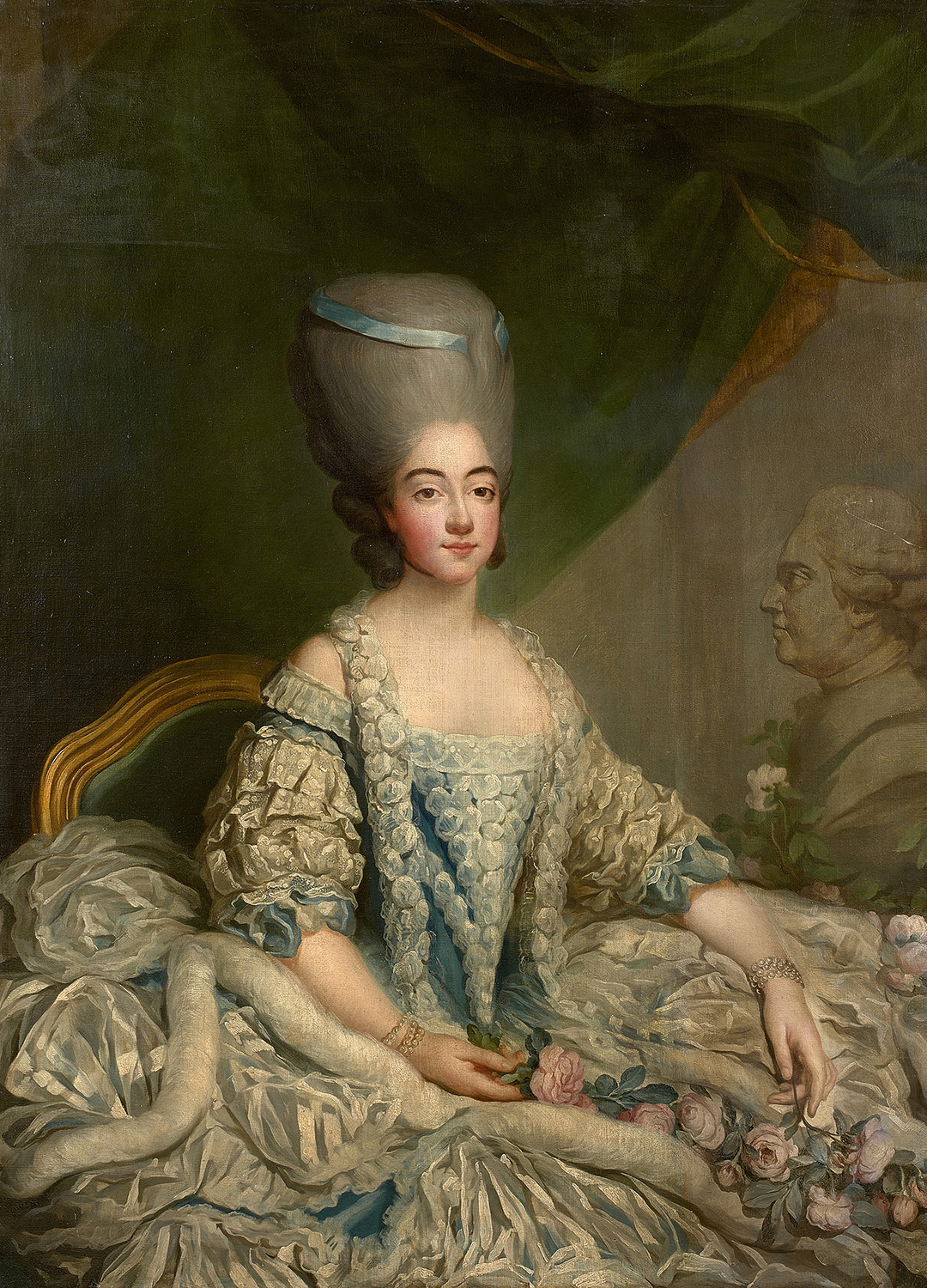
When Marie Antoinette arrived at Versailles the court was pleasantly surprised by her lovely appearance; a few years later another foreign bride was set to arrive and hopes were that she, too, would be pretty on the eyes. However, once Marie Josephine of Savoy arrived the court was sorely disappointed. 

Unlike the perfectly white and rose skin tone of the Dauphine, the new Comtesse de Provence's hue was sallow. Louis XV was particularly appalled by her nose which was quite large; the king went so far as to label it a "villainous nose". Her eyebrows were large and bushy (they were giving the less than flattering comparison to "capillary hedges") and her face was described as "swarthy". She did have one redeeming quality according to Madame de Campan: her eyes but the otherwise kind-hearted companion to the Queen added that it was "the only praise that could reasonable be bestowed on her".
What was even more mortifying was that the new-comer had a little mustache which provoked quite a deal of snickering. Some remarked that it would be more welcome in a guardroom. 

Billedresultat for comtesse de provence
Marie Josephine

Her figure was not quite as elegant and slender as her Austrian-born sister-in-law. It was rather more robust but without being fat. Whereas Marie Antoinette indulged in frequent bathing Marie Josephine  was found to have a profound dislike of the activity. This was - unfortunately - coupled with an utter lack of interest in perfume and the resulting body odour can well be imagined. Her husband were not particularly interested in sharing her bed and this considered to be the reason.

However, there was a very practical reason for her initial lack of hygiene. Upon her arrival at Versailles her apartment was still under construction - including her bathroom. Thus, it was not possible for her to wash properly until the work was completed. This accounts for the initial uncleanliness but cannot explain away her later antipathy towards a bath.

It was not the first time an unattractive princess (or prince for that matter) had graced the halls of Versailles. Beauty could not be expected but the court definitely expected the new Madame to at least take care of the little beauty she had. Alas, it quickly turned out that the Comtesse had basically no sense of personal hygiene. Apparently, hints and admonitions were not quite enough. It eventually got so bad that the Savoyard ambassador was requested to write to the new bride's father. In the following correspondence the ambassador entreated his master to have a - written - word with his daughter - especially concerning her hair and teeth. As the poor ambassador observed: "Such things that are regarded elsewhere as minutiae are essential in this country".


Billedresultat for comtesse de provence


Her very upbringing could be a clue as to her inattentiveness to personal hygiene. As the ambassador rightly points out things were not quite as meticulous everywhere. The court of Savoy was known for having a rather laissez-faire attitude towards just such things. If Marie Josephine had never been accustomed to - or encouraged to - bathing it is hardly a surprise that she would not be a regular bather. 

One thing of these "minutiae" things were rouge. At the court of Savoy rouge was not considered to be in fashion; however, at Versailles it was still very much the hallmark of the aristocracy. It should be said that the Comtesse immediately applied the very circular red patches to her cheeks in an effort to blend in better. 
Sadly for her immediate entourage Marie Josephine never quite embraced the sense of hygiene so desired by the court she now inhabited.

Wednesday, 6 June 2018

Louise Marie Thérèse Bathilde d'Orléans & Louis Henri de Condé

Rather unconventionally, Louise Marie was the elder in the relationship. When the couple was wedded on 20 April 1770 she was twenty years old while Louis was just fourteen. Due to the bridegroom's young age he was not expected to consummate the marriage just yet. This meant that Louise Marie was sent back to the convent where she had been living for years. However, in a rather gallant move, the young Duc d'Enghien fetched his bride away from the cloister and took her back to his estate.

Such a romantic gesture might have foretold of a happy union but that was not to be. After just six months the young Louis was tired of his new wife. Nevertheless, the couple managed to conceive a child: a son, Louis Antoine Henri, who was to be their only child.


Bathilde d'Orléans, duchesse de Bourbon.png
Louise Marie


As Louis grew so did his interest for women - that is any other woman than his wife. He took mistresses from both court and Paris and did little to hide his escapades. One of Louis' primary mistresses was an opera singer by the name of Marguerite Michelot. He would have two daughters by her. Louise Marie was immediately blamed for her husband's unfaithfulness. As was custom for the time it was often thought that a husband's wandering eye was due to the wife's inattention or rejections. 

Louise Marie refrained from having any affairs of herself while married but she was not unaware of her husband's. She caused quite a scandal when she set up a play at court. This was not only a harmless pastime but a frequent one; smaller plays were often played in the private apartments of Versailles. What was unusual, however, was that Louise Marie's play strongly hinted and disapproved of her husband's adultery.
Apparently, this little jab at Louis was enough and he filed for a legal divorce in 1780. 

For Louise Marie this meant that her life would suddenly change. Separated women were not allowed at court; their male counterparts were still welcome. Thus, Louise Marie was forced to live away from court. To her relief it was not to be an existence of squalor. She retired to the Château de Chantilly where she spent her time quite contentedly. It was not until the couple had separated that Louise Marie decided to have an affair of her own with the Chevalier de Roquefeuil. There has been speculated that she had a daughter by him and passed her off as a daughter of a secretary. 

Condé, Louis VI Henri de - 2.jpg
Louis
The couple would never have a rapprochement. During the revolution Louis fled to England while Louise Marie remained in France. Once the monarchy had been restored in 1815 the families of the two long-separated spouses wished them to rebuilt their marriage. Louise Marie refused and Louis did not protest. By then they had not been living together as husband and wife for thirty-five years. 
Louis continued with a new mistress - an English prostitute named Sophia -  and Louise Marie took a new lover in the shape of a young gendarme.

Louise Marie died in 1822 and Louis followed her eight years later.

Sunday, 3 June 2018

Henri III de Bourbon-Condé, Prince de Condé

Henri Jules de Bourbon-Condé was born in Paris on the 29 July 1643 to one of the most renowned generals France had ever produced: the Grand Condé. From the beginning of his life, Henri was at the very top of French society. His father's military prowess aside he was the nephew of Cardinal Richelieu through his mother, Claire-Clémence de Maillé-Brézé. Not only that but Henri was destined to inherit one of the largest fortune in France. 

So, the future looked bright for the new-born boy. With the ever-constant fear of the sky-high child mortality he was baptized immediately and granted the title of Duc d'Albret. Just three years later he rose again in the court hierarchy; his grand-father died which meant that Henri would become the Duc d'Enghien instead. Curiously, his position as son of Monsieur le Prince meant that he himself would possess two of the rare and simple titles throughout his life: first, Monsieur le Duc, second Monsieur le Prince. 

Billedresultat for henri jules de bourbon condé
Henri Jules

While Henri was blessed with money, position and land, it soon became apparent that something equally crucial was sorely lacking: mental health. His temper was completely uncontrollable and he would often fly into fits of rage. It was said that his temper was so extreme that it was "positively dangerous to contradict him". Coupled with his temper he had an unfortunate penchant for brutality which hardly can have endeared him to either soldiers nor servants. 
His physical appearance was equally unfortunate. Henri was considered to be short - even for the age - which could have been accepted but he was also terribly ugly.
It was not all bad, though. His exterior may leave the best of courtiers with little to say but his mind was not without merit. Even the ever-critical Duc de Saint-Simon acknowledged that Henri had a very keen mind whose intelligence spanned from art to mechanics. He appears to have had some political cunning as well. Being endowed with a large fortune made it possible for him to offer loans to members of the Parisian Parlement - favours that could be cashed in later. 

His actions were often drastic and quite unexpected. It would seem he suffered a good deal from restlessness. It would not be uncommon for him to suddenly uproot himself - and his entourage - and move to another of his residences in a moment's notice. This left his servants with the unsettling prospect of being constantly prepared. Consequently, every residence he owned would prepare supper for him in case he fancied a change of scenery.

Despite these unsettling character traits he was nevertheless destined to follow in his father's footsteps. For this particular purpose he was sent to the Rhine. However, it was very clear that the brilliant military mind of the father had not been passed on to the son. The nomination therefore became merely nominal. 

Still, he was expected to do very well on one other front: marriage. It could well be imagined that the bridegroom's character and appearance must have weighed heavily on the minds of potential brides; but in some cases the wealth and position was considered to outweigh such "minor" attributes. At first it was thought that he would marry Élisabeth-Charlotte d'Orléans, daughter of Gaston d'Orléans but she got away.
Anne Henriette of the Palatinate was not so fortunate. The daughter of the Count of the Palatinate Simmern, she was a rather risky choice. At the time of the marriage - late 1663 - the Fronde was not yet a distant memory and the mother of the bride (Anne Gonzaga) had been a notorious supporter of the uprising. Nevertheless, the couple was married at the Louvre.

Billedresultat for henri jules de bourbon condé


As could be expected, Anne Henriette fate as Henri's wife would not be a particularly good one. The courtiers remarked that the new Madame la Duchesse was very pious and good natured. It was also remarked that she was often beaten by her husband. 
The couple managed to have ten children. Henri dallied in extra-marital affairs as well - although it seems unlikely that he should attract many people with his behaviour. One affair with Françoise-Charlotte de Montalais resulted in a daughter by the name of Julie. She was legitimised in 1693.

He did manage to have another mistress: the Marquise de Richelieu. However, he broke with her once he found out that she was also flirting with the Comte de Roucy.

Henri took particular pleasure in gardening. By 1698 he had had a shipment of orange trees transported to the Hôtel de Condé in Paris. His contact in this endeavour was Hans Willem Bentinck with whom he had an extensive correspondence. The following year Henri is already discussing new gardening schemes to be carried out at the Château de Chantilly. This latter residence was a favourite of his and he hosted several large-scale parties here. 

As Henri grew older his fits of violence became more bizarre. Soon, they were overshadowed by a growing mental illness: lycanthropy. This disorder results in violent hallucinations often were the sufferer is convinced that he/she has been transformed into an animal. For more on his illness and the symptoms of it, read this post. It is hardly unnatural that such a strain on his health should have consequences. Henri died on 1 April 1709 in Paris.

Saturday, 2 June 2018

Princes & Princesses of the Blood

Ranking immediately behind the royal family these were the most privileged courtiers at Versailles. The eldest were known by a simplified version of the rank: Monsieur le Prince, for example. But since the majority of these specifically honoured persons had more than one child. This would mean that there were a lot more princes and princesses of the blood than what could immediately be deducted from their titles.

So, here they are:

Monsieur le Prince

Henri II de Bourbon-Condé, Prince de Condé


Louis d'Orléans, Duc d'Orléans

Louis Philippe d'Orléans, Duc d'Orléans

Louis Philippe Joseph d'Orléans, Duc d'Orléans


Madame la Princesse


Françoise-Marie de Bourbon, Duchesse d'Orléans


Louise Henriette de Bourbon, Duchesse d'Orléans

Louise Marie Adélaïde de Bourbon, Duchesse d'Orléans


Monsieur le Duc


Louis I de Bourbon-Condé, Duc d'Enghien

Louis II de Bourbon-Condé, Duc d'Enghien


Madame la Duchesse 


Marie Anne de Bourbon, Duchesse de Bourbon

Caroline of Hesse-Rotenburg, Duchesse de Bourbon


Louise Marie Thérèse Bathilde d'Orléans, Princesse de Condé


Monsieur le Comte

Louis de Bourbon-Soissons, Comte de Soissons

Joseph-Emmanuel of Savoy-Carignano

Eugène-Maurice of Savoy-Carignano

Louis Thomas of Savoy-Carignano

Thomas Emmanuel of Savoy-Carignano 

Eugène Jean of Savoy-Carignano


Madame la Comtesse


Olympia Mancini

Uranie de La Cropte de Beauvais

Maria Theresia of Liechtenstein 

Other princes and princesses of the blood: