Saturday, 9 September 2017

The Domino

The domino - not the effect, mind you - was connected to the mysterious masquerades of the 18th century. Incidentally, it refers to both a mask and a cloak. 

The mask covers half the face and has rounded edges. The cloak originated in Venice; the early masquerades became fashionable all over Europe which further spread the use of the domino cloak. Both pieces were usually black but could be seen in white or blue - silk was the preferred fabric. The domino cloak was voluminous - this added both a touch of the dramatic as well as being practically large enough to accommodate the lavish costumes.

Both men and women wore dominos. The sleeves were wide and usually the cloak was outfitted with a removable hood (this hood was referred to as a bahoo). Actually, the word "domino" was derived from the hoods worn by French priests in the Middle Ages. 

Billedresultat for 17th century domino cloak
Example of a domino cloak

Masked balls at Versailles were numerous and the domino was the go-to costume. These pieces of clothing had another function. By concealing the identity of the wearer it allowed people to move far more freely and converse with whoever they pleased. For the sake of diversity the upper part of the bourgeoisie were often invited; these would otherwise never have been permitted to mingle with princes and ducs but everything was possible in disguise.

Edmond-Jean-Francois Barbier gives us a description of a domino worn by Louis XV in 1737. On 4th March the king had dined at Versailles where one of his gentlemen had brought nine domino masks. Louis XV's blue cloak was then accented by a pink domino mask.


A lady with both a domino cloak and
mask in hand

Marie Antoinette also used a feminine version of the domino cloak to attend masquerades without being immediately recognized. However, she was not always so lucky. One woman managed to recognize her and began chastising Marie Antoinette for not acting like a "proper wife" who ought to stay at home with her husband - Louis XVI did not attend that ball.
This particular queen is also said to have donned the cloak on the evenings of some court balls. The public was permitted to invade the garden during these festivities which only added to the number of people gawking at her.


Tuesday, 5 September 2017

The Sneaking Death: Gangrene

Gangrene causes tissue to decay most commonly due to issues with the blood supply or diabetes. Usually, when a limb is gangrened it becomes blue, purple or black. The most famous sufferer of gangrene at Versailles was Louis XIV - it would kill him in 1715.  Another prominent member of the royal family who suffered from it was the Grande Dauphine; when she died in 1690 her autopsy revealed that her stomach was severely gangrened. 

When Louis XIV contracted gangrene the doctors would also refer to it as "mortification". It shows just how feared the disease was that no one was willing to inform the king of his actual state; it was not until they had no other choice that the message was finally delivered. 


Dry gangrene of the foot and ankle Wellcome L0061216.jpg
A gangrenous foot


The doctors facing gangrene had few options. The one most agreed upon was amputation of the infected limb if possible. Obviously, in the case of the Grande Dauphine it would not have been an option. Considering not only the excruciating pain of having an amputation performed without anesthetics but also the high risk of infections it is little wonder that some people refused to undergo the procedure. One such was Lully. He actually gave himself gangrene during one of his performances in January 1687; the composer accidentally pierced his toe with his baton. The toe became infected but he refused to have it removed - it would be his death.

Amputation is still considered to be the most effective way of stopping gangrene. The scary part about this disease is that it will continue to spread if not checked beforehand. Suffering from the affliction is agonizing but also a rather smelly affair. When Louis XIV was on his deathbed the courtiers were unwilling to stay anywhere near his bedchamber due to the stench.
Billedresultat for gangrene historical illustration
Amputation of a gangrenous leg. No wonder the patient is praying ...

The example of Cardinal Dubois makes it more understandable why some might be hesitant to be operated on. The original cause for the surgery was an abscess on the bladder; consequently, the surgeons cut into his body to remove it. In the process they discovered that the organs in his lower body was terribly afflicted with gangrene. Whether due to the gangrene or the operation, the cardinal died shortly afterwards.

The Comte de Provence would be terribly plagued by gangrene after the French Revolution when he was king himself. It would eventually lead to his death, too. 

Saturday, 2 September 2017

House of Coligny

The Coligny-family could trace its roots back to 863 and had their origins in Bresse. Since their nobility stretched quite a way back it is no wonder that they should already be established nobility when Louis XIV was born.
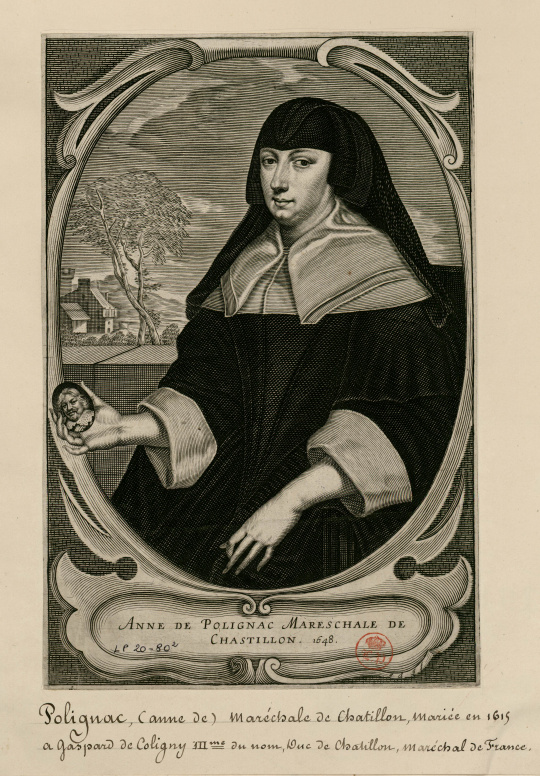
When the future Sun King was born the primary member of the Coligny-family in France was Gaspard III de Coligny. Gaspard was known at court as the Comte de Coligny but later advanced (considerably) to the rank of Duc de Coligny. Since he served Louis XIII in the Thirty Years' War it is quite likely that his service here helped his promotion. For those interested in Marie Antoinette, he was married to Anne de Polignac.


Image illustrative de l'article Maison de Coligny
Coat-of-arms

The family had been in significant trouble during the French Wars of Religion. Unlike most of their aristocratic equals the Colignys were Protestant. This would prove to be fatal for a number of the family's members. They appeared, nevertheless, to have had a rather open attitude to the individual's choice of religion. For example, several converted to Catholicism but were not cast off.

The house of Coligny fostered several distinguished people but the most famous was William III, King of England. Furthermore, the family held the titles of :
Duc de Coligny
Prince de Montbelliard
Comte de Savigny
Comte de Laval
Marquis de Coligny
Marquis de Saint-Bris

The founder of the House of Coligny was Guillaume de Coligny. From him two branches spread of the family were founded through his three sons: Jean, Jacques and Antoine. It is from the eldest, Jean, that the main Coligny-family heralded.


Jean III de Coligny married Éleonore de Courcelles
           Their child: Gaspard I

Gaspard I married Marie Louise de Montmorency. They had five children:
           Madeleine: married to Charles de Roye
           Pierre, Seigneur de Châtillon
           Odet: Archbishop of Toulouse, then Cardinal de Châtillon
           Gaspard II, Comte de Coligny and Admiral
           Francois, Seigneur d'Andelot

Gaspard II married Charlotte de Laval. They had three children:
          Louise: married to (I) Charles de Téligny, (II) William I of Orange-Nassau, Stadtholder of
          Holland. Her great-grandson was William III of England
          Francois, Comte de Coligny
          Charles, Marquis de Coligny

Francois married Marguerite d'Ailly. They had four children:
          Henri, Comte de Coligny - he fell at the Siege of Ostend
          Gaspard, Comte de Coligny, later Duc de Coligny
          Charles, Seigneur de Beauport
          Francoise: married to René de Talensac

Gaspard III married Anne de Polignac. They had four children:
          Maurice, Comte de Coligny
          Gaspard IV, Duc de Coligny and Duc de Châtillon
          Henriette: married (I) the Count of Haddinton, (II), Gaspard de Champagne
          Anne: married to Georges II, Duke of Wurtemberg-Montbéliard

Gaspard IV married Élisabeth-Angelique de Montmorency. Their son:
          Henri-Gaspard, Duc de Coligny

Henri-Gaspard died young without an heir

The family of Jacques (son of Guillaume) held the title of Comte de Saligny while Antoine's family held that of Marquis de Coligny.

Family members:

Image illustrative de l'article Gaspard IV de Coligny
Gaspard IV
Isabellemecklenburg.jpg
Élisabeth-Angelique
Description de cette image, également commentée ci-après
Louise de Coligny
Atelier de Jan Antonisz van Ravesteyn
Gaspard III
Billedresultat for anne de polignac
Anne de Polignac


Some interesting facts about the family:

  • Gaspard IV's marriage to Élisabeth-Angelique was a love match 
  • Gaspard II was murdered during the Massacre of Saint Bartholomew 
  • Francois d'Andelot married a wealthy heiress from Brittany. Through her he became a part of the Guise-family's circle which supported Diane de Poitiers (favourite mistress of Henri II)
  • Gaspard IV had the favour of Louis XIV who appreciated his military skills. Gaspard was sent to the Battle of Charendon during the Fronde where he was killed by a shot in the kidney at just 28 years old. Louis XIV gave him the honour of being buried in Saint-Denis
  • Louise de Coligny's marriages had rather bloody endings. Her first husband was also murdered in the Saint Bartholomew's Massacre while her second was assassinated
  • Henriette de Coligny's second marriage to Gaspard de Champagne was annulled; she herself also converted to Catholicism and was a renowned poet
  • Maurice de Coligny was killed in a duel against the Duc de Guise
  • Louise de Coligny died at Fontainebleau where she was the personal guest of Marie de Medici 


Sunday, 27 August 2017

The Jewels of Marie-Josèphe

Marie-Josèphe of Saxony entered Versailles as the second wife of Louis Ferdinand and as such immediately commanded a special position as Dauphine. Despite giving birth to no less than three kings her life at Versailles has been somewhat overshadowed. Still, there are ways to find an insight into her life; one is through the inventory of her possessions made up immediately after her death in 1767.

Amongst the Dauphine's numerous possessions were several jewels and precious stones. Not only does these give us an idea of her personal taste but also of the fashions at the time.


Princess Maria Josepha of Saxony in circa 1744 before becoming Dauphine of France by Klein Daniel.jpg
The jewels on Marie-Josèphe's bodice could very well have
been a part of the Crown Jewels when she arrived in France

The first set of jewelry granted to the new Dauphine were not new; rather they had belonged to the previous Dauphine, Marie-Thérèse-Raphaëlle, who had died shortly after her marriage. Given the price of the jewels in question it is hardly surprising that the king wanted to "recycle" them; after all the pieces in themselves were not exactly tainted by their former owner's demise.

The set of jewelry were made up of pieces that Marie-Thérèse-Raphaëlle had brought with her from Spain and others that Louis XV had given her on occasion of her marriage. The set was said to be amongst the most beautiful pieces of jewelry made in the 18th century. The set was comprised of a brilliant diamond parure or set.


Besides this magnificent present the Dauphine acquired several other pieces over the years. These included:

Shoe buckles shaped in an oval and covered in eight large diamonds

Earrings of pear-shaped diamonds 

A tassel - probably meaning a pendant - of one large diamond surrounded by six smaller ones

Two ornaments for the sleeve in the same style as the earrings. These were made to accompany them as a set.

A diamond necklace with two pear-shaped stones and a little bow; these were worn with seven small "buttons". Most likely, these were more like small brooches that could be attached wherever on the gown than what is usually associated with buttons.

A jewelry case for a ribbon and its pendant as well as twelve diamond pins

Gemstones brought with her from Saxony. These included clusters of jewels, pear-shaped precious stones and earrings. A diamond-encrusted bow with a pear-shaped diamond as well as a smaller bow also came from Saxony.


Billedresultat for marie josephe de saxe
This presumed portrait of the Dauphine shows
her wearing two pieces found in her possession in
1767: the bracelet with a portrait of her husband
and the aigrette with pear-shaped diamonds

Large girandole earrings from Louis XV

A bracelet made of 290 brilliants 

Two bracelets with the portraits of the king and the Dauphin respectively. The portraits were surrounded by small brilliants and held together by six rows of white pearls.

An aigrette with four pear-shaped diamonds

Shoe buckles designed with flowers of diamonds

A cross of brilliants 

A brooch shaped like a bouquet of white and yellow diamonds and rubies

A bow of diamonds and emeralds. This particular piece is mentioned in connection with dressing-gowns so it is possible that it was used to close her dressing gowns.

Maurice Quentin de La Tour, Marie-Josèphe de Saxe, dauphine (1756-1760) -002.jpg
The necklace could possibly be that which was
made of Oriental pearls. The brooch show another
portrait of the Dauphin

A bow of diamonds and emeralds with a pear-shaped diamond

Earrings with pendants of emeralds and diamonds

A ring with an emerald lozenge and four small brilliants

An aigrette with brilliants and emeralds whose middle forms a Holy Spirit with five pear-shaped diamonds

An aigrette with three pear-shaped stones: two brilliants and one emerald 

An aigrette with a large ruby and pear-shaped diamonds; also this hair-piece had flowers of diamonds and rubies

A pair of earrings with rubies and brilliants

Very large, round earrings in pink

Two bracelets of six rows of pearls

Princess Maria Josepha of Saxony in circa 1744 before becoming Dauphine of France by an unknown artist.jpg
The pair of three-rowed pearl bracelets features portraits - presumably those
of the king and the dauphin

A golden fan encrusted with amethysts and brilliants

A six-row pearl necklace 

A large necklace of 23 Oriental pearls

A fan encrusted with mother-of-pearl, pearls, brilliants and rubies

A watch and accompanying chain with diamonds

A collar with a pair of girandole earrings. These were decorated with topaz from Saxony and came with a case - another three small diamonds came with the case.

A bracelet of seven rows of pearls with brilliants and emeralds

A bow with a large, square Spinel (ruby-like) stone with diamonds and rubies 


Obviously, the Dauphine did not lack for options! The total worth of these pieces were 737.762 pounds. The estimate was done by the royal jeweler who carried out the estimation on 21 June 1767.


Monday, 21 August 2017

Marie-Charlotte de Campet de Saujon, Comtesse de Boufflers

Marie-Charlotte Hippolyte de Campet de Saujon was born on 6 September 1725 to the Baron and Baronesse de la Rivère. Given that her parents held the lowest ranking title in the nobility her marriage was quite a catch. 
In 1746 she was married to Édouard de Boufflers-Rouverel, Comte de Boufflers. Having thus moved two steps up the hierarchical ladder Marie-Charlotte aimed for a life at court. It did not take long before Marie-Charlotte fell pregnant. She gave birth in 1746 to the couple's only child: a son. Soon, there was a position available to her. The newly married Comtesse de Boufflers was attached to the household of the Duchesse de Chartres as a dame du compagnie. 

In her capacity as companion to the Duchesse Marie-Charlotte lived at the Palais-Royal. Here, she met the Prince de Conti; the two became rather fond of each other and were soon known to be lovers. Marie-Charlotte could have continued her career at court quite unnoticed if it had not been for a disagreement with the house of Orléans. She was soon obliged to leave the Palais-Royal (which belonged to this branch of the Bourbon-house); instead, she purchased a small hôtel near the Grand Prior's palace.


Marie-Charlotte de Boufflers (1725-1800).jpg
Comtesse de Boufflers by Carmontelle

Having a penchant for company - probably acquired in the service of the Duchesse - and a quick wit it seemed inevitable that the Comtesse de Boufflers should found her own salon. Marie-Charlotte was    completely under the spell of Anglomania which seized Paris in the latter part of the 18th century. She played hostess to celebrated philosophers including Didot, Rousseau, Hume, Prévost etc. She made a close friend in Madame de Deffand who names the Comtesse as her "idol" in her memoirs.

Marie-Charlotte was inspired by her learned visitors and took to writing herself; she never did reach the fame of her circle, though. Given her fondness for all things English she was an obvious candidate for accompanying the French ambassador's wife, Madame d'Usson. The party crossed the Channel in 1763; once on English soil Marie-Charlotte found that her reputation had preceded her. The Comtesse de Boufflers became the guest of honour and was paid compliments by Samuel Johnson and Horace Walpole. She would later received both in Paris.

Two years later, she was once again in Paris. In 1765 her lover granted her the Château de Stors. Now she had a residence which suited one of her repute. However, she was never really attached to the court at Versailles. Perhaps the feud with the Orléans-clan made her a persona non grata. She had only travelled there upon the death of her father-in-law in 1750. Despite being well-known to the court she was not officially presented there until 1770. This time it was her new lover, the Marèchal de Luxembourg, who performed the introduction.

Marie-Charlotte lost her husband in 1764; she had hoped to contract a new marriage to her long-term lover, the Prince de Conti. The match never materialized, though. Although the couple had remained lovers for years the Prince was not interested in making her his wife. Even if he had been so inclined it is likely that her "low-born" origins would have presented a difficulty. Perhaps this unfulfilled wish was what cooled their relationship; as stated, she had taken another lover by 1770. 

Marie-Charlotte with her granddaughter
In 1773 she acquired another property - a country house at Auteuil. She would retire hereto in 1776 when the Prince de Conti died. Still, she kept her house in Paris as well. Her salon was still in full swing where she would meet influential people. The Comtesse de Boufflers had ties to the Swedish king and even arranged the marriage between the Swedish ambassador and Germaine Necker. Dividing her time between her salon in Paris and her estate at Auteuil - and several other properties - she kept herself busy. The advent of the French revolution brought a final end to her salon in 1789. 

Marie-Charlotte was briefly in danger of becoming yet another victim of the guillotine. She was arrested during the Reign of Terror but was let go by the revolutionary tribunal. During the revolution she was obliged to sell some of her property including the Château de La Rivère de Fronsac. In 1795 she suffered the loss of her son. As it happened she would not outlive him long. Marie-Charlotte died in 1800 in Rouen - the same place she had been born.

Saturday, 5 August 2017

Deadly Labours: Childbirth, Stillbirths & Miscarriages

"One is never closer to death than when giving life". Childbirth has been the death of thousands of women - if not millions - since the dawn of time. This was a risk which no woman could feel completely safe from - not even the most privileged ones.
Giving birth could prove to be fatal to the mother but so could the time immediately afterwards. Infections or issues connected with the delivery meant that even if both mother and child survived the labour it was far from completely over with. Those were the concerns which faced pregnant women everywhere. However, some never made it to full term. Miscarriages or stillbirths were equally possible and each left a mark on the woman's body; childbearing in itself is extremely taxing to a body and the rate of which some women conceived children fatally damaged their health.

Puerperal fever was one of the major risks to mothers in an era when bacteria was all but unknown. The fever was the result of improper hygiene - mostly on account of the doctor never washing his instruments or hands. This would take the life of the mother after the birth; in some cases it could be several days before the fever became fatal.

These royal ladies all had several pregnancies but, sadly, not all ended well. Only the more prominent members of the royal family are included in this post.

Marie Thérèse, Queen of France 
The consort of Louis XIV went through six pregnancies of which only one child survived past infancy. Those of her children who did not survive were: Anne-Élisabeth de France (1 1/2 months old), Marie-Anne de France (1 month old), Marie-Thérèse de France (five years old), Philippe Charles de France (three years old) and Louis Francois de France (five months old).

Pregnancies: 6
Stillbirths: 0
Miscarriages: 0

Billedresultat for marie thérèse of france
Marie Thérèse


Henrietta of England, Duchesse d'Orléans
The marriage between Henrietta and Philippe, Duc d'Orléans was haunted by a string of miscarriages. Despite Monsieur's obvious homosexual preferences he managed to fulfill his duty and got his wife pregnant no less than eight times in nine years. This considerably undermined Henrietta's health which could ultimately have led to her early death. Of her eight pregnancies two children survived: Marie Louise (later Queen of Spain) and Anne Marie d'Orléans (later Duchess of Savoy and mother to the Duchesse de Bourgogne). One of her sons, Philippe Charles, died at the age of two.

Pregnancies: 8
Stillbirths: 3 (in 1667 she delivered two stillborn sons and a daughter the year before)
Miscarriages: 2


Billedresultat for henrietta of england
Madame, Henrietta of England


Marie Anne Victoire de Bavière, Grand Dauphine
Although her marriage to the Grand Dauphin was not a happy one she managed to perform her duty by bringing three children into the world - all boys.

Pregnancies: 3
Stillbirths: 0
Miscarriages: 0


Relateret billede
The Grande Dauphine

Elizabeth Charlotte of the Palatinate, Duchesse d'Orléans
As Monsieur had not had any living sons with Henrietta, his marriage to the Princess Palatine was arranged. In this manner she proved more effective. Not only did she never suffer a miscarriage or a stillbirth but she delivered that precious boy. Her first child, Alexandre Louis, died at the age of three.

Pregnancies: 3
Stillbirths: 0
Miscarriages: 0


Princess Palatine


Marie Adelaide of Savoy, Duchesse de Bourgogne
Since her marriage took place when she was just 12 years old it is no wonder that the young Duchesse waited a few years before having children. Once she began she was deemed successful in that she bore three boys to full term. However, it was not without difficulties. Marie Adelaide suffered several miscarriages - one which could be contributed to Louis XIV's rather selfish demand that she travelled with him to Marly although high pregnant. When this occurred the Duc de La Rochefoucauld remarked that she had had those before which gives us an indication that she may have struggled with pregnancies. It is difficult to know exactly how many times the Duchesse actually fell pregnant. 

Pregnancies: about 5
Miscarriages: at least 2
Stillbirths: 0


Billedresultat for duchesse de bourgogne
The Duchesse de Bourgogne as Dauphine


Marie Leszczynska, Queen of France
Marie Leszczynska was chosen to become the wife of Louis XV particularly because she was of an age to bear children - and that she certainly did. Her marriage with Louis produced no less than 10 children: eight girls and two boys. Impressively, only one child died in infancy: Philippe de France who died at the age of three. 
The queen eventually became so tired of being "always giving birth" that she and her husband decided to have no more children.

Pregnancies: 10
Stillbirths: 0
Miscarriages: 0


Billedresultat for louis xv birth complications
The long-serving Marie Leszczynska who grew
tired of always bearing children

Marie Antoinette, Queen of France
It took an astonishing seven years before the Austrian-born queen of France brought a child into the world. However, from then on Marie Antoinette continued to add another three children to the royal nursery. Her youngest daughter, Sophie, died as an infant while her eldest son, Louis Joseph, died at the age of eight. Her two remaining children, Marie Thérèse and Louis Charles, survived their infancy but the young boy was murdered during the revolution.
Her first lying-in nearly cost her her life but not because of complications with the birth itself. The bedchamber was so crowded that it became insufferably hot; consequently, the queen fainted during her labour.

Pregnancies: 6
Stillbirths: 0
Miscarriages: 2


Marie Antoinette with her three surviving children. The
dauphin points to the empty cradle which used to hold
Princesse Sophie


Several other women in the royal family succumbed to the dangers of childbirth. These included:

Maria Teresa Rafaela, Dauphine of France
The first wife of Louis Ferdinand fell pregnant not long after her marriage. When she gave birth on 19 July 1746 something went horribly wrong; she died on the 22 July. The child - a daughter - died at the age of two.


Augusta of Baden-Baden, Duchesse d'Orléans 
Died at the age of 21 whilst giving birth to a girl. The child was born in August 1726 and Augusta's death might very well have been caused by similar circumstances to the miscarriage of the Duchesse de Bourgogne. Francoise Marie de Bourbon (her mother-in-law) forced her to drive from Versailles to the Palais-Royal in her ninth month - the pains of labour had already begun and she was obliged to stop at Sèvres. The turbulent journey must certainly have weakened her body.


Marie Thérèse Félicité d'Este, Duchesse de Penthièvre
The Italian-born wife of the Duc de Penthièvre died at the age of 27 due to complications after the birth of their third child. The boy would die shortly afterwards.


Louise Diane d'Orléans, Princesse de Conti
The daughter of the Regent Philippe d'Orléans Louise had married the Prince de Conti and given birth to a son in 1734. Two years later she was pregnant again but this time something went wrong during her labour. She died while delivering the baby - a stillborn son - at the young age of 22. 

Friday, 4 August 2017

Versailles (2015-)

The new drama focusing on Louis XIV and his building of Versailles is the newest series in a line of shows concerning historical eras. Alas, "Versailles" follows the pattern of "the Tudors" and "the Borgias" when it comes to a rather light take on historical accuracy.

SPOILER ALERT

Historical Inaccuracies 

  • While the affair between Louis XIV and Henrietta, Duchesse d'Orléans has been speculated it is far from considered a certain thing; particularly because such an affair would be considered incest in Catholic countries
  • A whole string of characters are completely made up: Fabien Marchal, Madame and Mademoiselle de Clermont and the Duc de Cassel, Claudine and her father, Montcourt and the poor family who is murdered by roguesL
  • Aniaba of Issigny (the African prince) did actually come to France but not until the 1700's and it is not known whether he was actually a prince
  • Marie Thérèse's birth of a black daughter never occurred 
  • Naturally, Madame de Montespan could not have forced the Duc de Cassel to come to Versailles - nor have been abused by him - since he is not real
  • Louis XIV makes only little resistance to Louise de La Vallière's plea to enter a convent. Although the king refused to let her go he quickly seems to change his mind. In reality he did not permit her to leave until 1674
  • The near-fatal illness of Louis XIV took place much earlier than depicted when he was with his army at Metz
  • William of Orange's marriage with Mary of England took place in 1677 - not in 1670
  • Throughout the first and second season the face of Versailles if completely wrong; for obvious reasons it is the modern facade but considering that CGI was used for other views of the chateau it is still an inaccuracy 
  • Louis XIV's affair with Madame de Montespan ends far sooner than their actual rupture

What the show got right:

  • The Chevalier de Lorraine was greatly at odds with both Henrietta and Elizabeth Charlotte
  • Madame de Montespan is seen urinating in a hallway; although the marquise has never been caught in this situation it was not uncommon amongst other courtiers
  • Louis XIV did have affair with both Madame de La Vallière and Madame de Montespan at the same time. They even shared an apartment!
  • Today it is widely believed that Henrietta died of natural causes but in her time it was genuinely thought that she could have been poisoned. The culprit was suspected to be the Chevalier de Lorraine
  • The fictional Duc de Cassel complains about the size of his "apartment" which he compared to a broom closet. Many of the aristocrats who were housed at Versailles had to make do with tiny, cramped quarters which must have come as a shock compared to their luxurious châteaux