Saturday, 18 March 2017

Madame Victoire's Apartment


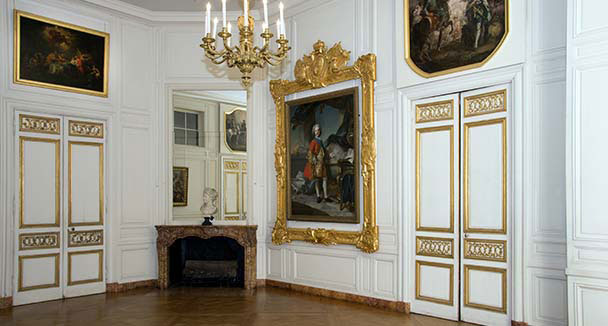
1) First Antechamber

This was the first antechamber of Madame Victoire - the "leading lady" of the Mesdames Tantes. It formerly served as Louis XIV's bath chamber at which time the salon was covered in tiles and a large tub was placed at the centre of the room - the tub is now at the orangerie.

Madame Victoire was not the first of the Mesdames to inhabit this room. Madame Adelaïde had lived there from 1752-53 and Madame Sophie had also occupied the room from 1755-1767 - and then it was passed on to Madame Victoire.

Billedresultat for versailles seconde antichambre victoire

Relateret billede


2) Second Antechamber

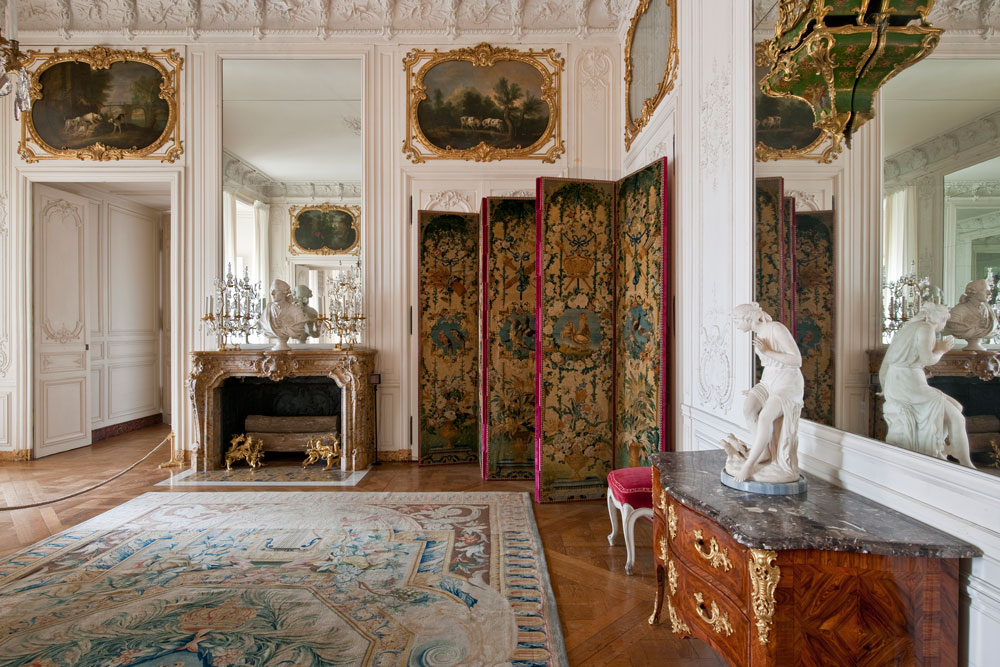
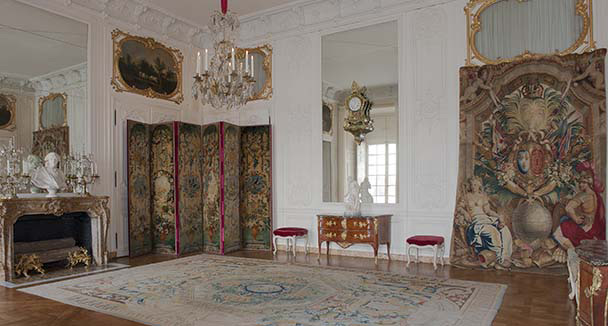
Along with the First Antechamber of Madame Victoire this room was originally a bathroom of Louis XIV. The Sun King had chosen to use marble for the walls and floors (much like you see in bathrooms of today). One end of the salon was dominated by a couch placed inside a framed alcove. The window shutters are also from the time when the room functioned as a bathroom and they are decorated with dolphins.

After Louis XIV the room went into the possession of the Count de Toulouse and after him the Countess de Toulouse. But rooms at Versailles often changed hands and this particular salon soon became the home of Madame Adélaïde. Madame Victoire took over the room but at that time she lived with her two other sisters Sophie and Louise. The room finally became Madame Victoire's completely when it was made into a second antechamber in 1767 - that year the alcove was removed.

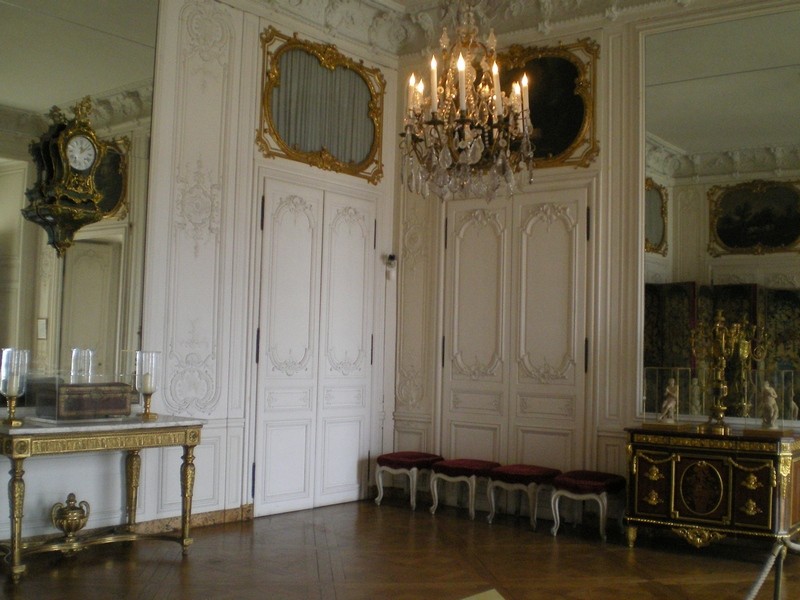
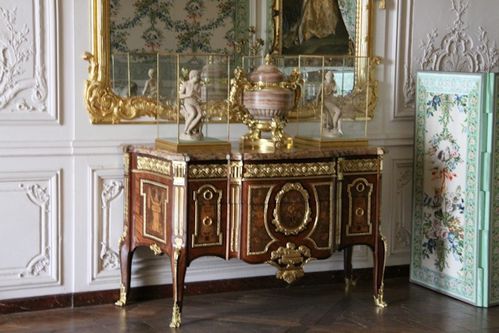
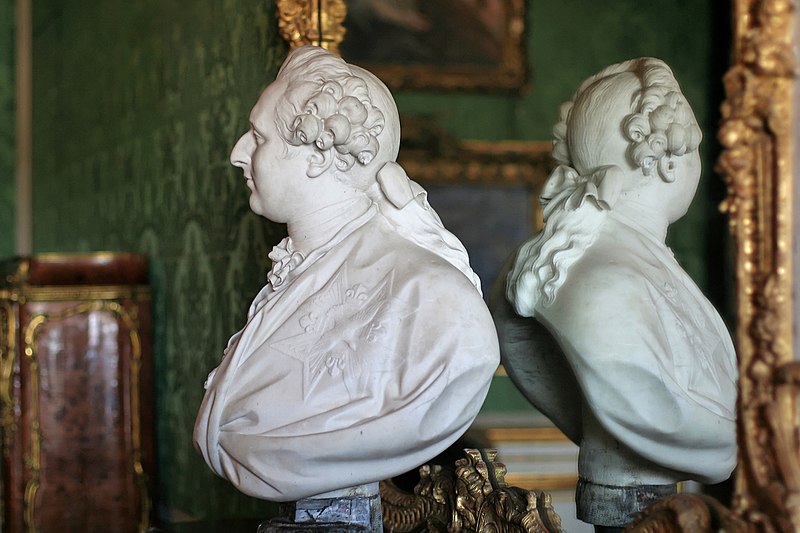
It is widely believed that the wood-works were carved for Madame Victoire herself. The paintings above the doors (by Oudry) were originally intended for the Dauphin but found their way into this salon instead; they depict the Fables of La Fontaine. A white marble bust of Marie Josephine Louise of Savoy is placed on the mantelpiece. A Riesener chest-drawer placed in this room has been transferred from the southern wing from the apartment of the Countess d'Artois. A large folding-screen has been placed in the corner and a clock in the "Chinese" style rounds up the inventory list of the second antechamber. The colour of the walls are white which is quite a rare sight at Versailles; normally a wall is either elaborately decorated or painted in a pale colour on carved wood-work.
Billedresultat for versailles seconde antichambre victoire

Billedresultat for versailles seconde antichambre victoire

Billedresultat for versailles seconde antichambre victoire

Billedresultat for versailles seconde antichambre victoire


3) Grand Cabinet

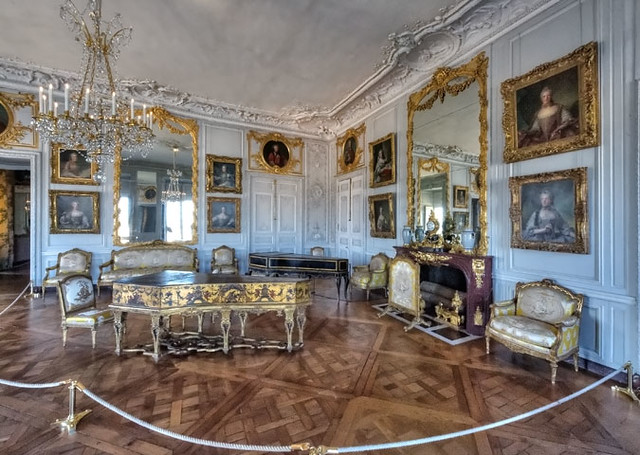
Louis XIV used this room as a part of his bathing rooms - it was known as the octagonal room. At that time it was renowned for the extreme wealth in marble, paintings and sculptures that had gone into this room but that changed when the room was handed over to the Mesdames Tantes in 1763. They thought that the marble décor was too old-fashioned and immediately had the room redone after the new fashions. The only remaining parts of the original room are the cornice, the beautiful fireplace and the decorations in the corners - everything else had undergone a monumental change.

There is one object in particular that remains as a testimony to Madame Victoire's passion for music: the harpsichord by Blanchet. Madame Victoire was regarded as one of the finest players of this instrument - a thought shared by people outside the French court. Mozart himself dedicated his first six pieces on the harpsichord to the Madame.




4) Bedchamber

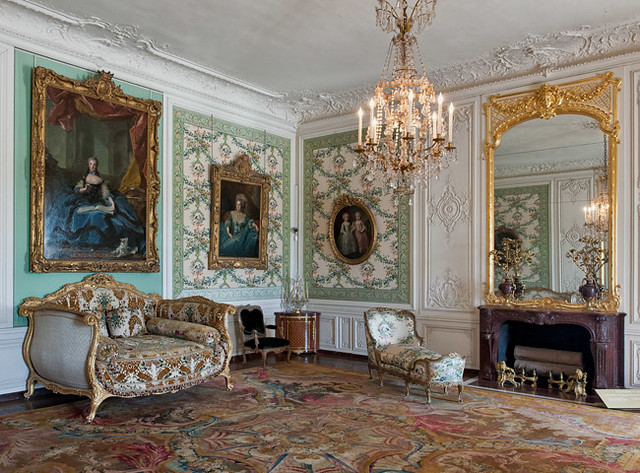
This room has changed hands quite a lot of times. Its first owner was Louis XIV who used it as an antechamber to his bathroom(s) - it was called the ionic antechamber due to the twelve marble columns that made out the decoration. Then it changed to the hands of the Count de Toulouse and from him to the Countess de Toulouse. Madame Adélaïde took over next until the room was passed on to the youngest sister of the Mesdames, Madame Sophie. Madame Sophie was given this room in 1767 and used it as a bedroom. A year later it changed owner again and became the bedroom of Madame Victoire as we know it today.

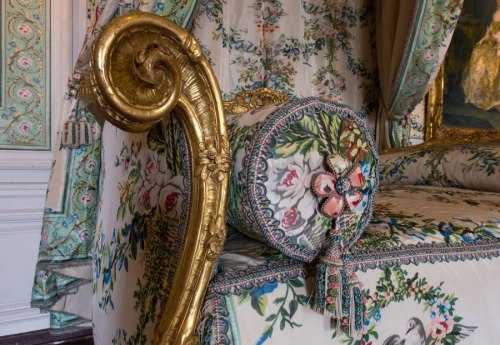
Rousseau was given the task of cutting the wood-work of Madame Victoire's bedchamber. The dominant colour of the bedchamber is a soft green mixed with a white pattern. When Madame Victoire took over the room in 1769 two corner cupboards was delivered from Péridiez. They were sold during the revolution but returned to Versailles when they were bought back in 1982 from England (before that the cupboards had been located in Russia). The screen in front of the fire-screen was delivered to the bedroom of the Countess de Provence in 1787.

Quite a few of the occupants of the room has been portrayed in paintings that now adorn the walls:
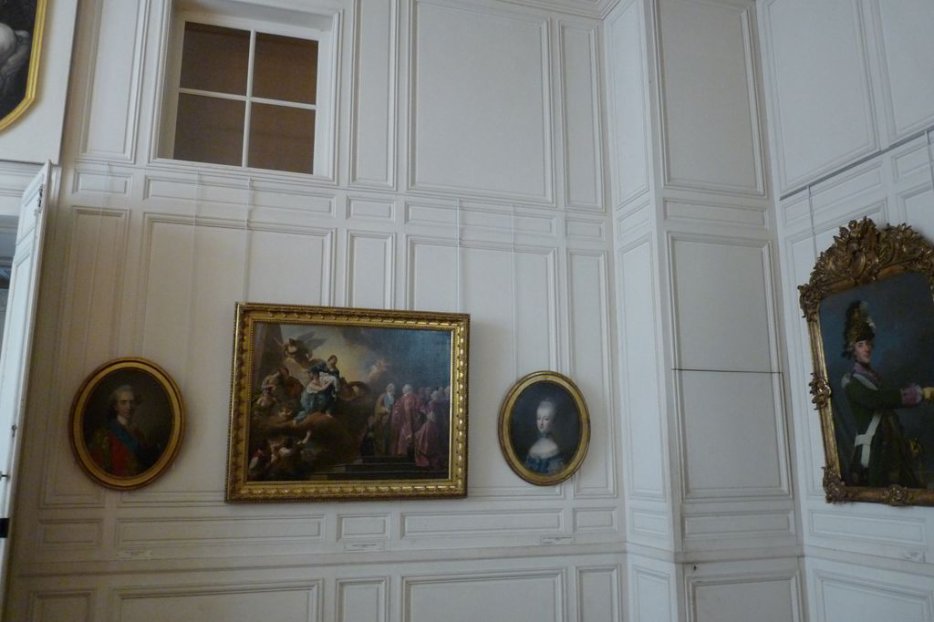
A portrait of Madame Sophie hangs above the left entrance - the princess is wearing a pink gown. Marie-Josèphe of Saxony is portrayed in the large portrait to the left of the rear wall. The centre picture is of Madame Adélaïde and to her right is the Dauphin Louis (son of Louis XV).

Billedresultat for versailles chambre victoire


Billedresultat for versailles chambre victoire


5) Blue Cabinet

The interior cabinet of Madame Victoire (the room is also referred to as "Petit Cabinet Bleu") was originally a part of the Doric Hall which was a part of the bath apartments. The large hall (also consisting of the two rooms next to this) was converted in 1724 to two antechambers for the Comte and Comtesse de Toulouse. The Comtesse de Toulouse's antechamber was further divided in 1767 into two small chambers. From then on the two small cabinets would function as a living room and a library. Madame Victoire commissioned a chest of drawers in 1768 which is still placed in the cabinet; today her alabaster dish is placed upon it. Antoine Rousseau was responsible for the pretty white and pale-blue wood-work done to the walks and the fireplace was created by Serancolin - both were restored to partially their original state. The dominant writing desk was made for the Mesdames Tantes for their favourite place of Bellevue.

A portrait of Madame Victoire herself hangs in the chamber. A couple of chairs in the room was originally located in the salons of Madame d'Harcourt but they were moved to the eldest of the Mesdames Tantes' rooms in 1787. Another portrait hangs in the room and portrays Madame Adélaïde.


Madame Victoire

6) Library

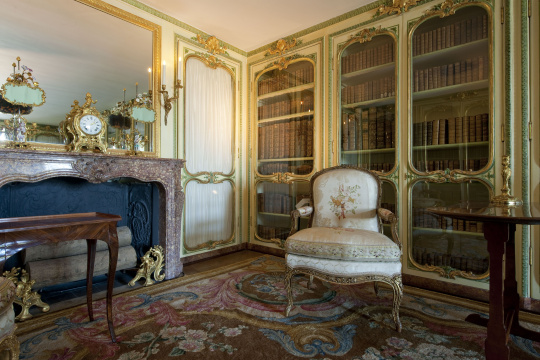
Madame Victoires' library was previously a part the salon next to it. The books in the cupboards are engraved with Madame Victoire's crest. The cupboards also contains the geographical maps of Madame Elisabeth and parts of a china set made by the court-favourite Sèvres that was originally made for Madame Adélaïde but is now on display in her sister's library.
However, it is a certainty that the vermeil table was made for Madame Victoire - it has her coat of arms engraved in it. The chairs were delivered to Madame de Pompadour in between 1755-60 and was later used by Madame Victoire as a part of her furniture at Bellevue - they were created by Nicolas Quinibert Foliot. The desk was created for either Madame Sophie or Madame Louise in 1760 and was originally housed in the south wing of the château. The top of the cupboards are painted in a pale moss-green surrounding a golden medallion.
A painting of the Battle of Fontenoy is placed in one of the cupboards.

Billedresultat for versailles bibliotheque victoire

Billedresultat for versailles bibliotheque victoire

Relateret billede


Thursday, 16 March 2017

Louis de Mornay, Marquis de Villarceaux

Louis de Mornay was born in 1619 in Paris to Pierre de Mornay and Anne Olivier de Leuville. His father was in possession of several small "seigneuries" which were basically areas which he was governing.

Military careers were very common in the young Louis' family and naturally he was to go that way as well. By virtue of his noble birth he quickly managed to get the position of captain-lieutenant in the Grand Dauphin's service. Later, he was made captain of the guards to the Dauphin which meant that he spent a lot of time with the royal heir. Naturally, it was a huge advantage that he spent so much time with the future Louis XIV.
Quickly, Louis de Mornay became a well-known name at court - so well-known that even Saint-Simon bothered to mention him in his memoirs. However, Saint-Simon does not paint the most flattering of portraits of Louis; he considered him to be a seducer who made "a lot of noise with women". 

Presumed to be Louis de Mornay, marquis de Villarceaux (1607-1691), 17th century by Jean Petitot le Vieux. Villarceaux was the lover of  Francoise d'Augbigne (the future Madame de Maintenon) from 1660-1663, after the death of her first husband.:
Presumed to be Louis de Mornay

There seem to be something about this charge of being somewhat of a libertine since Saint-Simon is not the only one who noted it. Another memoir-writer, Gédéon Tallement de Réaux, had a more gallant way of describing the young nobleman's behaviour but agreed that his reputation with women was infamous. Louis' love of women eventually got him into trouble when he was sentenced to a spell in the Bastille for allegedly "seducing a young maiden".

It was decided that he was to marry and the choice fell on one of Anne of Austria's ladies-of-honour: Denise de La Fontaine d'Esche. The couple were married on 8 May 1643. Denise was older than Louis but also ranked above him at court which meant that the marriage was not without its advantages. Louis XIV decided to make his name-sake captain of the royal hounds which gave Louis responsibility for no less than 70 hunting dogs. Considering the Sun King's fervent pleasure in hunting it was certainly a sign of favour.

Being now a married man did not deter Louis from having affairs. He again drew attention to himself with an affair with Anne de L'Enclos - better known as Ninon de Lenclos. The scandal soon became the talk of the Parisian salons and was made even greater when he suddenly moved to his country estate of Villarceaux and took his mistress with him. Here she gave birth to a son whom Louis recognized in 1657. This baby boy would later be given a position in the King's Navy as an officer.


Billedresultat for villarceaux
View of Louis' estate of Villarceaux

Eventually, his relationship with Anne came to an end and he embarked on another with a woman who would become infamous in France. Her name was Francoise Scarron but is better known as Madame de Maintenon. Francoise Scarron was actually a friend of Louis' wife with whom she exchanged several letters. When she became a widow the two began a love affair which lasted three years. During this period Louis had his mistress painted completely in the nude. Their relationship ended when Madame de Maintenon realised that she would get further in her career with a stern religious attitude. 
Louis would become a favourite companion of the ageing Sun King who probably appreciated that the Marquis relinquished his mistress without a fight. Given the struggle the King had had with Madame de Montespan's husband he was surely relieved.

Louis de Mornay died on 21 February 1691 without a mistress and in debt. His tomb was destroyed during the revolution.

The Dauphin's Apartment


1) Library

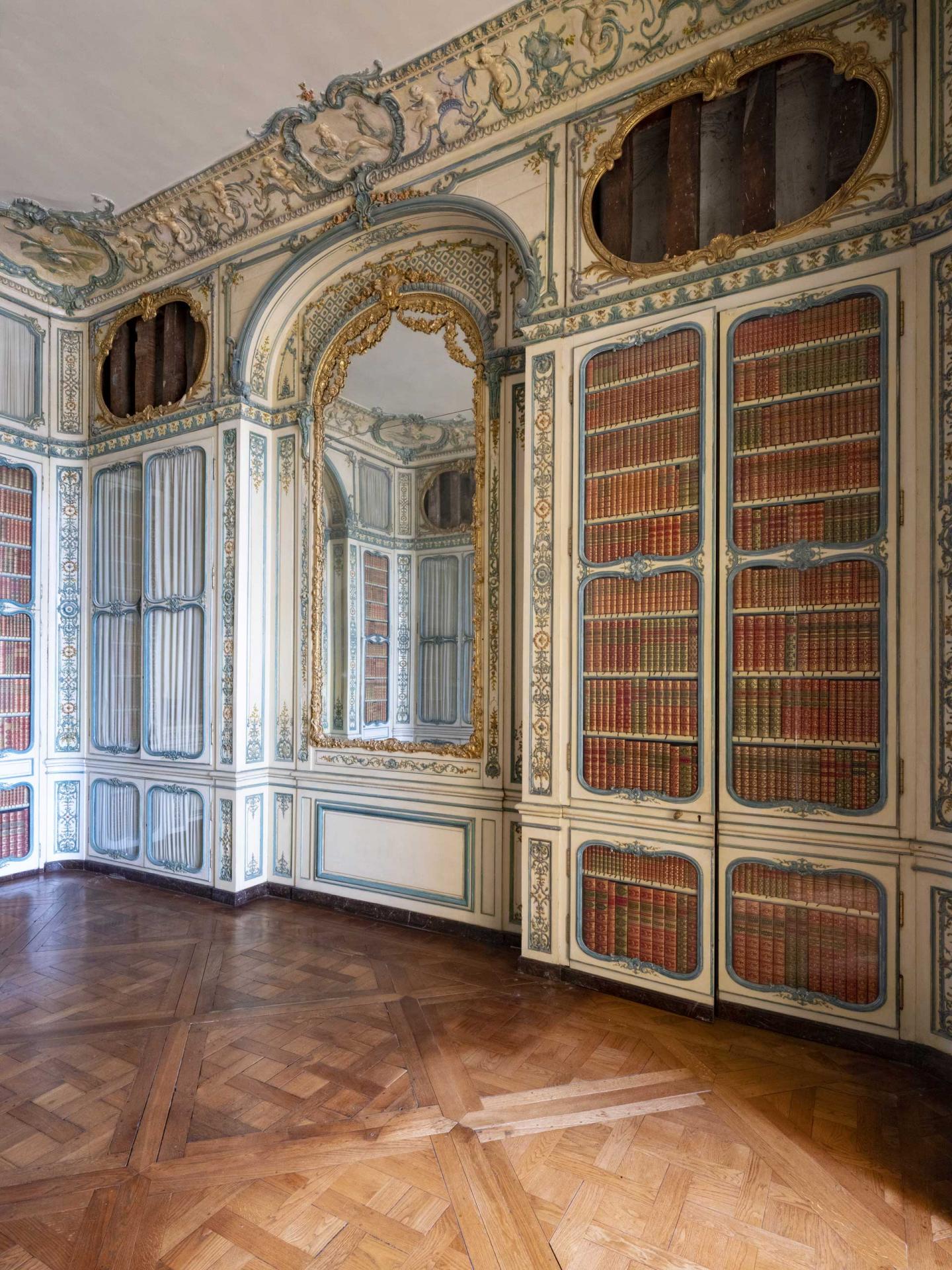
This room served as a library to Louis XV's son and later on to Louis XVI when he was Dauphin. Louis XVI's mother also inhabited this particular room prior to her death. The very taste of Louis XV is clear throughout the decorations of his son's library; many of these consists of angels playing instruments - music was always a great comfort to Louis XV. The panelling - of wood - dates back to 1755. Joseph Vernet painted the sea landscapes on the four over-doors.
The furnitures of the library counts a chest of drawers - containing a golden clock - by Criaerd and a writing table dating from the year of 1756 and commissioned for Louis XVI.

In order to create a perfect symmetry in the room, the many "books" are in fact merely pieces of books. The glass "cabinets" for books are lined with blue silk. 


2) Grand Cabinet

The Grand Cabinet of the Dauphin was originally divided into three different rooms: a study and bedroom for Monsieur and a study for Madame. Monseigneur took over the apartment next until Louis XIV (ever eager for changing his palace) had the three rooms combined into one big apartment for the Dauphin in 1693. Louis XV's (for whom the reconstruction had been done) decided to entirely change the décor of his Grand Cabinet. He only kept the fireplace and the panelling - both done by Verbeckt.

The Dauphin wanted paintings of three of his sisters (Madame Adélaïde, Victoire, Élisabeth and Henriette) and appointed Nattier to perform the task. Today these paintings are no longer in France and has been replaced by paintings by Charles-Joseph Natoire that formerly hung in the princes' apartments at Versailles and Marly. As always, the Dauphin was to have the finest furniture. The writing desk was delivered by Antoine-Robert Gaudreaus but the seats were not created for the Dauphin. Instead they used to occupy the apartment of the Duchesse d'Harcourt. One of the most spectacular objects in the room is the globe - or two globes to be precise.
The inner globe shows the coastlines and heights and depths of the ocean - it was created by Mentelle 1786. The outer one depicts the terrestrial and celestial globe. Besides Mentelle, Vernet and Gardeur were also appointed to finish the globe. It was ordered by Louis XVI who intended to use it for the education of his son, the Dauphin - Louis XVI himself was very interested in geography and probably enjoyed the globe very much himself. A console table (now classified as a part of the French National Treasure) was created for the Dauphin (son of Louis XVI) in 1787.


STUEPLAN - VERSAILLES OG DEN FRANSKE REVOLUTION


Château de Versailles, appartement du Dauphin, grand cabinet du Dauphin, corniche 01.jpg


3) Bedchamber

The decoration of the Dauphin's Bedroom is from 1747. Originally, there was a small room where the Dauphin would exhibit his paintings - that is why the tapestry suddenly changes from green to white and gold. The original bed of the Dauphin has been lost and the exhibited bed is in the style of "la Duchesse". The bed was made in 1740 for the Duchesse de Creéquy and embroidered in Saint Cyr. Meanwhile, the globe on the dresser was made for the Duc de Chartres in 1705.

Gabriel designed the drawings for this room and later he also designed the decorations. At that time the alcove was hung with silk and the walls were covered in oak planks. When the revolution broke out this room was occupied by the son of Marie Antoinette and Louis XVI - he would later be remembered as Louis XVII. Also Marie Thérèse spent some time in these rooms at the time.


Versailles - Apartments of the Dauphin - Green Room


File:Château de Versailles, appartements du Dauphin et de la Dauphine, chambre du Dauphin, buste de Louis XVI, Augustin Pajou (1779) 01.jpg


4) Second Antechamber

Most of this room was previously a part of Monseigneur's apartments at Versailles and were known to be one of his most elaborately decorated rooms. No expenses had been spared and the results were Monseigneur had his and his wife's interlacing initials inlaid in the parquet floor that was designed for the room. Large mirrors in ebony frames and copper and pewter marquetry are a part of the lavish décor. On the wooden tables pieces of china and rock crystals have been placed.
The room was further expanded in 1747 to the full size we see today - sadly the extremely lavish décor was removed in favour of simple panels. The present portraits in this room is of the Mesdames (daughters of Louis XV) and are all done by Jean-Marc Nattier.


5) First Antechamber

Today, the First Antechamber of the Dauphin is noticeable in the obvious lack of furniture. There are no chairs or cabinets placed in the room. One of the walls is dominated by a large window facing the Cour de Monseigneur and the rooms leads one on to the Second Antechamber of the Dauphin. The two minor windows were added to the room on the order of Louis XVI who wanted to create a connection between Marie Antoinette's chambers and the Dauphin's. One of the doors leads up to the Chamber d'Oeuil de Bouef. When the palace was stormed on the night between October 5-6 Louis XVI used this passage to reach his children.

The main décor is very simple; the panels are white with a golden edge. The paintings as well as the mirror is framed in golden frames. The only other pieces of furniture is a fireplace and a simple chandelier.


Billedresultat for versailles premier antichambre du dauphin