Friday, 21 May 2021

A New Wife for Louis XV?

While his predecessor, Louis XIV, is believed to have secretly remarried after the death of his wife, Marie Thérèse, the same can not be said for Louis XV.  After the death of Marie Leszczynska on 24 June 1768, the 58-year old king was initially not expected to remarry. He already had plenty of daughters - whose very presence at court strained both the treasury and the number of available apartments - and three male heirs in the form of his three grandsons. Thus, there was no immediate need for the king to take another wife.

However, that notion soon had to be rethought - at least by some courtiers. While his wife was still lingering, the king had been introduced to his last maitresse-en-titre, Madame du Barry. While Madame de Pompadour had been a bourgeoise, du Barry was even lower on the social scale. The daughter of a seamstress, the beautiful young woman had dappled in prostitution - to put it politely. Pompadour had been pushing the envelope but du Barry was simply going too far in the eyes of both his court and his people.

Those who were staunchly against the new favourite sought a way for the king to redeem his reputation. Eventually, they realised that the only way for this to come about was for the king to remarry. Naturally, they had a candidate handy: Archduchess Marie Elisabeth of Austria. She was a daughter of Maria Theresia and Francis I - and sister to Marie Antoinette. There were powerful supporters for this match. Both the Duc de Choiseul (still the most influential minister at court) and the ambassador Mercy-d'Argenteau were busily advocating for the match. Likewise, Mesdames de France urged the king to give France another Queen; and conveniently supported the chosen candidate. According to Hugh Noel, they used Madame de Durfort to deliver their message of support to the king quite bluntly.


Louis XV in 1773

While the two politicians worried about their own positions at court and the international consequences a new mistress - of such base origins, too - could have, the king's daughters were fearful for their father's soul. As he was approaching his sixtieth birthday they thought it better that he focused on his domestic life than cavorting with a du Barry. His daughters were persistent creatures - and they had all the time in the world. Again according to Noel, they managed to extract a promise from their father to sent a proposal to Vienna on the condition that he did not object to her appearance. He did indeed sent Ducrest to Vienna to paint a portrait of the potential bride; in the mean time, the court waited.

Yet, not everyone was pleased with the new scheme. One of the greatest supporters turned into a wavering uncertainty when the Duc de Choiseul was influenced by his formidable sister, the Duchesse de Gramont. Mercy-d'Argenteau certainly laid the lion's share of the blame on that lady's door. He argued in his journal, that the presence of a "judicious and amiable queen" would make the king realise how many abuses were committed in his ministries. Since many of the noble families - including the Choiseuls - took great advantage of these, it had to be prevented. The marriage might still have taken place - there were rumours that a contract of a double alliance had already been drawn up. This would have seen Marie Elisabeth married to Louis XV and Marie Antoinette married to the dauphin.


Marie elizabeth.jpg
Marie Elisabeth of Austria

But then tragedy struck. Marie Elisabeth had long been considered to be the most beautiful of the imperial archduchesses. It was therefore all the more devastating to her that she contracted the dreaded disease smallpox. While she survived, her looks did not. She was hit especially hard and left permanently scarred to such a degree that she was removed completely from the royal European marriage market. Considering that many a king or queen had had to make due with spouses with marks of disease, the archduchess must have been terribly afflicted by the disease.

This presented Louis XV with the very excuse he could use with his daughters. He had only promised to marry her if she was not unobjectionable to look at - now that was out of the question. Instead, the pro-Austrian party had to be content with the union between Louis Auguste and Marie Antoinette. 

As always, it was almost impossible to tell how the king felt about the abandoned project. He never gave any inkling of his private feelings (even Madame de Pompadour had described him as "impenetrable") and it is quite likely that he was willing to enter into another marriage. As for the bride-not-to-be, her feelings were far more easily deduced. Not only had she lost the chance of becoming queen of France, she had lost any opportunity for marrying at all. Reports from contemporary writers suggest that she spent most evenings weeping. It cannot have been easy for her either when her youngest sister departed for France alone a few years later.

Tuesday, 20 April 2021

Film Fashion: Dangerous Liaisons

Based on the novel of the same name by Pierre Choderlos de Laclos which was published in 1782. The novel - and movie - focuses on the diabolical couple of the Marquise de Merteuil and the Vicomte de Valmont whose mind games and utter lack of compassion cast their other companions' lives into turmoil. Eventually, however, the two get what is coming to them.

The movie was released exactly 206 years after the book and features Glenn Close, John Malkovich, Michelle Pfeiffer and Uma Thurman. Although the original book was released in the final decade of the ancien regime but the costumes in the movie points to a somewhat earlier date - most likely in the mid-18th century.

Without a doubt, this movie contains some of the most accurate and beautiful costumes for a movie set in the 18th century.


Marquise de Merteuil

This pink/peach robe à la Française is a perfect example of the sort of fashion, a woman from the aristocracy would wear for a soirée at her own estate. It has just enough of the elaborate decorations - i.e. the bows and the pleated ribbons - but is kept in an overall discreet tone. In comparison, some of the contemporary gowns worn for court were often in bold patterns or brighter colours.


Another costume which corresponds perfectly with the scenario it is intended for. The yellow silk set consists of a caraco jacket and a silk skirt with contrasting gloves, fastenings and hat in black. Notice that the caraco and the skirt are not made of the same fabric - instead they are kept in matching tones.


There is a distinct resemblance between this gown and the turquoise/pink gown worn by Madame de Pompadour in her famous portrait. Another robe à la Française in deep blue silk with pink details and a stunning pearl parure. Like in the pink gown above, the bodice is dominated by three bows increasing in size. The roses on the ribbons are quite an unusual choice but complements the gown very nicely.


Usually, the dressing-scenes of 18th century films shows a chemise and often a rather plain corset. In contrast, the costume department for this movie has applied a sense of realism in the toilette of the Marquise de Merteuil. Notice the pannier which is based on actual, surviving pieces from the 18th century. Likewise, the corset in a bright blue - possibly silk - fabric is not unlike those housed by museums today. Everything in this scene reflects the character's wealth: the three servants helping her get dressed, the lavish amount of lace and the expensive silks.


Compared to the other gowns worn by the Marquise this one is remarkably muted in colour. The white is quite unusual since white gowns would normally be adorned with colourful details such as embroidered flowers or pleated ribbons - or perhaps more bows. This one is rich in adornments but they are kept in either white or champagne and therefore does not provide the usual colour contrast. 


Personally, this is my least favourite of the marquise's costumes but it cannot be denied that it is beautifully executed. The bodice is quite unusual; it does not appear to be a separate piece but simply created by putting a sheer fabric over the fabric beneath and lining the edges with a contrasting green fabric. The bows on the arms are made from the same green fabric.


Vicomte de Valmont

A beautiful example of a male courtier's clothing - lush velvet and very elaborate silver embroideries and buttons. The colour is remarkably hard to discern correctly. On some photos it looks bluish with a purple tone but in others it is clearly dark green. Either way, the coat's colour is accented by the embroidery on the waistcoat.


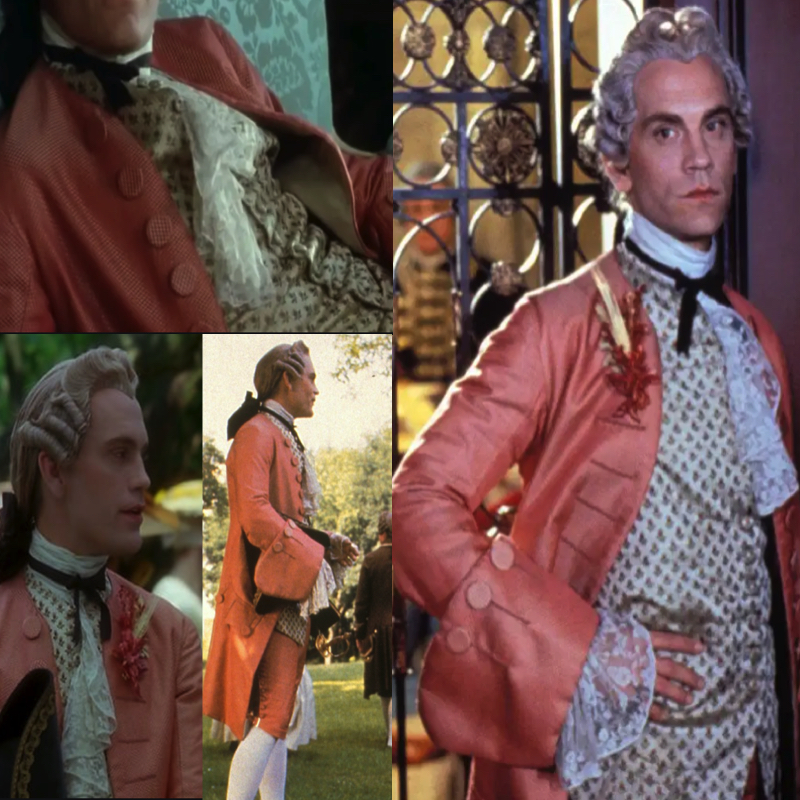
This pink suit matches the colour of the marquise's dressing gown seen in the beginning of the movie almost perfectly. While the coat in itself is rather simple, the waistcoat adds a layer of luxury to the ensemble with its delicate embroidery in what appears to be metallic thread.


The floral pattern is somewhat unusual in that the flowers are quite large. At this point in time, fashion tended more towards smaller flowers - usually done in embroidery. The suit itself is quite dark which is also a tad odd compared to the brighter costumes of the time. However, the scene in which this suit is worn is very melodramatic and as such the costume neatly underlines the atmosphere.


A grey coat with a fine pattern in white and matching breeches. The waistcoat is most likely the same as is worn in the costume beneath. Again, the buttons are quite large and appears even more so when contrasted with the delicate embroidery on the waistcoat and the pattern of the coat.


Another one of the vicomte's suits where the design is focused primarily on the waistcoat and edges of the coat - all of which have been heavily embroidered with golden and champagne-coloured thread.


Cécile de Volanges

Céline's dresses are generally more modest and more neutral in their colours. This particular gown is typical of the type of fabric that became fashionable in the 1770's - particularly the small flowers. This robe à l'Anglaise is really quite simple with no adorned bodice or contrasting petticoat. The only show of extravagance is the layered lace at her elbows.


Another white gown worn by Uma Thurman in her role as Cécile, this one looks like a less elaborate version of the white gown worn by the Marquise de Merteuil - perhaps reference to Cécile coming more and more under the control of the marquise? Of course, the colour symbolism should not be disregarded either; at this point in the movie she is still an innocent, virtuous young lady.


Madame de Tourvel

A rather neutral beige dress with small pink flowers, this gown would be suitable for a woman of her rank: not quite as extravagant as an aristocrat's but suited for the wife of a statesman. While the gown itself does not have the otherwise typical ribbons or bows, the ruffles at the neck provides a modest piece of accessory.


The only one of Madame de Tourvel's gowns to have a more bright colour-scheme, this outfit is also a caraco combined with a contrasting skirt. The pattern on the blue caraco almost looks like chinoiserie which became very popular in the 1770's.


Again, the bodice has been framed with ribbons rather than being its own separate piece of clothing. This robe à la Française is neatly topped off with a straw-hat - also adorned with flowers to match those on the gown itself. Note that pleats hanging from the shoulders.


Others

Madame de Rosemonde (played by Mildred Natwick) wears predominantly dark colours associated with widowhood. As such, her clothing stands in stark contrast to the occasionally very flamboyant colours of her co-stars. It was not unusual for women to discard the lightest colours as they grew older - for instance, Marie Antoinette ceased wearing pink when she turned 30.


The mother of Cécile, Madame de Volanges, wears this bright fuchsia gown with a green petticoat - and an impressive array of pearl jewellery. Note that the bodice has been arranged in a scallop pattern in ruffled ribbons.


Peter Capaldi stars as the valet of the Vicomte de Valmont, Azolan, and as such is primarily seen in his livery. Therefore, it is practical but not entirely devoid of embellishments as this would have been an outward symbol of his employer's wealth.


And finally, Laura Benson portrays Émilie who is one of the vicomte's more mercenary mistresses. She is seen wearing a bright yellow robe à la Française with red bows on her bodice - perhaps it is not a coincidence that the shade of red is exactly that of Azolan's? After all, they are both in the vicomte's pay.


Monday, 12 April 2021

The Colour Palette of Fashion: Black

Unlike other European powers - particularly Spain - black was never truly the colour in French fashion during the 17th and 18th centuries. Instead, the French focused on more colourful ensembles to signify wealth and status. Traditionally, entirely black ensembles were worn for mourning by the French courtiers whereas single articles of clothing could be black if combined with other colours. The Spanish court, in contrast, highly valued somber black outfits and that trend spread to a remarkably wide array of European countries: the Netherlands, England, Denmark, Sweden, Naples etc. Yet, while France stuck to their richer colours that is not to say that they abhorred black or only used it for mourning - rather, it was merely used on a far smaller scale. There was another reason behind the French reluctance to don completely black outfits in the 18th century; traditionally, black had been the colour assigned to the Third Estate in the Estates-General.

Surprisingly enough, black was a particularly difficult colour to achieve which made black clothing quite expensive - especially if the fabrics were valuable in themselves, i.e. silk. The original way to achieve black in Europe was to continually dye a fabric with woad which was otherwise used to get a nice blue tone. Already at that point, the extra labour involved in the dyeing process would have spiked up the prices. 

Caraco 1770-89, Gown late 18th century, suit
1774-89 and suit mid-18th century


These did not fall when a more convenient way of dyeing clothing black was found. The Spanish colonies in South America yielded completely new ways of achieving a more pure black colour - undoubtedly, this was another reason for the Spanish fondness for the shade since it thus displayed their imperial power. With French colonies emerging in the Americas too, logwood became the preferred way of dyeing black.

The introduction of logwood to Europe was an instant hit with the cloth merchants. Logwood is a hardy plant that grows easily and yields a wide variety of dyes besides black: purple, blue, grey.


Lady Frances Courtenay, Marquise of Llano,
Louisa Ulrika of Prussia and Maria Josepha Sobieska


Considering Louis XIV's personal ties with Spain (his wife and mother were both Spaniards and his grandson would become king of Spain) it is hardly surprising that he would often display the colour in his own wardrobe. Notably, he and Philippe d'Orléans took advantage of the dark background to highlight the exquisite diamonds they wore.

Madame de Maintenon also made great use of the darker tones which was quickly followed by other ladies at court. Her predecessor, Madame de Montespan, had worn somewhat richer colours but was noted to have intertwined black ribbons with her curls on several occasions. Armour, too, was often designed to be almost black in colour which contrasted nicely with the intricate details in gold or silver.


Empress Maria Theresia (in mourning), Amalia van
Solms-Braunsfel, (presumed) Count Flaminio Tassi
and Sir Christopher Wren


During the reign of Louis XV there was a general shift from the darker to the lighter colours when it came to fashion. This was largely thanks to the influence of Madame de Pompadour who championed the rococo style. Nevertheless, black still managed to sneak its way into the everyday-life of Versailles. For instance, when it came time for the king's debotter (a brief ceremony when he took off his hunting boots), his daughters, Mesdames, would leave their apartments wearing a black taffeta cloak to conceal the fact that they were basically deshabillé underneath.

In the 1770's and 1780's black was quite fashionable for accessories. For instance, M. de Bouilly noted that Marie Antoinette had worn a pouf of black velvet on the day of his presentation. The death of Louis XV also presented a new opportunity for Rose Bertin to cash in on the royal death. Soon, headdresses with black marigolds or other flowers were seen everywhere.


Jacques François Bégouën, unknown lady, 
Madame de Ventadour and Philippe d'Orléans


Towards the dying years of the French monarchy black was in bad standing; when combined with yellow it represented the imperial house of Austria, the native dynasty of the then-hated Marie Antoinette. It was also seen to be symbolical of the wearer's mourning for the old way of life. Indeed, the records of Rose Bertin shows that after the royal family had been taken to Paris, there was a high demand for black items of clothing. In itself this is rather ironic considering that white was the colour of the French monarchy.

Sunday, 11 April 2021

The Price of Glory: Military Injuries

The vast majority of male aristocrats spent a part of their lives in the king's army; some made it their primary career while others served briefly. The risk attached to that service varied depending on whether France was currently at war. If not, a military service could consist of managing a regiment or a posting to a specific garrison. However, if France was at war the service became far more active - and far more dangerous.

Then, as now, military service inevitably involves the risk of serious personal injury or even death. Naturally, this was the case for the aristocratic sons of France as well although they did not expose themselves to the same amount of danger as the professional soldiers in the front lines. It should be pointed out, though, that in order for a young man to distinguish himself (and potentially be rewarded by the king) he would have to stick his neck out. This would often entail being at the very centre of the action, i.e. by leading cavalry charges.

As could be expected not everyone made it home safe and sound. Some never returned at all while others had to live with the permanent damages. Interestingly enough, the contemporary memoirs rarely mentions such things even when describing men who had spent their entire lives in the army. One exception is the memoir of the Marquis de Dangeau but there was a very clear reason for this: the injured was his own son.


Philippe de Courcillon was 22 years old when he was serving at the Battle of Malplaquet on 11 September 1709. During the battle, the young man was injured in the leg and the wound proved very serious; so serious that the doctors on hand decided to amputate his leg. His father, the famed memoirist, mentions that the amputation had been performed on the thigh. Philippe was sent back to Versailles where the king was kind enough to lend him his personal surgeon, M. Marèchal (his name, not to be confused with the title). The days that it took to bring Philippe back to court had left his wound in a terrible state. 

The surgeon found the patient in such imminent danger that he decided to remove more of the thighbone. The concerned father explained that the surgeon's decision was because the wound had begun to fester and the skin had regrown "too quickly". One can only imagine the pain that Philippe must have been in. Almost miraculously he survived the second operation as well. However, it cannot be ruled out that the trauma had caused irreparable damage to Philippe's body and mind. He died ten years later, at just 32 years of age.


Also at Malplaquet was Pierre Montesquiou d'Artagnan, Comte d'Artagnan, who commanded the right flank of the French forces. As he led his forces, the Comte d'Artagnan (whose name would be immortalised in "The Three Musketeers" by Alexandre Dumas) was a prime target for musket shots. During the battle three horses were shot from under him and he himself did not go completely unscathed: after the battle, four dents from bullets were found on his cuirass protecting his chest. He was wounded, presumably by just such a musket shot.

Pierre de Montesquiou d'Artagnan
Comte d'Artagnan


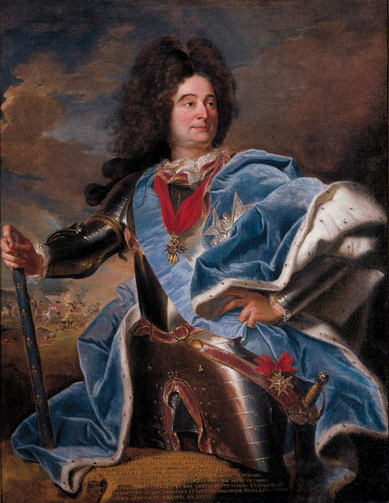
Of all the men who were wounded at Malplaquet, one of the most distinguished was Claude Louis Hector de Villars, Duc de Villars. Like the Comte d'Artagnan, he was the victim of a musket shot which hit him in the knee. Despite his obviously painful injury, the newly-created Marèchal de France insisted on remaining with his troops and continued giving orders from a litter until he finally fainted. He was then carried back to the French camp. The incident is referred to in his private memoirs. He mentions that he had his wounds dressed "at once" - he also attest to the immense amount of pain he must have been in by writing that once he was insensible he was carried all the way back to Quesnoy without his knowing it. 

It is not surprising that the Marèchal de Villars was a popular man with his troops. Besides this fervent devotion to duty, he had voluntarily made do with the decreased rations of the common soldiery after the disastrous winter of 1709.


Marèchal de Villars


A few decades later, Louis de Brienne de Conflans, Marquis d'Armentières, found himself at the battlefield of Guastalla during the War of the Polish Succession. There, he served under the Marèchal de Coigny when the battle commenced on 19 September 1734. At the time, Louis was 23 years old and had commanded his own regiment since the age of 16. During the battle Louis was wounded by a musket shot which hit him in the neck. Remarkably, Louis survived but he must have had a visible scar which he carried until his death in 1774.


The Battle of Fontenoy was the greatest military triumph of Louis XV's reign but it saw its fair share of death and injury as well. One who experienced just than on his own body was Marc-René de Voyer de Paulmy d'Argenson, marquis de Voyer and son of the Minister for War. Marc-René was Mestre de Camp of the Berry-regiment which meant that he led the charge against an English detachment. In some manner, he appears to have been knocked unconscious and was dragged back behind French lines. For two hours, he remained unresponsive and was generally believed to be dead. It is not unlikely that he suffered at least a concussion and appears to have made a full recovery. 

Marc-René was wounded again, 13 years later when he partook in the Battle of Crefeld. However, this particular injury is unspecified and does not appear to have been serious either. 


File:Battle of Fontenoy 1745.PNG
The Battle of Fontenoy


One man who did not sustain his wound on European soil was a man with an impressive amount of first-names: Jean Baptiste Charles Henri Hector d'Estaing, more commonly referred to as the Comte d'Estaing. He offered his services when France (once again) went head-to-head with England in India. The Comte d'Estaing was posted to the siege of Madras in December 1758. During a minor battle between French and English troops, the Comte d'Estaing found himself in a very unfortunate situation when he was unhorsed by the English troops. Nevertheless, he continued to fight until he was stabbed twice with a bayonet. Only then did he formally surrender.

Rather than shipping him the long way back to France, he was taken into the very city that he was besieging. His wounds were treated but cannot have been particularly bad since he was soon negotiating with the English governor. He was given the opportunity to be released on parole but initially preferred to be kept until an exchange of prisoners could take place - this would also allow him to resume fighting. It was not until the arrival of the English fleet at Madras that the Comte accepted his situation and agreed to the parole. The consequence was that he would only be released - unmolested - if he refrained from further action against the English. 


Noël de Jourda de Vaux, comte de Vaux, maréchal de France (1705-1788).jpg
Comte de Vaux - wounded five times during his career

By the end of his career, Noël Jourda de Vaux, Comte de Vaux, had participated in five major battles, thirty sieges and earned the esteem of two Marèchaux de France: de Broglie and de Saxe.

The Comte de Vaux was wounded no less than five times. In and of itself, such a number might not seem terribly high but considering the non-existing hygiene and dubious medical practices, this is quite impressive. He sustained his first two wounds in the battles of Parma and Guastalla while serving as a captain in 1734. Five years later, he found himself once again engaged on Italian soil - more precisely at Corte. While holding his post in a monastery, he and his troops were set upon by about 2.000 Corsicans. At a disadvantage, he was wounded twice but the French soldiers managed to drive the Corsicans out which left an opportunity for medical treatment. 

His final wound is the only one we know the origin of. At the siege of Bergen-op-Zoom, his division was deployed to the village of Vouet. It was here that an enemy force of 10.000 men descended upon the French soldiers who had to retreat. During the battle, a shell exploded near the Comte which caused his final battle scar.

Friday, 9 April 2021

The Château de Meudon: The Grand Dauphin's Personal Retreat

In June of 1695, the Sun King struck a bargain with Anne de Souvré - widow of his minister Louvois and owner of a charming château called Meudon. In exchange for the Château de Choisy and the balance in cash, Meudon would be sold to the crown. Once Madame de Souvré agreed, the king gave it as a present to his son and heir, Louis.

Meudon had the exquisite advantage of being located right between Paris and Versailles. Therefore, the heir could be close enough for his all-seeing father to keep an eye on him but far enough away to establish a semblance of privacy. Until then, the Grand Dauphin had been living with his father for the vast majority of his life. It is therefore not surprising that Louis treated his new estate as a true gift.

The painting of the château below shows a somewhat small castle in red bricks. This is the Château-Vieux, or the Old Castle. In the background stands the Château Neuf which was added later on to house more people. To the right in the painting is a single story block; here, the dauphin's offices, kitchens and servants' quarters were placed.


File:Détail chateau meudon pierre denis martin 1723.JPG
Meudon at the time of the Grand Dauphin


As can be seen from the floor plans below, the guests were primarily the Grand Dauphin's immediate family and his friends. As such, it was definitely a change from the bustling of Versailles where any courtier was not only admitted but expected to appear. That, however, would not last forever. By 1705 the court was beginning to look for new beginnings. The king was getting old and some decided to curry favour with the heir to the throne. This created the problem of housing a new score of courtiers at a rather small retreat. 

Amongst those who flocked to the dauphin were courtiers who felt overlooked by the king or even unfairly treated. They saw the Grand Dauphin as their golden ticket back into the favour of a monarch - or at least maintaining their connections with members of the royal family. The latter was easily done at Meudon since especially the dauphin's half-sisters and his sons and daughters-in-law were frequent guests there.

Like his father, Louis had a love for building. He had a grotto in the garden - long outdated and considered unfashionable - replaced with an entirely new building. This was referred to as the Château Neuf and will be discussed briefly below. While the Grand Dauphin was there he could indulge in both his love of architecture (he had some rooms redone several times) and his passion for hunting. The woods surrounding the estate were filled with deer and he did not have to travel far to engage in his favourite type of hunting: wolf hunting.


File:Distribution rez de chaussée 1700 château de Meudon.JPG
Ground floor of the original château, 1699/1700


Despite being the Grand Dauphin's personal retreat, he was never quite far from his father's control. It was registered as a royal building under the control of the Bâtiments du Roi which meant that any maintenance and embellishment were paid for by the king's coffers. It is therefore a tad surprising that Louis XIV allowed the extravagant sums that his son's projects cost. At least 3.000.000 livres were spent in the sixteen years that the Grand Dauphin had the enjoyment of his château. A massive sum, indeed, but the king was hardly one to lift an admonishing finger considering the sums he had spent on Versailles and Marly.

The décor of the château was almost a mix of the signature baroque style of Versailles and the Regency-style that was to come. Some has credited the artists working on Meudon with laying the first steps for the development of the rococo. For the Grand Dauphin, this new domain provided a unique opportunity for setting his own, personal stamp on an estate. While he still had to rely on the artists employed by his father - a direct consequence of being administered by the Bâtiments du Roi - Louis did what he could to make the place truly his. He removed a part of his extensive collection of objets d'art to Meudon which certainly added to the château's prestige. Amongst these pieces were his exquisite collection of Chinese porcelain.

Both the old and the new châteaux were redecorated with paneled woodwork which was often either gilded or painted in light tones. Especially the latter touch was a break with the darker, deeper tones used in Versailles.

First floor, 1701


The dauphin was immensely found of the elaborately decorated wooden furniture which were produced by both Boulle and Foulon. Naturally, these would become a firm fixture in the furnishings of Meudon. While the original château is long gone, we do have some insight into the taste of décor utilised by the Grand Dauphin. Besides his personal collection, it is known that his bedroom alcove was decorated with twelve wooden panels. These were completed by Claude III Audran and were designed so that each panel represented a month of the year - with a pagan deity signifying the specific month as well as a zodiac sign. 


The Château Neuf (left) with the original castle at the centre,
both overlooking their shared garden

The Château Neuf

The Château Neuf was a beautiful albeit odd building. Having been built on a rather steep slope, it is not the same from both sides. The subaltern levels were primarily used for either storage or services such as kitchens. The floor plans of the Château Neuf are usually either blurry or in French. I have edited them to provide some clarity. The letters corresponds to the following "code":

A = Bedchamber, B = Cabinet, C = Wardrobe, D = Grand Staircase, E = Vestibule, F = relating to services, i.e. meal preparation and wine cellars, G = Corridors, H= Chapel, H1 = Tribunes used during service, I = Staircase, K = Open to the vestibule below, L = Guards' Room, M = King's Bedroom, N = King's Antechambers, O = Gallery and P = Toilet


From the floor plans it is very clear that the sole purpose of the new building was to provide a temporary accommodation for courtiers. There were 24 apartments, all of which consisted of a bedchamber, a cabinet and a wardrobe. In such cases, a wardrobe would also be the sleeping quarters of a chamber maid or lackey.

It is also interesting to note that specific chambers were marked for the king's use but were never actually used by the king. Instead, he slept in the original château. It was customary to provide such accommodations, even in castles not owned by the royal family.


Louis would fall seriously ill in April 1711. Eventually, he would die at Meudon that same month. From then on the château became the official château of the dauphin of France. However, none of the subsequent dauphins showed nearly as a great a passion for it as their late relative. As such, it was seldom used during the reign of Louis XVI. It was used as a retreat for the ailing dauphin in the 1780's as the air was said to be particularly pure there - unfortunately, it did not save the boy's life. Sadly, Meudon was one of the estates that did not survive the test of time. Unlike many other royal residences, this one was not destroyed in the revolutionary fury. Rather, the château burned down in 1795. 

Thursday, 8 April 2021

The Colour Palette of Fashion: Orange

Unlike red natural sources for a pure orange dye was rare in Europe. Generally, such sources as Campeche and pernambuco wood had to be imported from the Americas which caused them to be very expensive. A rule of thumb was that natural dyes that could produce either red or yellow could also be used to produce orange. Two instances of this can be found in Godfrey Smiths "The Laboratory..." from 1740. In this book, he provides the reader with two recipes for dyeing silk orange - both requires alum and so-called Orléans yellow.

Robe à l'Anglaise 1745, Robe à la Française 1750's,
Robe à la Française 1750-90 and unknown date


The colour orange was used in a more political sense too. For instance, Louis XIV is said to have banned wearing the colour orange in 1672 as France was then at war with the Prince of Orange, the future William III of England. The immediate consequence was that orange clothing was quickly dyed another colour. Luckily for fans of the colour, the ban was not permanent and orange was once again seen on the fashion scene in the 18th century.


Robe à la Française 1770's, robe à la Française
1735-40, robe à la Française 1740's and open
robe 1750-80

Orange does not appear to have ever reached great popularity in France. Rather, it is far more common to see surviving pieces with orange used as a complimentary colour rather than the primary one. Ironically, the use of orange blossoms were very popular both as perfume and embroidered on silks.

There is definitely a reason for the absence of orange in the often-changing fashions of the late 18th century. Marie Antoinette was said to abhor the colour and is alleged to have declared - whether true or not - that she would not receive anyone who wore the colour. If this is even remotely true, then it is not a big surprise that the colour was not seen much at court at that time.


Suits from 1750's, 1765, 1775-90 and 1760's
respectively

Due to rather limited use of orange in fashion, there are only a few references to orange clothing in connection with Versailles. Yet, we know that on the bedding ceremony of the Duc and Duchesse de Bourgogne, the dressing gown handed to the young groom by Louis XIV was made of orange silk. This alone clearly shows that the king's ban on the colour had already abated by this period. 

In 1786, the Prince of Wales wore a suit of orange serge for his father's birthday; his suit was heavily adorned with silver tissue as well as diamond and sapphire studs. 


Unknown lady, Javier de Bourbon, Marie Barbara
Eleonore of Schaumburg-Lippe and Xavier of Saxony


Wednesday, 7 April 2021

What Happened to the Other Royal Children?

It is well-known that Louis XIV and Marie Thérèse produced an heir in the shape of Louis - better known as the Grand Dauphin. However, Louis had five siblings none of whom survived their childhoods. But exactly what happened to them?

The Grand Dauphin was the eldest child of the couple. He was born in 1661 and augured well for the hopes of any future progeny - he was both male and robust. However, whatever hopes his birth might have sparked, these were soon shattered.


The very next year - 1662 - saw the arrival of another royal baby. This time it was a girl who was  born on 18 November and christened Anne-Élisabeth. However, after just over a month of life, the little girl contracted a chest infection which led to her death on 30 December. Apparently, the tradition of placing the hearts of deceased royalty in the Val-de-Grâce arose around the time of Anne-Élisabeth's death. The nuns allegedly requested Anne of Austria permission to keep the young girl's heart which was granted - and following that it would be the final resting place of the literal hearts of the royal family.

One aspect stands out as a testament to the rigid calendar of court life. Anne-Élisabeth's death occurred in the midst of the festival season. Just a week after her death, the court ballet "Ballet des Art" was performed - and re-performed the day after her funeral. Several members of the royal family performed in person, including Louis XIV and Henrietta of England. 

To modern observers this appears obscene, at best. However, there was not a tradition for putting on mourning for children under the age of 7 - not even royal ones. While the parents were naturally allowed to grieve in private, no public show of grief was exhibited: no court festivities were halted. This can also be attributed to the sex of the child. Female children were considered to be of less importance since they could not inherit - thus, their deaths in infancy were rarely mourned.

Marie Thérèse with the Grand Dauphin

After the death of Anne-Élisabeth, the Queen found herself pregnant two years later. Another daughter was born and named Marie-Anne; but the story of Anne-Élisabeth repeated itself with eery similarity. The child was born on 16 November and would die on 26 December. Like her sister, there was no official show of mourning for the young Marie-Anne. It was Marie-Anne's birth that gave rise to the rumours that the queen should have given birth to a dark-skinned child. However, contemporary sources refer to the fact that the child was possibly born prematurely and was born with a bluish tint usually associated with deprivation of oxygen. Either way, the infant must have recovered her breath since she did manage to live for little over a month.

When Marie Thérèse went into labour for the fourth time, the court was sorely disappointed when yet another daughter was born on 2 January 1667. The newborn was named after her mother and proved to be more robust than her older sisters. At court, she became known as Madame Royale - a title later renewed for the daughter of Louis XVI. Apparently, Marie Thérèse were eager to place her daughter on the throne of Spain - her own native country. If this had happened the implications - genetically speaking - could have been disastrous. 

While her mother was thus dreaming of a future queen of Spain, the little girl was adored by both the royal family and the court. She was raised at the Château de Saint-Germain-en-Laye, which also happened to be the birthplace of her august father. Sadly, this would also turn out to be her last residence. At the age of 5, the young Madame Royale contracted tuberculosis from which she died on 1 March 1672.


Marie Thérèse de France, Madame Royale by Jean Nocret (Museo del Prado).jpg
Madame Royale


If the birth of Madame Royale had been a disappointment, the arrival of Philippe-Charles on 5 August 1668 was anything but. The young boy was named after his uncle and immediately given the title of Duc d'Anjou - incidentally, this title had previously belonged to that very uncle. While it was hoped that the dauphin Louis would grow into adulthood and inherit the throne, it was always necessary to have a "spare" in case of sudden death. For the royal couple, there was yet another reason to rejoice at the birth of their newest child. Marie Thérèse is alleged to have repeatedly attempted to make him the sole heir of the king's cousin, the Grande Mademoiselle, whose fortune was unequalled.
Once again, the queen's hopes were dashed. Like his sister before him, Philippe-Charles contracted a chest infection which led to his death on 10 July 1671.

The final child of Louis XIV by Marie Thérèse was another longed-for son: Louis-François. He was born on 14 June 1672. Like his brother, he was given the title of Duc d'Anjou. Unfortunately, his life would be short and he would die on 4 November 1672 - aged just five months old.


Detail of a portrait of the royal family as Greek gods.
Standing is the Grande Mademoiselle,
Louis XIV is wrapped in a golden cloak,
Marie-Thérèse dressed in pink and blue.
The three children are the Grand Dauphin (with the red sash over his legs), 
Philippe-Charles as cupid and the little Marie-Thérèse with a garland of
flowers.


There are a few aspects about the children's deaths that warrants comment. First, they were all born and lived at the same place: the Château de Saint-Germain-en-Laye. Considering that at least two of the children died of chest infections, it might have been a contributing factor. After all, the royal castle had been built in 1124 and rebuilt in 1529 which meant that building features such as insulation and sanitation were not ideal. 

Child mortality was rampant, too, for much of history. The Institut National d'Études Demographiques records that by the 18th century, one in three French children died in infancy or childhood. As such, the death of the royal children were not surprising. It should also be remembered that even though they were born into a state with physicians and regular food - far from the norm - they were definitely not more secure against the scourges of childhood. For instance, the quality of medical practices were far from high and the drastic "cures" applied to them might just as well have killed them.

But there is one final aspect that should definitely not be overlooked: inbreeding. Louis XIV and Marie Thérèse were cousins - and first-cousins at that. Furthermore, besides the fact that their parents were siblings, their other ancestors were often related to some degree. It cannot be ruled out that the inbreeding had had seriously detrimental health consequences for the young, royal children.