Sunday, 20 December 2015

Madame de Montespan: the Real Queen of France?

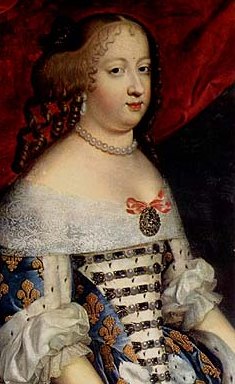
Even though Louis XIV never permitted his mistresses to openly insult his wife, the Queen, he himself did nothing to prevent his consort from feeling miserable. The most dominating of the King's mistresses was Madame de Montespan whose magnificence was never matched by any other mistress at Versailles.

But how differently was Marie Thérèse treated from Madame de Montespan?


The long-suffering Marie Thérèse

The King spent most of his time in the apartment of Madame de Montespan where he would do everything from meeting his ministers to dining with their children. Meanwhile the Queen had to be contend with seeing her husband when he decided to fulfil his conjugal duties.

Usually when travelling the Queen had once been reduced to sitting with both Madame de La Vallière and Madame de Montespan. This had been the case in 1673 when Louis XIV dragged the entire court to the front-line - at this time Madame de Montespan was heavily pregnant. But when Madame de Montespan had finally gained complete ascendancy she travelled with the King in his carriage. The Queen was from then on travelling alone or with her ladies in her carriage - behind the King's.

Once Versailles was finally completely finished the difference once again became painstakingly obvious. The Queen was given eleven rooms to make up her apartment on the second floor. Meanwhile, Madame de Montespan could dance around in no less than twenty rooms on the first floor.


Madame de Montespan

Whenever the Queen and the maitresse-en-titre was out promenading their elaborate gown made it necessary to have someone carry their trains. The Queen had to make due with a simple non-titled page but Madame de Montespan had the honour of having her's carried by the Duc de Noailles.

It did not take long before Madame de Montespan even to take control over the Queen's closest circle. Marie Thérèse had been allowed 12 ladies-in-waiting when she became Queen of France. Madame de Montespan worried that having 12 beautiful ladies swirling beneath the King's eyes would be too great a temptation. The ladies-in-waiting were transformed to 12 dames du palais and Athénaïs soon made it possible to dismiss all twelve of them if only one transgressed.

At one point Marie Thérèse was reduced to imploring the favourite to not send a Spanish attendant of the Queen's home to Spain. As it happens, it had been Athénaïs who had had the attendant dismissed in the first place since she had insulted the mistress. Madame de Montespan agreed to letting the Queen keep her friend but the signal was obvious: the mistress outranked the Queen.

Despite these obvious humiliations the Queen never complained to the King. Her complete submission to the King's infidelities resulted in an odd kind of respect from Louis. Although he never treated her with more respect than a Queen should deserve upon her death Louis remarked: "This is the only trouble she has ever caused me".

Saturday, 19 December 2015

Splendour of the Crown: Royal Gifts

As an addition to my other post on New Year's festivities at Versailles I have gathered some examples of the sort of presents that were exchanged within the gilded walls of Versailles. These include presents given in all sorts of occasions.
Gifts of cold hard cash was common too but I find that these represents the splendour of the court of France. Also, posts and positions were frequently given away, especially at weddings.


Presents
When the Duchesse de Bourgogne gave birth to the future Louis XV she received an oriental casket from Louis XIV. It opened via a secretly hidden spring and once the Duchesse found it she discovered a perfect set of pearls and 4.000 louis d'or.

Louis-Philippe received two horses from the royal stables when he first met Louis XV at the age of fourteen

Marie Antoinette sent a chemise à la Reine to her friend, the Duchess of Devonshire. Once the Duchess had been seen sporting the new trend it immediately became all the rage.


Wedding Presents

Marie Thérèse sent Louis XIV a beautiful chest filled with chocolate - a treat that had not yet established itself at the French court.

Louis XIV gave jewellery worth 73.000 livres to Mademoiselle d'Orlèans when she married the Duc de Berri. The groom was given jewels worth a staggering 300.000 livres!

When the King's brother, Monsieur, married Louis XIV bestowed on him the vast palace of the Palais-Royal. It would remain in the hands of the Orlèans family.

Madame de Montespan arranged the marriage of one of her sons to the eldest daughter of the Duc d'Uzès, Julie-Françoise. She then proceeded to give the bride a necklace of diamonds and emeralds worth 40.000 écus and a basket filled with scents, ribbons, fans and gloves.

Marie Antoinette received the diamonds and pearls that had belonged to the previous Dauphine as well as a single-row pearl choker brought to France by Anne of Austria. A fan encrusted with diamonds was also a part of the King's wedding gifts; so was bracelets with her cipher written on the blue enamel clasps. As a gesture of good faith Madame Adélaïde gave the new Dauphine a key that would allow her to use the private corridors. 

It was common - especially during Louis XV's reign - to give the ladies attending a wedding (such as maid-of-honour) fans as presents.

New Year's Presents

When Madame de Montespan's career as the King's maitresse-en-titre was coming to an end Athénaïs decided to grant her (soon-to-be) former lover a present in her typical splendid style. Athénaïs paid 4000 pistoles to have a book illustrating the sieges of the campaign in Holland in 1672 created. Not only was the book bound with gold it contained verses by Racine and Boileau. Louis XIV was thrilled with his present.

The first son of Marie Antoinette and Louis XVI was gifted with a set of dominos made from the same stone and marble used for the Bastille.

Marie Lescszynska received a golden snuff-box from the King; however, what the Queen did not know was that the box had originally been intended for the King's new mistress, Madame de Pompadour's mother.

Diplomatic Presents

Louis XIV received the speciality wine of Transylvania called Tokaji from Francis II Rákóczi. That actually resulted in wine becoming rather popular with the French court.

In 1668 Louis XIV received an elephant from the King of Portugal. The elephant had originally come from Congo and died in 1681.

In 1686 the King of Siam sent a substantial amount of gifts to the entire royal family. These gifts were as exotic as one would expect from the King of Siam since they all related to the relatively new trend of drinking hot chocolate. The King received two silver chocolate pitchers; similarly the Dauphin was also given two pitchers but these were decorated with elaborate floral motifs in gold. The Queen received a smaller but golden pitcher.

Two porcelain vases, a centrepiece and two smaller ewers were sent from Saxony to France as a part of the plan to have the Dauphin married to Marie Josepha of Saxony. In that same period another set was made for the Duc de Richelieu who had been sent to Saxony for the proxy wedding in January 1747.

In 1758 Louis XV sent the first diplomatic set of Sèvres-porcelain to King Frederik V of Denmark. It consisted of 72 plates and 164 hollow ware pieces; the cost was 34.542 livres. The set was in response to a stallion of the Frederiksborg breed sent by the Danish King earlier.
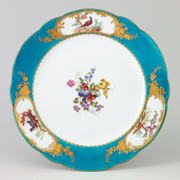
Plate from the set sent to
Frederik V


Madame de Pompadour played an essential role in getting Louis XV closer to a reconciliation with Austria and for that Empress Maria Theresia (Marie Antoinette's mother) sent the royal favourite two lacquer boxes from the Empress' own collection. The boxes were personally selected and sent from Vienna. The gift truly was magnificent since the mounts were not of ormolu as was usually the case but of solid gold and a portrait of the Empress was incorporated into the design. 

Louis XVI received two large eagles for the royal menagerie from the Governor of Kamchatka

Estate Presents

Louis XIV gave Madame de Montespan the estate of Clagny in response to the golden book mentioned earlier in 1682

In 1769 Louis XV gave the château de Louveciennes to Madame du Barry

A month after ascending to the throne in 1774 Louis XVI handed over the keys for the Petit Trianon to Marie Antoinette.

Madame Élisabeth received the estate of Montreuil - where she had spent a great part of her childhood - as a present from her brother.

Thursday, 10 December 2015

The Battle for the Throne: The Princes vs. the Legitimised Bastards

In the early years of the 1700's the King was old and everyone had their eyes both on the still all-powerful Louis XIV and on who were to succeed him.
After Louis XIV had legitimised his sons by Madame de Montespan the French court was primarily divided into two opposing factions: that of the Princes and that of the legitimised sons.

The Princes' faction was made up of the old garde of the French nobility; these were the proper noble families whose birth was not stained by bastardy. That last part was especially easy to publicly demonstrate since the legitimised children of the King were obliged to display a clear bar on their coat-of-arms indicating their dubious ancestry. That was not required of those born on the right side of the sheet.


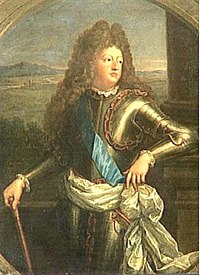
Portrait of Philippe d'Orléans, Duke of Orléans in armour by Jean-Baptiste Santerre.png

Especially the houses of Orlèans, Conti and Condé were the frontrunners of the Princes' faction. The Legitimised party was headed by the Comte de Toulouse and the Duc du Maine - referred to as "the bastards" by the Duc de Saint-Simon - but had the support of the other children of the King - most of whom had been married into the noble families of France. Another supporter was Madame de Maintenon whose patronage can probably be traced back to the support from the King's natural children to see her recognised as Queen of France.

Everything depended on who were to rule France once the King was dead. Since the Dauphin was just a few years old the Duc d'Orlèans was entitled to the regency. To prevent this from happening the Legitimised faction launched an attack on the would-be regent. When the Duc and Duchesse de Bourgogne suddenly died the rumours of poisoning swept through court. Thanks to the combined efforts of the legitimised sons and the King's confessor (another supporter of "the bastards") it did not take long to point out the suspect. Soon after the public took hold of the idea as well and the Duc d'Orlèans had to put up with being shouted after when he went to Paris.


Duc du Maine2.jpg
The Duc du Maine

After considering the case news reached the Duc d'Orlèans at his estate of Saint-Cloud that the King had found him to be entirely innocent. Just like that everything changed once again for the future Regent - and the bastards.

In 1715 on the first day of September Louis XIV died and all hell broke lose. However, since the Duc d'Orlèans had been publicly cleared of the charges made against him he stood in a strong position to claim the regency. But the will of the late monarch disappointed him; rather than naming the Duc d'Orlèans as Regent, Louis XIV had established a regency council - with the Duc du Maine and Comte de Toulouse. Although the Duc would still be presiding over the council he would have no actual power.

Portrait painting of Louis Alexandre de Bourbon, Count of Toulouse by Hyacinthe Rigaud.jpg
The Comte de Toulouse
The end to the bitter feud came swiftly and dramatically. Already on the day after the King's death the Duc d'Orlèans swept into Paris and declared that he had law and tradition on his side (which was true). The "bastards" could only sit and watch as the Duc d'Orlèans easily gained the approval of the gathered parlament. By the end of that day it was settled. The Duc d'Orlèans became Regent while the King's legitimised sons quickly went into an embarrassing retreat.

Tuesday, 1 December 2015

The South Wing - First Floor of 1775-80


A) Duchesse de Tallard (Governess of the Children of France until she was replaced by the Princesse de Lamballe)

B) Apartments of Mesdames Tantes

C) Unknown

D) Mademoiselle de Roche-sur-Yon

E) Comte d'Estrées

F) Grand Prior

G) Comte de Toulouse

H) Governor of the Dauphin

I) Marèchale Berwick

J) Madame de C.

K) Unknown Monsieur

L) Duchesse de Duras

M) Prince de Rohan

N) Captain of the Guard

O) Duchesse de Luynes

NOTE: Apartments D and E were given to the Princesse de Lamballe when she became Governess of the Children of France

Tuesday, 17 November 2015

Porcelain Case


This beautiful porcelain case bears the arms of the Duc de Choiseul while he served as Minister of Foreign Affairs. It is estimated to have been made in 1765 by Niderviller. It is currently in the collections of the Louvre.

The Grand Dauphin's Secret Marriage

The Grand Dauphin had already once married for politics - to Maria Anna of Bavaria - and when she died after ten years of marriage he decided that his next wife would be of his own choosing. However, when the most eligible bachelor in France suddenly becomes single it will not do to have him married of to a maid-of-honour.

The court had long been aware that the Grand Dauphin was very much in love with Mademoiselle Choin, maid-of-honour to the Princesse de Conti. It was rumoured - and is quite likely - that the two were lovers while Maria Anna was still alive. Actually, there is one big clue that can hardly be overlooked: Mademoiselle Choin was pregnant at the time of her wedding.

The Grand Dauphin

Their wedding took place in the first half of 1694 but it is uncertain exactly when. Mademoiselle Choin was never given the title or honours belonging to a Dauphine nor was she acknowledged as the Grand Dauphin's wife. Actually, she would keep the title of Mademoiselle Choin for the rest of her life. The Grand Dauphin, however, did refer to Mademoiselle Choin as his "legal spouse" in a letter to Madame de Maintenon dated 19 July 1694.
That child she expected was born in 1694 and was quickly dispatched into the countryside. Here the little baby boy died nearly two years later without having received a name.

Normally, Mademoiselle Choin lived at Meudon which was the Grand Dauphin's private residence. Whenever she did go to court she was sure to find a friend in Madame de Maintenon with whom she was particularly good friends.
Even though the actual status of the two's relationship was not fully acknowledged it was completely obvious to the prying eyes of Versailles that something had happened. For one, Mademoiselle Choin was allowed to sit in the presence of the royal family despite not being a Duchesse. Also, she addressed the royal family by their first names.


Mademoiselle Choin

One of the reasons why Louis XIV accepted the marriage was undoubtedly the discretion showed by both the Grand Dauphin and Mademoiselle Choin. The latter never tried to meddle in politics and proved herself to be a modest addition to the royal family since she had no interest in displaying any extravagance. The Grand Dauphin never pressured his father for these honours and never made any scandal of the matter. All in all it was as discreet as Louis XIV could wish.

The marriage seems to have been based on genuine affection. When the Grand Dauphin died in 1711 Mademoiselle Choin left court and went to reside in private. Although the Grand Dauphin had left her a large sum of money she refused them with the phrase: "when he was alive I needed only him and now after his death only a small income".
Louis XIV awarded her with a pension which she mostly spent on charity before dying 21 years later.

Pranksters and Princes

Life at court is often enough portrayed as an endless succession of glittering balls and magnificent intrigues. However, the reality was somewhat different. Actually, for the common courtier life was remarkably dull and most days were spent lounging around waiting for something to do - or for the King to pass by. Understandably, some found it irresistible to indulge in practical jokes to both their own amusement and now ours.

The Duc and Duchesse de Bourgogne decided to take their practical jokes to the King's retreat of Marly. The Princesse d'Harcourt was often bound to a sedan chair that was wheeled about. Knowing that the Princesse would want to go from the château of Marly to a garden attraction the two planned ahead. They planted a series of firework bombs along the gravel path they knew the Princesse would use. Once she was in the middle of the path they ignited them and watched the poor, terrified Princesse d'Harcourt shriek from within her sedan chair. Her porters were not of much help - they ran away immediately and let the Princesse guard herself! Meanwhile the courtiers invited to Marly all enjoyed the spectacle from afar.

Billedresultat for princesse d'harcourt
The poor Princesse d'Harcourt

Sadly, this was far from the first prank played on the Princesse d'Harcourt by the two. During another visit to Marly which took place during the winter. The Duchesse de Bourgogne and her inner circle gathered snowballs. Then, using an extra key, they locked themselves in and threw snowballs on the sleeping Princesse! Yet another time the Princesse's sleeves were fastened to her chair before a page put fireworks under it. That particular antic even drew a smile from Louis XIV.

Actually, the Duc de Bourgogne was infamous for laying small traps all around his estates so that visitors might be unexpectedly become the butt of a joke.

Madame de Chartres and her sisters got a hold of petards and decided to disturb Monsieur who was staying at the Trianon. The let off the petards until the smoke was heavy enough to drive the poor man from his chamber.

The Duc de Lauzun was another great prankster and due to his close friendship with Louis XIV he often got away with it. One such prank was played on his own nephew; Lauzun had managed to make the young nephew Commander of the Gendarmerie and on the day that the boy was to thank the King for his appointment Lauzun struck. Lauzun had promised to give his nephew an exquisitely fine suit for his first meeting with the Sun King. To be fair the suit might have been very fine indeed but there was a catch: it was styled in the fashion of 50 years ago. So, the poor nephew was made the laughingstock of Versailles while he tried to maintain some dignity.
For everyone feeling bad for the nephew just keep in mind that Lauzun treated him excessively well and granted him not only generous presents but also bequeathed him a large inheritance.

Duc de Lauzun

The Duc also played a clothes-related prank on the Colonel of the Dragoons Tessé. Tessé did not now exactly how he was to appear in front of the King to give his thanks for his new promotion so Lauzun advised him that it was tradition for the Colonel of the Dragoons to always wear a grey hat. Unbeknownst to Tessé, Louis XIV hated the colour grey so much that he had had that particular tradition abolished four years prior.

On one Christmas Eve Louis XIV had announced his intention of going to a midnight Mass which saw the grand ladies of the court hurrying up to get their fine dresses on. When they were back a guard informed them that the King had changed his mind and off to bed they went. We can only imagine the astonishment of Louis XIV when he arrived to find no one there!

Years later it would seem that even the otherwise reserved Louis XVI was fond of innocent pranks. The secret hallway leading from his apartment to that of Marie Antoinette was lined with benches where servants could often be found asleep. It quickly became a common joke to either spray water into the open mouth of a sleeper or draw a moustache with a cork if the sleeper had their mouths shut. Allegedly, this was a great source of amusement to both King and servants.