Monday, 26 October 2015

Look-Book: Accessories


Look-Book: Jewellery

Through the 18th century the diamond business boomed in France which was particularly due to the fact that French diamond merchants discovered efficient ways of carving the expensive products without damaging them.
Sadly, due to the terrors of the French revolution very few of the original royal jewels still exist. These jewels are from the same age and would be similar to what courtiers at Versailles would have worn - after all France was the fashion idol of the world.


The Duchesse de Bourbon and the Duchesse d'Orléans

It was easy enough to find rivals at Versailles with countless factions and families betraying each other for minor favours. That is why it would seem quite odd that some of the fiercest rivals would be within the same family - unless there is a specific reason.

For an illegitimate child it was impossible to know exactly where you stood at court. There was no title to inherit and no official pedigree to lure in possible suitors. That was especially true for the King's illegitimate children. Two of his children by Madame de Montespan became fierce rivals already from their early adolescents and their competition ended only with their deaths.

Louise Françoise

Louise Françoise de Bourbon and Françoise Marie de Bourbon were both born on the wrong side of the sheet. Luckily for them their father was Louis XIV and he was determined to see all of his children succeed.
The two sisters' rivalry began with one of the most important alliances a young noblewoman could make: marriage. As the eldest, Louise Françoise was married off first at the age of 11; her bridegroom was Louis de Bourbon, Prince de Condé and later Duc de Bourbon. So far so good. Louise Françoise and Françoise Marie's relationship might have been a whole lot better had not Louis XIV decided to shock his court. Despite being a younger sister Françoise Marie was married to one of the most eligible bachelors at court: Philippe II d'Orlèans. As the son of the King's own brother he would one day become Regent.

To sum up Louise Françoise became the Duchesse de Bourbon and Françoise Marie became Duchesse d'Orlèans.

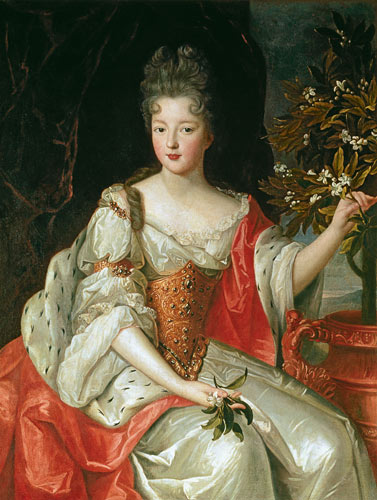
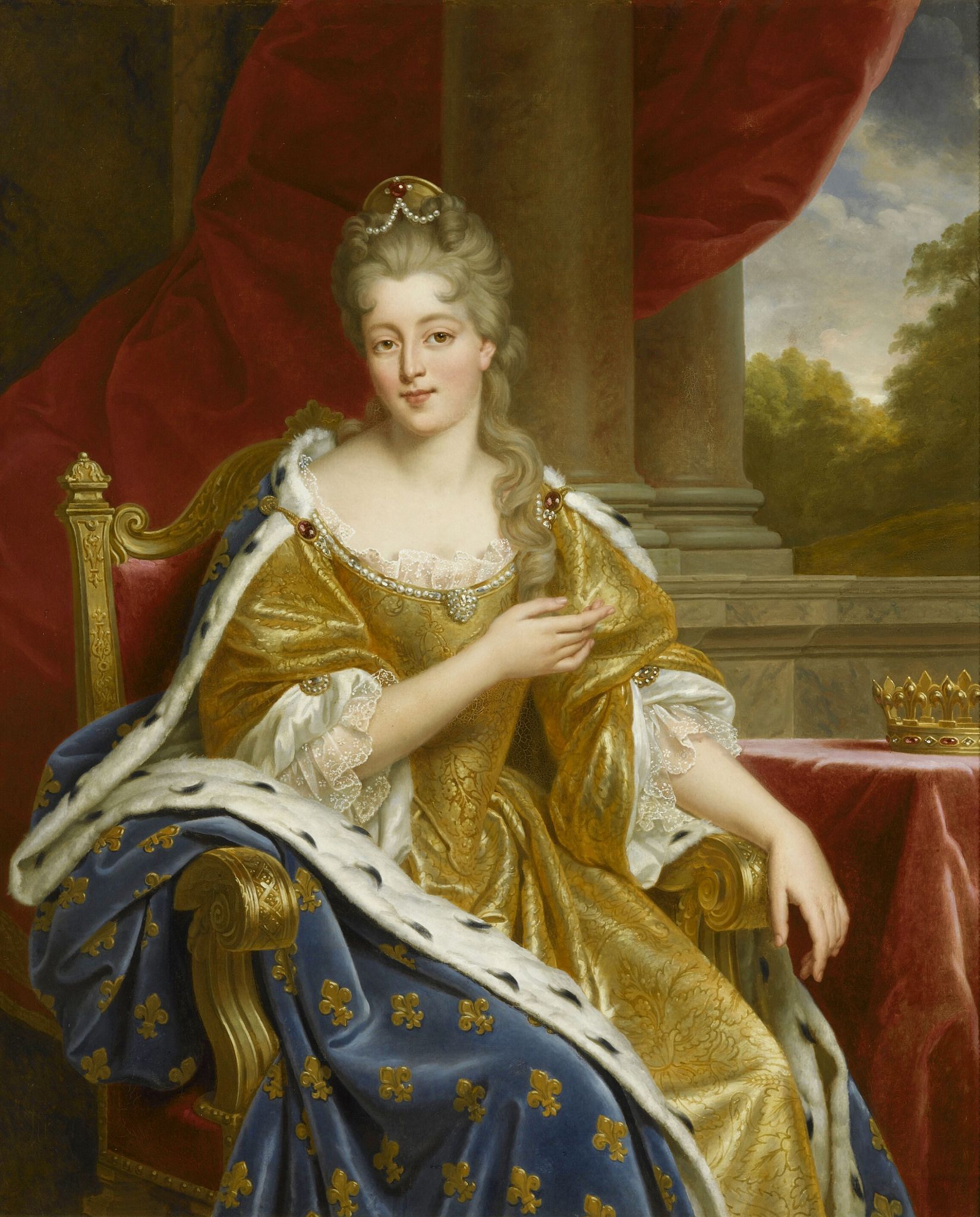
Daughters of Louis XIV and Madame de Montespan,Louise Francoise Princesse de Conde  the elder daughter is on the right with Francoise Marie Duchesse dOrleans on the left:
Louise Françoise (left) and Françoise Marie (right)

The latest match also meant that besides wounded pride there was a whole new sting of "insults" to Louise Françoise. First of all, their august father handed Françoise Marie a dowry twice the size of what had accompanied Louise Françoise into her marriage. Second, Françoise Marie now out-ranked her elder sister which meant that she took precedence at court.
To add salt to the wound it was well-known that Françoise Marie was Louis XIV's favourite daughter.

When Louise Françoise's father-in-law died in 1709 she stood to become First Princess of the Blood due to her marriage. However, the title was transferred from the House of Condé to that of Orlèans - in other words to Françoise Marie! Even though the latter never actually styled herself as Madame la Princesse it was a thorn in the side of Louise Françoise.

Françoise Marie as Duchesse d'Orlèans

Several years later another nail in the coffin of their relationship was firmly in place. Charles, Duc de Berry (son of the Grand Dauphin) was still unmarried and quite the catch. For a while it was rumoured - and practically expected - that he would marry the daughter of Louise Françoise. However, Françoise Marie quickly stepped in and snatched Charles up as a bridegroom of her own daughter!

As if the lucky star of Françoise Marie had not blinded Louise Françoise enough worse was yet to come. When Louis XIV died in 1715 Philippe II d'Orlèans was made Regent - consequently Françoise Marie was now the highest-ranking woman in France which was the closest thing to being Queen anyone could come.

Saturday, 24 October 2015

Madame de Montespan and Isabelle de Ludres

No one challenges the King's mistress. Few rules were as clear as this one but occasionally someone would forget it.

Even though the King already had his official maitresse-en-titre this was no reason as to now have more casual liaisons once in a while. Since a relationship with the source of power itself could be very advantageous it is no wonder that the then reigning mistress Madame de Montespan was eager to keep any potential rivals at bay.


Madame de Montespan

Isabelle de Ludres was one such rival. Her affair with Louis XIV began in 1675 but it not to be a threat to Madame de Montespan. By all appearances Louis XIV made it very clear that the affair was to remain a secret - perhaps the immense temper of his favourite was a deciding factor in that.

However, Isabelle de Ludres simply could not resist the temptation and quickly spread the news of their affair. That would have been a nuisance at best but Isabelle made her final mistake when she publicly declared that the King loved her more than Madame de Montespan.

Isabelle de Ludres

Angered by such arrogance Louis XIV sent her packing in 1678. While Madame de Montespan continued her reign as royal favourite for some years to come Isabelle de Ludres first went to a convent and was eventually given a marquisate. But her dreams of ever replacing Madame de Montespan as royal favourite was thoroughly crushed.

Stockings

1640's
1650-1750
1670, England
1700-25
1700-50, Spain
1750
1750-1800
1750-75, France or UK
1750
1750's, England
17th century, Italy
17th century, Spain
Late 18th century,
France
Mid 18th century, Spain
Belonged to Mme. de
Pompadour

Marie Antoinette and Madame du Barry

One of the most infamous rivalries of Versailles is undoubtedly that of the then Dauphine Marie Antoinette and the King's maitresse-en-titre Madame du Barry.

The rivalry was brought on due to several circumstances. When Marie Antoinette arrived at Versailles she had no knowledge of how common it was for Kings and Emperors to take mistresses. Her own father had had several but she never saw or heard of them so she left Austria without any idea of that sort of relationship. Once established at Versailles it is easy to understand why the first shock at the favourite's actual relationship with the King was strengthened. Eager to please her husband Marie Antoinette immediately caught on to Louis Auguste's immense dislike of Madame du Barry; a dislike shared by his aunts whom Marie Antoinette saw every day.
From Madame du Barry's point of view pride certainly had the lion's share of her side in the conflict. Also, though eagerly engaged in politics Madame du Barry seemed to be unable to understand that the woman she was so openly against would one day become Queen.

Marie Antoinette at the time of her wedding -
this portrait was actually sent to Louis XV for
his approval of her as Dauphine 

In the days following the wedding of Marie Antoinette and Louis Auguste several theatrical performances had been ordered by Louis XV. As the King's undisputed favourite Madame du Barry was guaranteed some of the best seats for her and her attendants. However, when the Comtesse arrived a couple of ladies-in-waiting - including the Duchesse de Grammont who happened to be the sister of the Duc de Choiseul - to the Dauphine had taken their seats and refused to budge. As if this was not bad enough the ladies insulted the royal favourite as well. Understandably upset at such a treatment Madame du Barry went straight to the King who - for once - took action and exiled the Duchesse de Grammont.
Whether Marie Antoinette knew of the particulars concerning her lady-in-waiting's disgrace is unknown but she was aware that it was Madame du Barry who had cost her a companion. This hardly improved their relationship.

This triumph of Madame du Barry was soon turned into one of Marie Antoinette. When that same Duchesse's health deteriorated rapidly it soon became clear that she needed the expertise of the Parisian doctors. However, Madame du Barry was unable to let go of the grudge she held towards the Duchesse and would have prevented her receiving the necessary treatment if she could. But Marie Antoinette cleverly appealed to Louis XV's sentiments when she remarked that besides the injustice and unkindness such a situation would create it would be a great unhappiness to herself if one of her household was to die while still in disgrace with the King. That did the trick and the Duchesse de Grammont returned to Paris.
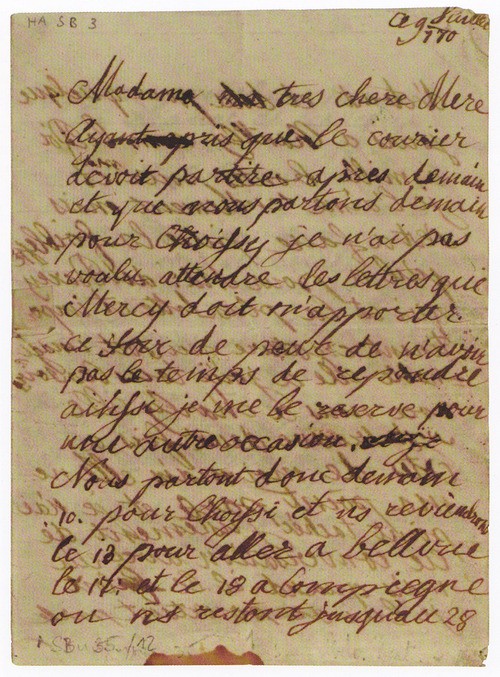
Letter of Marie Antoinette to her mother Empress Maria Theresia
of 9 July 1770 in which Marie Antoinette describes Madame du
Barry as the stupidest creature she ever met

Some time later the faction which Madame du Barry was a fervent supporter of (the d'Aiguillon faction) finally succeeded in having the Duc de Choiseul dismissed. Marie Antoinette was devastated. It had been the Duc de Choiseul who had brought about the union between France and Austria and to the young (and lonely) Marie Antoinette he was the only political friend she had. Madame du Barry made no attempt at hiding that she had indeed been instrumental in bringing about the minister's fall.

As it was quickly apparent to Madame du Barry that she would not become a friend of the Dauphine she apparently decided to simply stop trying. Despite her otherwise calm nature Madame du Barry was often heard mocking and insulting the Dauphine even in the presence of the King. These cutting remarks might have been ignored by the Dauphine - who due to the utter lack of secrecy at court knew all about them - had they not touched a nerve. Madame du Barry often commented on the unconsummated state of the Dauphine's marriage which struck at the heart of Marie Antoinette's personal problems.

Detail of Marie Antoinette playing the harp during one of those balls that
Madame du Barry was barred from

So far Marie Antoinette had excluded the royal favourite from her private balls. Since these soirées were not only socially delightful but an honour Madame du Barry soon complained to the King. Louis XV approached the Dauphine who delicately said that she could hardly invite the Comtesse since the King's daughters (Mesdames Tantes) were always invited. Everyone knew of Mesdames Tantes' strong dislike of their father's newest mistress and since Louis was ever frightful of creating embarrassment he agreed with the Dauphine.


A rather scandalous episode occurred one afternoon while Marie Antoinette and the Princesse de Lamballe was taking the air in one of the inner courtyards. The two ladies narrowly avoided being hit by the contents of a chamberpot being emptied from the attic-apartment of Madame du Barry. While there can be little doubt that Madame du Barry herself did not do it and that the serving girl who did probably did not see the two, it still made plenty of good gossip.

Madame du Barry
Empress Maria Theresia of Austria was very well aware of her daughter's feud with the King's mistress and she was not pleased. Since Marie Antoinette's marriage was still unconsummated the young Dauphine was in a dangerous position; non-consummation was a valid reason to annul a marriage. To the Empress it was vital that Marie Antoinette did not make her position worse by insulting the King and she continuously demanded that Marie Antoinette ended her silent treatment. With the formidable letters from her mother as well as the constant pressure from the Austrian ambassador Marie Antoinette finally caved in.
On 1 January 1772 she made the following remark to the Comtesse:
"There are a lot of people today at Versailles"

This remark was short enough in itself but it was all that was needed. Being made in full public it was a triumph for the Comtesse who was not allowed to address the Dauphine herself. Ambassador Mercy-Argenteau was quick to praise Marie Antoinette but she made it very clear that she would never talk to her again.
Nonetheless, the King was pleased and for a short while Marie Antoinette received a short break in the stinging letters from her mother.

The rivalry officially came to a close in 1774 when Louis Auguste became Louis XVI and Marie Antoinette became Queen. One of the first acts of Louis XVI was to exile the former favourite from court and ordered her to spend time in a nunnery. Madame du Barry was never allowed back to court.

In a stroke of tragic irony both Marie Antoinette and Madame du Barry would end their lives by the guillotine.

Friday, 23 October 2015

Emmanuel-Armand de Richelieu, Duc d'Aiguillon

Born on 31 July 1720 with the impressive full name of Emmanuel-Armand de Vignerot du Plessis de Richelieu. As the nephew of the Duc de Richelieu it was only natural that Emmanuel-Armand should make his debut at court - here he was known as the Duc d'Agénois until his father's death.

Following the traditional path of young noblemen he entered the army at seventeen. Here he apparently made a good impression - that or his good connections helped him - because he was made a colonel just two years later. Having made an early reputation in the army, it was time to marry. This took place not long after his military promotion (in 1740) when he wed Louise Félicité de Brehan.

As a rising star at the infamous court of France it was only appropriate to take on a mistress. So, Emmaunel-Armand did and in style. He began an affair with the beautiful Marie Anne, Marquise de La Tournelle. However, something got in the way. None else than Emmanuel-Armand's uncle, the Duc de Richelieu, who had set his mind on presenting Marie Anne as the new mistress of Louis XV. As it turned out Marie Anne was loyal to Emmanuel-Armand and rejected the King. Unsurprisingly, Louis XV did not take kindly to this rejection and took a rather drastic measure. Together with the Duc de Richelieu the King took advantage of Emmanuel-Armand's military experience and dispatched him to Italy where he was to fight in the War of the Austrian Succession.

This could easily have been the end of Emmanuel-Armand when he suffered a serious injury. However, the young colonel turned out to be harder to get rid of than anticipated. Rather than perishing on a far away battlefield, Emmanuel-Armand returned to France where he was greeted as a hero.
Thinking that since war did not prove enough to keep Emmanuel-Armand away, the Duc de Richelieu turned his attentions towards another great destroyer of men: love. Shortly after returning to court Emmanuel-Armand as sent on his way again; this time to Languedoc. Here, a beautiful lady was waiting with clear instructions to do everything in her power to seduce him which she succeeded in. Once the Duc de Richelieu learnt of certain romance letters, it did not take long for Marie Anne to find out. That proved the end to Emmanuel-Armand and Marie Anne's affair.

Continuing his military career for a while he then returned to court where he found his place among the Dévot faction. Perhaps a twist of irony but this faction was particularly opposed to Madame de Pompadour - perhaps a bit of resentment there? Besides Madame de Pompadour he was also a fervent opponent of both the Parlement and the Jansenists. Overall, he was soon known to be against any kind of change whatsoever which made him a perfect target for pamphleteers.

If the air in Paris became a bit too hostile, Emmanuel-Armand could soon turn his gaze elsewhere when he was appointed governor of Brittany. However, he did not take long to fall out with his new province. After a detour involving an invasion of Britain, Emmanuel-Armand had become a nuisance to both the Parlement in Paris and Brittany. However, Louis XV remained a firm believer in him, despite their past differences.

Emmanuel-Armand at the invasion of England
Once back at court, Emmanuel-Armand quickly found his way back to the Dévot party. Emmanuel-Armand was made Minister of Foreign Affairs when Louis XV decided to reorganise the government. Surprisingly enough, this promotion was instigated by Madame du Barry. This new government was deeply unpopular and as a minister Emmanuel-Armand was soon a scape-goat. From there on his political career went down-hill. First, he agreed to the division of Poland and then he approved the suppression of the Jesuits - a society he had hitherto been a supporter of.

His final mistake was to fall out with the new Dauphine Marie Antoinette who was opposed to him as a creature of Madame du Barry. When she became Queen Marie Antoinette demanded his exile which was brought about in 1774. This was the end of Emmanuel-Armand as a public figure. He died in 1788 - so forgotten by society that his exact date of death was not recorded.