Sunday, 16 April 2023

Charles Godefroy de La Tour d'Auvergne, Duc de Bouillon

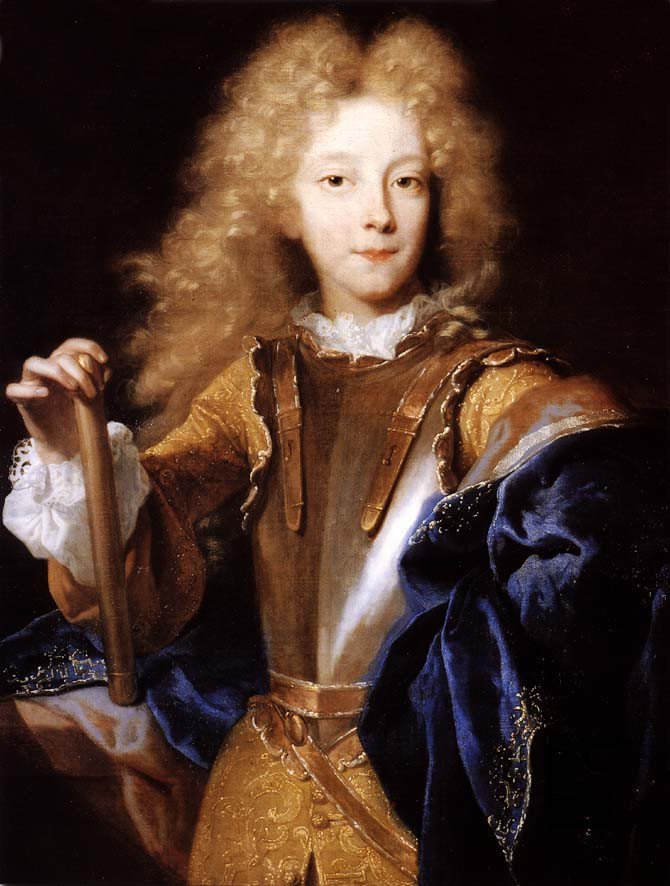
Charles Godefroy de La Tour d'Auvergne was the last child born to Emmanuel Théodose de La Tour d'Auvergne and Marie Armande Victoire de La Trémoille; as the third son, there was little chance of Charles inheriting more than a smaller curtesy title. He was born on 16 July 1706 and spent his childhood in somewhat obscurity. At the age of eleven, his mother passed away and his father remarried to Louise Françoise Angélique le Tellier.

The home-life of Charles was changing. His new stepmother gave birth to a half-brother in 1718 before dying in 1719. This prompted his father to remarry again, this time to Anne Marie Christiane de Simiane who - in turn - had daughter. Like her predecessor, Anne also died young after just a few years of marriage. Despite being in his sixties' Charles' father remarried for the fourth time to the beautiful (and young) Louise Henriette Françoise de Lorraine who gave Charles another half-sister.

Thus, in the space of 12 years, Charles had had three stepmothers and three half-siblings. Little is known of the particulars of his personal upbringing which likely took place away from both court and his father. As he grew older, Charles' personal status would change considerably. His eldest brother had died before Charles was born but he was still the younger of two remaining son - until 1723.


The year 1723 turned out to be a turning point in Charles' life. His brother married the Polish-born Maria Karolina Sobieski - promptly Frenchified into Marie Caroline - before dying just ten days after their wedding. This premature death had two massive consequences for Charles: firstly, he was catapulted from the third son to the heir of the Duc de Bouillon and secondly, he was given a wife.


Charles-Godefroy de La Tour d'Auvergne.jpg
Charles Godefroy

The union between Charles and Marie Caroline was unexpected by outsiders. By Catholic law such a marriage required papal dispensation as the two were considered to be relatives due to Marie Caroline's first marriage. This dispensation was promptly acquired by Marie Caroline's sister, Clementina, but without either informing or asking permission from the bride's father. This caused a massive rift between Marie Caroline and her wealthy parents. That wealth happened to be the motif behind the hasty remarriage; the young woman had been given a massive dowry of 750.000 livres.

Marie Caroline became pregnant with their first child who was named Marie Louise Henriette Jeanne. Their second (and last) child was the son Godefroy Charles Henri.

By this time, the relationship had deteriorated rapidly; the couple officially separated in 1730 with Marie Caroline travelling to Poland to restore relations with her father. Meanwhile, Charles took up a liaison with none other than his last stepmother! 

The life of the Duc de Bouillon was characterised by libertinage, privilege and royal favour. At court, he had the advantage of being a favourite of Louis XV who often included him in his private dinners behind the scenes. Charles possessed no fewer than three of the most coveted positions at court: Grand Chambellan, Grand Écuyer and Grand Maître. These brought him both considerable income and influence, the latter boosted by his personal friendship with the king.

Indulging fully in the finer things in life, Charles had several affairs and dappled heavily in gambling. Unfortunately, he was not particularly skilled at the pastime - the Duc de Luynes claimed that his gambling debts amounted to over a million livres. Ironically, Charles owned several of the most beautiful properties in France which helped diminish the public appearance of financial troubles. He therefore had high hopes that Marie Caroline would reconcile with her immensely wealthy father.

Besides his gambling, his temper was apparently not entirely under control. An incident occurred at his country estate in 1731 which ended in a brawl between himself and the Duc de Durfort; the scuffle went so far as Durfort being stabbed.

Still, his contemporaries hesitated to label him entirely a bad egg. Despite his propensity for scandal, his ill-luck at gambling and his less desirable qualities, he was also said to possess integrity and bravado. In this manner, he resembled Louis XV whose own libertinage was counteracted by several strong, good qualities. 


Marie Caroline

Marie Caroline never returned from Poland; she died in 1740. Charles did not seem to care much about the loss of his estranged wife.

His financial issues caused him to sell his viscounty of Turenne to Louis XV. His relationship with the king only grew closer over the years; he would even act as intermediary between Louis XV and "Bonnie Prince Charlie" prior to the latter's arrest. His personal expenses must have been considerable; the Duc de Luynes reported that his annual income was about 500.000 livres with one of his counties being worth 250.000 livres.

One would imagine that a man of Charles' tastes would not care particularly much about the emerging Enlightenment ideas and that might have been true. Nevertheless, he came to the rescue of Rousseau whose Journal Encyclopédie was in dire danger of being strangled by external powers. Charles offered the tiny territory that was his duchy of Bouillon for the philosopher who then successfully published his work. Charles himself was not much in favour if these new ideas but the publishing meant creating a potentially lucrative income for his tiny duchy. It worked, as the editions were in demand and generated a small fortune.

By this time, Charles was getting on in age but still had enough spirit to engage in various liaisons. His affair with Mademoiselle de Verrières resulted in an illegitimate son, Charles Godefroy. 

Charles Godefroy died on 24 October 1771 at his estate of Montalet. 

Saturday, 15 April 2023

The Complicated Family Relations of the Duc de Bouillon

Marriages between cousins were the norm rather than the exception for centuries; it was therefore not considered unusual and is still practiced in some areas today. Likewise, having official or public extramarital affairs were not necessarily scoffed at either.

However, even in such a society there were relations that caused starched eyebrows to be raised - and the Duc de Bouillon is a good example of that.

Charles Godefroy de La Tour d'Auvergne was the result of a union between the houses of La Tour d'Auvergne and La Trémoille. As the son of a duke, he found himself at the very pinnacle of French society, even more so after the premature deaths of his two elder brothers which made him the heir. He was married to a Polish noblewoman in 1724. Her name was Maria Karolina Sobieska and she was nine years his senior which was quite unusual.


Charles-Godefroy de La Tour d'Auvergne.jpg
Charles Godefroy


What was even more unusual was the fact that she happened to be the widow of his late brother, Frédéric Casimir, who had died at just 20 - in 1723. That meant that immediately upon his death, arrangements were made for the young widow to be remarried to her brother-in-law. Sadly, the marriage between Maria Karolina and Frédéric Casimir must be amongst the shortest at Versailles. They had been married on 20th September 1723; ten days later, the bridegroom was dead, allegedly from the aftermath of a serious horse-riding accident. The fact that he also contracted smallpox - which he infected his new bride with - did not help matters.

The union between Maria Karolina and Charles Godefroy would have needed a papal dispensation as the governing law of the catholic church considered them to be already related. Maria's own relative, Clementina, personally wrote to the pope and was apparently successful. However, her father had not even been informed of the new match which left a deep rift between father and daughter. Their marriage would result in two children: Marie Louise and Godefroy Charles Henri. To make matters even more complicated, Maria had initially been considered as a bride for the brothers' father, Emmanuel Théodose.

The marriage was a disaster. The couple were not well-suited for each other which finally resulted in a public separation in the early 1730's. It is rather sad to think that Maria Karolina went to such great lengths to obtain the marriage only for it to turn out so poorly.


Portrait of Maria Carolina de Bouillon - Google Art Project.jpg
Maria Karolina


Having married his brother's widow, Charles Godefroy made another (more dubious) decision which would come dangerously close to incest. As was almost expected, Charles took a mistress. That in itself would not have raised many eyebrows if the object of his affection had not been his own step-mother!

Louise Henriette Françoise de Lorraine was notoriously beautiful with piercing dark eyes, an oval face and red lips. She had married Emmanuel Théodose in 1725 which made her the stepmother of a man who was a year older than herself. Five years later, her husband was dead which left her widowed at just 23 years old. She herself would die at 30 having made a name for herself as a woman with many lovers and few scruples.

Their affair was a massive scandal which garnered plenty of attention; after all, Emmanuel Théodose had only just died before his son and his widow got together. Their liaison caused considerable damage to the already terribly strained marriage of Charles Godefroy and Maria Karolina. It is said that the latter coolly commiserated with her husband on the loss of his "dear stepmother" - although the same letter also mused that her husband would surely not be too heartbroken.


The entire absurd family history ended somewhat tragically for most parties. Louise Henriette Françoise died young, Maria Karolina died alone in Poland (little regretted by her husband) and Charles Godefroy continued on in his debauched life.

Poudre à la Maréchale

Originally created by the Maréchale d'Aumont, this particular type of cosmetic dates back to either 1669 or 1675 depending on the source consulted. The powder - poudre - was used on the wearer's hair; such cosmetics were becoming increasingly popular as powdered wigs became a necessity in the fashion world.


Amongst the many attributes which made the poudre à la maréchale so popular was both its efficiency and its pleasant scents. Perfumed powders were gaining ground in a wide variety but the maréchale appears to have hit a particularly popular blend. The main perfumes in the powder were iris, coriander, rose, clove and tiger nut. However, these ingredients were far form the only ones used in the concoction. According to the Parfumeur Français, a proper version also contained orange blossom, sandalwood, lavender, cinnamon, lemon peel, marjoram, benzoin and labdanum. 

Whether they were all combined into the same batch is somewhat unclear but it does not seem terribly unlikely. The presence of some rather expensive ingredients certainly helped bring the price up - especially considering that some recipes called for ingredients imported from very specific places. Some were within France itself - such as roses from Provence - whereas others had to be brought in from abroad - like irises from Florence.


The main body of the powder was a type of starch which could become conveniently greasy enough to use on the intricate coiffures. As such, it was fairly widely used.

A rather unusual anecdote exist surrounding this powder. Allegedly, Madame de Pompadour received a mysterious snuff box with unidentified white powder traces. Fearing that it might be poison, she had her physician, Quesnay, examine the material. In a somewhat anticlimactic end, he concluded that the powder was poudre à la maréchale.

The popularity of the powder continued after the fall of the ancien regime; largely aided by the long-lasting effects of the powder.


Interestingly, the powder could also be combined with other products. If sold in smaller packages, they could be mixed with a lotion or pomade to imbue an otherwise bland concoction with its delicious - and heavy - scent. Furthermore, the scent achieved by the myriad of luxurious ingredients also made a popular perfume - still sold today by high-end perfumers. 

Sunday, 9 April 2023

The House of Créquy

Originating in the 9th century, this family had its roots in Artois. Over the years, the family split into six separate branches of which one had become extinct by the ascension of Louis XIV to the French throne.   This left a total of five branches of which two would later merge.

However, it can be argued that there were as many as 18 branches as the family grew - this post focuses on these four primary families.


The Duc de Lesdiguières

The title had originally been created for François de Bonne de Lesdiguières whose only legitimate child was the daughter Madeleine. She married Charles de Blanchefort de Créquy, thus bringing the duchy into the Créquy-family after her father's death. Charles died just around the ascension of Louis XIV.

1) François de Bonne de Créquy & (1) Catherine de Bonne, (2) Anne de la Magdeleine 

François reached the rank of Marechal de camp and commanded the regiment of French Guards. He inherited most of his possessions through his mother which is why he added her surname - de Bonne - to his own.

François' first wife, Catherine, happened to be his aunt. The couple had no children which prompted Charles to remarry after her death.

Anne was marquise de Ragny in her own right. She was quite the desirable connection; as the only-child, she would inevitably bring her marquisate - with its considerable estate - into her husband's family. She was also the granddaughter of the Duc de Retz.

The couple had two children.

  • François Emmanuel, Duc de Lesdiguières
  • Charles-Nicolas, Marquis de Ragny

François de Bonne de Créqui, MRF - Vizille.jpg
François


2) François Emmanuel de Créquy de Bonne & Paule Marguerite Françoise de Gondi

Besides his inevitable military career, François was an avid collector of art. He inherited the governorship of Dauphiné from his father alongside his ducal title.

Paule Marguerite Françoise was an impressive match. As the sole heiress of the Duc de Retz, she became the Duchesse de Retz in her own name as well as the marquise de La Garnache, Comtesse de Joigny and Baronne de Mortagne. Despite such an illustrious portfolio the choice of a Retz-bride was a risky one.  The Cardinal de Retz had opposed Louis XIV during the Fronde which placed the entire family in bad standing at the French court.

The couple had one child:

  • Jean François Paul, Duc de Lesdiguières

Paule Françoise de Gondi.jpg
Paule Marguerite Françoise

3) Jean François Paul de Créquy de Bonne & Louise Bernadine de Durfort

Serving as a brigadier in the king's army, Jean died unexpectedly young at just 25. His death followed severe injuries sustained in battle. The couple had no children; oddly enough, Louise did not remarry despite being just 23 years old when she became a widow.

Jean François Paul

Louise Bernardine


4) Alphonse de Créquy & Gabrielle Victoire de Rochechouart

Alphonse was a cousin to Jean François Paul. He was also the head of the fifth branch - that of the Comte de Canaples; he would later inherit his younger brother's possessions, too. He was a close friend of the English Charles II and thus had close ties to the English court. This connection was rather a fall-back as it was the result of a failed career at the French court. Lacking the talents of his brothers, Alphonse tried his luck across the Channel where he proved far more successful. 

Gabrielle was the niece of Madame de Montespan and thus a member of the influential Mortemart-family. She outlived her husband by 29 years.


The couple had no children which resulted in the extinction of the title in 1711.


The Prince de Poix

Antoine de Créquy had held the title for years but as a Catholic clergyman, he had no legitimate children. Upon his death, he left the title to his nephew, Antoine de Blanchefort, on the condition that he took up the name of Créquy again. He was a Créquy through his mother, Marie de Créquy. From thence, the family became known as the Blanchefort de Créquy. By the reign of Louis XIV, they were headed by:

1) Charles III de Blanchefort de Créquy & Anne de Beauvoir du Roure

Charles III never actually assumed the title as he predeceased his father, Charles II. Anne, on the other hand, lived a staggering 58 years longer.

The two had had three children:

  • Charles, Prince de Poix and Duc de Créquy
  • Alphonse, Comte de Canaples
  • François, Marquis de Marines

2) Charles IV de Blanchefort de Créquy & Anne-Armande de Saint-Gelais

Charles IV was elevated to the title of Duc de Créquy by Louis XIV who also made him governor of Paris. The couple enjoyed immense royal favour and even hosted the English royal family-in-exile at their private estates. Charles' good fortune stemmed from his loyalty to the crown during the Fronde where he had placed himself at the disposal of Anne of Austria and Louis XIV - the latter ensured his further elevation at court.

Anne-Armande held the position of dame d'honneur to queen Marie-Thérèse which placed her in a position of immense influence at court. She held an enviable reputation at court; considered beautiful, pious and respectful, Anne-Armande and Charles seemingly had a good relationship. When he died in 1687, she permanently retired from court.

The could had just one child:

  • Marguerite, Duchesse de Thouars


The title went to the La Trémoille-family after the heiress, Marguerite de Blanchefort de Créquy, married the Duc de Thouars.


The Comte de Créquy-Bernieulles

Probably the shortest-lived branch of the five, this one counted just a single occupant:

1) Alexandre de Créquy & Marie Maignard

Alexandre was the eldest of seven children of which only one had children - and that was not Alexandre but his sister, Renée, who had married Gabriel de Mailloc. Alexandre had inherited all the titles of his father which included the counties of Créquy-Bernieulles and Cléry as well as the barony of Combon.

Marie Maignard was a member of the noblesse de robe as her father was the President of the Parliament in Normandy. The couple had no children, so the title went to Renée's son: Gabriel-René de Mailloc. This also meant that it officially exited the Créquy-family, as Gabriel-René went by his father's name.


The Marquis de Créquy

1) Philippe de Créquy & Louise de Vieuxpont

Philippe could be classed as a member of the lower nobility by the rank of his titles; he was a seigneur of seven different locations as well as baron of Bainquetun. However, this left him very little leverage when it came to advancement. 

Louise came with a connection to the Beauffremont-family as well as being the daughter of the seigneur of three different places. The couple married in 1624 and had three children:

  • Philippe II
  • Jean II
  • Louis 
2) Jean II de Créquy & Madeleine Le Fèvre de Caumatin 

Jean inherited the titles and land when his elder brother, Philippe, died without an heir. He followed his father's footsteps into the army where he was made maréchal de camp in 1651. 

Madeleine was the daughter of a state councillor who had also served as ambassador to Switzerland. The couple had seven children:
  • Henri-Jacques, Marquis de Créquy
  • Jean-François
  • Louis
  • Madeleine
  • Unknown female
  • Henri Alexandre, Marquis d'Hemont
  • Antoinette, abbess

3) Henri-Jacques de Créquy & (1) Marie-Marthe de Manneville, (2) Marie-Antoinette de Musnière

Henri-Jacques elevated the family considerably from the somewhat obscurity of being seigneurs to being marquises. This opened a whole new playing-field for the family, including possibilities for further advancements.

Marie-Marthe was dame de Baroménil in her own right. She gave her husband four children:
  • Unknown male
  • Henri-Charles
  • Madeleine
  • Marie-Catherine, dame de Baroménil
Marie-Antoinette was the baronne d'Espinefort - she seemingly had one child:
  • Jacques-Charles, Marquis de Créquy

4) Jacques-Charles de Créquy & Marie-Louise d'Auxy

The family continued to rise during this generation, as Jacques-Charles added the title of Comte de Gensay as well as the baronies of Benin (like the country) and Vineville. Jacques-Charles was a particularly successful soldier - he steadily rose through the ranks until he became a Lieutenant General. He was also made governor of Dommes and served as the Duc d'Orléans' chamberlain.

Marie-Louise was in the service of the Princesse de Conti as her dame d'honneur. 

The couple had two children:
  • Marie, Comtesse d'Aubry
  • Anne Madeleine Françoise, Comtesse de Mesmes
As their daughters were unable to inherit the family's growing number of titles, these went to Charles-Henri de Créquy, the descendant of Henri Alexandre, Marquis d'Hemont. This had the advantage of keeping the title within the family.


Tuesday, 28 March 2023

Marie Leszczyńska: Portrait of a Queen

Marie Leszczynska was the longest-serving queen consort of French history - she spent 42 years at the French court, gave the king ten children and enjoyed immense popularity from the people. Nevertheless, she remains a somewhat anonymous figure in the age of Versailles. Her reserved personality, dedication to duty and charitable disposition made her an ideal consort but not fit for neither courtly nor city gossip. As it happens, Marie Leszczynska managed to avoid any scandal during her entire tenure as queen of France.

The king's mistresses - particularly the sophisticated Madame de Pompadour and the scandalous Madame du Barry - tend to take center stage, pushing the devout Marie Leszczynska into the background. Later on, the reign of Marie Antoinette further pushed her predecessor into the background, albeit unintentionally. Whereas Marie Antoinette seemingly could do nothing right in the public's eye, Marie Leszczynska was admired and adored throughout her life.


The question remains, what type of woman was the Polish-born queen? What did she like, what were her passions, her hobbies?

Traditionally, Marie Leszczynska has been described as a very religious woman which is certainly accurate. Even as Louis XV drifted further and further away from his religious duties, his wife delved into hers. Her private chambers were typically adorned with religious paintings (a total of 34 for her private apartment alone) - another great interest of hers. Throughout her life she would show particular fondness for the Virgin Mary - like her father had - and the devotion of the Sacred Heart.

While she is traditionally associated with the Dévot faction at court, she maintained a thoroughly neutral position politically. Whereas her children attempted to use their influence within this faction, she had learned her lesson from an ill-fated attempt at political maneuvering shortly after arriving at court. Perhaps this contributed to both her popularity with the people and the perception of her position as superfluous for the ambitious courtier. In comparison to i.e. Madame de Pompadour - whose political influence was both widely known and resented - the queen stayed clear of such dealings which helped keep her name out of less fortunate affairs. However, anyone who wished to advance themselves at court knew that they would gain nothing through the queen which left her somewhat abandoned - or rather, as abandoned as a monarch can be in an absolute monarchy.


Marie Leszczynska had a fascination with the Far East. Her interest developed and she would even dedicate a small room to "Chinese"-inspired décor in 1747; typically, this would be a rather romanticized version of the Far East, as told by stories. Her cabinet was redesigned in 1761 to form the so-called "Chinese cabinet" before being made into a library for Marie Antoinette.

Likewise, she was a collector of Japanese lacquer-ware, Chinese porcelain and painted on imported silks, the latter of which were hung in her little cabinet. Her taste spilled over into the other royal residences, including Fontainebleau where she had a cabinet in the chinoiserie-style delivered to in 1737.


Much like her husband, Marie Leszczynska was quite a reserved person. She enjoyed her privacy and would frequently retire to her small private apartment, either alone or with a few close friends. Typically, she would spent at least two hours here every morning. It was on her initiative that the queen's apartment was expanded by a private section - the inner apartment. Whereas she understood and accepted her role as one of the fixtures of the court, she allegedly truly became herself when surrounded by a few, close friends. Amongst these were the ducal pair of the duke and duchesse de Luynes with whom she often spent her evenings.


Comment Marie Leszczynska manqua le cœur de Louis XV - Plume d'histoire
Marie as a young queen


One characteristic that is rarely mentioned when discussing the queen is her taste for the arts. Paintings were a favourite of hers but music and literature were also amongst her interests. Interestingly, she seems to have arranged a small chamber to act as a tiny studio for herself; here, she was guided by the master Oudry himself. It is not difficult to draw parallels between her hobby and that of her husband's scientific pursuits or her grandson's lessons at the forge. 

Music, too, played a massive part in her life. Both she and Louis XV were musically inclined - Marie Leszczynska more than her husband - and she ensured that all her daughters were proficient musicians. It was also not unheard of for her to request smaller concerts to be performed in her apartment. The concerts she hosted in her apartments were typically repeats of shows performed in Paris - which she rarely went to - or spiritual concerts. These were held in numerous different locations from the queen's own apartment to the Menagerie or the Salon of Peace and constituted a fixed point in court life; as such, she was a pivotal part of maintaining a musical atmosphere at court. The queen herself was proficient in three different instruments and would receive the young Mozart as a private guest.


She had a talent for linguistics, speaking six different languages (Polish, French, Latin, German, Italian and Swedish) and was generally given a very thorough education including mathematics, theology, sciences and the arts. This capacity for knowledge was something which she passed on to her daughters, particularly Madame Adélaide, who was said to have an insatiable thirst for knowledge. Marie Leszczynska herself maintained her own erudite pursuits; she read an enormous amount and was said to have had a good sense of humour. 


undefined
Marie Leszczyńska, 1753


While Louis XV was a notoriously avid hunter, there is little to suggest that Marie Leszczynska had a similar interest in this royal pastime. Her position as the long-suffering wife a husband consorting with a string of mistresses, her public admiration also stemmed from her dedication to charity. She received remarkably little in allowance, much of which went directly to the poor. Amongst her personal campaigns was the so-called Queen's Convent which provided girls from poorer backgrounds with an education; this echoes the efforts of Madame de Maintenon's school of Saint-Cyr, except that Maintenon's efforts were concentrated on noble but impoverished girls with the end-goal of marrying them off decently. 

Upon her death in 1768, the queen had established herself as one of the most popular royals in France. To the ancien regime, she was the ideal queen consort: she had fulfilled her primary duty of producing an heir (and eight princesses), devoted her time to charity and religion and stoically endured her husband's infidelities. Furthermore, her lack of political interference fit perfectly the ideal of the queen as been apolitical. Those were the characteristics that made Marie Leszczynska beloved by the people. They would have known little of her love of painting, of music, of intimate dinners with friends or her fascination with Asian culture. Her charity and duty made her a good queen; her talents, tastes and convictions made her a person.

Wednesday, 22 March 2023

Deadly Labours: Deaths in Childbirth at Court

Childbirth is a dangerous experience - even more so in an age where knowledge of bacteria was yet more than a century away. Unfortunately, this lack of knowledge resulted in the deaths of thousands of women, of which the ladies of the court were certainly not exempt. Generally speaking, childbed fever (as it was termed) was caused by a streptococcal infection leading to sepsis - unfortunately, this was typically transferred to the birthing woman's nether regions by the hands of those attending her. The numbers vary according to the source; some claim that 40 of 1000 women died during the childbirth itself whereas another source points to 1 in 20. The latter number also accounts for women dying after the birth itself - i.e. from complications - which makes it far more plausible.


At court, the highest-ranking woman who succumbed to death in childbed was the dauphine Marie Thérèse Raphaëlle. She had been married to Louis-Ferdinand for just about a year when she gave birth to their only child on 19 July 1746. Sadly, she appear to have been infected during this period and sepsis soon set in; the dauphine died on 22 July at the age of 20 years old.


The pressure to "produce" an heir for the various aristocratic families often led to such deaths as being quickly forgotten. If the child survived - and was male, mind you - it would still be necessary to produce a spare to the valuable heir. Thus, the late mother was quickly replaced by a new woman. The women involved were often quite young as they were married in their mid-teens and quickly set about establishing  the next generation.


Anne Marie Louise de La Tour d'Auvergne, Princesse de Soubise, had been married off at the age of 12. She conceived her first child, a daughter, at the age of 15 before falling pregnant again at 17. The second delivery went wrong, however, when she fell seriously ill after having birthed her son in September 1739. She died shortly afterwards - her husband went on to remarry twice. In a disturbing twist of fate, her successor would suffer the same fate. The widower, Charles de Rohan, remarried a year and a half after the death of Anne Marie Louise to Anne Thérèse of Savoy. Anne Thérèse was 27 years old - in other words a decade older than Anne Marie Louise - when she went into labour with her first child. Little is known of what actually happened except that the Princesse de Soubise died after having giving birth. One can only wonder whether it were the same people attending the two consecutive princesses...


Auguste of Baden-Baden, Duchesse d'Orléans, had given birth three days earlier when she died on 8 August 1726. The 21-year old had been brought to France from Bavaria to marry the Duc d'Orléans just two years earlier. The widower remained unmarried until his own death sixteen years later.


The pregnancy of Gabrielle Émilie du Châtelet, Marquise du Châtelet, was neither planned nor particularly welcome. She had been estranged from her husband for quite a while which allowed them both to indulge in their separate affairs. The extremely intelligent marquise had a steady relationship with Voltaire before becoming entangled with the poet Saint-Lambert. She fell pregnant by him at the age of 42 which in itself caused quite a scandal. There is some suggestion that Gabrielle Émilie had misgivings about her pregnancy; she confided to her friends that she did not think she would survive the birth.

Such misapprehension would be common enough even for a woman who had given birth thrice before. When she went into labour on 4 September 1749, her fears appeared to be well-founded, but not due to gynecological issues. The marquise died of a pulmonary embolism six days after the delivery.

Emilie Chatelet portrait by Latour.jpg
Marquise du Châtelet


The daughter of the Duc de Bouillon, Armande de La Tour d'Auvergne, was married at the age of 15 to the Prince d'Epinoy. Rather quickly the young princess conceived their first child; she went into labour in early April 1717. However, something went wrong, although it is unclear exactly what happened. The result was devastating with both the 19-year old mother and the child dying.


The premature death of the Princesse de Conti, born Louise Diane d'Orléans, was the result of a premature delivery. She was five months pregnant when she went into labour at her private estate of Issy. The child appears to have been stillborn but the mother suffered severe complications from her ordeal. For three whole days, she lingered before dying on 26 September 1732, at the age of 20. 


Pierre Gobert - Portrait of a Princess of Conti - Versailles MV 3821.jpg
Louise Diane 

Marie Louise Élisabeth d'Orléans, Duchesse de Berri, lived a remarkably scandalous life. Infamous for her numerous affairs, drinking issues and her extreme life style, the Duchesse de Berri fell pregnant which caused yet another scandal. The crux of the issue was that her husband had died five years previously which made it painfully obvious that the child was illegitimate.

The Duchesse de Berri attempted to conceal her state by deceiving clothing and continuing her lifestyle, even continuing participating in theaters and her father's notorious suppers. On 30st March 1719, she went into labour which would turn out to be particularly gruesome. The child, seemingly, would not arrive. For four days, she suffered to the point of a priest being summoned. He, however, refused to give her the last sacrament due to her scandalous lifestyle. Eventually, she gave birth to a girl. Her health was entirely shattered by her ordeal but wanted to continue the illusion of having not been pregnant at all. Thus, she retired to her estate of Meudon where she participated in a ball. However, this exertion was far too much for her weakened body to endure which caused her health to further deteriorate.

Madame herself paid the Duchesse a visit the following month which gives an indication of how poorly she truly was. According to Madame, the Duchesse had severe pain in her feet which caused her doctors to bleed her from the foot. While the pain was somewhat alleviated, her health failed to restore itself. By 21st July 1719, Marie Louise Élisabeth was extremely weak. She died that day; the obligatory autopsy revealed that she was pregnant again.


Pierre Gobert, Gallery of Beauties, Nymphenburg - Duchesse de Berry.jpg
Duchesse de Berri


Originally born in Modena, the Italian Marie Thérèse Félicité d'Este was married to the Duc de Penthièvre in December 1744. She had the good fortune of enjoying a good marriage to her French spouse which resulted in six children. However, when she became pregnant with her seventh child, the Duchesse de Penthièvre had seemingly run out of luck. At this point, Marie was 27 years old and she managed to give birth to a daughter before dying herself. It is unclear whether she died directly after the labour or from puerperal fever.

Her husband was reported to be completely devastated by her loss; for the rest of his life, he was said to tear up when her name was mentioned. Sadly, the daughter, too, did not survive for more than a few hours. For once contemporary sources give an indication of what might have contributed to the tragic incident. Apparently, the many consecutive pregnancies had taken their toll on her body and the labour for each was described as "laborious" which could indicate long labour.


Image illustrative de l’article Marie-Thérèse-Félicité d'Este
Duchesse de Penthièvre

The eldest "Mazarinette", Laura Mancini, had come to France on the invitation of her relative, Cardinal Mazarin. There, she had been married off to the Duc de Mercœur at the age of 14. Giving birth to her first child at 17 and her second at 18, Laura was pregnant again when she turned 20. On 27 January 1657, she gave birth to their third son, Jules César. It is likely that she contracted puerperal fever after the birth which resulted in a period of ill health after the delivery. 14 days later, Laura died.


Laura Mancini 01.jpg
Laura Mancini


The king's mistresses were not excluded from the plight of their fellow women's suffering. Mademoiselle de Fontanges notoriously died at the age of 19 after having given prematurely birth to Louis XIV's child.

Charlotte Rosalie de Choiseul-Beaupré was exiled by Madame de Pompadour for getting too close to Louis XV. She died of childbirth the following year with the child being rumored to be having been the king's. Pauline Félicité de Mailly-Nesle, Marquise de Vintimille, had fallen pregnant by the king. Unlike other women on this list, she died during the childbirth itself from convulsions. The child survived and was raised by her relatives; sadly, her body was mutilated by an angry mob when the guards left their station.


undefined
Pauline-Félicité

Whereas death was obviously the extreme end of the spectrum, women faced considerable obstacles in an age with limited knowledge of both female anatomy and general hygiene. One can only imagine the agony experienced by the Marquise de Clermont whose labour lasted a staggering eight days in 1758.


Frustratingly, it is often impossible to determine exactly what happened during such deliveries. Details were rarely - if ever - mentioned as being considered too intimate for public release. Instead, it is usually simply mentioned that the woman in question died in childbirth. It is also likely that the doctors simply had no answers to share; they might be able to diagnose puerperal fever but had not means of curing it. Likewise, if something went wrong during the delivery itself there was very little to be done.


Today, most infections experienced by new mothers can be treated with antibiotics - something which was entirely unknown until the 20th century.

Saturday, 18 March 2023

The Jewels of the Queen Mother

Anne of Austria had been queen consort of France for 28 years and regent for her son, Louis XIV, for eight years. Through these years, she had amassed an impressive collection of jewellery. Upon her death on 20 January 1666, an inventory of her belongings was drawn up, as per tradition. This allows us to take a look into the jewellery owned by the late queen mother.

The jewellery was appraised by the duo Pittan and Ballin. However, the pieces found in her inventory does not account for all the jewels she owned. For instance, her wedding jewels were lavish but some do not appear to be amongst those listed in the inventory. The inventory of the jewellery which she brought with her into France spanned over 13 pages alone. To truly show the jewels that Anne of Austria would have had at her disposal, I have included such other jewels as well. The reason for such disparity is the trend which is still prevalent today of restyling gemstones into modern pieces, including melting gold down for new jewellery. This would explain why so little of her original jewellery dowry appear to have been intact at her death.


Anne of Austria (1601–1666), Queen of France, Consort of Louis XIII
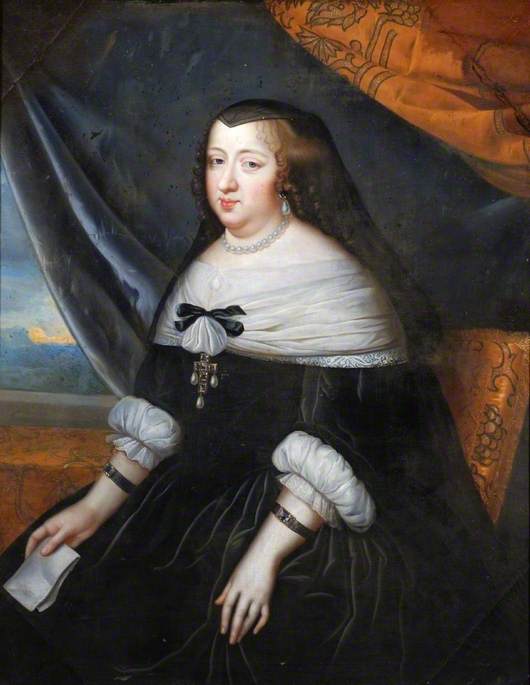
Anne as a widow

Rings

In total, 51 rings were located in her possession

1 ring with brilliants 
1 sapphire and diamond ring
2 rings with yellow diamonds 
6 rings with large rubies
3 spinel rings
5 rings with smaller rubies
3 turquoise rings
2 sapphire rings
1 topaz ring
2 emerald rings
1 diamond ring with the portrait of Louis XIII
1 ring with the portrait of a saint
2 peridot rings
1 amethyst ring
3 portrait rings depicting Henri IV, Louis XIII and the Infanta Isabella
1 carnelian ring
1 lapis lazuli ring
1 diamond ring with unknown gemstone

In total, her ring collection was estimated to be 30.000 livres worth.


Necklaces

1 pearl necklace - simply referred to as "the Queen's necklace". This would be handed down to both Marie Leszczynska and Marie Antoinette. Consisting of 30 large pearls 

1 necklace, estimated at having a total of 300 carats - 5.000 livres

1 long necklace in pure gold, enameled in white, red, green and grey, and set with rubies and diamonds

1 large diamond pendant (likely for the gold necklace)


After she became a widow, Anne reverted to her favourite pieces which appears to have been a set - a semi-parure - of a pearl necklace and a pair of matching pearl earrings. For one, many of her portraits feature her wearing just such a small (but immensely expensive) set.


Earrings

1 pair of diamond earrings with each earring consisting of four large diamonds with smaller diamonds hanging underneath - 50.000 livres

1 pair of earrings consisting of square diamonds with large pear-shaped pearls hanging from the diamonds - 26.000 livres

1 pair of diamond and pearl earrings - 50.000 livres

1 par of earrings of enameled gold set with diamonds


Design for earrings worn by Anne

Bracelets

1 bracelet with diamonds and emeralds - 1.500 livres
1 bracelet with green rock crystals and diamonds - 450 livres
1 bracelet with rubies, diamonds and pearls, unknown value
1 bracelet with carnelians, pearls and diamonds - 300 livres
2 bracelets with carnelians and diamonds - 400 livres
2 bracelets with gilded lapis lazuli and diamonds - 300 livres
1 bracelet of pale blue enamel and small diamonds - 100 livres
2 bracelets of horn material - 80 livres
1 jade bracelet - unknown value
1 bracelet with the king's hair - unknown value
1 bracelet of 14 diamonds and golden bows covered in black enamel - 10.000 livres
1 bracelet of 7 large diamonds mounted on jade - 17.500 livres
1 bracelet of 9 large emeralds and 9 diamonds - 4.800 livres
1 bracelet of twelve different gemstones, each surrounded by three smaller diamonds - 5.500 livres
2 bracelets of 14 peridots each, rubies and diamonds - 1.000 livres
A pair of bracelets, one with amethysts and one with diamonds - 1.200 livres
2 bracelets with 13 large rubies each, adorned with diamonds - 20.000 livres


Portrait of Queen Anne of Austria (1601–1666)?" Anonymous - Artwork on USEUM
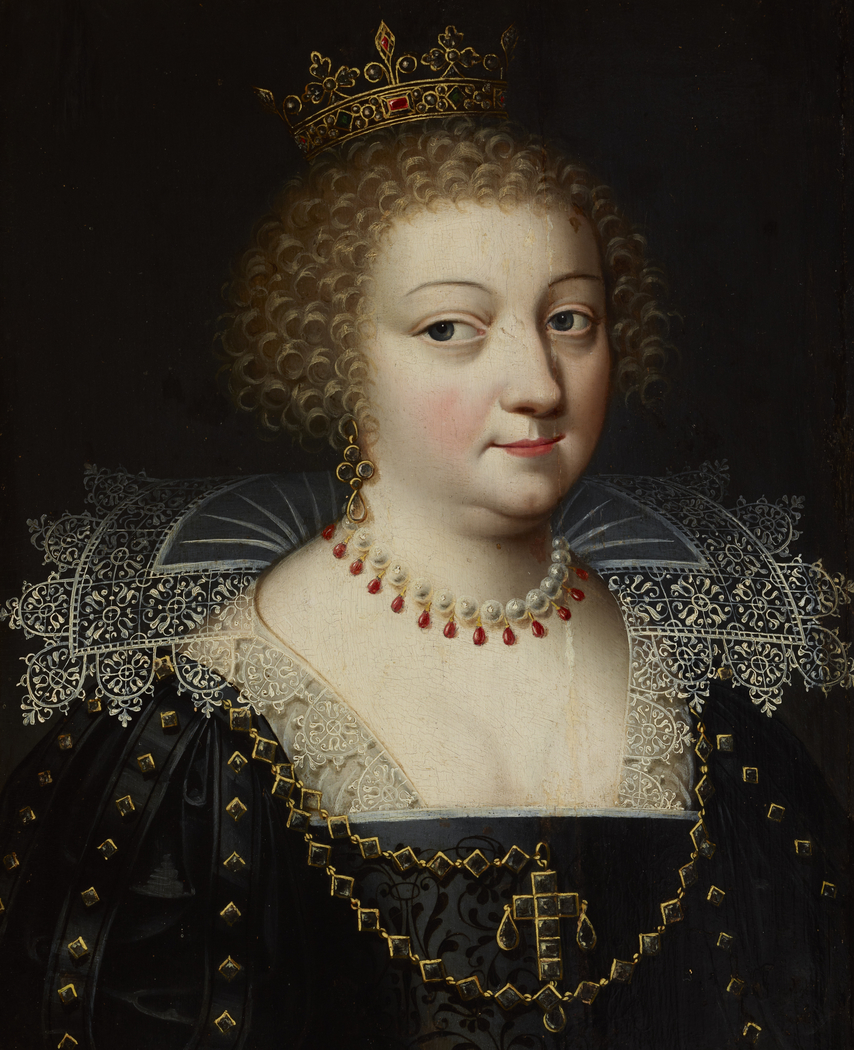
Anne as Queen of France 

Watches

1 carnelian watch adorned with diamonds and attached to a matching carnelian bracelet - 1100 livres
1 lapis lazuli watch also adorned with diamonds and attachable to one of two matching bracelets
1 watch of turquoise and diamonds
1 watch of blue enamel (likely a match to the bracelet)
1 watch with amethyst, diamonds and emeralds - 1.200 livres
1 watch with amethyst, topaz and diamonds - 1.000 livres
1 watch of filigree - with a matching chain - and adorned with diamonds - 600 livres
1 watch previously belonging to the Spanish ambassador - 100 livres
1 large golden watch - 100 livres
1 small watch, "always worn by the queen" - 100 livres


Being an immensely devout woman, Anne had a penchant for Christian jewels, such as rosaries, cross pendants etc.

Religious jewellery

An emerald cross entirely covered with diamonds - 2.500 livres
A cross with a very large ruby adorned with diamonds - 3.500 livres
A ruby cross with diamonds - 600 livres
A filigree cross covered in yellow diamonds - 2.400 livres
A small sapphire cross with four diamonds - 1.200 livres
A cross with five diamonds - 2.000 livres
A large cross with a centerpiece consisting of a massive lozenge-shaped diamond with three large diamonds hanging beneath - 130.000 livres
Another large cross with a large diamond at its centre, four slightly smaller diamonds and finally four small diamonds - 70.000 livres
A large cross made up of pearls and diamonds - 26.000 livres
A large cross with very large diamonds - estimated at about 250.000 livres
A cross with a crown supported by four diamonds - 5.000 livres
A remarkably colourful cross with diamonds, rubies, topaz, sapphire and emerald - 6.000 livres

Besides these pendants, the queen owned countless rosaries of every imaginable material - from diamonds and gold to chrysolite, turquoise and carnelian. 36 different rosaries were listed in a single inventory which indicates that they were stored at the same place.


Finally, the queen's personal collection included various loose gemstones often of immense value. For instance, Cardinal Mazarin had left her several such pieces in his will, including a very large diamond called the Rose of England and a perfect cabochon from the Far East. Her wedding ring had consisted of a large, square diamond.


Considering the price of some of the items above, it is hardly a surprise that the jewellery which Anne of Austria left to her sons was worth over 1.300.000 livres. They were to be divided between Louis and Philippe, with most pieces going to Philippe. This was Anne's own wish - particularly that Anne's granddaughter through Philippe - was to inherit her jewellery as the king's daughter-in-law would be sufficiently provided for.