Thursday, 25 November 2021
Court Artefacts: Scientific Instruments

Court Artefacts: Miscellaneous
Louis XVI used this notecase for his secret correspondence with Beaumarchais. The case is made from red leather and decorated with golden details; the interior is lined with green silk. Due to the confidential contents, the notecase was protected by a lock which required a password to open it - that password was "A LOUIS" or "To Louis". The six metal disks would have to be aligned correctly to open it - much like a safe. The case was sold by the auction house Thierry de Maigret who appraised to to between 15.000-20.000 euros - however, it ended up selling for 110.000 euros.
Sunday, 21 November 2021
Marie Antoinette's Diamond Bracelets
On 9 November 2021, the auction house Christies sold a remarkable pair of diamond bracelets. Christies have sold hundreds of pristine pieces of jewllery over the years but these bracelets are spectacular due to two particular factors. First, the diamonds themselves are stunning. Secondly, they belonged to Marie Antoinette.
Once imprisoned during the French Revolution, the royal family attempted to hide or smuggle out their precious jewellery collections. Marie Antoinette took it upon herself to carefully wrap her jewels in cotton to protect them. Those jewels of the ci-devant queen that did manage to survive the revolution were often broken up - and on occasion sold separately - and thus no longer represent their original shape. That is where these bracelets stand out: they have remained largely intact in more than two centuries.
![]() |
| Photo from Christies' website |
Marie Antoinette ordered the bracelets in 1776 for a staggering 250.000 livres; a sum that she would struggle to pay and would eventually turn to her husband, Louis XVI, for help. From the king's meticulous private expenditure book we find several entries of interest. On 18 February 1777, he noted:
"Paid the Queen, on account of the 162.600 livres which she owes Boehmer for diamond bracelets, 24.000 livres"
Boehmer was the man who created and sold the bracelets to the queen. He was also the man behind the infamous Diamond Necklace which brought the queen's reputation to an all-time low after she was erroneously accused of having attempted to purchase it.
![]() |
| Detail of Wertmuller's portrait showing the chatelaine |
News of the extravagant purchase was immediately spread throughout Europe. One key source were the foreign ambassadors, including the Austrian Comte de Mercy d'Argenteau. It was he who informed Maria Theresia, the queen's mother, which he did on 16 July 1776 in a private letter. In this letter, the ambassador report that the bracelets cost nearly 300.000 livres; he also mentioned that the queen had had to give several of her own diamonds in trade which the jewellers appraised unreasonably low. As so often before, the Austrian Empress had a stern opinion on the matter which she certainly did not attempt to hide in her letter of 2 September 1776. In this written reproach, the mother lecture her daughter that she has "unsettled her finances" by such a lavish purchase. To the rather frugal Empress, such an expense was nothing less but "humiliating", as she made sure to inform her daughter.
Marie Antoinette is portrayed wearing her bracelets in the portrait of 1785 by Wertmuller. Enjoying a walk with her two children near the Petit Trianon, the queen is adorned with a chatelaine made up of two large diamond bracelets - the very ones purchased in 1776.
The bracelets are made up of 56 large, round diamonds each - four of which are mounted on the clasp while the three at the very centre are larger than the rest. This amounts to a total of 112 diamonds of 140-150 carats.
![]() |
| Marie Thérèse wearing the bracelets in 1816 |
During her imprisonment, Marie Antoinette managed to successfully smuggle out the bracelets. In a twist of fate, the very man she sent these - and other - jewels to were none other than the Comte de Mercy d'Argenteau who stored them in Brussels for a few years. They were then sent to the court of Vienna where they would be handed over to her daughter, Marie Thérèse - the only surviving member of the inner royal family. She would be painted wearing one of them in 1816.
From then, they would remain in the possession of her family until they were finally sold for 7.117.308 euros or 5.974.993 pounds.
Tuesday, 16 November 2021
Auctioning the Past: A Court Collection
As one of the biggest and most sophisticated auction houses, Christies has had its fair share of auctions dealing with the remains of Versailles. One particular such took place on 16 April 2012 during which several pieces of art of the French royal family was sold.
A different sort of remnant of the court was this book from 1740. It is a detailed account of the wedding and subsequent celebrations held in honour of Madame Louise Élisabeth's wedding to Don Felipe of Parma. Madame Louise Élisabeth was the eldest daughter of Louis XV - and the only one to marry. Such volumes were nothing new; during the reign of Louis XIV, publications would detail any larger royal festivities - particularly after the court moved out of Paris.
This portrait - which fetched 21.250 euros - is presumed to be of Madame Adélaide, the fourth daughter of Louis XV. It is the work of Louis Dupont. If you think the style is very similar to court favourite Nattier, then you are correct. Dupont was a protégé of the archbishop of Bayeux (a member of the Luynes-family) who paid for him to study under Nattier.
Travel trunk in red leather with the coat-of-arms of Marie Thérèse of Savoy, Comtesse d'Artois. When the court travelled from residence to residence, the royal family often transported their personal belongings in trunks such as these.
A similar item is the travelling trunk below which belonged to one of Mesdames, the daughters of Louis XV. It is hazarded that this particularly trunk was used to store items of clothing in - possibly for Madame Adélaide.
Madame Élisabeth, sister of Louis XVI, is portrayed in a park next to her nephew, the Dauphin. The watercolour sketch is by Antoine-Louis-François Sergent-Marceau who completed it in 1786; in a rather disturbing turn of events, four years later he would join the revolutionaries and later still, partake in the September Massacres of 1793. Just eight years after he painted this sketch both of the sitters were dead - the young dauphin of illness in 1789 and Madame Élisabeth by guillotine in 1794.
Presumed to be a portrait of the Comte de Provence as a child, this portrait was painted by an unnamed member of Louis Tocque's entourage. The orders and the blue sash worn by the young boy clearly denotes his royal status.
This case in red leather has two interlaced L's underneath a crown - it is therefore likely that they belonged to Louis XV himself. It looks remarkably much like the travel trunks and might have been used for storing smaller bowls when the king was on the move - which was very frequently. Within the case are two smaller compartments; the key also bears the French coat-of-arms.
Another presumed portrait, this one shows the young Duc de Bourgogne. As the eldest son of Louis Ferdinand and Marie Josèphe de Saxe, he was to have inherited the title of dauphin after his father. Unfortunately, he died at the age of just 10 years - this portrait is presumably painted when he was seven years old by Louis Dupont. Upon his - and his father's - premature death, the throne went to his younger brother: Louis XVI.
This toilet nécessaire is marked with the arms of the Marquis and Marquise de Guesnon. It contains ten glass bottles and several small pots of Sèvres porcelain. The styling of the box is very in tune with the passion for Far Eastern influences. It is estimated to have been made between 1774-80 which places it in the beginning of the reign of Louis XVI. We know from the Almanach de la Cour that Jean Blaise Guesnon died in 1784 and had previously been employed in the king's household.
The Princesse de Lamballe is depicted by Marie-Victoire Lemoine in this portrait from 1779. At this point, Madame de Lamballe was recognised as part of Marie Antoinette inner circle; despite her young age, the Princesse was a widow and extremely wealthy. At court, she held the impressive position of Surintendante of the Queen's household - the highest position available to a woman at court.
Fetching a staggering 109.000 euros, this single chair was commissioned by Madame Élisabeth for her apartment at Compiègne. It was delivered to her at an unknown date but duly stamped with its provenance.
Saturday, 30 October 2021
Portrait Gallery: Marie Thérèse Raphaëlle, Dauphine of France
Born as the daughter of Philip V of Spain and his consort, Elisabeth Farnese, Marie Thérèse Raphaëlle was married to Louis Ferdinand de Bourbon, Dauphin of France. Their marriage took place in 1745 as a part of the reconciliation between France and Spain made necessary by the abrupt return of Infanta Marie Anne Victoire to Spain. She was initially meant to have been the wife of Louis XV but her young age and the king's dire need for an heir resulted in the betrothal being broken up. Now, some twenty years later, the two families reunited with the marriage of Louis and Marie Thérèse Raphaëlle.
While this union proved remarkably happy, it would also prove to be very short. Finding herself to be pregnant, Marie Thérèse went into labour on 22 July 1746. Sadly, she would not survive the delivery and died at the age of 20.
1) Portrait of Marie Thérèse Raphaëlle a year before her death but after her wedding to Louis Ferdinand, that is in 1745. The portrait was painted by Daniel Klein the Younger.
2) Louis-Michel van Loo painted the young dauphine in 1745 in a white silk robe volante.
3) This portrait by Jacobo Amigoni shows Marie Thérèse Raphaëlle in a far simpler attire than the other two. Rather than the heavy diamond jewellery, the dauphine is adorned simply with a flower in her hair and a pearl earring.
4) Painted between 1729-1733 shows a very young Marie by Jean Ranc. Given that she was born in 1726, she would be between 3 and 6 years old here.
5) Another portrait by Louis-Michel van Loo, although this particular portrait is of an unknown date. Still, given the obviously young age of the sitter, it was likely painted while she was still in Spain.
6) While the exact time of this portrait is unknown there are several clues in the portrait itself. An ermine-trimmed cape with golden fleur-de-lis is draped over Marie Thérèse Raphaëlle's shoulder and she has a portrait of her husband in her bracelet - hence the portrait must have been painted after her wedding. This limits the time frame to 1745-46.
7) Yet another piece of work by van Loo, this is a very good example of an official state portrait. Decked out in fine jewels and once again draped in her adopted country's fleur-de-lis, Marie Thérèse Raphaëlle is otherwise dressed in heavy brocaded silk.
8) Jacopo Amigoni returned to depict the dauphine once again and repeated his remarkably simplistic style. The portrait is presumed to be of Marie Thérèse Raphaëlle and does have some similarities, notably the long, slim nose.
9) Louis Tocqué is behind this second version of a state portrait. Compared to the one by van Loo, Marie is depicted as having a wider face than in her other portraits.
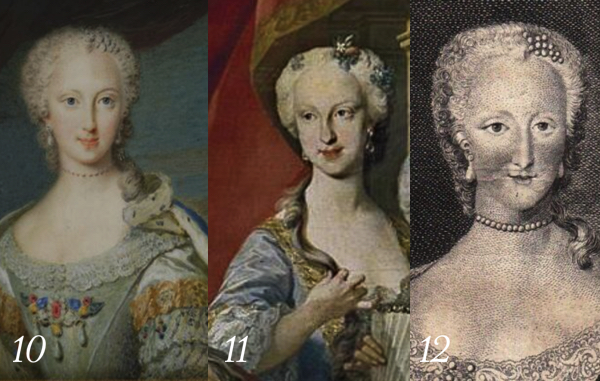
10) This miniature was painted in 1744 after the style of van Loo but not by that artist himself. The portrait was likely made in connection with the betrothal of the young couple.
11) Detail of family portrait done in 1743. Marie Thérèse Raphaëlle was depicted next to her younger sister, Maria Antonia Fernanda. Louis-Michel van Loo was also behind this particular image.
12) Engraving of the short-lived dauphine which appears to have been made from the same sketch as the miniature in number 10 - but was likely drawn by another artist as the features are slightly different.
Tuesday, 26 October 2021
Portrait Gallery: Marie Antoinette: Archduchess & Dauphine
October 16th, marked the 227th anniversary of the execution of Marie Antoinette. In honour of her memory, this post focuses on the portraits of the ill-fated young woman who would one day become queen of France - and end her days on the scaffold.
Marie Antoinette was born on 2 November 1755 and became Dauphine of France upon her marriage to Louis Auguste on 16 May 1770. When negotiating her marriage, one of her strongest, physical characteristics was her flawless skin - described as a perfect mixture of milk and roses. Finally, she would ascend the throne on 10 May 1774.
The Archduchess (1755-1769)
The Dauphine (1770- May 1774)
Sunday, 3 October 2021
Targeting: Louis XIV
Censorship was extremely strict in France during the old regime - particularly so during Louis XIV. Yet, even during the reign of the Sun King, defamatory pamphlets were printed abroad (usually in the Netherlands) and secretly imported. It was especially during the latter part of Louis XIV's reign that the absolute monarch came under increased scrutiny. Following decades of almost unbridled success abroad - both militarily and politically - France suffered several setbacks. This resulted in taunting from foreign powers as well as scathing criticism from within; albeit the latter had to be incredibly cautious since the penalties for lèse-majesté were severe.
Below you will find several of the pamphlets levelled against Louis XIV:
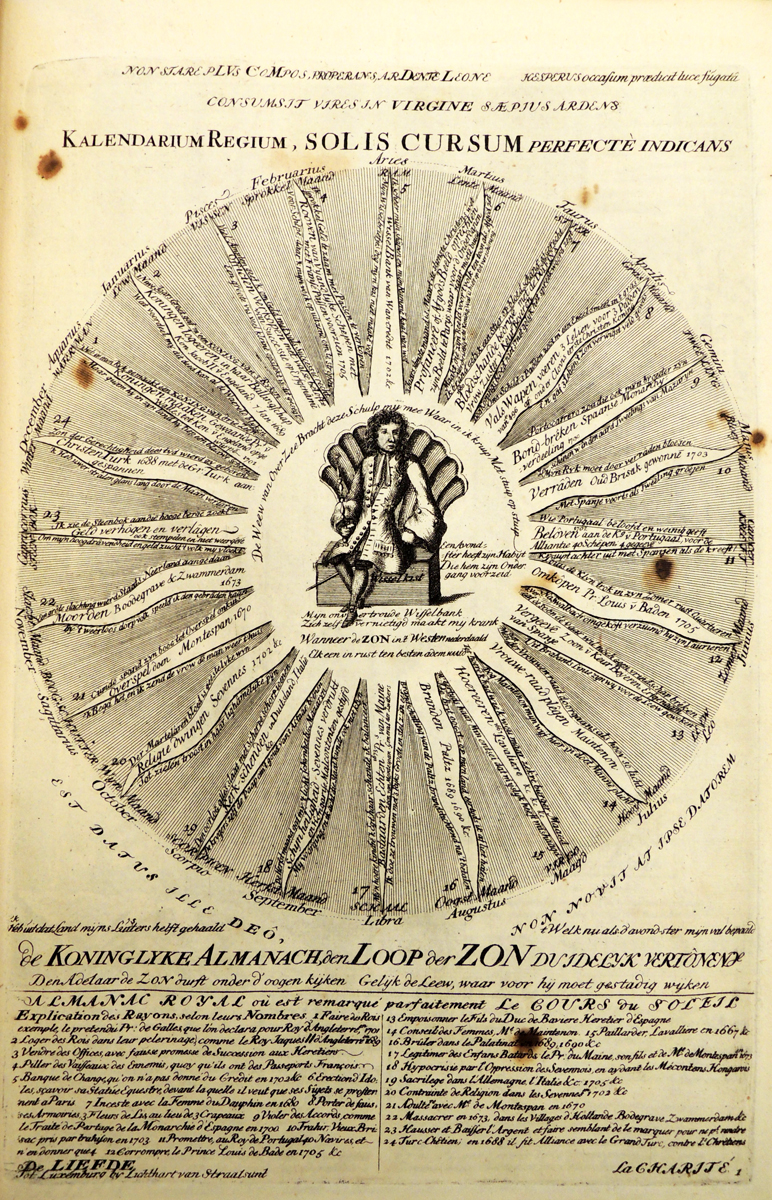
The Netherlands was a hotspot for anti-French sentiments due to the continued assaults on the territories by Louis XIV. During the War of the Spanish Succession (1701-14), a whole miniseries of caricatures were printed in the Netherlands of the French king. The pamphlet below depicts the king at the center of the sun with each ray describing a crime committed by the king - in both French and Dutch. There is some disagreement as to who created the design. Some sources name Carel Allard while others point to Romeyn de Hooghe.

Romeyn de Hoogh was the mind behind the satire below. It is based on the oft-used allegory - which can be found within Versailles itself- of the king in a chariot surrounded by allegorical creatures and symbolism. However, unlike at Versailles, everything here is meant to insult rather than glorify the king. Instead of standing proudly in a warrior-like pose, the aging king is supported by crutches and his chariot itself is falling apart. The woman represents the evening star - and Madame de Maintenon. She is seen as outright directing the king's course towards the ferocious lion and eagle waiting ahead.

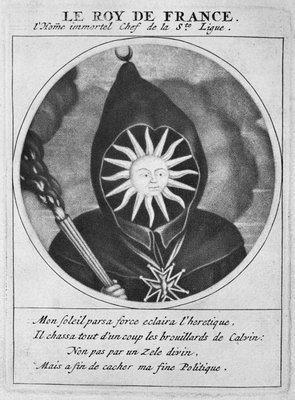
The Revocation of the Edict of Nantes (1685) made Louis XIV an easy target for outside critique - especially from Protestant countries as well as Anglican England. The hooded figure below depicts the king - represented by this signature sun emblem - with the sinister poem beneath:
"My sun shines brightly on the heretic; it chases away the mists of Calvin; not from a divine zeal; but for my fine politics to conceal".
The authors were Cornelius Dusart and the publisher was Jacob Gole; the former was a Dutchman while the latter was the son of a Huguenot who had had to flee France during the persecution of the Protestants that followed the ever-increasing hostility issued from Versailles.

The solar eclipse of 12 May 1706 was irresistible to Dutch engravers who saw the multitude of prints that could be made from the symbolism of the king's personal emblem, the sun. Again, Madame de Maintenon is featured - this time accompanied by Philip V of Spain (grandson of Louis XIV) - in a "conference" with the Sun King. The newly crowned king of Spain is begging his grandfather to let him return to France because the Spaniards are "wicked". He is apparently refused with the point of a hand above with "a multitude of miseries" is written.

The engraving beneath shows the king in a far more modest métier than what he usually was depicted in. Louis is depicted as the town-crier of Versailles, equipped with a bell and a dog. Behind him the battle of La Hogue. The list in his hand contains the names of the ships he lost during that particular naval engagement and which he now offered a reward for.

The king's private retreat of the Grand Trianon was mocked as being a den of scandal and the even more dreaded woe - female influence. In this Dutch engraving, a beleaguered Louis XIV is physically crushed by his mistresses while his male courtiers look on in astonishment. Meanwhile, the symbols of his absolute power has either fallen to the ground (the scepter) or is being used to further press him down. All three of his primary mistresses are represented: Madame de La Vallière, Madame de Montespan and Madame de Maintenon.
What is interesting from the caricatures above is that only the last one directly attacks Louis XIV's private life and his character. The vast majority of the focus is on politics - especially territorial disputes and downright war - which is hardly surprising considering that they were created by nationals of countries which the king had waged war on. As for the king's character, he is referred to as a man from whom flows a "multitude of miseries" and who is controlled by women. The latter, particularly, was seen as demeaning in the 17th and 18th centuries.
Yet, it is worth noticing that the king's person is otherwise left alone. His successors were subjected to far more openly lewd caricatures which more often than not directly attacks the physical appearance of the subject or perceived (or real) flaws.