Tuesday, 28 September 2021

The Decline of Orlèans Power

Upon the death of Louis XIV the late king's nephew, Philippe II d'Orlèans, took power as regent for the child-king, Louis XV. Up until then, the Orlèans branch of the royal family had enjoyed little influence under the Sun King, despite their close proximity to the all-powerful monarch. Louis' own brother, Philippe, was never given any significant political power; his military prowess had likewise been forcibly limited on the king's orders. From early childhood, Philippe had been instilled with the dogma that his brother was the chosen one - he would be master, Philippe would not. Neither had the Sun King been particularly generous when it came to his young nephew, Philippe II, whom he would always regard with some distrust.


Philippe II's eight year tenure as Regent of France (1715-23) would prove to be the height of Orlèans-power. Once the young Louis XV celebrated his majority, the ci-devant regent was offered the post of prime minister but turned it down. Little could he have known that his successors would drift further and further away from power during the remainder of the Old Regime. But what happened to the Orlèans-family? 


Portrait painting of Philippe of France, Duke of Orléans holding a crown of a child of France (Pierre Mignard, Musée des Beaux-Arts de Bordeaux).jpg
Philippe I - brother of Louis XIV who was
kept completely in the king's shadow politically


Philippe II knew that he could not retain power forever - nor did he attempt to forcibly continue his hold on power after Louis XV's majority. Still, he could attempt to place his son and heir in a position of unequalled influence. Thus, from an early age Philippe II's son, Louis d'Orléans, was groomed for power. At just 15 years of age, he was admitted to the royal council. Further posts were showered upon him including the governorship of the Dauphiné and Colonel General of the Infantry. However, for all Philippe's planning, there was one thing he did not anticipate - Louis was not particularly politically astute.


Portrait of Philippe d'Orléans, Duke of Orléans in armour by Jean-Baptiste Santerre.png
Philippe II - the capable Regent


Philippe died in the same year that Louis XV reached his majority (1723). While the former regent himself declined the offer of prime minister, he might very well have expected the new king to offer it to his son instead. However, Louis XV named the Duc de Bourbon instead. Philippe might have been able to steer his cousin towards a more favourable offer for Louis. If he had such designs - which he likely did - he would never be able to act upon them. Philippe died in December 1723, leaving his 20 year old son to pave his own way in the treacherous world of Versailles politics.


The Duc de Bourbon was all too aware that Louis d'Orlèans was the obvious candidate for the post of prime minister and kept an eye on the young man. In an effort to protect his own interests, the Duc de Bourbon would often oppose Louis in political discussions. Meanwhile, Louis worked with the ministers serving as Secretaries of State for War. He would eventually occupy this post himself from 1723-30. Louis  might have been able to accrue more political influence if he had not decided to go against the Cardinal Dubois.


Cardinal Dubois had been prime minister during the regency and had gained the trust of Louis XV. Therefore, it was extremely unwise to make an enemy of the Cardinal who had all but free access to the impressionable king. Still, as one of the First Prince of the Blood, there were some advantages. For instance, Louis stood proxy for the king upon the king's marriage to Marie Leszczynska in 1725. 


From the 1730's, Louis' political influence grew increasingly weak. He was removed from his post of Colonel General of the Infantry in 1730; the degradation was the work of another cardinal, this time Cardinal Fleury. Despite his otherwise poor track record with men of the cloth, Louis was immensely devout. As his political life and influence dwindled, his religious fervour grew. While this earned him the respect of the equally devout Marie Leszczynska, it did little to advance his career at court.
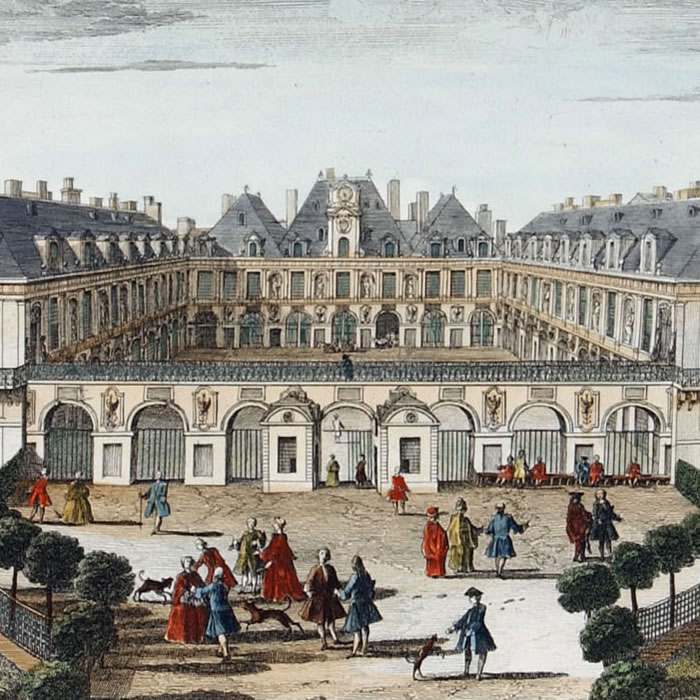

The Palais-Royal in the mid-18th century - few
could have known that this former gift from the king
would become a centre of anti-royal propaganda


One particular reason for why Louis XV never granted his cousin special favours can be condensed in one word: suspicion. By the early 1730's the king had only one son - and an infant at that. Louis XV was well aware that should his own line produce no more sons, the crown would be inherited by his cousins, the Orlèans. He was therefore extremely wary of allowing his cousin too much power.

Such royal ill-will was unfortunately met with an apparent unwillingness on behalf of Louis d'Orlèans to engage actively in politics. So, on one side there was a king hesitating to grant too much and on the other, a cousin not interested in grasping for power himself. The result was a sort of stalemate in which neither party pushed in either direction. As a consequence, Louis d'Orlèans remained on the sidelines politically.


For Louis, the point-of-no-return came when he all but retired to a convent after 1740. While he retained his title, any political interference were out of the question. This would have been the time for Louis' own son, Louis Philippe I, could have stepped in and regained some of his family's former influence.


Portrait of Louis, Duke of Orléans aged 27
Louis d'Orlèans - the duke whose religious
fervour caused him to retire completely
from court


Louis Philippe could have become far closer to the crown by a wholly different route than politics: love. At the age of 15, he had fallen in love with Madame Henriette, daughter of Louis XV and Marie Leszczynska. Both he and his father, Louis, sought the king's permission to marry - and were refused. Once again, Louis XV's suspicion hampered the designs of the Orlèans. Louis XV was concerned that if Louis Philippe married his daughter, his new son-in-law could become a dangerous political rival. It should also be said that another ghost from his father's past played a significant part in derailing the matrimonial project. Cardinal Fleury was amongst those who advised the king against the marriage.


Rather than a royal princess, Louis Philippe married a royal cousin. Louise-Henriette de Bourbon-Conti was married to Louis Philippe in 1743. With little prospect of having any role to play at court, Louis Philippe turned to the army. Following several stints in 1742-44, he returned to France - but not to court. Rather than going back to Versailles, Louis Philippe settled in his country estate of the Château de Bagnolet; on occasion, he would travel to the Palais-Royal - the Orlèans-residence in Paris - but rarely went to court. 


Louise Henriette - wife of 
Louis Philippe I


The world of Versailles worked on the principle of "out of sight, out of mind". Anyone who were not seen by the king did not count as a political entity. Therefore, even when Louis Philippe inherited the title of Duc d'Orlèans in 1752, he had little to no influence. Furthermore, there were increasingly little physical space for the Orlèans-family at Versailles. The ever-expanding royal family meant that the apartments occupied by other branches of the Bourbon-family became ever smaller and further from the heart of the palace. Whereas Philippe d'Orlèans (brother of Louis XIV) had occupied the entire first floor of the Aile des Princes, his successor had four rooms of the first floor of the Aile du Nord by 1744; the Duc de Chartres (son of the Duc d'Orlèans) had another four immediately next to him.

Their living arrangements at court would deteriorate further as the royal family was augmented over the years. With the arrival of not just the Mesdames but the numerous children of the dauphin - and later their own wives and children - there simply was not room for the Duc d'Orlèans to have very much space.


Louis XV - and later Louis XVI - both encouraged their Orlèans cousin's taste for country life. Louis XV bestowed upon him the hôtel of Grand-Ferrare at Fontainebleau  as well as that of Duplessis-Châtillon in Paris. While Louis Philippe thoroughly enjoyed his country life, he once again found his family's marriage plans thwarted by the king. Louis Philippe had had the son Louis Philippe Joseph (better known as Louis Philippe II) by Louise Henriette de Bourbon-Conti.


Louis Philippe had intended to marry off his son to the Polish Maria Kunigunde, sister to Marie Josèphe of Saxony. However, Louis XV vetoed the match with the explanation that the 29 year old bride was too old. She was seven years older than the prospective husband - ironically, Marie Leszczynska had been exactly seven years older than Louis XV himself. Yet, it was thought that she would be too old to start having children - and of course, there was the matter of placing an Orlèans prince so close to the Polish throne.


Louis Philippe d'Orléans (1725-1785) as Duke of Orléans by Alexander Roslin, Stockholm.png
Louis Philippe I - the Orlèans who found 
himself constantly thwarted by the king in his
marriage projects

Throughout his life, Louis Philippe I made one particular protest against the king's power. On 20 February 1756, he presented the king with a petition signed by no less than 4 princes of the blood and 24 dukes. The document was the culmination of several months' conflict which centered around the very essence of power. Besides the absolute power of the king, France was governed by the Parlements and the Great Council. The former dealt with the judiciary aspect of governing while the latter was far more ambiguous. The Great Council rested entirely on the prerogative on the king; its members were chosen and dismissed by him. As such, it was an instrument used to execute the king's command. 

In protest of the arbitrary power of the Council, the Parlements refused to register its decrees which effectually prevented the royal will from being carried out. They went even further by suggesting that the princes of the blood and the dukes should take their official places in the midst of the Parlement - thereby effectually challenging the king's authority. Naturally, the king forbade his high nobility to attend. While they obeyed, they drew up a petition expressing their displeasure at such a command. That was the very petition that Louis, Duc d'Orlèans delivered to Louis XV on that February day. 

Louis - already worn down by months of somewhat unexpected political opposition and turmoil - was immensely angered by the document. While nothing as yet came of the petition, it did nothing good to Louis Philippe d'Orlèans' political prospects.


By the time Louis Philippe II came into the world, his family's position was somewhat odd. Despite being one of the wealthiest and highest ranking in France, they had never had so little influence. After having fulfilled his military duties, Louis Philippe returned to France where he joined the court of the new king, Louis XVI and Marie Antoinette. However, Louis Philippe quickly clashed with the new queen which extinguished any hope of a political renaissance. The young Duc de Chartres had grown up with a nagging sense of jealousy of his royal cousin. He was convinced that his birth entitled him to a greater share of influence and grew to despise his all-powerful cousin, Louis Auguste.


Frustrated by his utter lack of influence, Louis Philippe began a campaign against not only the reigning king but the institution of the monarchy itself. His immense dislike of Marie Antoinette kept him well away from Versailles and he actively encouraged pamphleteers to use his Palais-Royal to issue their anti-royal propaganda. It was from his premises that some of the most vile things were written of the young queen; most of the common people eagerly believed the smear campaigns which heightened his own popularity.

Louis XVI initially preferred to leave his wayward cousin to his own devices but was forced to intervene when Louis Philippe openly challenged Louis XVI's authority before the Parlement de Paris in 1787. Consequently, the king exiled him which played perfectly into the hands of the propaganda machine supported by Orlèans gold.


Louis Philippe II - the duke who
voted for the king's death and allowed
the Palais-Royal to be a hotspot of
revolutionary activity


Louis Philippe was quick to realise that his way to popularity was to ally himself completely with the new ideals of a democratic government. He took the name Philippe-Égalité and used his immense resources to provide the emerging revolutionaries with both a safe haven and funds. One of the most astounding displays of treachery to his own family came in 1793 when the then-reigning Duc d'Orlèans voted for the execution of his cousin, the king.


The news of the Orlèans vote sent shockwaves through the staunch royalists. It had been no secret that Louis Philippe had done his utmost to undermine the authority of the monarchy; still, few had seriously considered that he would actively be involved with the king's death. Louis XVI himself expressed his great sorrow that his own cousin had betrayed him. Whether Louis Philippe actually intended to turn France into a democracy or saw himself as a new king will always be up for discussion.

In the end, all Louis Philippe's intrigues could not safe him from the shifting tides of the revolution. Just little over 11 months after the trial of Louis XVI, Louis Philippe found himself mounting the same steps to the guillotine. He was guillotined on 6 November 1793; his son - the newest Duc d'Orlèans - was in exile where he had turned his back on the revolutionary cause.


Thus, the family of Orlèans experienced a sharp decline in influence at the court of Versailles. It was a story that reached its climax (during the age of Versailles) with the regency and ended on the bloodied steps of the guillotine; it was also a tale of apathy, jealousy, intrigues and above all - power.


A historical postscript

After the revolution, the House of Orlèans experienced a brief resurgence in influence. The restoration of the monarchy under Louis XVIII (the former Comte de Provence), the relations between the Orlèans and the royal family continued its icy course. The new king had neither forgotten nor forgiven that the new Duc d'Orlèans' father had caused so much damage to the monarchy, going so far as to vote for the death of the king. As a consequence, Louis XVIII refused to formally grant Louis Philippe the rank of royal highness. It was not until the former Comte d'Artois ascended the throne as Charles X that this dignity was restored to Louis Philippe. He, however would experience even greater honours when he was made King of the French in 1830. However, he would be forced to abdicate in 1848.


Sunday, 26 September 2021

Film Fashion: Jeanne Poisson, Marquise de Pompadour

This French movie depicts the life of Louis XV's most famous mistress: the Marquise de Pompadour. Released in the same year as Sofia Coppola's "Marie Antoinette" - 2006 - the movie stars Hélène de Fougerelles and Vincent Perez as the semi-royal couple. It is one of the few movies to include a depiction of Marie Leszczynska and her children by Louis XV which makes the movie quite interesting.


Marquise de Pompadour


An apple-green robe à la Française with yellow/orange details. On first look, the dress is not particularly special but upon a closer look, the details truly shows. Several ruffles edge the bodice as well as the overskirt's edges and matches the three attachments - one on the left side of the bodice and one on each sleeve. Rather than jewels, Hélène was styled with lace and silk ribbons around her neck - quite true to the real Pompadour's style.


If this gown had been turquoise rather than lavender, it would have been almost a complete replica of the one worn by the Marquise de Pompadour in her most famous portrait. As it is, the pink bows and matching ruffles were the very style favoured during the rococo-period - the bejewelled stomachers were only worn for special occasions. 


In a complete contrast to the other, more pastel-coloured gowns worn by Hélène as Jeanne Poisson, this robe à la Française was worn during a scene in which the new favourite is introduced to the queen. That might be why the fabric is much heavier, almost old-fashioned; as such, it could be seen as an effort to blend in with the tastes of the queen's elder entourage.

Besides the heavy golden/black brocade, the bodice is quite interesting. The embroidery's pattern is very unusual compared to what was usually seen at the time.


Another robe à la Française designed for the Marquise de Pompadour. This one in pale blue silk with small embroidered flowers and blue ruffles along the neckline and down the length of the bodice. The skirt is hardly seen but what can be peeked from beneath her arm it appears to continue in the same pattern.


This yellow set is interesting from a historical fashion point of view. A caraco is rarely seen in historical movies in quite this manner; usually they are made of a matching fabric to the skirt. While the black contrasts suits the colour well, it is a shame that they look a bit too modern - almost like something that could be found in a normal fabric-shop. Nevertheless, the fabric chosen for the caraco is very beautiful; a yellow silk brocade that gives an impression of luxury.

The straw hat is a very nice touch which the actual Pompadour herself wore on occasion; as is the case for the white neck-ruffles.


The left gown is very simple and worn before Jeanne Poisson was introduced to court. Such a gown would never have been seen at Versailles but corresponds to what bourgeoisie women would wear on an everyday basis. This is particularly emphasized by the complete lack of accessories - no ruffles, no bows, no pearls or gemstones.

The second gown is somewhat puzzling. It looks more like something from the 16th century with the way the sleeves are cut to reveal the chemise below. Furthermore, the machine-embroidered flowers on the bodice and the choice of what looks to be velvet gives the entire dress almost a Renaissance look - quite an odd choice for the woman who embodied rococo!


These last two gowns are good examples of fabric used for 18th century gowns; on the left, a blue/white chinoiserie fabric is a nice nod to the fascination with the Far East that was sweeping through Europe. The gown is rather simple in itself with no contrasting colours but the overall impression is of an impeccably clean and sophisticated lady.

The second is a far more classic floral pattern on a white background. The fabric looks more like a type of cotton or similar type of fabric. Again, the only ornaments are the white ruffles and a few buttons on the bodice. For women choosing to wear such a floral pattern there was one particular advantage: it could be matched with almost all colours. Blue, red, green are all found in the pattern which would allow for a more adjustable piece of clothing.

Louis XV


A yellow silk suit with a matching golden waistcoat in a damask-pattern, there is an echo of the yellow outfit worn by Madame de Pompadour above. The black details only add to the similarities; the king's black velvet tricorne hat is topped with white feathers and the black is again seen on the bow tying his perruque together.

The embroidery on the overcoat was a classic trait of menswear from the high-nobility during this point in time. Metal thread and even actual gemstones were used to create a more luxurious appearance - and of course, it would be hand-embroidered.


Again, the elaborate embroidery is the key factor of this coat. Silver thread with some gold thread interwoven in the fabric gives a shining effect to the sky-blue velvet. The coat was used on two different occasions in the movie - on the right photo, an order can be seen attached with a bright red fabric as well as the sky-blue sash of royalty.

On the left photo, the king wore a pink waistcoat embroidered with more silver - this time in emblem-patterns. As was the custom, his cravat can be seen sticking out at the neckline - generally, a gentleman's (even a king) cleanliness was judged by how clean his linen were.


Considering the pastel hues used as a matter-of-fact by the emerging rococo, this suit is remarkably dark. Dark blue silk makes up the foundation of the suit with burgundy embroidery and golden buttons. Although it is hard to see, the waistcoat is a deep red, almost scarlet silk with golden embroidery.


This is a good example of an outdoor coat - the design does not vary a lot from the coats worn by the men of the court during the latter years of Louis XIV. The large buttons and the leather-gloves indicates that the king wore this coat for hunting. The coat itself was made from blue silk with silver embroideries on it. The trousers appears to be pink.

Marie Lezczynska


A robe à la Française, this is the main gown worn by Marie Leszczynska in the series. The design corresponds well to the style of the actual queen which was often described as being rather conservative - some even called it "boring". However, the colour combination is certainly anything but. The greenly turquoise clash with the rusty burgundy - the overall impression is of a somewhat unfashionable gown. It is very likely that that was done on purpose.


Due to the monochrome colour scheme - presumably worn for a mourning scene - the gown is somewhat difficult to discern properly. Yet it appears to - again - be other simple with the sole ornaments being the two bows and ruffles along the outer skirt. But this might very well be due to the context the gown is worn in. During mourning periods, displays of jewels were prohibited.


This was the only photo I could find of this gown which looks far more in tune with the reigning fashions. The muted rode-tone of the brocade is feminine but the cut gives the gown a more matronly look - again, undoubtedly on purpose. Note, that the mauve ruffles appear to continue down the length of the gown and is matched by a bow on the bodice and two more - one on each sleeve.


Mesdames


Madame Adélaide is depicted wearing this robe à la Française in golden/beige brocade with coral details. The design chosen is far more in keeping with the emerging rococo style than the gown worn by her mother; the gown is overflowing with adornments: ruffles, elaborate embroidery on the bodice and lush silks.

The fabric used for the bodice is a tone brighter than the coral of the outer skirt. The result is that the wearer's pale complexion is highlighted.


In comparison to Madame Adélaide's gown, this one is very plain, primarily due to the choice of a single-coloured silk for the outer skirt and sleeves. The colour-scheme itself is not far from her "sister's" with the same golden and pink tones reappearing. The most dominating feature of the bodice is the somewhat large, embroidered bow with a jewel at the clasp in the centre.

Others


The gown was worn by a waiting-woman of Madame de Pompadour's which explains the plainer appearance of the design. The costume designer did a very good job at demonstrating the difference in class by the costumes. The fabric used for this particular gown appear to be of a poorer quality and while it does have ruffles, the overall impression is of a woman from a lower, social background.

The gentleman's suit follows the fashion trends for men quite well although both the overcoat and the waistcoat seems to be too big for him. Another thing is that the waistcoat would not usually hang like that. The embroidery is a good example of a man of quality - but lesser means - as it is of a rather limited scope but still in golden thread.


These three ladies also display a difference in class through their clothing. The right and left photo are both of the same woman - Madame de Pompadour's mother. It is clearly made for a bourgeoisie woman who tries to emulate the tastes of the court.

The courtier in the middle, in contrast, wears a lavishly adorned bodice. The effect appears to have been made using a mixture of ruffles, bows and pearls. The fabric is of a green silk with reddish details. Note that the lady repeats the choice of pearls on her wrist, around her neck and in her hair.

Saturday, 18 September 2021

To Die For: Madame du Barry's Jewels

Born as an illegitimate commoner, Madame du Barry's rise through the ranks allowed her to dedicate some of her immense fortune to her passion: jewels. And who was better to furnish her with both the means and the object itself than the king?

Throughout her tenure as the royal mistress, Madame du Barry was showered with jewels, gemstones, parures etc. The most famous piece made for her was never seen by Louis XV himself but caused irreparable harm to his predecessor. In 1772, Louis XV commissioned Auguste Boehmer and Paul Bassange to create a superb necklace whose design was considered lavish even by the standards of the time. That very necklace would later become the focal point of the infamous Affair of the Diamond Necklace.

Such a large piece required the very best diamonds and thus it took the two jewellers years to complete their task. Sadly for them, when they finally did the king was dead and the intended recipient banished from court. It was estimated that the necklace had cost the pair 2.000.000 livres - it is hardly a wonder that they desperately tried to sell it to the new queen.


A reconstruction of the necklace designed
by Bassange and Boehmer - it would later
cause the public downfall of Marie
Antoinette

While the tale of the infamous diamond necklace is well-known it is far from the only worthwhile addition to the ci-devant favourite's collection. Even after the death of her royal lover, Madame du Barry continued to amass diamonds from the funds left to her by the king. Still, there can be no doubt that her glory days were between 1769-1774. For instance, in 1772 alone Aubert furnished her with jewels amounting to 91.000 livres. She would later return to Aubert in 1775 when she purchased a magnificent parure worth 390.000 livres.

According H. Welschinger, the accounts left by the leading jewellers in Paris reveal that in the years 1768-1774, she "only" spent 2.000.000 more on jewels than previously. 


Once she had become the king's official mistress, there was little to stem her passion for gemstones. She ordered bejewelled shoe-buckles in various colours so that they would always match her gown. Madame du Barry appears to have used her jewels to literally dazzle the court - especially when she was nervous or eager to show off her position. For instance, when she arrived (unexpectedly) at La Muette she was glittering in brilliants. On another occasion, she received a hitherto unheard-of honour by being allowed to dine with the royal family. Taking advantage of the occasion to further demonstrate both her beauty and influence, she arrived in a gown of cloth-of-gold and jewels allegedly worth 5.000.000 livres.

Besides the staggering number - and price tag - of her jewels, Jeanne knew how to make herself noticed. Before her, the ladies of Versailles had stuck to one colour at a time; as such, it was unthinkable for one to wear more than one colour. Yet, Madame du Barry openly flaunted this unwritten rule and happily matched rubies with emeralds, grey and pink pearls etc.


Madame du Barry

After the death of Louis XV, Madame du Barry continued to have a court income as stipulated by the late king's will. However, her extremely high expenditure soon meant that she was obliged to sell off some of her beloved jewels to keep her creditors at bay. For instance, she parted with two magnificent parures of diamonds and rubies which were so grand that they could only be worn at court - a place she was not likely ever to return to.


It was not just in her accessories that Jeanne's expensive hobby was channelled. She would order gowns with gemstones sewn into the fabric - Rose Bertin supplied her with one which also sported golden sheaves embroidered on blue satin.


Of course, the entire extent of the jewelry collection can hardly be estimated precisely. However, here and there the historical records handed down to us gives an insight into the type of jewels that Jeanne Bécu bought and received as gifts. One of the most valuable documents comes from the lady herself. Upon the theft of her jewels in 1791, Madame du Barry drew up an immense and detailed list - with the help of her jewellers - of the pieces that had been stolen. The list was long and described a collection of such lavish wealth that it understandably invoked anger in a country devastated by extreme poverty. Even today, more than two centuries after the fact, the list shows an impressive collection. Given the sheer length of the list, the various pieces have been grouped (the original list was published by the Goncourt-brothers):

Rings:

  • 1 ring of white brilliants with a large diamond
  • 3 other rings with brilliants 
  • 1 ring with a large, square sapphire stone on which was engraved a cupid; it also had two brilliants 
  • 20-25 unspecified rings
  • 1 onyx ring with the portrait of Louis XIII with sardonyx details 
  • 1 ring of Caesar surrounded by brilliants
  • 1 ring with a large, square emerald
  • 1 puce-coloured ring
  • 1 ring with burnt cornelian on which an image of Bacchus was engraved
  • 1 ring with an image of Louis XIV on yellow sardonyx 
  • 1 heart-shaped sapphire surrounded by diamonds 


Earrings:

  • 1 pair of white brilliants
  • 1 pair of chandelier earrings with large brilliants worth 120.000 livres
  • 1 pair of chandelier earrings mounted on two shafts of a column of gold and enameled in lapis-lazuli surmounted by two silver turtledoves 
  • 1 pair of pearl-shell earrings with the portrait of Louis XIV


Necklaces & Pendants: 

  • 1 necklace of 24 brilliants finely mounted
  • 1 cross with 16 brilliants
  • 1 double-row of pearls containing about 200 pearls and 1 large brilliant at the front; below the brilliant hung a tassel with fringes and knots - all set in brilliants


Watches:

  • 1 bejewelled watch
  • 1 gold watch by Romilly
  • 1 more, but smaller, watch by Romilly surrounded by four diamond hoops with a coat-of-arms on the other side


Bracelets:

  • 2 bracelets of unspecified design
  • 2 bracelets of six rows of pearls; each bracelet had a large emerald. On one the initials "D B" (du Barry) was engraved, on the other two "Ls" (Louis). The clasps were set with brilliants
  • 2 bracelets with four diamonds each


Gemstones & Loose Pearls:

  • A heart shaped sapphire originally owned by Louis XIII
  • 5 white brilliants
  • 2 pendant-shaped brilliants
  • 1 large and square brilliant
  • 17 diamonds "entirely out of shape" - one had been mounted as a pendant
  • 1 long, pin-shaped brilliant
  • 1 row of 104 stringed pearls
  • 40 diamonds
  • 1 lozenge shaped brilliant


Miscellaneous:

  • A rose "finely mounted" with no less than 258 brilliants and a large stone in the centre 
  • 8 pieces of ribbon in puffs, each with 21 brilliants 
  • 1 pair of shoe-buckets of 84 brilliants
  • 1 purse of blue silk with brilliants on the clasp and tassel
  • 2 portraits of Louis XV
  • 1 pair of sleeve-buttons formed of an emerald, sapphire, a yellow diamond and a ruby, all of which were surrounded by rose-coloured brilliants
  • 2 strings of watch-guards of 16 links with 3 stones, one being an emerald and two brilliants
  • 1 cap with a very large and square brilliant and three large emeralds underneath and a brilliant on each side
  • 2 opera glasses with the portrait of Louis XV on the sides; one was enamelled in blue, the other in red, and both had been mounted in gold 


Despite this extensive list, the whole is rounded up with the rather vague "... and many other jewels of very good value".

In all, she had jewels worth 1.500.000 livres stolen which included over 140 large diamonds, 300 large pearls, 3 large sapphires, 7 large emeralds, 700 brilliants - and countless other onyxes, rubies etc. Madame du Barry had often been critisiced for been somewhat indiscriminate when it came to the quality of her jewels. The above-mentioned list does hint that something of the kind was the case. For instance, the official list specifically mentions that 40 of her diamonds were not cut in a good shape - yet she had purchased them.


The inventory of the stolen jewels, 1791


Jeanne Bécu's very love of jewels shone through in her attempt to reach out to the dauphine Marie Antoinette. After the newly-arrived Austrian dauphine had publicly snubbed the king's mistress, the latter decided to try and woo the future queen by sending her diamond earrings. However, she was unsuccessful.


Besides the jewels stolen in 1791, Madame du Barry had had a good deal more. Over the years following the king's death she had often had to sell some of her jewels to pay off debts - either her own or those of her relatives. Yet, we do know that she owned several other pieces including:

  • A ring of arborized agate surrounded by brilliants worth 480 livres was delivered to her in 1769 and paid for by the king
  • A watch adorned by diamonds worth 5.400 livres and made by Lepaute 


Once she had been sentenced to death, she allegedly confessed to having buried several chests of valuables in the grounds of Louveciennes. Besides diverse plates and silverware, the condemned lady claimed that the following could be found in the ground:

  • A chain of diamonds with two tassels
  • Two earrings of diamonds; each had 9-10 stones of which the front ones were very large
  • A ruby ring with white diamonds
  • A necklace with five pearls set in gold
  • A collar of pearls 
  • A diamond ring
  • A "beautiful" engraved stone mounted on chains of gold to make a necklace
  • Two necklaces of coral, one of which was mounted on gold
  • An emerald ring with white diamonds
... And a portrait of Louis XV in a gold frame.


Following her execution, the remnants of her collection was sold at auction by Sothesby's in 1795. The auction fetched what amounts to 1.281.210,99 euros (1.093.302,26 pounds 1.502.251,88 US dollars). This alone goes to show the sheer size and value of her original collection.

Saturday, 4 September 2021

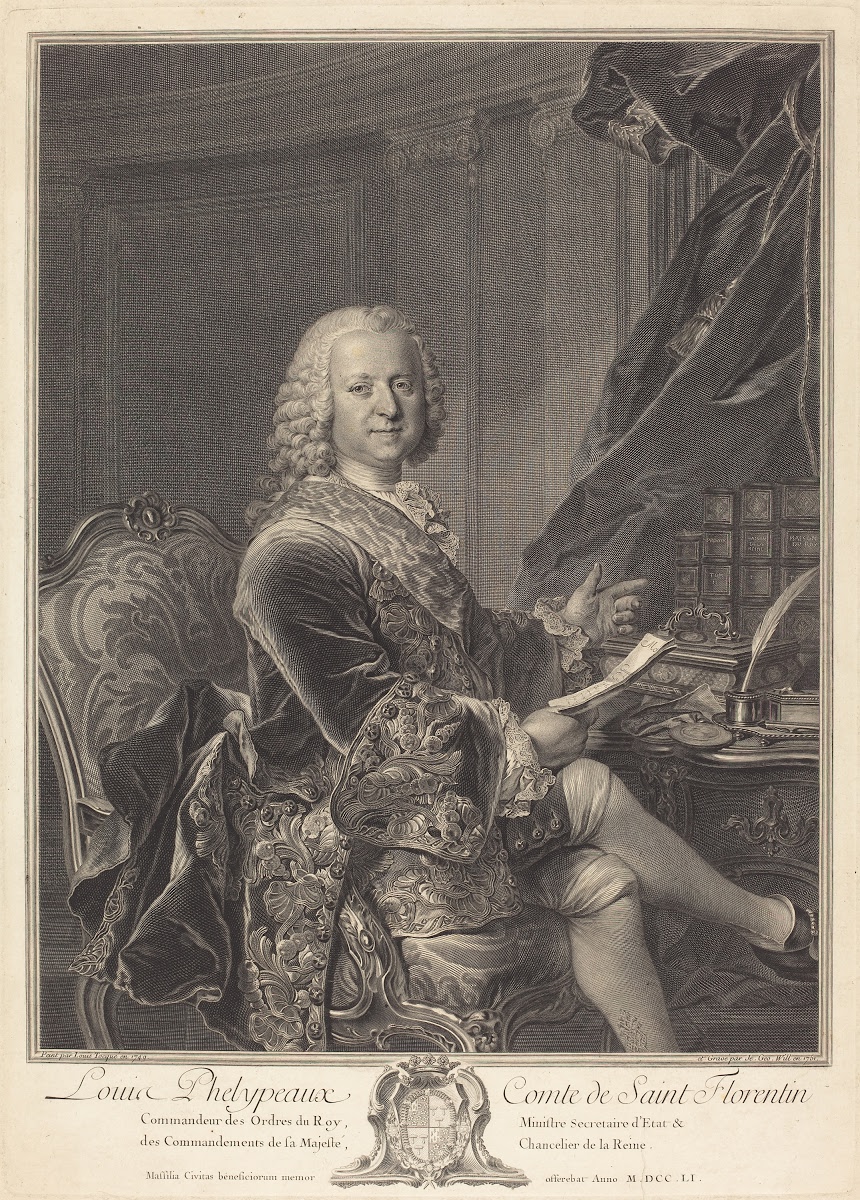
Louis Phélypeaux, Duc de La Vrillière

Born in Paris on 18th August 1705,  Louis was the son of two courtiers who both possessed considerable positions at court: his father, another Louis, was minister of state while his mother, Françoise de Mailly-Nesle who was dame d'atours to Marie Leszczynska for 11 years.

Growing up, Louis was given the title of Comte de Saint-Florentin. He was destined to follow in the familial career path: that of politician. Both his father and grandfather had been ministers for quite a specific area: Protestantism. In the profoundly Catholic France, the king had established the post of minister to deal with matters pertaining to the reformed religion.

Saint-Florentin, comte de.jpg
Louis with his order of the Saint-Esprit


When Louis turned 20 years old, he inherited his father's title of Marquis de La Vrillière as well as his post as minister. Ten years later, he officially became a freemason. By this time, Louis had more than proved his worth as a minister to Louis XV. This meant that he was given a new post in 1749 - and a coveted one at that: Secretary of State of the Maison du Roi. As such, he was the nominal head of the king's household and wielded considerable power at court. Louis apparently pleased his king in this capacity since he was permitted to remain in office until 1770; that was a record amount of time spent in this post.

Louis married Amélie Ernestine de Platen-Hallermund on 15 May 1724. She was a German by birth as the granddaughter of the Duke of Brunswick and Luneburg; her father had been the first German Duke of York. The couple had no children and Louis lost his wife in 1767. When he was not at court, Louis spent his time at the Hôtel de Saint-Florentin which he had had designed by Chalgrin.

Louis does not appear to have been blessed with a comely face. His figure was rather corpulent throughout his life and his eyes were considered to be "beady". Nevertheless, he managed to remain at court - and in some power - due to his abilities as a courtier. He understood the king's mood quite well and understood even better that it was political suicide to make an enemy of the monarch's mistress. Thus, he made sure to throw dinner parties for them. For instance, he held one in honour of Madame du Barry to which he also invited many of Marie Antoinette's ladies - most refused. For this, the king was grateful, especially when it came to those of his mistresses that were otherwise shunned by the court. Louis reaped the rewards and was eventually made the first Duc de La Vrillère.


Louis Phélypeaux, marquis de La Vrillière — Google Arts & Culture
The classic portrait of a minister - seated at his desk

As minister, the Duc de La Vrillère was not necessarily well-liked by his fellow courtiers. One of the reasons for his reputation was based on the practice of lettres de cachet. These were used to dismiss a minister - or courtier - from court by the king's express order. Louis XV was particularly fond of using this conveniently passive aggressive manner of ridding himself of troublesome people; unfortunately for the Duc de La Vrillère, he was often tasked with delivering them. It is hardly a wonder that people would feel uneasy if he suddenly showed up. It was gossiped that his mistress sold blank lettres de cachets for those wishing to eliminate a rival from the courtly scene.

He would finally leave to replace Choiseul as minister of foreign affairs but would not remain in that post for long. He officially took the job on Christmas Eve 1770 and was replaced on 6 June 1771. Marie Antoinette was credited with the dismissal but she had no particularly influence on politics, especially not as dauphine. Louis' last post was also as minister which he resigned in 1775 when he turned 70 years old. Louis died on 27 February 1777.

Friday, 16 July 2021

Lost Wardrobes: Marie Adélaide of Savoy

Few people had such a dramatic impact on their surroundings at court as Marie Adélaide of Savoy. When she arrived in France in late 1696, the aging Louis XIV's court had become morose. Dominated by the rather austere Madame de Maintenon, the fêtes and sumptuous celebrations which had put Versailles on the map were long since over. However, the arrival of the then 11 year old princess changed everything. She immediately enchanted the king who in turn showered her in jewels, favours - and clothing.


As the Duchesse de Bourgogne, Marie Adélaide became the leading lady of Versailles. With neither queen nor dauphine, she was the foremost lady and was expected to be a focal point of the court. As such, it is no wonder that her clothing was subject to intense scrutiny.


Marie Adélaide at ca. 15 years old - her almost
signature silver gown with the French fleur-de-lys
embroidered on the blue satin cape

Her wedding dress was in the classic cloth-of-silver with elaborate silver embroideries and precious stones. For accessories, she wore rubies and pearls - the latter a present from her father, Victor Amadeus. The gown was very heavy with a massive train of over 7,5 meters; following the ceremony in the chapel, the royal family had a dinner after which she returned to her chamber and was allowed to remove the gown for a little. However, she had to put it on again for the evening entertainment. The petticoat was trimmed with silver ribbons and further adorned with pearls, diamonds and rubies. 


Previously, she had worn a silver brocade gown for her proxy wedding in Turin. Apparently, the silver was a good choice for her as her thick, brown hair contrasted nicely with it. Again, the train was immense. It measured over 8 meters in length and was so covered in pearls, gemstones and embroidery the it took three people to arrange it behind her


The duchesse de Bourgogne wearing
her favourite colour 


Following her wedding in 1697, her dresses were meticulously noted by both courtiers and journalists. The night after the wedding day, she wore a gown of red velvet with gold embroideries and diamonds. On 9th December that year, she made her first visit to Saint-Cyr to which she wore a white gown so heavily embroidered with silver that she could barely stand - remember that she was still just 12 years old. The following days say several balls; on the first night she wore a gown of cloth-of-gold trimmed with diamonds. The king had let her borrow several of the Crown Jewels for her headdress. For the final ball, she wore an entirely black gown strewn with diamonds and pearls braided into her hair.


As the years wore on, Marie Adélaide was given the royal Menagerie as her private hang-out. Here, she preferred loose-fitting gowns rather than the stiffly corseted silhouette worn at court. Likewise, at Marly, there were more opportunities to wear something a little less Versailles. For a masquerade she wore a gown in the "Spanish style" with a small cap on. Usually, the court of Madrid had a very austere sense of fashion so perhaps this was a different type of dress?


This could very well be an example of
the type of loose-fitting clothing she would
wear at the menagerie or as a part of an
allegorical depiction


Red happened to be the Duchesse de Bourgogne's favourite colour. It is not a coincidence that she is depicted in this shade on several occasions; the most famous of which is in a red riding gown with golden trimmings. 

For her portrait in 1709, she wore a classic robe de cour of an almost silver colour. The fabric appears to be some sort of brocade or satin. The bodice is very tightly laced and adorned with multi-coloured gemstones - particularly rubies can be seen. Once again, the formality of the gown required a train - which in turn required a servant to take care of it. Another glimpse of her in a formal gown show her in a blue, brocaded gown with heavy gold and silver embroidery - and of course, a train.


Her position as First Lady of the court meant that Marie Adélaide had to be present for all the biggest events at court. When it was decided that Mademoiselle - the daughter of Philippe d'Orléans and Elizabeth Charlotte of the Palatinate - was to marry the Duc de Lorraine, the Duchesse de Bourgogne wore a gown of silver tissue with golden flowers embroidered also with a tint of red and green. On the following night, she wore a gown of grey damask - again the choice of grey-silver two nights in a row - with silver flowers and a necklace of emeralds and diamonds.


In 1705, she is depicted wearing a velvet gown of either a very dark green or black with large slits on the sleeves to show off the pristinely white satin beneath. A similar colour is woven into her hair.


1705

Wednesday, 14 July 2021

Lost Wardrobes: Louis XIV

Louis XIV was a man who understood the concept of "dress to impress" - the Sun King used his elaborate wardrobe to underline his supreme power and status. Not only his private gloire was expressed in this manner; favoured courtiers, too, were easily recognizable through their clothing. From their high red-heeled shoes to their blue justacorps indicated that the wearer was in the king's good graces.

During his reign, the colours in fashion were far darker than the pastel tones usually associated with Versailles: deep red, royal blue, black, dark green etc. All were typically in lush fabrics such as velvets or brocade with a great attention to lace. Particularly a man's cravat and the visible sleeves of his undershirt was used as a marker for his personal hygiene.

Louis XIV (1666) Charles le Brun.jpg
The intricate embroideries and the
plumed hat gives a good idea of the
king's style

Most of the information passed down to us from contemporaries refers to the more elaborate of the king's outfits. One such inform us that on 6 April 1665, the king wore a flame-coloured hat alongside a coat and waistcoat so heavily embroidered that one could not distinguish the fabric underneath. On another occasion, the king wore a suit of black velvet with jacquard-design and the Saint-Esprit Order. This was accessorised with a cane and a hat adorned with a rose of diamonds.


As a part of his wedding celebrations, he was reported to have worn clothing of golden brocade with black laces and diamonds. When his new wife, Marie Thérèse made her public entry, the young king wore a coat embroidered with both pearls and diamonds and trimmed with lace and silver ribbons. The master of the wardrobe estimated that the king's clothing for his marriage and the subsequent celebrations had cost 90.000 livres.

Louis14-E.jpg
Notice the gold brocade fabric visible at the
sleeves


Receptions of foreign ambassadors - primarily the non-europeans once - were spectacular. Especially the receptions of the representatives of Asian royalty caused the French court to pull out their finest clothing. When he received the envoys from Siam in 1686 he wore a golden suit of silk studded with diamonds - allegedly these were worth 2.000.000 livres. During his last grand ambassadorial reception - this time for the Persian ambassador - his black velvet suit was embroidered with gold and had diamonds worth a staggering 12.000.000 livres! The Duc de Saint-Simon noted that the weight of the precious stones had an unfortunate impact on the king's otherwise regal bearing - he seemed to be bending under their weight and had to change before dinner.

Generally, the king appear to have preferred darker colours - particularly black - towards the end of his life. These tones set off the brilliant diamonds interwoven in the fabric and created a magnificent effect. 

During a ball at Fontainebleau in 1677, the Mercure Galant reported that twelve new suits had been ordered for the king by his master of the wardrobe. One such was made of gold lamé which had been embroidered with both gold and silver. His accompanying sword was encrusted with diamonds worth 150.000 livres - allegedly. 

For the wedding of the Duc de Bourgogne and Marie Adélaide of Savoy in 1697, the king wore another suit of cloth of gold with additional gold embroidery at the seams. Generally, the suit of gold appears to have been a favourite of the king's when it came to more solemn occasions. At his own wedding, Louis XIV had also worn such a suit.


Louis XIV (Mignard).jpg


Even in mourning, the king's clothing represented his rank. He alone was entitled to wear violet in honour of recently deceased monarchs. Consequently, when his wife died he donned a completely violet suit.


The tendency to only report the most elaborate of the king's attires gives an impression of a monarch who was always sumptuously dressed. This was not the case, however. On an everyday basis, the king was noted to wear quite simple clothing - of course of the best quality, but not necessarily overly decorated. Louis took this a step further when he went on campaign with his army. One of the simpler outfits worn by the king was noted by an English reverend visiting in 1714. He saw the French king wearing a camlet suit trimmed with golden lace and a white feather in his hat. 

On such everyday occasions, the king very rarely wore jewels. The only ones he would wear were the typical diamond-encrusted buckles. Particularly following the death of Mademoiselle de Fontanges, the Sun King took to wearing darkly coloured coats (especially brown and black). However, his waistcoats were typically very richly embroidered and could be of greens, blues or reds. 

Another slight reference to the king's clothing is given when Madame de Montespan was in favour. At this time, the reigning favourite had a coat made of the same fabric which had been used for the king's suit - an azure blue fabric. This was worn for church. As a younger man, the king had had a penchant for wearing plumed hats - his then-fiancée exclaimed that she had fallen in love with him through a portrait of him wearing just such a hat.


Louis XIV

Several of the contemporary engravings depicts the king wearing different suits. One - probably from the late 1670's-early 1680's - shows the king in a blue coat with plenty of golden embroidery. His stockings and the up-turned sleeves clearly show a purple shade - also embroidered in gold. The whole ensemble was covered with a long, red sash with golden details.


Another show an older king wearing what could very well be a scarlet velvet coat with blue lining and golden embroideries. The waistcoat was white and matched the coat in the lavishness of the embroidery. A black hat was trimmed with white feathers and the king wore the Cordon Bleu.


One stable in the king's wardrobe was the cravat. In most of his portraits - even those in which he is wearing armour - a delicate lace cravat shine through in its whiteness. In an effort to promote the national production of lace, he only wore those produced within France. Prior to that, the finest lace was bought in the Netherlands, Belgium or Italy - it was largely thanks to Cardinal Mazarin that French lace-making came into being.

Saturday, 3 July 2021

Lost Wardrobes: Marie Antoinette

The female consort to the king of France was not only the Queen of France but also the undisputed Queen of Fashion in the 18th century. Once she became queen, Marie Antoinette enthusiastically took the role of setting the trends for the entire world. In her first years as a consort, her fashion became ever wilder until she took a turn for the far more simple styles.

Her position as an Austrian-born queen made her the target of politically driven enemies from the day she arrived at Versailles. One of their greatest strategies for attacking her was her spending, especially on clothing. While it was expected of a French queen to spend considerable amounts on clothing - to maintain both her status and position as the leading lady in fashion - her enemies and the public took offense at the nature of her expenditure. It was not particularly the clothing bills, but that the queen's personal tastes dictated these - and her tastes were often in direct contradiction to the established order. As such, her clothing was considered to be unacceptable because they were too personal.

The propaganda directed against Marie Antoinette during the revolution covered everything from her friends and family to her fashions. This latter part is the one that has stuck in the public imagination which is why her wardrobe continues to attract attention. Sadly, very few items of her wardrobe survives to this day. A good deal of the queen's wardrobe as it was in 1789 was destroyed during the storming of Versailles in early October that year. The clothing she had previously worn was usually appropriated by her ladies-in-waiting and her dame d'atours - both of whom could claim parts of the royal wardrobe as a bonus. Her most extravagant dresses have also been lost to history. None of Rose Bertin's - the creator of these extravaganzas - accounts survive to this day which means that we have scattered documentation as to the queen's wardrobe.


In an attempt to construct an insight into the doomed queen's wardrobe, the following list is drawn from first-hand accounts, more recent literature and portraits.


While still a dauphine, the young woman learned to ride horses to accompany her husband on his favourite pastime. Dunoyer de Noirmont reported at this time that the dauphine wore a blue velvet dress  adorned with a golden braid and a hat adorned with white feathers. The choice of colour was likely not Marie Antoinette's own, as blue had been the traditional colour worn for the king's hunts since Louis XIV's time. As such, it was likely an attempt to show that she belonged to the king's own hunting party.

At other times, she would don a red redingote, also with golden braids. This is a particularly masculine outfit - completely intentional, as women took inspiration for their riding gear from their male counterparts - and was even topped with a classically French tricorne hat. It was in this very costume that Joseph Krantzinger captured her in 1771. In the portrait a bodice of red-and-white striped can be seen in what appear to be silk.

The Dauphine in 1771 by Joseph 
Krantzinger

For a brief while, the dauphine went so far as to wear breeches while riding. She is portrayed wearing apple-green trousers astride a horse and a clearly masculine coat of yellow-orange silk - also lined with apple-green. This quickly stopped, though, after it was made clear that it was highly unladylike.  Not long after, another equestrian portrait was done which shows her in a traditional side-saddle wearing a grey redingote with a sumptuous hat with feathers. Later still, she was depicted wearing a redingote of striped black fabric with almost a top-hat from which two real pink roses were attached.

For the wedding of her sister-in-law, Clotilde, in 1775, the new queen was wearing a silver-brocade dress with unusually few gemstones and feathers. Instead, the bodice was decorated with pink flowers.

While in mourning for Louis XV, the new queen wore a gown of black silk with sleeves heavily ruffled. Her gown included two ruffled stripes of black lace which traced upwards from the bodice to round over the young lady's shoulders.

Marie Antoinette's coronation gown was a marvel in its own right. Created by Rose Bertin, the dress was extremely heavy due to the sheer amount of diamonds and precious stones embroidered into the priceless fabric. The designer herself suggested that the gown should have its own cart for the trip to Rheims - where the coronation was to take place - but she was overruled. 


The queen in a green gown with multi-
colored trimmings, 1780 by Drouais

Following the birth of their first son, a ball was held at Versailles by the royal bodyguards. Marie Antoinette opened the ball in October 1781 and the future Marquise de La Tour du Pin remembered that the queen was wearing a deep blue gown heavily embroidered with sapphires and diamonds. While imprisoned on the first day of 1792, she was noted as wearing a blue silk grande habit for the reception of the representatives of the Parisian municipality. Her gown was apparently skillfully embroidered.

The infamous Estates General of 1789 required everyone to dress according to their rank. For the queen, this meant the traditionally lavish grande robe de cour. Marie Antoinette chose a cloth-of-silver for her gown which was covered with the finest white diamonds owned by the crown. In contrast, Louis XVI wore a splendid cloth-of-gold. Many of the crown's finest jewels were displayed on her gown and in her hair, including the Sancy, the Mirror of Portugal and the Guise Diamond.

On a similar occasion, the opening of the National Assembly, she wore a gown of purple, white and silver with ostrich feathers in her hair.

As a young dauphine, she wore
this gown of violet with ruffles and
lace

In Stefan Zweig's biography on Marie Antoinette, it is noted that when the mob broke into Versailles in the night between 5th - 6th October 1789, she quickly dressed in a plain, grey gown of silk and a black hat with a thick veil which hid her features.

When envoys from Tipu Sultan, king of Mysore, paid their respects at Versailles they brought with them gifts from their own sovereign. One of these included a very fine, white Indian muslin. Marie Antoinette had the fabric turned into a remarkably simple gown - probably due to the quality of the fabric which needed little adornment. The gown remained in the possession of Madame Campan after its owner had been executed. It was Madame Campan herself who wrote that the queen's primary dress at the Petit Trianon consisted of a white gown, coloured ribbon (this could be of a single colour or stripped/dotted) and a straw hat. 

Marie Antoinette in her personal
 favourite - this portrait caused an outrage
as it was considered to be too simple for 
a queen of France 

These white gowns were often made of muslin or cambric. A particular favourite with the queen was the choice of a lilac or lavender colour for the ribbon on her hat. The infamous portrait by Madame Vigée le Brun shows the queen wearing just such a cambric gown. The complete lack of jewels, ribbons or any of the other adornments worn at Versailles was immediately criticised by the public - ironically, the same public that berated her when she did wear those accessories.

One of the few outings she was permitted a prisoner of the state was a visit to Bellevue in the summer of 1790. The Comtesse de Boigne recorded her dress for posterity: a white gown embroidered with clusters of mauve flowers, a fichu and a matching mauve ribbon tied in a bow on the chest. To top it off, she wore a straw hat with another mauve ribbon.

It was customary for the queen to order dresses on specific days. For instance, a new gown for easter and all saints' eve were ordered every year - the latter because it coincided with her birthday. For her last year at Versailles, Marie Antoinette had an easter gown of white, Italian silk which had been embroidered with Reine-marguerite flowers - also of silk. The one for all saints' eve was of brown satin.


The queen in grande habit de
cour, 1780

By the 1790's, circumstances - and the queen's personal taste - meant that she spent less and less with Rose Bertin. While the milliner burnt most of the queen's accounts, the orders she had placed in 1791 still exist. These clearly show that the queen was not ordering new garments but rather had existing ones repaired or redone. This allows us to look into what was in the royal wardrobe. For this reason we know that in the year 1791, the queen's wardrobe counted these state gowns or grande habits de cour:

1 gown of orange velvet trimmed with gauze, 1 striped gown with various exotic bird feathers, 1 dress of violet taffeta and 1 of violet silk, 1 gown of lilac silk imported from India, 1 of orange velvet trimmed with marten fur and 1 gown of blue, embroidered satin for New Year.

At the same time, robe à la Turque were very popular with the queen. It is noteworthy that of the repairs ordered by Bertin state robes and "Turkish" robes - and two redingotes - features heavily. This means that we also know that she had:

1 such gown of blue taffeta shot with black, 1 of pink taffeta, 1 gown with violet stripes and a crêped skirt,  1 gown of blue and white striped satin and 1 dress of Indian satin "painted white and pink".


As a new sovereign, it came as a matter of course that the new queen was to be portrayed in all her royal splendor.  From 1775-79, these official portraits show the queen in the time appropriate grand robe with its characteristically enormous panniers, tightly laced bodice and lavish decorations.

Marie Antoinette in 1775 by Dagoty


The grande robe depicted by Dagoty above is a sublime example of a state gown. Clear blue silk makes up the base for oversized garlands of striped fabric held together in knots of precious stones. If you look closely, the lilies stuck into these diamond clusters are real lilies. The bodice replicates the garlands in a smaller version while the sleeves are made almost entirely of delicate lace. Naturally, the ermine-trimmed robe of deep royal blue embroidered with golden fleur-de-lys nails home her status. Topping off the ensemble is a small, blue hat with a single, white feather.

Another grande habit de cour was from 1778 and consist of a massive gown of white silk trimmed with golden tassels, ribbons and braids. More white silk was used to festoon the petticoat in large curves. The bodice is made up completely of white silk arranged in horizontal ruffles with a large, white bow of satin - note that the ruffles are continued in gauze which is wrapped around her neck. The sleeves are also of white silk but have several layers of exquisite lace.

Grande habit by Vigée Le Brun


The portraits of Marie Antoinette gives a visual representation of what she wore at different times in her life.

When Madame Vigée Le Brun painted her in 1787 surrounded by her children the queen was dressed in a gown of scarlet velvet lined with some type of fur - possible marten. The neckline shows both white gauze and delicate white embroidery on the bodice. Although it is difficult to see from the position in which she is sitting, the bodice appears to have been cut in the manner of a zone front.

Élisabeth Louise Vigée Le Brun: Marie Antoinette and Her Children
Marie Antoinette, 1787

Probably the most famous portrait by Le Brun of the queen is Marie Antoinette à la Rose. The portrait was done after the "original" showing the queen in her extremely simplified gauze gown caused national outrage. Unusually, the maligned queen was accused of not properly representing her rank in such simple clothing. Others claimed that it seemed as if the queen had been painted in her underwear. In response, Marie Antoinette was painted anew in a traditional gown of blue silk with delicate white embroideries, ribbons of white gauze and a bow of white-and-blue silk. Her signature feathers are also back atop of a hat equally adorned with gauze.

Louise Elisabeth Vigée-Lebrun - Marie-Antoinette dit « à la Rose » - Google Art Project.jpg
Marie Antoinette à la Rose

During the latter part of the 1780's, Madame Vigée Le Brun primarily painted the queen in rich velvet gowns. Besides the red one above, she also portrayed her in a royal blue with a pristinely white petticoat. Once again, three white feathers can be seen swaying from the queen's hat which also has a veil of a thin fabric, either lace or gauze. Note that the hem of the petticoat is trimmed with fur - like the red version.

1788, also by Vigée Le Brun

As she passed the age of 30, the queen began to dress more conservatively. This portrait by Adolf Ulrik Wertmüller shows the queen in a remarkably simple dress - words that were usually not connected with the creator: Rose Bertin. Gone are the tons of ribbons, bows, artificial flowers and gemstones. Apart from the quality of the silk fabric, the only other luxuries are the sumptuous amounts of lace around both the neckline and the sleeves. The queen is still wearing jewels although they are far more discreet than otherwise common at court: two chains hang from underneath her bodice - one of diamonds and one of pearls. Likewise, the tone of her dress is replicated in the pearl bracelet. Finally, there are buttons of diamonds on the stomacher and enameled rings on her fingers.

By Wertmüller