Saturday, 17 October 2020

The Massacre of the Duc de Brissac

Louis Hercule Timoléon de Cossé-Brissac had long played a prominent role at the court of Versailles when the 1780's came to a close. His loyalty to the crown remained even after the 6th October 1789. When the National Assembly decreed that the ci-devant king was to have a so-called "Constitutional Guard", it fell to the Duc de Brissac to led the guard - a task he took on willingly. His loyalty was aptly illustrated by his answer to why he chose to take on such a dangerous position: "I do it because I owe it to the king's ancestors and mine".

However, the National Assembly grew increasingly paranoid at the thought of the king having an armed guard at his side. Soon, they became convinced that it was only a matter of time before the guard would pose a threat to the new regime. Thus, it was disbanded. 

That was not the end of the matter for the Duc de Brissac. Louis XVI had attempted to warn his loyal courtier but in vain. Once again, the courage and loyalty of the Duc de Brissac shone through. He responded to Louis XVI's advise to flee with:

"Sire, if I flee they will call me guilty and you will be thought an accomplice; my flight would be an accusation against you and I would rather die!"

He was charged with treason; the claim was that he had encouraged the guardsmen to abandon the National Assembly and join the king's cause. Louis Hercule was to be sent to Orléans where he would face his "trial". Once at Orléans, he was imprisoned in Minimes where he was interrogated. 

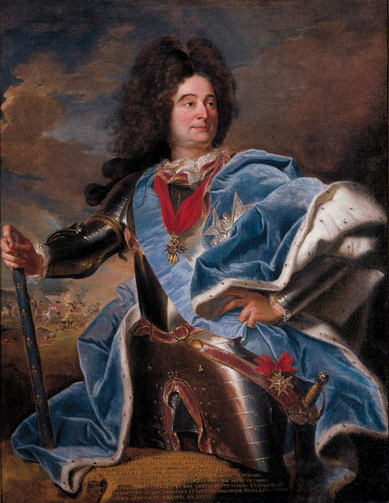
Louis-Hercule-Timoléon de Cossé, duke of Brissac - Anonyme — Google Arts &  Culture
Louis Hercule Timoléon de Cossé-Brissac


The Duc did not lose his nerve behind bars. He set up games for his fellow prisoners to distract them from their dire circumstances. Nevertheless, he was not unaware of the position he was in. When the royal family were transported to the Temple he thought it necessary to rewrite his will - apparently, he knew the outcome of his upcoming trial. 

By September he was to be transported to Versailles. On the 9th September 1792, the wagon with 54 prisoners arrived at the former royal village. The Duc de Brissac stood upright in the third wagon with his blue sash fastened across his chest.  When the convoy came to a halt it was met by a group from Paris which has been described with the sinister term "assassins". According to some, they immediately asked who the Duc de Brissac were. Once he was pointed out they attacked - Louis Hercule was dragged down from the cart. He could not properly defend himself as his hands were shackled. Nevertheless, he managed to hold off his assailants for quite some time before he was cut down by a sword.

His attackers did not leave his body in peace. Instead, his ears and head were cut off and put on spike. From there they marched to the Château de Louveciennes where the mistress of Louis Hercule lived. She was particularly well known by the contemporary world as Madame du Barry. His head was then taken off the spike and thrown through her windows. As for the rest of his body, sources vary on what happened. Some claim that the limbs of those massacred were stuck on the fences of Louveciennes. 

Now, the remains of the Duc de Brissac are buried in the Cemetery Saint-Louis at Versailles.

Friday, 16 October 2020

Louis III de Bourbon-Condé, Prince de Condé

When Louis de Bourbon-Condé was born on 10 November 1668, he was immediately given the title of Duc de Bourbon. The third of his parents nine children, he would spent the majority of his childhood in relative obscurity. It was not until he turned 18 years old that Louis began to play his part as a courtier of Louis XIV.

By 1686, he was given the rank of Chevalier de Saint-Esprit. From then on, his military career blossomed. In quick succession he became first a colonel, then a Marèchal de Camp and finally a Lieutenant General. The mid-1680's were generally a busy time for Louis. Besides his newfound military life, he was also destined to make an illustrious match.

Undoubtedly, his future bride's identity had been discussed for years by his parents. They could hardly have imagined that they would be obliged to marry off their son to a woman who had been born illegitimate. The redeeming aspect was that that woman's father happened to be Louis XIV. Mademoiselle de Nantes was born by Madame de Montespan and fathered by Louis XIV. When the match was proposed, the majority of the court expected a prompt refusal on behalf of the young man's father. However, Henri-Jules de Bourbon-Condé had other ideas. In an attempt to gain royal favour, he agreed to the mésalliance.

SAS LE PRINCE LOUIS III DE BOURBON-CONDÉ MONSIEUR LE DUC DE BOURBON PRINCE  DU SANG | Bourbon, Royal family portrait, French prince
Louis III de Bourbon-Condé

Thus provided with a wife, Louis entered Versailles were he was known as Monsieur le Duc. He did not cut a very striking figure. His family were generally known to be remarkably short - even for the times. Even though he was not as short as his doll-like sisters, he was still quite short. The more notable feature was his head. Louis suffered from macrocephaly, a condition that results in an unusually large head.

His education had been quite good and he appears to have had a sound understanding. Nevertheless, he was not exceptionally bright and had no need to further himself beyond his already exalted position. At Versailles, this meant that he faded into the background. The one point that did mark him out for attention was an unfortunate legacy from his father: insanity. Whereas Henri-Jules was known to have been incurably insane, Louis appears to have slipped further into madness as he got older but never reached the complete mental collapse of his father.

Louis' semi-royal bride provided him with nine children; the first of which was born a few years after the marriage.

By 1709, Louis inherited the title of Prince de Condé as well as the considerable assets of this title. However, he would not enjoy them for long. One night, he was driving across the Pont Neuf in Paris when he suffered a fit of apoplexy. Louis died on 4 March 1710.

Saturday, 26 September 2020

Cabinet of Curiosities: Comte de Menars

Abel-François Poisson, Marquis de Menars was known primarily through his connection to his sister: Madame de Pompadour. Just like his sister, he was an avid collector and had a rather substantial collection including pieces of art and more unorthodox items. His collection included 166 paintings, 7 enamel portraits, 24 miniatures, 23 sculptures, 11 vases, 22 bronze figurines, 20 medallions, hundreds of drawings, countless books, porcelain etc.

The collection included an astonishing amount of royal likenesses. Most of the royal family were represented but primarily Louis XV - understandably, considering his connection as both sovereign and his sister's lover.


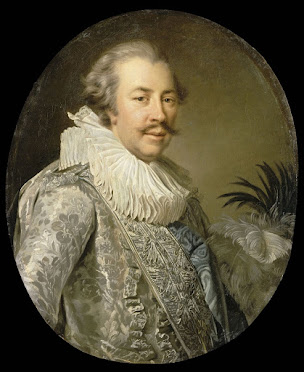
upload.wikimedia.org/wikipedia/commons/thumb/7/...
The Marquis de Menars


Of the more interesting features were:


2 globes (one celestial, one terrestrial) decorated with copper rings, mounted on wooden stands

1 cameo of a female in profile, made from carnelian and onyx and surrounded by brilliants

1 "Lanterne Magique". This was the precursor to a projector which allowed the user to insert different                 glass images which would be projected onto a wall. The Marquis' set included twelve different glass images.

2 heads carved from Carnelian 

1 odometer, a round apparatus which measures a distance travelled 

1 coconut from Manilla (considered so exotic that it warranted its place here!)

2 small bronze cannons, mounted on wood

1 natural crystal mounted on an ivory stand

Several pieces of fabric from Tahiti

1 model of a turning fireplace

2 rosaries, one with beads of lapis lazuli and one with agate 

Several models of sheep (one wonders why)


The Marquis appears to have been a man of varied tastes. Besides his more notable features, he also possessed the more mundane features of an amateur scientist, such as thermometers, barometers, scales and a microscope.

On the few occasions that the Marquis did venture to Versailles, it is likely that he shared his interest for science with Louis XV - who was infamously fond of the new discoveries within that field.

Cabinets of Curiosities

Throughout history, royalty has had collections of "oddities". These would range from exotic stones to alleged mythical creatures. As the Age of Enlightenment spread through Europe, the interest for science rose. An increasing amount of aristocrats began to collect their own cabinets of curiosities. 

Some collections were vast and counted several hundreds of bizarre items while others were rather modest. Today, they provide us with an interesting insight into both the personality of the owner and the age in which he lived.

Due to the restricted amount of space available at Versailles, anyone who had a substantial collection was obliged to store it elsewhere - usually in their country estates.
These were some of the courtiers who built up their own cabinets of curiosities:


Thursday, 24 September 2020

Selling the Queen's Jewels: Marie Antoinette's Jewels Sold

Hosted by Sothesby's, the jewels belonging to the Bourbon-Parma family were sold in 2018. These included jewels that once adorned the Queen of Fashion herself - Marie Antoinette. But how did the ill-fated queen's jewels end up there?

Most of the royal family's Crown Jewels were sold by the revolutionaries and often broken up into pieces. However, the beleaguered royal family did manage to smuggle out some pieces which were sent to the queen's nephew, the Emperor of Austria-Hungary. From there, they passed through the hands of several royal families before finally ending up on the auction block at Sothesby's. As such, it should be remembered, that the diamonds, pearls and other precious stones are not necessarily in the original design - almost the contrary. It was not uncommon to have diamonds reset in modern patterns; besides the smuggling itself would occasionally require pieces to be broken up.

Nevertheless, these were the magnificent jewels whose origin can be traced back directly to Marie Antoinette or others connected with the court of Versailles (NOTE: unless stated otherwise, the photos were taken by Sothesby's to whom credit goes).


A superb diamond parure

In order to create this stunning diamond parure, a great deal of exquisite stones were needed; many of which came from the collections of persons connected with Versailles. The five largest stones are believed to have been the property of Marie Antoinette while others belonged to her daughter, Madame Royale, and the Duc de Berry.

Price realised: 855.000 CHF (724.128 pounds)


A pearl necklace with clasp

While the (detachable) rows of pearls are impressive in themselves, it is the clasp that warrants closer attention. Once, Marie Antoinette had a matching pair of bracelets with that very clasp and also six rows of pearls. It is a pretty good example of how a piece can be altered into a new purpose.

Price realised: 100.000 CHF (84.693 pounds) 


Three diamond rings

These rings must have meant something special to Madame Royale, as they were left to her by her mother, Marie Antoinette. The first ring is mounted with diamonds and contains a profile miniature of the late queen herself. 

Price realised: 250.000 CHF (211.733 pounds)


The second ring shows Marie Antoinette's monogram set in diamonds. The ring also contains another, more personal remnant of the queen: a lock of her hair. Undoubtedly, that is why the ring was sold for such an exuberant amount.

Price realised: 447.000 CHF (378.579 pounds)


The last shows the letters MD for Monseiur le Dauphin, Madame Royale's grand-father (he is better known as Louis-Ferdinand). Naturally, Louis-Ferdinand and Madame Royale would never meet but it must have been a reminder of the family that she had lost. It had once been in the possession of Marie-Josèphe de Saxe, mother of Louis XVI.

Price realised: 125.000 CHF (105.866 pounds)


The queen's pearls

This is one of the pieces that is closest to its original form. When Marie Antoinette owned the necklace, it was longer and included the pearls from both images. They were later split up to form the two separate necklaces we see today. The necklace contains no less 119 pearls (of which just three are freshwater pearls).

The clasp of the first, three-rowed necklace is in the shape of a star and is set in diamonds. The clasp was added later, so it is not a part of the original piece.


Price realised for the first: 2.295.000 CHF (1.943.713 pounds)

Price realised for the second: 447.000 CHF (378.579 pounds)

These earrings are also made up of pearls that belonged to the same necklace as the ones above. It has later been set with diamonds. All four pearls were saltwater and the "new" design is from the early 19th century.

Price realised: 447.000 CHF (378.579 pounds)


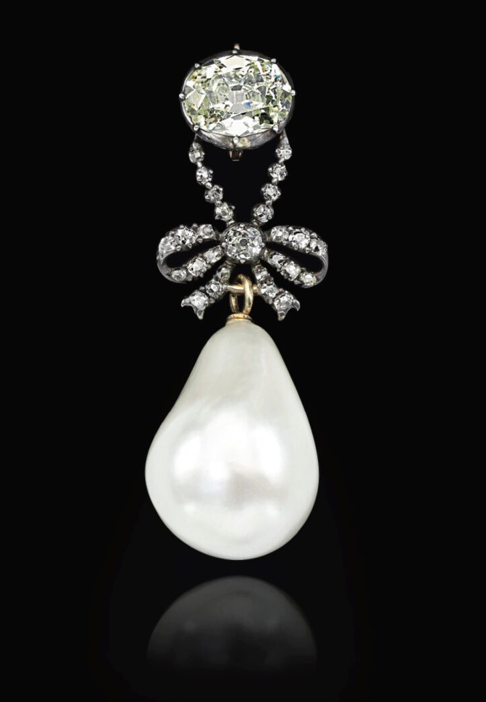
However, that is not the end of the pearl necklace! The original piece was adorned with a pearl pendant which is now an individual brooch but otherwise in the same fashion as before. The large pearl dangles from a bow of smaller diamonds which again are suspended from a large, oval diamond.

This piece was one of the most expensive at the auction and fetched a record price of 36.427.000 CHF! For those of us who do not usually deal with Swiss francs this is 30.851.260 pounds.


In case you are having a hard time imagining the original piece in all its glory, Sotheby's attached the following image: 


A diamond brooch

The trend of bow-shaped brooches was popular throughout most of the latter half of the 18th century. This particular diamond bow belonged to Marie Antoinette. The large, yellow diamond is detachable. Originally, the brooch was a part of a set including possibly a tiara.


Price realised: 2.115.000 (1.791.265 pounds)


A golden pocket-watch

This golden pocket watch looks rather modern compared to the other pieces. When opened, it displays the queen's initials, MA, and three fleurs-de-lys. Besides the gold, the watch is adorned with many small pearls and blue enamel. It would have hung from a chain.


Price realised: 250.000 CHF (211.733 pounds).


The entire auction included 100 lots - some of the pieces have not been seen in public for more than 200 years, as they have been privately owned. The ten pieces that originally belonged to Marie Antoinette sold for a total of 33.740.293 pounds!

Monday, 31 August 2020

The House of Villars

The family of Villars originated from the region of Lyonnais where the males of the family had long held positions as échevin (the equivalent of an English alderman). As such, they were considered as part of the lower nobility. However, that was to change over the span of the 16th and 17th century.

By 1586 the family was made a part of the nobility. In the following Grand Siècle the family saw one of its own being raised to the rank of Duke.


1) Claude-Louis-Hector de Villars & Jeanne Angélique Rocque de Varengeville

Claude was born in 1653 and received an excellent education before entered the Grand Écurie where he would join the musketeers. As it happened, his prowess in warfare would be the making of him. Luckily for him, he had the best masters as he served under both Turenne and the Grand Condé. At the same time, he possessed the delicate tact required of diplomat; the combination made him an invaluable tool for a king with such grand ambitions as Louis XIV.
At court, he were the object of some scandal. Apparently, the new duke preferred the company of men (romantically) which sent not a few tongues wagging. Voltaire described him as being greedy for honours - perhaps a sense of inferiority? His ducal title was new and his family could not boast quite the same pedigree as his fellow dukes at court. Nevertheless, his merits was generally acknowledged to include unshakeable bravery and a strong sense of honour.

Eventually, Claude was granted the exalted title of Marèchal Général des Camps et Armées du Roi - one of only six to achieve that honour. He partook in the campaignof the War of the Polish Succession at the age of 80 but it proved to much and he died in Turin in 1734.

Jeanne Angélique was thirty years her husband's junior, being born in 1682. She was the daughter of the seigneur de Varengeville and as such her husband's elevation was a great advancement for her, too.

The couple had a single child - hardly surprising considering that her husband spent the vast majority of his time at war and was a homosexual:
  • Honoré-Armand de Villars

Rigaud - Claude Louis Hector de Villars - Château de Vaux-le-Vicomte.jpg
Claude-Louis-Hector


2) Honoré-Armand de Villars & Amable-Gabrielle de Noailles

Honoré-Armand was born in 1702 and followed in his father's footprints - but only to a certain degree. He served under his father in Italy in 1733. However, he did not spent much time with the army besides this. At court, he was a notable member of the Académie Française. Like his father, Honoré-Armand was homosexual - his sexuality earned him the name of "l'ami de l'homme".

His father's advancement meant that a prestigious marriage was in store for the young Honoré-Armand. He was married to a daughter of the numerous Noailles-family, Amable-Gabrielle de Noailles. Honoré-Armand had a taste for the literary arts and amassed quite an impressive library. After 1750, he spent very little time at court, preferring his private estates where he entertained Voltaire and Duclos.

Amable-Gabrielle was the daughter of the Duc de Noailles and held the position of dame de compagnie to Marie Leszczynska. She would later become dame d'atours to the queen. With such an important office, Amable-Gabrielle was required to remain at court on a permanent basis. When Marie Leszczynska died, Amable-Gabrielle was allowed to remain in her position when Marie Antoinette arrived.

It would seem that their relationship was one in name only. Her husband's preferences meant that the couple never had children; however, Amable-Gabrielle did have a daughter fathered by Jean Philippe d'Orléans (illegitimate son of the Duc d'Orléans). The daughter was named Amable-Angélique and married to the Comte d'Egmont; however, she was soon widowed and entered a nunnery.

When Honoré-Armand died in 1770, the male line died out as did the title.


Honoré-Armand de Villars
Honoré-Armand


Amable Gabrielle de NOAILLES : Family tree by Antistar - Geneanet
Amable-Gabrielle


Interesting facts and anecdotes:
  • The house of Villars produced 5 archbishops for the city of Vienne (not Vienna, that is)
  • Claude-Louis-Hector had two brothers; Armand died at the siege of Douai and Henri-Félix became a cleric
  • Pierre de Villars (father of Claude-Louis-Hectors) served as ambassador to three countries: Spain, Savoy and Denmark
  • The Château de Vaux-la-Vicomte became a property of the Duc de Villars in 1710

Tuesday, 23 June 2020

The King's Morbid Fascination

Kings, like everyone else, have their own preferments and fascinations. However, Louis XV had a particularly morbid fascination with a gloomy subject - death.

The king's displayed a continued fascination with death which made his company uneasy. Madame du Hausset was in particularly good position to give an insight into the king's private character. As Madame de Pompadour's maid-of-honour, she was with the two of them on more intimate occasions. In her memoirs, she recalled an incident when the king was traveling to Crècy where Madame de Pompadour would entertain him. On the way, the king spotted a few crosses and ordered his carriage (and those of his entourage) to come to a halt.
Louis then called a groom and asked him to go to the graveyard to see if there were any signs of new graves having been dug. The groom (probably perturbed) went to do as he was told and returned with an affirmative answer; indeed, three new graves had recently been dug. Madame du Hausset recalls that the ladies in his company were visibly disturbed but does not mention the king's reaction.

It would appear that this fascination was not a temporary whim. Madame de Pompadour told her ever-present du Hausset that the king "loved talking of death".  She was not the only one who noticed the king's strange conversation topics. The Duc de Cröy remarked that the king would sometimes change the subject of a conversation to death or the prayers said for the dying, even if the subjects had been markedly different.

Image illustrative de l’article Emmanuel de Croÿ-Solre
The Duc de Cröy - who noticed the king's
penchant for morbid topics of conversation

Death was everywhere in the 18th century; rampant infant mortality, recurring epidemics, brutal criminal punishments and a very limited medical knowledge all contributed to a society that was frequently visited by death. Judging by the reactions of Madame de Pompadour and her ladies, they had no particular fascination with the same subject despite living in the same reality as the king.

The king's interest might stem from his early childhood. Before Louis turned 5 years old, he lost his father, mother and older brother; he would then lose his great-grandfather and found himself the last of that branch. Perhaps the young boy became intrigued by that intangible thing that deprived him of his closest family?

It certainly would not be odd, especially considering that he would live to see a good deal of his friends and family die around him. His wife, two sons (including the heir, Louis Ferdinand), two daughters-in-law, three daughters, a grandson and two mistresses all died during his lifetime. It probably did not help that some had rather dramatic deaths; Madame de Châteauroux, for instance, died in violent cramps. Others died suddenly such as Madame Henriette, who had complained a little of feeling tired but not ill - she died three days later.
This - as well as almost entirely ineffective medical knowledge - could well explain another aspect of the king's interest. He would, occasionally, attribute certain looks on his courtiers to be a sign of their impending death. For instance, he once (in the hearing of the person in question) remarked that a gentleman looked particularly pale. The king concluded that he probably had just one month left to live in.


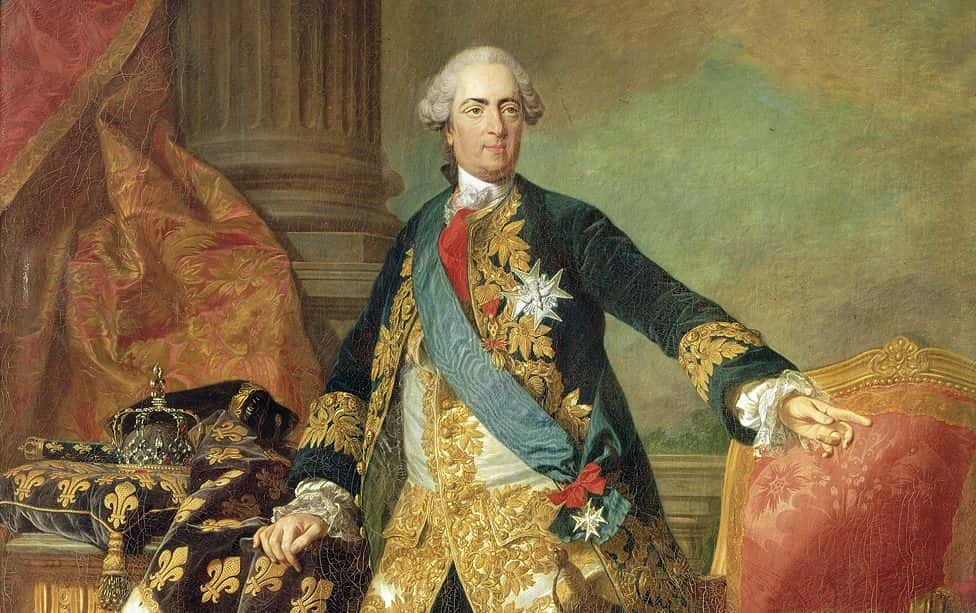
www.factinate.com/wp-content/uploads/2018/10/16...
Louis XV

The odd thing was that while the king was deeply interested in mortality, he was also terribly afraid of dying. In his childhood, he had been drilled in the horrors of hell and the punishments awaiting  unrepenting sinners there. It is hardly surprising, then, that a king whose personal life was well-known for its pleasures would fear the punishment of an after-life. It was said, that during his nearly fatal illness at Metz, he had been plagued by horrific hallucinations of exactly these punishments "dancing on his bedside". It would seem that the king's morbid fascination was much like watching a train-wreck: disturbing to look at, but hard to look away from.

It is claimed that the king's own demise would be a result of his peculiar interest. When he was out riding, he passed a funeral cortege and rode up to the mourning. He asked who their dearly departed was and what he had died of; he was told that the deceased had died of the smallpox at which he allegedly started and immediately turned his horse around. Despite his prompt departure, he was soon struck with the same illness - and died from it.