Friday, 20 October 2017

Choosing a King's Bride

The young Louis XV was in a very precarious situation dynastically. Both his parents and his brothers had died young due to illness and the king's health was fragile. So, a bride was vital for carrying on the French throne. Initially, an agreement had been reached with the Spanish king that Louis XV would marry Infanta Maria Anna Victoria.
The Infanta was very young, though - she was only three years old when she arrived at Versailles while Louis was eleven. She remained at Versailles for a couple of years until something happened to drastically change the situation. Louis XV's health was delicate and he became ill which prompted the Prime Minister - the Duc de Bourbon - to annul the agreement and ship the Infanta back.

The search was on for a bride who was healthy and old enough to carry an heir. A list was made of 99 princesses who would all suit as a potential queen of France. The list included the names of the princesses, their dynastic heritage, their ages (ranging from 13 to 22), their appearances, health etc. Some of these were:

Elizabeth Petrovna 
Born: 29 December 1709
Dynasty: Romanov 
Reason for rejection: Peter the Great - her father - visited Versailles and Louis XV while the king was still a boy. While in France he suggested his daughter, Elizabeth, as a bride for Louis XV. However, she was initially rejected because of her mother who had been a maid.
Became: Tsarina of Russia

Billedresultat for empress elizabeth russia
Elizabeth

Princess Anne of England
Born: 2 November 1709
Dynasty: Hanover
Reason for denial: Her father - George II of England - was primarily on the throne due to being a Protestant. If Anne was to become queen of France she would have to convert which was rejected.
Became: Princess of Orange

Billedresultat for anne princess of orange
Anne


Princess Anne Charlotte of Lorraine
Born: 17 May 1714
Dynasty: Lorraine 
Reason for rejection: the House of Lorraine was a direct rival of both the House of Orléans (which the Regent belonged to) and of the Duc de Bourbon 
Became: Abbess of Remiremont  

Princess Anne Charlotte of Lorraine by Gobert.jpg
Anne Charlotte


Landgravine Caroline of Hesse-Rotenburg 
Born: 18 August 1714
Dynasty: Hesse-Kassel  
Reason for rejection: she was infamous for her bad temper!
Became: Duchesse de Bourbon (meaning that she married the Duc de Bourbon instead!)

Caroline

Henriette-Louise de Bourbon, Mademoiselle de Vermandois
Born: 15 January 1703
Dynasty: Bourbon (she was the sister of the Duc de Bourbon)
Reason for rejection: she refused to marry the king since she would rather join a convent 
Became: Abbess of Beaumont-lès-Tours


Princess Amelia of England
Born: 10 June 1711
Dynasty: Hanover
Reason for rejection: like her sister, Anne, she was a Protestant
Became: remained unmarried as Princess of England

Princess Amelia of Great Britain (1711-1786) by Jean-Baptiste van Loo.jpg
Amelia


Élisabeth-Alexandrine, Mademoiselle de Sens
Born: 5 September 1705
Dynasty: Bourbon (another sister of the Duc de Bourbon)
Reason for rejection: not quite clear but possibly doing to her close relationship with her brother. Cardinal Fleury was eager that the Duc should not get more power.
Became: remained unmarried with the title of Mademoiselle de Sens

Mademoiselle de Sens wearing Fleur-de-lis by a member of the school of Nattier.jpg
Élisabeth-Alexandrine


Princess Barbara of Portugal
Born: 4 December 1711
Dynasty: Braganza 
Reason for rejection: unknown - possibly it was considered too much of an insult to Spain
Became: Queen of Spain

Barbaradebragança.jpg
Barbara


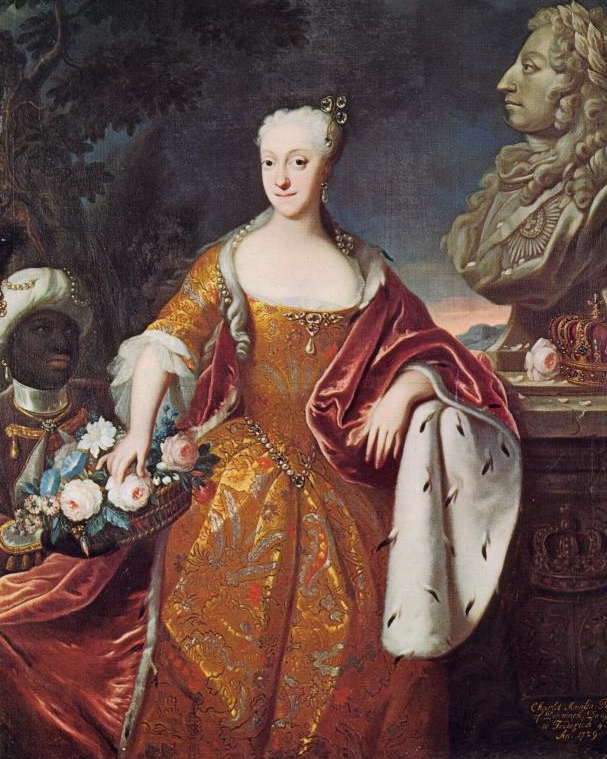
Princess Charlotte Amalie of Denmark-Norway
Born: 6 October 1706
Dynasty: Oldenburg
Reason for rejection: Denmark-Norway's tense relationship with Sweden, an ally of France
Became: remained unmarried as Princess of Denmark-Norway
Charlotte Amalie

First, the list was shortened to 17 princesses and then further reduced to four - including both sister of the Duc de Bourbon. However, Louis XV and Cardinal Fleury rejected them all and the original list had to be looked at again. Surprisingly, Marie Leszczynska had not even made it to the list of 17 candidates. The choice was considered an odd one: an impoverished second daughter of a man who had lost his throne. Add to that that she was already 22 years old. 
Nevertheless, politically it was a good choice. After the snubbing of the Infanta France had to be careful not to antagonize their neighbor further - the worst-case would be the eruption of a war. The choice was diplomatic nightmare. The English could not accommodate the conversion to Catholicism, an Austrian would upset the Spanish while a Dane would definitely create a drift between France and Sweden - as would a Russian potentially. 

Marie Leszczynska had the clear advantage of being a politically neutral choice. Since her father was no longer king of Poland he was not considered to be a danger anymore and therefore his daughter would insult few monarchs. The young woman herself was old enough to provide an heir immediately and while not considered beautiful she was warm, kind and devout.

Saturday, 14 October 2017

The Aigrette

The aigrette was fashionable in most of the 18th century but also in the previous century. The term refers to either a jewelled ornament for the hair or a plume of feathers likewise attached to the coiffure. 

In the 1680's fashions once again favoured the high hairstyles which saw the reemergence of the aigrette. By this age it became common to reserve the best diamonds for those used in hats and aigrettes. Marie Louise d'Orléans - daughter of Monsieur - was a great fan of a new trend of aigrette: having inscribed words or names on the aigrette. Marie Louise had the name of her future husband, Carlos II of Spain, written in her own.


Billedresultat for portrait detail aigrette
Small aigrette worn by Marie
Thérèse Raphaëlle

Marie Leszczynska is seen wearing a splendid aigrette in her state portrait. When Monsieur de Chabot married the daughter of the Duc d'Anville the bride was given a purse of 100 louis and a precious aigrette according to the Duc de Luynes. This alone shows how  popular the accessory was. The same Duc also refers to a particularly magnificent diamond aigrette owned by "the younger Madame la Duchesse" which was estimated to be worth 100.000 livres.

With the popularity of the aigrette is is little wonder that they were often used as presents. One rather odd instance was when Madame de Pompadour found out that one of the minor mistresses of Louis XV was pregnant. When the time came for the young woman to be delivered of her child the Marquise charged her lady - Madame du Hausset - with going to the convent where the birth was to take place and present her with the gift of a diamond aigrette.

Billedresultat for marie antoinette aigrette
Louis XVI's gift to Marie Antoinette

Marie Antoinette made the aigrette one of her first fashion statements. She was fond of real feathers which immediately became all the rage - so much so that an entirely new trade sprang up in France. This greatly angered the Dauphine's mother who scolded her daughter for it. Louis XVI made a discreet hint to spend less on the trend by gifting his wife with an aigrette made from diamonds already in his possession. 

Bathilde d'Orléans, Princesse de Condé

Born on the 9 July 1750 at Saint-Cloud Bathilde d'Orléans was the daughter of Louis Philippe d'Orléans and Louise Henriette de Bourbon. As such she was a descendant of both Louis XIV and his brother, Philippe. During the first eight years of her life she was a common fixture at court where she was known Mademoiselle being the eldest unmarried lady in the royal family. However, with the death of her mother in 1759 her father sent her to a convent.

Portrait of Bathilde d’Orléans.jpg
As a young woman

Convent educations were not unheard of - Louis XV's daughters all spent their young years in convents. What was unusual was that she remained in the convent until the age of 20. The reason for this long spell was that she was initially suggested as a bride for the Duke of Parma (favourite grandson of Louis XV) but this never amounted to anything. Consequently, she had to remain cloistered for a little longer until a husband was found. 
That husband happened to be Louis Henri, Duc d'Enghien (later Prince de Condé) who was six years her junior. They were married in 1770 at the chapel of Versailles. However, their marriage had a short honeymoon. After six months Louis Henri had apparently tired of his wife and turned his attentions elsewhere. Nevertheless, Bathilde was entitled to a place at court as the Duchesse d'Enghien. From then on the couple only saw each other sporadically. 


Bathilde d'Orléans, duchesse de Bourbon.png
While Duchesse de Bourbon

Despite their estranged relationship she managed to become pregnant and gave birth to the couple's only child: a son called Louis Antoine. Having thus fulfilled the purpose of their marriage the couple saw even less of each other. By 1780 Bathilde had had enough of her husband's very public and humiliating sidesteps. The one affair that turned out to be the final drop was with an opera dancer by the name of Marguerite Catherine Michelot. The couple separated and - as was usual for the time - Bathilde was blamed for the collapse of their marriage.

Being a separated wife she no longer had the right to appear at court. Undeservedly exiled, Bathilde went to her country estate Château de Chantilly. For a while she took up abode with her father and his new wife - the same woman who had allegedly insisted that Bathilde be sent to a convent. Her father died in 1785 which meant that her brother became the Duc d'Orléans. Since she could obviously no longer stay with her father she purchased house in Paris which she called the Hotel de Clermont as well as another estate, the Château de Petit-Bourg.


Billedresultat for bathilde d'orleans
By Drouais


Bathilde had no intention of accepting the role society would otherwise have her play of a celibate, discarded wife. She had an affair with the Chevalier Alexandre Amable de Roquefeuil with whom she had a daughter christened Adélaide-Victoire. She had little contact with her son since by law he was the "property" of his father so it is hardly strange that Bathilde did what she could to keep her daughter close. In order for this to happen she had to pretend that Adélaide-Victoire was the daughter of her secretary. 
By 1787 she made another purchase - this time directly from Louis XVI. This time it was the Élysée Palais where she had a small hamlet built. The hamlet was heavily inspired by that at Chantilly. While living at the Élysée Palais she began studying the occult. Hitherto, she had been a very spiritual woman (a remnant of her days at the convent). Astrology, magnetism of animals, dream interpretation and chiromancy all became subjects of interest to Bathilde. Painting became another - although more traditional - pastime of hers. 

With such an open mind it is hardly surprising that the salon which she hosted became renowned for its liberality. 

Once the revolution broke out she sided with her brother and his democratic tendencies. While her husband and son fled France she remained and donated her vast wealth to the revolutionaries. During these years she became known as Citoyenne Verité - Citizen Truth. However, the new state was not a grateful one. The remaining members of the Bourbon family were arrested and imprisoned - including Bathilde. After a year and a half her brother was guillotined and everyone expected her to be next. However, she was saved by the so-called Thermidorian Reaction and restored to her residence of Élysées. Sadly, since she had given her money to the state, which then betrayed her, Bathilde was forced to rent out most of the palace. 

By 1797 she was forced to emigrated with her daughter by the new government. They were sent to Spain under the watch of French guards. One of these became her lover and she kept in contact with him during her time in Spain. While there she founded a pharmacy and a hospital where those seeking aid could find it.


18th century Portrait of Bathilde d'Orléans by a member of the École Française.jpg


Surprisingly, she did not relinquish her republican views. Initially, she had admired Napoleon but that changed once she learned that he had had her son executed. The enmity between them was further exacerbated by Napoleon keeping her from returning to France for ten whole years. When the Bourbon dynasty was restored to power un 1815 her Élysées residence was exchanged for that of the Hotel Matignon. In her usual spirit she immediately gave the property to a nunnery and charged them to pray for those executed during the revolution.
Not long after Bathilde returned to France she was met with a request from her family. They wished her to return to her husband which she promptly refused. Rather daringly, she responded by resuming the affair with the guardsman who had escorted to Spain. Their romance was to last three more years before he died.

Bathilde herself died under rather dramatic circumstances. In 1822 she was taking part in the march towards the Panthéon when she suddenly collapsed. She was immediately taken to the house of a Sorbonne-lawyer where she died.

Surprisingly, Bathilde held four titles during her life: Mademoiselle before her marriage, Duchesse d'Enghien (1770-72), Duchesse de Bourbon (1772-1818) and Princesse de Condé (1818-1822).

Friday, 13 October 2017

Court Artefacts: Books

Most members of the aristocracy had libraries of their own and their books were recognizable by the owner's coat-of-arms.


This book, published in Paris, 1658, is a volume originally written by Julius Caesar describing his military campaigns. This is the 3rd French edition, revised and corrected. Because it bears the royal arms of King Louis XIV, it either belonged to the King and is therefore from the royal library, or was a presentation volume given by the King to a courtier.


Printed in 1658 this version of Julius Caesar's military  campaigns belonged to Louis XIV


Billedresultat for elisabeth charlotte de bavière


A book from 1672 with the arms of Elizabeth-Charlotte of the Palatinate


The Chronological History of Rome with the arms of the Grand Dauphin


This seventh volume of the history of Rome bears the arms of the Grand Dauphin


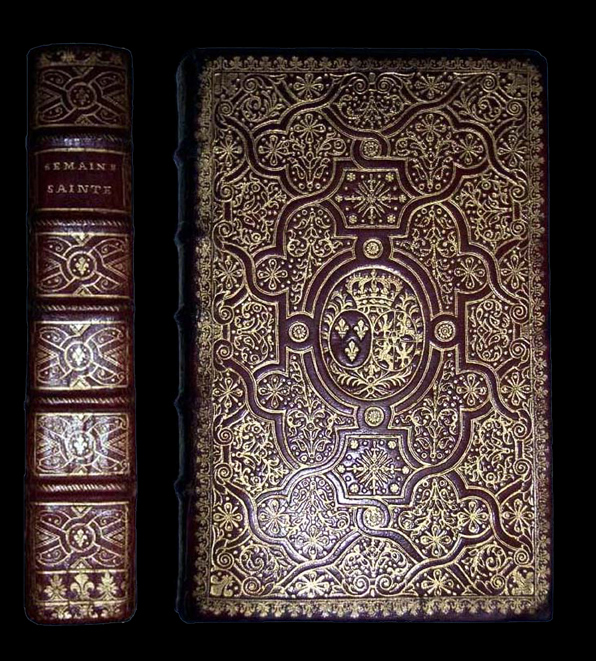
Book, French, Paris, 1728, bearing armorial crest of the Dauphin of France, son of King Louis XV and heir to the French throne, Office de la Semaine Sainte


Printed in 1728 in Paris this bound volume was in the library of Louis Ferdinand, son of Louis XV and Marie Leszczynska


Padeloup plaque


Another volume from 1728 which was the property of Marie Leszczynska. The title is  Office de La Semaine Sainte.


A French binding for Anne of Austria, wife of Louis XIII. Author: Catholic Church. Title: L'office de la Semaine saincte. Published: Paris: G. Clopeiau, 1627..large.jpg (1470×2231)


This happens to be the same story as the one above - only this one was made in 1627 and belonged to Anne of Austria.


Book belonging to Louis Ferdinand with an inscription for his son, the future Louis XVI


Louis Ferdinand owned this book and wrote an inscription for his son - the future Louis XVI - in it


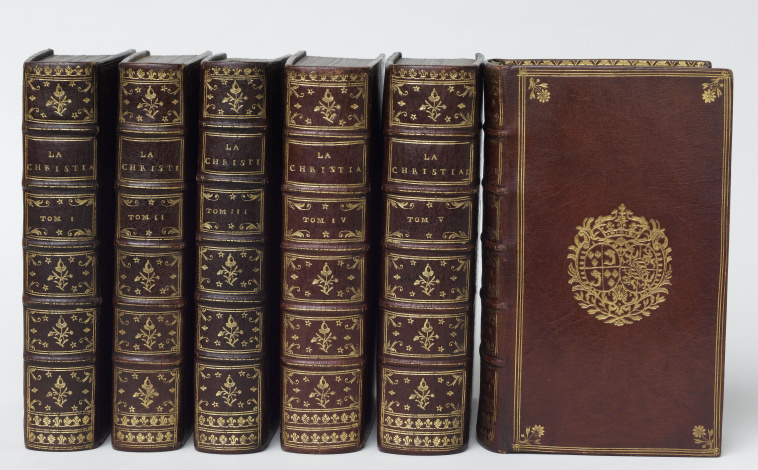
Six volumes bearing the arms of Marie Josèphe. This is a series with the name "La Christiade"


A red book bound in Moroccan leather with the arms of Madame de Pompadour. Her extensive collection of over 3000 volumes were primarily bound in this type of leather.


Four books also bound in red Moroccan leather - this time belonging to Marie Antoinette. The ones in the photo are: L'office de La Sermaine Sainte (again!), Les Plaideurs, Officium Parvum B. Maria Virginis and Histoire des Celtes.
They were sold at auction.


Two volumes of “Letters of Pliny the Younger,” bound with the arms of Madame Elisabeth of France


Madame Élisabeth owned these two volumes of Pliny the Younger bound in yellow leather.


Memoirs of the Comte de Gramont with the arms of the Comte d'Artois


The memoirs of the Duc de Gramont with the arms of the Comte d'Artois.


Books on famous people from the Roman antiquity bearing the arms of the Comtesse de Provence


The Comtesse de Provence was the proud owner of this series which focus on famous people of the Antiquity.


Thursday, 12 October 2017

Court Artefacts: Perfume Burners & Pot Pourri

With a comparatively poor sense of hygiene it is no wonder that Versailles during Louis XIV became known as "the perfumed court". However, even when hygiene became better the taste for perfume did not abate - just look at today. One way of using perfume was to burn it which would spread the pleasant aromas in the entire apartment.


Pot-pourri vase  1740  This single Chinese celadon jar was probably originally known as a ‘ginger jar’. It is decorated with deer and with pine, bamboo and prunus, the ‘three friends of winter’.   In the inventory of Madame de Pompadour’s possessions taken after her death in 1764...


Pot pourri vase from 1740 which belonged to Madame de Pompadour. The vase itself was imported from China and made from celadon. It was listed amongst the Marquise's property upon her death in 1764.


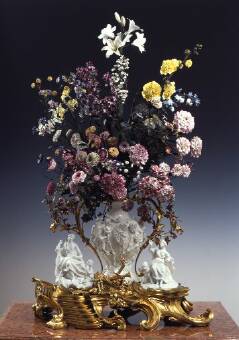
This magnificent piece was a present for the Duke of Saxony from Marie Josèphe - his daughter. The 470 flowers are artificial but the porcelain beneath is made for storing perfume so that the flowers could "spread" a lovely scent.
The porcelain and the gilded stand were made in Vincennes.


"Queen Marie-Antoinette's" agate incense burner in the Louvre comes from her Grand Cabinet there. It is the work of the jeweler to the king Charles Ouizille (1744-1830) and the miniaturist painter Jacques-Joseph De Gault (about 1738-1812). ca. 1784


Agate incense burner which Marie Antoinette once owned. It was a part of the decoration of her Grand Cabinet. The burner was made around 1784 by the king's jeweller, Charles Ouizille, with the miniature being by Jacques-Joseph de Gault.


Perfume stand procured in 1782


This perfume burner was originally made for the Duc d'Aumont but was acquired by Marie Antoinette following his death. This one dates back to 1782 and is by Pierre Gouthière.


Billedresultat for versailles brûle-parfum


Jade perfume burner owned by the Grand Dauphin, 1684-87. The gold work is made in the French fashions of the time.


Lacquer boxes used for incense - part of Marie Antoinette's extensive collection of Japanese objet d'arts.


Billedresultat for brûle-parfum comte d'artois


Another work by Pierre Gouthière for the Duc d'Aumont which was later bought by Louis XVI in 1782. They were recently sold by Sothesby at auction.


Marie Antoinette's collection of Asian objet d'arts included this perfume burner. It originated in China and dates back to the Kangxi-dynasty. It entered the queen's collection in 1780.


This crack-look vase features a small compartment for perfume and was a part of the décor of Louis XV's wardrobe. It was created in 1743

GemGem

Saturday, 30 September 2017

Court Artefacts: Toilette Item

Although personal hygiene was not the same as it is today the toilette was nonetheless vital; it became a status symbol and a ceremony in itself.


Washing bowl belonging to Françoise-Marie de Blois, Duchesse d'Orléans, 1717-1722


razor used by Louis XVI in the Temple Prison


Razor used by Louis XVI while imprisoned in the Temple


Crystal ewer and basin belonging to Marie Antoinette. The little golden dog on the lid opens the ewer - one must place a thumb in its mouth for the water to flow out!

Court Artefacts: Clothing, Shoes & Fabrics

The extravagant fashions of the ancient regime is one of the first things that comes to mind when one thinks of Versailles. Sadly, the majority of the royal family's lavish wardrobes were destroyed during the turbulent days of the revolution. Consequently, only a few articles survive but those that do still gives us an impression of the fashions and craftsmanship of the time. Since the category would otherwise be rather short I have chosen to include artefacts of courtiers as well. 

Note: this page does not concern itself with entire ensembles since these are to be found in the Fashion-section.


Bodice said to have belonged to Marie Antoinette. Note that this is not a whalebone corset which means that it would have been used for less official ceremonies.


Ribbon owned by Madame Adélaide who used it as a belt 


Silk waistcoat with floral embroideries which belonged to the Marquis de Beauharnais 


Chemise worn by the young Louis Charles - son of Louis XVI and Marie Antoinette. For those wondering why it looks so similar to a woman's chemise there is an explanation for that. Until the age of seven boys and girls wore the same chemise-style.


Fragment of the coat Louis XVI wore on the day of his execution, framed with an engraving of the King in prison writing his last will and testament.


Fragment of the coat worn by Louis XVI on the day of his execution, 1793 (sold at auction by auction.fr) 


The shirt that Louis XVI changed out of on the morning of his execution, 21 January 1793, kept by the family of the King's valet de chambre Clery (along with a pair of the King's pants), until 1882.


The shirt (lot number 186) was the one which Louis XVI slept in on the night before his execution. He changed into another one and left this one behind at the Temple where it was passed on to his valet, Cléry.


A piece of a dress worn by Marie Antoinette at the Temple prison. This fragment sold at Christie’s for $76, 184.


Fragment of a dress worn by Marie Antoinette while she was imprisoned at the Temple. It was sold at auction by Sothesby.


Lace worn by Madame Elisabeth, the sister of Louis XVI. It was given to the Bishop Dupanloup in the 19th century by the only surviving child of Louis XVI and Marie Antoinette, the duchesse d’Angouleme.          http://​teaattrianon.blogspot.com/2012/​02/bishops-alb.html


Lace worn by Madame Élisabeth during the last years of her life. It was later given to Marie-Thérèse, Duchesse d'Angoulême (Madame Royale) by Bishop Dupanloue


Let them eat cake! Marie-Antoinette's slippers sell for €50,000


Silk shoes belonging to Marie Antoinette which sold for 65.600 USD


Marie Antoinette's slippers, 1790-93, labelled "Worn by Maria Antonietta, late Queen of France at the time She was taken to Paris", The Metropolitan Museum of Art


Another pair of shoes belonging to the doomed Marie Antoinette. It was labelled as having belonged to the queen at the time when she was taken to Paris in 1789


Handkerchief with Marie Antoinette's coat-of-arms embroidered on it.