Tuesday, 9 December 2014

The King's Mark

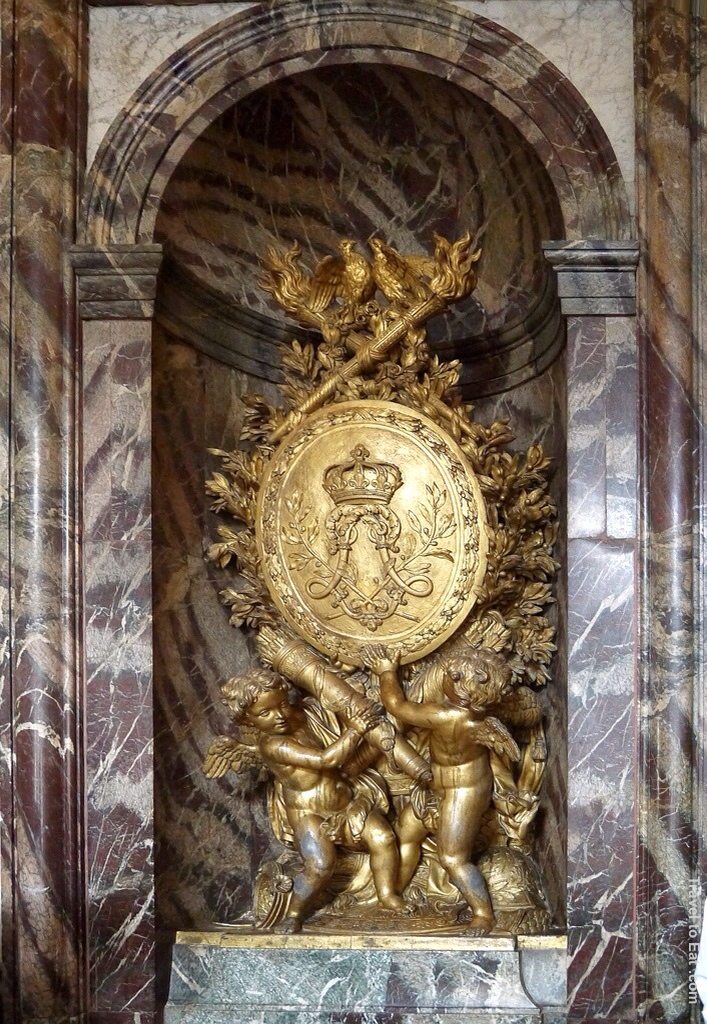
Louis XIV understood that it was one thing to take absolute power for himself but a whole other to keep the courtiers constantly reminded of just that. First, he assembled the courtiers at Versailles by making it impossible to get ahead without being near the King. And while they were there it might as well be that the very palace which they lived in carried the King's first letter: L.

Fleur de Lis and the double 'L' for Louis; gilded wood from Versailles.
Two intertwined L's on a door

More often than not there will be not one but two L's intertwined and topped with a golden crown. A sun is naturally not unusual to find either nor is a fleur-de-lis

The double-l of Louis XIV. Gilt decoration on a door panel in the Grands Apartments, Versailles
Another door from the King's grand apartment


Gilded ironwork at Versailles. Royal  #gold details
The front gate with both a crown, two L's and a sun


Throughout most of Versailles "L"s can be found in the most unexpected places from the exquisitely carved furniture to the marble floors. By making his initial a part of the very surroundings of his court, the court would never forget who was really in charge.


Inlaid marble floor with cipher of Louis XIV at the Royal Chapel at Château de Versailles
Marble floor of the chapel


There are only two other persons whose initials appears at Versailles: Marie Antoinette and Louis Philippe. When Louis XVI handed over Petit Trianon to his wife he also permitted her to tear down the "L"'s which had been installed for Louis XV and replace them with her "MA"s. This alone shows Louis XVI's affection for his wife; not only was anything other than "L" hitherto unseen but the new initials were those of a Queen.
Louis Philippe's contribution was far less than Marie Antoinette's but his initials can still be found on some spots.

Even this key to the chapel has tiny intertwined Ls
This medallion can be found at the Queen's staircase


Wood-carvings

Naturally, since both Louis XIV's successors carried the same name there was never any reason to change the initials. That does seem lucky when you consider how difficult it would be to tear up heavy, marble floor!

Monday, 8 December 2014

Madame Adélaïde

Gilles Joubert delivered this commode for Madame Adélaïde in 1770 who had it transported to the Château de Bellevue which in itself had been a present from her father. Joubert was 74 years old when he made it and at that time he had been cabinet maker to the King since 1748.
Ivory, bronze and marble makes up the parts of the commode that is not out of wood. Versailles bought back the commode in 2007 for 350.000 euros.

commode joubert bellevue

Sunday, 7 December 2014

Louis XV's Lacquer Commode

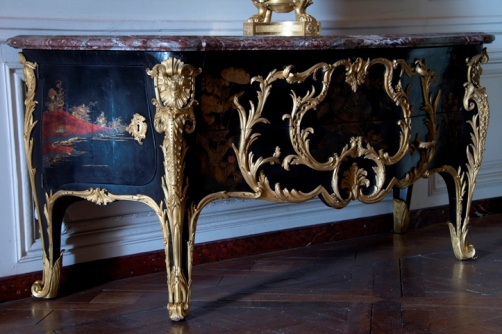
Louis XV received this commode in 1744 and immediately placed it at Choisy - one of his favourite residences. The commode is the work of Antoine-Robert Gaudreaus who had used screens with Japanese lacquer from the collection of Louis XIV himself. The top is of red marble.


Louis XVI moved the commode from Choisy to Saint-Cloud where Madame Elisabeth had the honour of showcasing the commode in her apartment. Later, it was moved into the chambers of Marie Antoinette but it remained at Saint-Cloud. Today, it has been brought to Versailles where it takes a dominant place in Madame Victoire's bedroom.


The Dauphin's Commode

On 29 January 1748 this commode was delivered at the Dauphin's library at Versailles. It was the design of Mathieu Criaerd. Since the commode was sold off together with the other inventory during the revolution the commode had to be bought back as soon as it was located. The price: 12.000.000 dollars! It has now been placed in the very room where it was once delivered.


Prince de Condé's Desk

Desk by André-Charles Boulle who was commissioned by the Prince de Condé to whom it was delivered in 1715. The Prince had the desk sent to the Château de Chantilly where it took a prominent place in the Corner Cabinet. The desk is made of ebony with golden carvings; each table leg is crowned by a woman emerging and at the centre drawer a lion's head dominates.

 - 172 ko

Détail du bureau plat exécuté par A.C Boulle pour le Prince de Condé, dans le Cabinet d'angle du Château de Chantilly
Detail of the keyhole


André-Charles Boulle

Saturday, 6 December 2014

Jewellery Cabinet

Jean-Henri Riesener is the workman behind this jewellery cabinet which belonged to the Comtesse de Provence, sister-in-law of Louis XVI. It was finished and delivered in 1787; it was said to have cost 80.000 livres to make. During the revolution it was confiscated and later offered to Napoleon who refused it.

When opened the cabinet consists of 18 drawers as well as 3 shelves. When created it was intended for the Comtesse's bedroom at Versailles but she changed her mind and had it placed in the Palais du Petit-Luxembourg.

Choisy Commode

Originally, this commode was intended for the King's apartments at the château de Choisy. It was the work of Antoine-Robert Gaudreaus who was the royal cabinet-maker until his death in 1746. Actually, this commode was finished just two years prior to his death.

The style is another example of the fondness for Japanese lacquer though this one was created in Paris.

At the death of Louis XV the commode was handed over to Louis XVI who had it transported from Choisy to Saint-Cloud. First it was placed in the apartment of Madame Adélaïde only to be transferred to that of Marie Antoinette. Currently, the commode is located in Madame Victoire's apartment at Versailles.