

Thursday, 17 July 2014


A Closer Look At: The First Ladies of the Bedchamber
The responsibility of the levée and coucher lay with the First Ladies of the Bedchamber - this post was occupied by two women. For the First Ladies of the Bedchamber time was of the essence. It was them that the Queen would inform of when Her Majesty rose in the morning, got dressed, went hunting etc. So far so good but this was the light weight of the job. The First Ladies of the Bedchamber were responsible for all pensions and payments going out of the Queen's Privy Purse - a heavy task indeed! To make it even more delicate the First Ladies were given responsibility of the Queen's diamonds. It also befell the First Ladies to make introductions to the Queen.
At the time of Marie Antoinette the yearly payment for the First Ladies of the Bedchamber was 12.000 francs which was not much considered the standard of the times. However, there was one other way of increasing their income and that was through candles. All the candles in the Queen's rooms - that is the bedroom, the closets and the card-room - belonged to these ladies. The candles alone could bring in 50.000 francs!
At the time of Marie Antoinette the yearly payment for the First Ladies of the Bedchamber was 12.000 francs which was not much considered the standard of the times. However, there was one other way of increasing their income and that was through candles. All the candles in the Queen's rooms - that is the bedroom, the closets and the card-room - belonged to these ladies. The candles alone could bring in 50.000 francs!
 |
| Madame Campan - First Lady of the Bedchamber to Marie Antoinette |
Wednesday, 16 July 2014
A Closer Look At: The Lady of Honour & Mistress of the Queen's Wardrobe
Next in rank to the Superintendent was the Lady of Honour (dame d'honneur) and the Mistress of the Queen's Wardrobe (dame d'atour). During the period when there was no Superintendent it was these two who were responsible for all the duties that would usually befall the Superintendent. However, the Lady of Honour had duties of her own as well; these included sending out invitations in the Queen's name, managing the Queen's trips to Marly, Fontainebleau, Petit Trianon etc. They were also accountable for the changes of furniture as well as for the lace and linen for the Queen's bed and public toilette. The Mistress of the Queen's Wardrobe was responsible for not only the Queen's clothing but also her napkins, chemises and lace. During the absence of the Superintendent these objects had been replaced every third year but Louis XV was advised to change it into every fifth year for financial reasons. Basically, the Lady of Honour and the Mistress of the Queen's wardrobe would amount to a manager in our days.
 |
| Duchesse de Crequy, Lady of Honour to Marie Thérèse |
A Closer Look At: The Superintendent of the Queen's Household
The leader of it all was the Superintendent of the Queen's Household to whom every new member of Her Majesty's household would swear a solemn oath of servitude. The Superintendent had quite extensive privileges for example being able to nominate someone for a post within the Queen's household; she also had the final say in quarrels between members of the household. Furthermore, the Superintendent could also dismiss anyone she did not think fit. A Superintendent was considered important enough to have her own rooms at Versailles and was the only female employee save the Governess of the Children of France to swear an oath to the King. The post of Superintendent was for life making the decision all the more important since the Queen could not get rid of the one holding the position once it was given.
Inevitable a post of this magnitude must have been haunted by some unpleasantness which is definitely the case with the role of the Superintendent. Louis XIV actually placed two of his favourites, Olympe Mancini and Madame de Montespan, in this dominating position which can not have been easy for Marie Thérèse - especially since the humiliation was performed twice.
Marie Leszczynska was so fed up with the extent of these privileges that upon the death of her Superintendent, Mademoiselle de Clermont, she asked the King to leave the post unemployed. It remained thus until Marie Antoinette appointed the Princesse de Lamballe to the powerful post, something she was later to partially regret when she had somewhat tired of the Princesse.
Inevitable a post of this magnitude must have been haunted by some unpleasantness which is definitely the case with the role of the Superintendent. Louis XIV actually placed two of his favourites, Olympe Mancini and Madame de Montespan, in this dominating position which can not have been easy for Marie Thérèse - especially since the humiliation was performed twice.
Marie Leszczynska was so fed up with the extent of these privileges that upon the death of her Superintendent, Mademoiselle de Clermont, she asked the King to leave the post unemployed. It remained thus until Marie Antoinette appointed the Princesse de Lamballe to the powerful post, something she was later to partially regret when she had somewhat tired of the Princesse.
 |
| Olympe Mancini - Superintendent to Marie Thérèse |
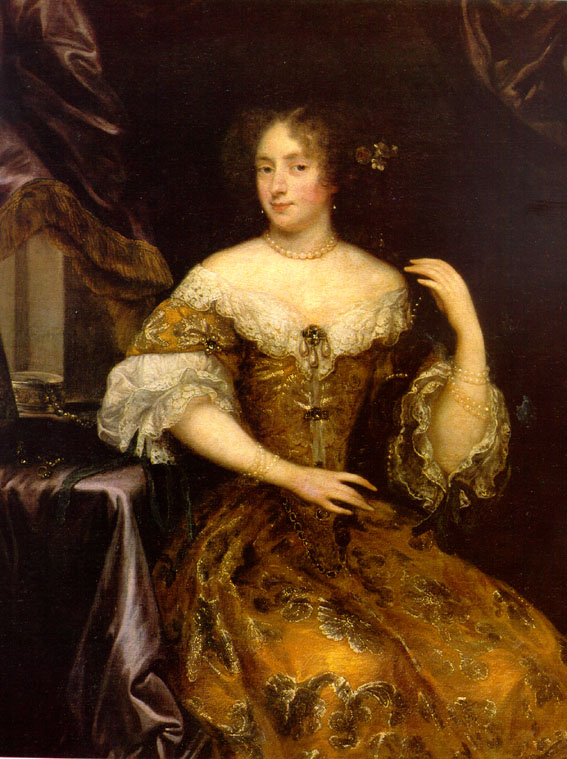 |
| Madame de Montespan - Superintendent (by order of Louis XIV) to Marie Thérèse. |
,_Pierre_Gobert.jpg) |
| Mademoiselle de Clermont - Superintendent to Marie Leszczynska |
 |
| Princesse de Lamballe - Superintendent to Marie Antoinette |
Subscribe to:
Posts (Atom)