Saturday, 3 July 2021

Lost Wardrobes: Marie Antoinette

The female consort to the king of France was not only the Queen of France but also the undisputed Queen of Fashion in the 18th century. Once she became queen, Marie Antoinette enthusiastically took the role of setting the trends for the entire world. In her first years as a consort, her fashion became ever wilder until she took a turn for the far more simple styles.

Her position as an Austrian-born queen made her the target of politically driven enemies from the day she arrived at Versailles. One of their greatest strategies for attacking her was her spending, especially on clothing. While it was expected of a French queen to spend considerable amounts on clothing - to maintain both her status and position as the leading lady in fashion - her enemies and the public took offense at the nature of her expenditure. It was not particularly the clothing bills, but that the queen's personal tastes dictated these - and her tastes were often in direct contradiction to the established order. As such, her clothing was considered to be unacceptable because they were too personal.

The propaganda directed against Marie Antoinette during the revolution covered everything from her friends and family to her fashions. This latter part is the one that has stuck in the public imagination which is why her wardrobe continues to attract attention. Sadly, very few items of her wardrobe survives to this day. A good deal of the queen's wardrobe as it was in 1789 was destroyed during the storming of Versailles in early October that year. The clothing she had previously worn was usually appropriated by her ladies-in-waiting and her dame d'atours - both of whom could claim parts of the royal wardrobe as a bonus. Her most extravagant dresses have also been lost to history. None of Rose Bertin's - the creator of these extravaganzas - accounts survive to this day which means that we have scattered documentation as to the queen's wardrobe.


In an attempt to construct an insight into the doomed queen's wardrobe, the following list is drawn from first-hand accounts, more recent literature and portraits.


While still a dauphine, the young woman learned to ride horses to accompany her husband on his favourite pastime. Dunoyer de Noirmont reported at this time that the dauphine wore a blue velvet dress  adorned with a golden braid and a hat adorned with white feathers. The choice of colour was likely not Marie Antoinette's own, as blue had been the traditional colour worn for the king's hunts since Louis XIV's time. As such, it was likely an attempt to show that she belonged to the king's own hunting party.

At other times, she would don a red redingote, also with golden braids. This is a particularly masculine outfit - completely intentional, as women took inspiration for their riding gear from their male counterparts - and was even topped with a classically French tricorne hat. It was in this very costume that Joseph Krantzinger captured her in 1771. In the portrait a bodice of red-and-white striped can be seen in what appear to be silk.

The Dauphine in 1771 by Joseph 
Krantzinger

For a brief while, the dauphine went so far as to wear breeches while riding. She is portrayed wearing apple-green trousers astride a horse and a clearly masculine coat of yellow-orange silk - also lined with apple-green. This quickly stopped, though, after it was made clear that it was highly unladylike.  Not long after, another equestrian portrait was done which shows her in a traditional side-saddle wearing a grey redingote with a sumptuous hat with feathers. Later still, she was depicted wearing a redingote of striped black fabric with almost a top-hat from which two real pink roses were attached.

For the wedding of her sister-in-law, Clotilde, in 1775, the new queen was wearing a silver-brocade dress with unusually few gemstones and feathers. Instead, the bodice was decorated with pink flowers.

While in mourning for Louis XV, the new queen wore a gown of black silk with sleeves heavily ruffled. Her gown included two ruffled stripes of black lace which traced upwards from the bodice to round over the young lady's shoulders.

Marie Antoinette's coronation gown was a marvel in its own right. Created by Rose Bertin, the dress was extremely heavy due to the sheer amount of diamonds and precious stones embroidered into the priceless fabric. The designer herself suggested that the gown should have its own cart for the trip to Rheims - where the coronation was to take place - but she was overruled. 


The queen in a green gown with multi-
colored trimmings, 1780 by Drouais

Following the birth of their first son, a ball was held at Versailles by the royal bodyguards. Marie Antoinette opened the ball in October 1781 and the future Marquise de La Tour du Pin remembered that the queen was wearing a deep blue gown heavily embroidered with sapphires and diamonds. While imprisoned on the first day of 1792, she was noted as wearing a blue silk grande habit for the reception of the representatives of the Parisian municipality. Her gown was apparently skillfully embroidered.

The infamous Estates General of 1789 required everyone to dress according to their rank. For the queen, this meant the traditionally lavish grande robe de cour. Marie Antoinette chose a cloth-of-silver for her gown which was covered with the finest white diamonds owned by the crown. In contrast, Louis XVI wore a splendid cloth-of-gold. Many of the crown's finest jewels were displayed on her gown and in her hair, including the Sancy, the Mirror of Portugal and the Guise Diamond.

On a similar occasion, the opening of the National Assembly, she wore a gown of purple, white and silver with ostrich feathers in her hair.

As a young dauphine, she wore
this gown of violet with ruffles and
lace

In Stefan Zweig's biography on Marie Antoinette, it is noted that when the mob broke into Versailles in the night between 5th - 6th October 1789, she quickly dressed in a plain, grey gown of silk and a black hat with a thick veil which hid her features.

When envoys from Tipu Sultan, king of Mysore, paid their respects at Versailles they brought with them gifts from their own sovereign. One of these included a very fine, white Indian muslin. Marie Antoinette had the fabric turned into a remarkably simple gown - probably due to the quality of the fabric which needed little adornment. The gown remained in the possession of Madame Campan after its owner had been executed. It was Madame Campan herself who wrote that the queen's primary dress at the Petit Trianon consisted of a white gown, coloured ribbon (this could be of a single colour or stripped/dotted) and a straw hat. 

Marie Antoinette in her personal
 favourite - this portrait caused an outrage
as it was considered to be too simple for 
a queen of France 

These white gowns were often made of muslin or cambric. A particular favourite with the queen was the choice of a lilac or lavender colour for the ribbon on her hat. The infamous portrait by Madame Vigée le Brun shows the queen wearing just such a cambric gown. The complete lack of jewels, ribbons or any of the other adornments worn at Versailles was immediately criticised by the public - ironically, the same public that berated her when she did wear those accessories.

One of the few outings she was permitted a prisoner of the state was a visit to Bellevue in the summer of 1790. The Comtesse de Boigne recorded her dress for posterity: a white gown embroidered with clusters of mauve flowers, a fichu and a matching mauve ribbon tied in a bow on the chest. To top it off, she wore a straw hat with another mauve ribbon.

It was customary for the queen to order dresses on specific days. For instance, a new gown for easter and all saints' eve were ordered every year - the latter because it coincided with her birthday. For her last year at Versailles, Marie Antoinette had an easter gown of white, Italian silk which had been embroidered with Reine-marguerite flowers - also of silk. The one for all saints' eve was of brown satin.


The queen in grande habit de
cour, 1780

By the 1790's, circumstances - and the queen's personal taste - meant that she spent less and less with Rose Bertin. While the milliner burnt most of the queen's accounts, the orders she had placed in 1791 still exist. These clearly show that the queen was not ordering new garments but rather had existing ones repaired or redone. This allows us to look into what was in the royal wardrobe. For this reason we know that in the year 1791, the queen's wardrobe counted these state gowns or grande habits de cour:

1 gown of orange velvet trimmed with gauze, 1 striped gown with various exotic bird feathers, 1 dress of violet taffeta and 1 of violet silk, 1 gown of lilac silk imported from India, 1 of orange velvet trimmed with marten fur and 1 gown of blue, embroidered satin for New Year.

At the same time, robe à la Turque were very popular with the queen. It is noteworthy that of the repairs ordered by Bertin state robes and "Turkish" robes - and two redingotes - features heavily. This means that we also know that she had:

1 such gown of blue taffeta shot with black, 1 of pink taffeta, 1 gown with violet stripes and a crêped skirt,  1 gown of blue and white striped satin and 1 dress of Indian satin "painted white and pink".


As a new sovereign, it came as a matter of course that the new queen was to be portrayed in all her royal splendor.  From 1775-79, these official portraits show the queen in the time appropriate grand robe with its characteristically enormous panniers, tightly laced bodice and lavish decorations.

Marie Antoinette in 1775 by Dagoty


The grande robe depicted by Dagoty above is a sublime example of a state gown. Clear blue silk makes up the base for oversized garlands of striped fabric held together in knots of precious stones. If you look closely, the lilies stuck into these diamond clusters are real lilies. The bodice replicates the garlands in a smaller version while the sleeves are made almost entirely of delicate lace. Naturally, the ermine-trimmed robe of deep royal blue embroidered with golden fleur-de-lys nails home her status. Topping off the ensemble is a small, blue hat with a single, white feather.

Another grande habit de cour was from 1778 and consist of a massive gown of white silk trimmed with golden tassels, ribbons and braids. More white silk was used to festoon the petticoat in large curves. The bodice is made up completely of white silk arranged in horizontal ruffles with a large, white bow of satin - note that the ruffles are continued in gauze which is wrapped around her neck. The sleeves are also of white silk but have several layers of exquisite lace.

Grande habit by Vigée Le Brun


The portraits of Marie Antoinette gives a visual representation of what she wore at different times in her life.

When Madame Vigée Le Brun painted her in 1787 surrounded by her children the queen was dressed in a gown of scarlet velvet lined with some type of fur - possible marten. The neckline shows both white gauze and delicate white embroidery on the bodice. Although it is difficult to see from the position in which she is sitting, the bodice appears to have been cut in the manner of a zone front.

Élisabeth Louise Vigée Le Brun: Marie Antoinette and Her Children
Marie Antoinette, 1787

Probably the most famous portrait by Le Brun of the queen is Marie Antoinette à la Rose. The portrait was done after the "original" showing the queen in her extremely simplified gauze gown caused national outrage. Unusually, the maligned queen was accused of not properly representing her rank in such simple clothing. Others claimed that it seemed as if the queen had been painted in her underwear. In response, Marie Antoinette was painted anew in a traditional gown of blue silk with delicate white embroideries, ribbons of white gauze and a bow of white-and-blue silk. Her signature feathers are also back atop of a hat equally adorned with gauze.

Louise Elisabeth Vigée-Lebrun - Marie-Antoinette dit « à la Rose » - Google Art Project.jpg
Marie Antoinette à la Rose

During the latter part of the 1780's, Madame Vigée Le Brun primarily painted the queen in rich velvet gowns. Besides the red one above, she also portrayed her in a royal blue with a pristinely white petticoat. Once again, three white feathers can be seen swaying from the queen's hat which also has a veil of a thin fabric, either lace or gauze. Note that the hem of the petticoat is trimmed with fur - like the red version.

1788, also by Vigée Le Brun

As she passed the age of 30, the queen began to dress more conservatively. This portrait by Adolf Ulrik Wertmüller shows the queen in a remarkably simple dress - words that were usually not connected with the creator: Rose Bertin. Gone are the tons of ribbons, bows, artificial flowers and gemstones. Apart from the quality of the silk fabric, the only other luxuries are the sumptuous amounts of lace around both the neckline and the sleeves. The queen is still wearing jewels although they are far more discreet than otherwise common at court: two chains hang from underneath her bodice - one of diamonds and one of pearls. Likewise, the tone of her dress is replicated in the pearl bracelet. Finally, there are buttons of diamonds on the stomacher and enameled rings on her fingers.

By Wertmüller

Sunday, 13 June 2021

Housing the Help

A natural part of most households - aristocratic or not - was the presence of servants. Naturally, when the courtiers moved to Versailles their households followed them. However, that presented a new issue. The apartments within the palace proper were often quite small even for the nobles. This meant that it was downright impossible to bring more than a few servants. 

The greater families had purchased a plot of land in the village of Versailles where they had erected their own hôtels. One could imagine that it would be far more pleasant to reside in a more spacious and private place than the apartments of the palace. However, the courtiers would strongly disagree. Particularly during Louis XIV, a successful courtier was one who was seen by the king - literally. Even those who did not have a position in the royal households could catch the king's eye or exchange a few words with him; and that is where the opportunity for advancement lay. Yet, to be constantly in attendance meant being as close as possible. For this reason, the majority of the aristocrats preferred to make do with a few rooms until/if a better apartment became available. 

For the servants of the aristocratic household this could have a direct influence on where they themselves lived. The vast majority of the household was housed in the family hôtel in Versailles but a few came to call the palace home. A gentleman or a lady could not go through the daily routines without the assistance of either a valet or a chambermaid - and these had to be at hand during the night as well. But where did they stay?

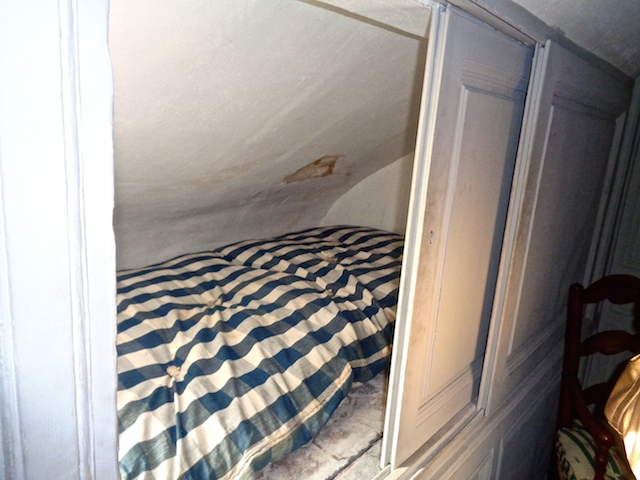
Most apartments consisted of a bedchamber, a cabinet and perhaps a wardrobe. The lucky ones could add a few antechambers or had rather large rooms. In this context, the servants' quarters were in the wardrobe. Today, the word would usually mean a space for storing clothes but the wardrobe - or garderobe - had a wider term in the 18th century. The room was often quite small and used to store a variety of household necessities including clothing, toilet articles and often the chaise percée if it was movable. Likewise, this is where the valet or chambermaid slept, usually on a bed that could be put aside during the day.


Visiting Versailles, private tour, Cubbyhole for sleeping
Photo of a cubbyhole used as a bed for a servant.
Taken by Sally Christie in 2015

Naturally, this also meant that a servant's room was typically incredibly small. For instance, the Duc de Saint-Simon's servant was housed in a tiny room which had such a low ceiling that a man could barely stand upright. While unpleasant it should be kept in mind that the room was not meant for actually living in. The servant would only sleep in the room while the day was spent almost entirely elsewhere. Still, it cannot have been particularly pleasant sleeping in a cramped room with no air circulation or heating.

For those nobles who had managed to get a hold of a particularly spacious apartment, this could be an improvement for their staff as well. In such cases, it was not uncommon for their room to have its own stove for heating but they were then obliged to share.

The natural consequence was that the master and servant lived very close together which came in handy in regards to the service itself but could easily become cramped. The lower ranking servants - such as pages or footmen - were often given field beds which were erected in the antechamber. Every morning they would store these away and go about their duties. Compared to the smaller, inner wardrobes these were at least more spacious. 

Dressing the Ladies: Madame Eloffe

While Rose Bertin has become known to history as Marie Antoinette's unofficial "minister of fashion" she was far from the only one to supply the queen - and her ladies - with finery. The direct rival of Madame Bertin was Adélaide Henriette Damoville better known as Madame Eloffe. She was highly favoured by the queen who often ordered her accessories and trimmings from her. 


Unlike Rose Bertin, her original accounts have survived the revolution. We are therefore able to directly see who ordered what which gives a unique insight into the fashions of the day. For instance, Madame Eloffe was a popular go-to for ladies - including the queen - who wished to have existing dresses altered or repaired. As it happens, such alterations are by far the most common in her accounts. If the ladies did not chose to have Madame Eloffe herself fix their stuff, then they would often order smaller pieces which could be added to existing garments. These are a few chosen examples of deliveries made to ladies of the court.


A black velvet gown sent in for Madame Eloffe to work on for the Duchesse de Fitz-James in the early months of 1787. It had a petticoat of white satin trimmed with sable and cost 50 livres. 

The Marquise de Lostanges ordered what appears to be a grand habit on 18th February 1787. The gown had wide panniers and the fabric chosen was striped with blue, gold and silver. The gown was heavily adorned with embroidery, garlands at the hem of the skirt, two rows of silver tassels, ribbons and "embroidery with stones" - presumably this means gemstones (or replicas) sewn into the garment. With that came quite a deal of lace for the sleeves. The entire ensemble cost the marquise 1.436 livres.

On 11th March 1787, the Marquise de Marconnay was officially presented at court. She had ordered her gown from Madame Eloffe who produced a concoction of silver striped fabric and silver polka dots. While the gown was primarily done in silver fabrics, there were also spots of blue and gold. As could be imagined of a presentation gown, it was elaborately adorned. This included a 5-yard silver braid, gold ears of wheat, Alençon lace, gold garlands and a silver belt trimmed in gold. The entire deal cost 2.019 livres.


A grand habit from 1785

Madame la Duchesse de la Vauguyon had ordered two gowns in the first quarter of 1787. One was robe à l'Anglaise of blue gauze; its petticoat was white with pink and purple ribbons. The other was a lilac gown with silver polka dots and a white petticoat also with silver polka dots. When counting the accessories - which included white feathers - her total was 1.274 livres

When the Vicomtesse de Briqueville was presented at court in September 1787, she wore a white gown with a petticoat of violet gauze. The hem of the skirt was adorned with gold and silver tasseled fringes as well as striped ribbons. The sleeves were done in intricate lace while the gown was heavily embroidered. It cost her 1.428 livres

An English straw hat was ordered for the Comtesse de Bourbon-Busset. She wanted it adorned with satin ribbons of purple with chocolate-coloured dots.

Many court ladies ordered their chemises from Madame Eloffe including Mesdames Adelaide and Victoire and the Comtesses d'Artois and de Provence. These were typically made from linen but had occasionally a touch of lace. Likewise, fichus were a typical order. For instance, the Princesse de Lamballe ordered several of English lace.

1788 Marie Adélaïde de France, fille de Louis XV, dite Madame Adélaïde by Johann Ernst Jules Heinsius (Châteaux de Versailles et de Trianon - Versailles, Île-de-France, France) From the lost gallery's photostream on flickr
Madame Adélaide in 1788

Madame Victoire ordered a new gown for the celebration of the day of Saint-Louis. It was a robe à l'Anglaise in purple English gauze with small, silver polka dots and Alençon lace. The account states that there were "a lot" of lace and ribbons - which is saying something! The king's aunt also ordered a black taffeta coat with English lace at the bottom. This might just have been the type of coat that Mesdames threw over their otherwise deshabillé to go see their father at his debotter earlier in their lives. 

The Duchesse de Narbonne ordered a mantilla shawl of black gauze embroidered with golden sequins. Each end of the shawl had golden braids and black tassels.

Madame Victoire had a dress of striped velvet in the colours blue, pink and white.

The Comtesse de Gand had a purple moire gown with white petticoat altered in the late spring of 1788. It would appear that a part of the skirt was raised slightly into a decorative knot.

While most of the other entries were for outer-garments, the Duchesse de Laval ordered a couple of panniers. One of them was intended for a grand habit and must have been of considerable width. It was covered with white and blue taffeta.

Several coats were ordered by the Comtesse d'Artois of white taffeta trimmed with English gauze. Either the Comtesse was planning ahead or it must have been some light coats because they were ordered in June 1788. A more curious item ordered by her was a wide belt in black velvet. Later in the year, an alteration was done to a robe à la Turque of rose taffeta.

A robe à la Turque

A good example of how gowns were reused is seen in the invoice written for the Comtesse de la Palisse in August 1788. A presentation gown was typically one of the most elaborate gowns a woman would have during her lifetime. For that reason, it is not surprising to see that she had hers altered for the reception of what appears to be an Indian ambassador. 

That very occasion caused several other ladies to rush to Madame Eloffe. One of these was the Comtesse de Pons whose gown was of silver - the entire gown seems to have been of silver fabric. The corset was covered in gemstones and a braid of silver and white bordered the neckline. 

On occasion, the accounts are somewhat vague. For the holiday of Saint-Louis Madame Victoire ordered a "magnificent gown and hat" - no particular description is given for the exact the design but it must have been elaborate as it cost 2.182 livres. Her sister, Madame Adélaide, was not to be outdone and ordered an even more expensive concoction. This one was of green and purple with a large headdress of blue gauze. It set her back just over 3.000 livres.

Friday, 21 May 2021

A New Wife for Louis XV?

While his predecessor, Louis XIV, is believed to have secretly remarried after the death of his wife, Marie Thérèse, the same can not be said for Louis XV.  After the death of Marie Leszczynska on 24 June 1768, the 58-year old king was initially not expected to remarry. He already had plenty of daughters - whose very presence at court strained both the treasury and the number of available apartments - and three male heirs in the form of his three grandsons. Thus, there was no immediate need for the king to take another wife.

However, that notion soon had to be rethought - at least by some courtiers. While his wife was still lingering, the king had been introduced to his last maitresse-en-titre, Madame du Barry. While Madame de Pompadour had been a bourgeoise, du Barry was even lower on the social scale. The daughter of a seamstress, the beautiful young woman had dappled in prostitution - to put it politely. Pompadour had been pushing the envelope but du Barry was simply going too far in the eyes of both his court and his people.

Those who were staunchly against the new favourite sought a way for the king to redeem his reputation. Eventually, they realised that the only way for this to come about was for the king to remarry. Naturally, they had a candidate handy: Archduchess Marie Elisabeth of Austria. She was a daughter of Maria Theresia and Francis I - and sister to Marie Antoinette. There were powerful supporters for this match. Both the Duc de Choiseul (still the most influential minister at court) and the ambassador Mercy-d'Argenteau were busily advocating for the match. Likewise, Mesdames de France urged the king to give France another Queen; and conveniently supported the chosen candidate. According to Hugh Noel, they used Madame de Durfort to deliver their message of support to the king quite bluntly.


Louis XV in 1773

While the two politicians worried about their own positions at court and the international consequences a new mistress - of such base origins, too - could have, the king's daughters were fearful for their father's soul. As he was approaching his sixtieth birthday they thought it better that he focused on his domestic life than cavorting with a du Barry. His daughters were persistent creatures - and they had all the time in the world. Again according to Noel, they managed to extract a promise from their father to sent a proposal to Vienna on the condition that he did not object to her appearance. He did indeed sent Ducrest to Vienna to paint a portrait of the potential bride; in the mean time, the court waited.

Yet, not everyone was pleased with the new scheme. One of the greatest supporters turned into a wavering uncertainty when the Duc de Choiseul was influenced by his formidable sister, the Duchesse de Gramont. Mercy-d'Argenteau certainly laid the lion's share of the blame on that lady's door. He argued in his journal, that the presence of a "judicious and amiable queen" would make the king realise how many abuses were committed in his ministries. Since many of the noble families - including the Choiseuls - took great advantage of these, it had to be prevented. The marriage might still have taken place - there were rumours that a contract of a double alliance had already been drawn up. This would have seen Marie Elisabeth married to Louis XV and Marie Antoinette married to the dauphin.


Marie elizabeth.jpg
Marie Elisabeth of Austria

But then tragedy struck. Marie Elisabeth had long been considered to be the most beautiful of the imperial archduchesses. It was therefore all the more devastating to her that she contracted the dreaded disease smallpox. While she survived, her looks did not. She was hit especially hard and left permanently scarred to such a degree that she was removed completely from the royal European marriage market. Considering that many a king or queen had had to make due with spouses with marks of disease, the archduchess must have been terribly afflicted by the disease.

This presented Louis XV with the very excuse he could use with his daughters. He had only promised to marry her if she was not unobjectionable to look at - now that was out of the question. Instead, the pro-Austrian party had to be content with the union between Louis Auguste and Marie Antoinette. 

As always, it was almost impossible to tell how the king felt about the abandoned project. He never gave any inkling of his private feelings (even Madame de Pompadour had described him as "impenetrable") and it is quite likely that he was willing to enter into another marriage. As for the bride-not-to-be, her feelings were far more easily deduced. Not only had she lost the chance of becoming queen of France, she had lost any opportunity for marrying at all. Reports from contemporary writers suggest that she spent most evenings weeping. It cannot have been easy for her either when her youngest sister departed for France alone a few years later.

Tuesday, 20 April 2021

Film Fashion: Dangerous Liaisons

Based on the novel of the same name by Pierre Choderlos de Laclos which was published in 1782. The novel - and movie - focuses on the diabolical couple of the Marquise de Merteuil and the Vicomte de Valmont whose mind games and utter lack of compassion cast their other companions' lives into turmoil. Eventually, however, the two get what is coming to them.

The movie was released exactly 206 years after the book and features Glenn Close, John Malkovich, Michelle Pfeiffer and Uma Thurman. Although the original book was released in the final decade of the ancien regime but the costumes in the movie points to a somewhat earlier date - most likely in the mid-18th century.

Without a doubt, this movie contains some of the most accurate and beautiful costumes for a movie set in the 18th century.


Marquise de Merteuil

This pink/peach robe à la Française is a perfect example of the sort of fashion, a woman from the aristocracy would wear for a soirée at her own estate. It has just enough of the elaborate decorations - i.e. the bows and the pleated ribbons - but is kept in an overall discreet tone. In comparison, some of the contemporary gowns worn for court were often in bold patterns or brighter colours.


Another costume which corresponds perfectly with the scenario it is intended for. The yellow silk set consists of a caraco jacket and a silk skirt with contrasting gloves, fastenings and hat in black. Notice that the caraco and the skirt are not made of the same fabric - instead they are kept in matching tones.


There is a distinct resemblance between this gown and the turquoise/pink gown worn by Madame de Pompadour in her famous portrait. Another robe à la Française in deep blue silk with pink details and a stunning pearl parure. Like in the pink gown above, the bodice is dominated by three bows increasing in size. The roses on the ribbons are quite an unusual choice but complements the gown very nicely.


Usually, the dressing-scenes of 18th century films shows a chemise and often a rather plain corset. In contrast, the costume department for this movie has applied a sense of realism in the toilette of the Marquise de Merteuil. Notice the pannier which is based on actual, surviving pieces from the 18th century. Likewise, the corset in a bright blue - possibly silk - fabric is not unlike those housed by museums today. Everything in this scene reflects the character's wealth: the three servants helping her get dressed, the lavish amount of lace and the expensive silks.


Compared to the other gowns worn by the Marquise this one is remarkably muted in colour. The white is quite unusual since white gowns would normally be adorned with colourful details such as embroidered flowers or pleated ribbons - or perhaps more bows. This one is rich in adornments but they are kept in either white or champagne and therefore does not provide the usual colour contrast. 


Personally, this is my least favourite of the marquise's costumes but it cannot be denied that it is beautifully executed. The bodice is quite unusual; it does not appear to be a separate piece but simply created by putting a sheer fabric over the fabric beneath and lining the edges with a contrasting green fabric. The bows on the arms are made from the same green fabric.


Vicomte de Valmont

A beautiful example of a male courtier's clothing - lush velvet and very elaborate silver embroideries and buttons. The colour is remarkably hard to discern correctly. On some photos it looks bluish with a purple tone but in others it is clearly dark green. Either way, the coat's colour is accented by the embroidery on the waistcoat.


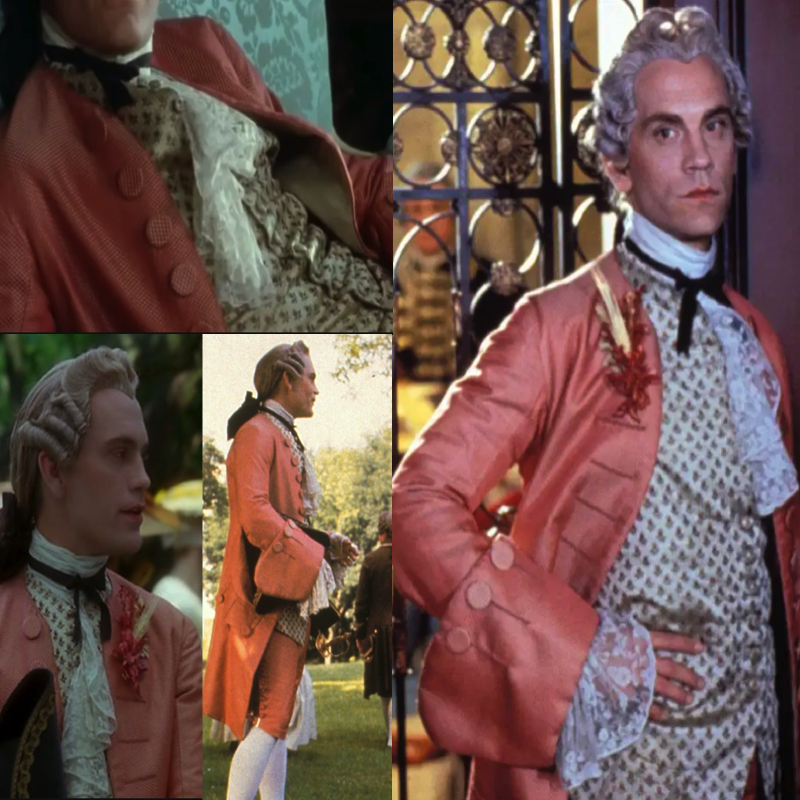
This pink suit matches the colour of the marquise's dressing gown seen in the beginning of the movie almost perfectly. While the coat in itself is rather simple, the waistcoat adds a layer of luxury to the ensemble with its delicate embroidery in what appears to be metallic thread.


The floral pattern is somewhat unusual in that the flowers are quite large. At this point in time, fashion tended more towards smaller flowers - usually done in embroidery. The suit itself is quite dark which is also a tad odd compared to the brighter costumes of the time. However, the scene in which this suit is worn is very melodramatic and as such the costume neatly underlines the atmosphere.


A grey coat with a fine pattern in white and matching breeches. The waistcoat is most likely the same as is worn in the costume beneath. Again, the buttons are quite large and appears even more so when contrasted with the delicate embroidery on the waistcoat and the pattern of the coat.


Another one of the vicomte's suits where the design is focused primarily on the waistcoat and edges of the coat - all of which have been heavily embroidered with golden and champagne-coloured thread.


Cécile de Volanges

Céline's dresses are generally more modest and more neutral in their colours. This particular gown is typical of the type of fabric that became fashionable in the 1770's - particularly the small flowers. This robe à l'Anglaise is really quite simple with no adorned bodice or contrasting petticoat. The only show of extravagance is the layered lace at her elbows.


Another white gown worn by Uma Thurman in her role as Cécile, this one looks like a less elaborate version of the white gown worn by the Marquise de Merteuil - perhaps reference to Cécile coming more and more under the control of the marquise? Of course, the colour symbolism should not be disregarded either; at this point in the movie she is still an innocent, virtuous young lady.


Madame de Tourvel

A rather neutral beige dress with small pink flowers, this gown would be suitable for a woman of her rank: not quite as extravagant as an aristocrat's but suited for the wife of a statesman. While the gown itself does not have the otherwise typical ribbons or bows, the ruffles at the neck provides a modest piece of accessory.


The only one of Madame de Tourvel's gowns to have a more bright colour-scheme, this outfit is also a caraco combined with a contrasting skirt. The pattern on the blue caraco almost looks like chinoiserie which became very popular in the 1770's.


Again, the bodice has been framed with ribbons rather than being its own separate piece of clothing. This robe à la Française is neatly topped off with a straw-hat - also adorned with flowers to match those on the gown itself. Note that pleats hanging from the shoulders.


Others

Madame de Rosemonde (played by Mildred Natwick) wears predominantly dark colours associated with widowhood. As such, her clothing stands in stark contrast to the occasionally very flamboyant colours of her co-stars. It was not unusual for women to discard the lightest colours as they grew older - for instance, Marie Antoinette ceased wearing pink when she turned 30.


The mother of Cécile, Madame de Volanges, wears this bright fuchsia gown with a green petticoat - and an impressive array of pearl jewellery. Note that the bodice has been arranged in a scallop pattern in ruffled ribbons.


Peter Capaldi stars as the valet of the Vicomte de Valmont, Azolan, and as such is primarily seen in his livery. Therefore, it is practical but not entirely devoid of embellishments as this would have been an outward symbol of his employer's wealth.


And finally, Laura Benson portrays Émilie who is one of the vicomte's more mercenary mistresses. She is seen wearing a bright yellow robe à la Française with red bows on her bodice - perhaps it is not a coincidence that the shade of red is exactly that of Azolan's? After all, they are both in the vicomte's pay.


Monday, 12 April 2021

The Colour Palette of Fashion: Black

Unlike other European powers - particularly Spain - black was never truly the colour in French fashion during the 17th and 18th centuries. Instead, the French focused on more colourful ensembles to signify wealth and status. Traditionally, entirely black ensembles were worn for mourning by the French courtiers whereas single articles of clothing could be black if combined with other colours. The Spanish court, in contrast, highly valued somber black outfits and that trend spread to a remarkably wide array of European countries: the Netherlands, England, Denmark, Sweden, Naples etc. Yet, while France stuck to their richer colours that is not to say that they abhorred black or only used it for mourning - rather, it was merely used on a far smaller scale. There was another reason behind the French reluctance to don completely black outfits in the 18th century; traditionally, black had been the colour assigned to the Third Estate in the Estates-General.

Surprisingly enough, black was a particularly difficult colour to achieve which made black clothing quite expensive - especially if the fabrics were valuable in themselves, i.e. silk. The original way to achieve black in Europe was to continually dye a fabric with woad which was otherwise used to get a nice blue tone. Already at that point, the extra labour involved in the dyeing process would have spiked up the prices. 

Caraco 1770-89, Gown late 18th century, suit
1774-89 and suit mid-18th century


These did not fall when a more convenient way of dyeing clothing black was found. The Spanish colonies in South America yielded completely new ways of achieving a more pure black colour - undoubtedly, this was another reason for the Spanish fondness for the shade since it thus displayed their imperial power. With French colonies emerging in the Americas too, logwood became the preferred way of dyeing black.

The introduction of logwood to Europe was an instant hit with the cloth merchants. Logwood is a hardy plant that grows easily and yields a wide variety of dyes besides black: purple, blue, grey.


Lady Frances Courtenay, Marquise of Llano,
Louisa Ulrika of Prussia and Maria Josepha Sobieska


Considering Louis XIV's personal ties with Spain (his wife and mother were both Spaniards and his grandson would become king of Spain) it is hardly surprising that he would often display the colour in his own wardrobe. Notably, he and Philippe d'Orléans took advantage of the dark background to highlight the exquisite diamonds they wore.

Madame de Maintenon also made great use of the darker tones which was quickly followed by other ladies at court. Her predecessor, Madame de Montespan, had worn somewhat richer colours but was noted to have intertwined black ribbons with her curls on several occasions. Armour, too, was often designed to be almost black in colour which contrasted nicely with the intricate details in gold or silver.


Empress Maria Theresia (in mourning), Amalia van
Solms-Braunsfel, (presumed) Count Flaminio Tassi
and Sir Christopher Wren


During the reign of Louis XV there was a general shift from the darker to the lighter colours when it came to fashion. This was largely thanks to the influence of Madame de Pompadour who championed the rococo style. Nevertheless, black still managed to sneak its way into the everyday-life of Versailles. For instance, when it came time for the king's debotter (a brief ceremony when he took off his hunting boots), his daughters, Mesdames, would leave their apartments wearing a black taffeta cloak to conceal the fact that they were basically deshabillé underneath.

In the 1770's and 1780's black was quite fashionable for accessories. For instance, M. de Bouilly noted that Marie Antoinette had worn a pouf of black velvet on the day of his presentation. The death of Louis XV also presented a new opportunity for Rose Bertin to cash in on the royal death. Soon, headdresses with black marigolds or other flowers were seen everywhere.


Jacques François Bégouën, unknown lady, 
Madame de Ventadour and Philippe d'Orléans


Towards the dying years of the French monarchy black was in bad standing; when combined with yellow it represented the imperial house of Austria, the native dynasty of the then-hated Marie Antoinette. It was also seen to be symbolical of the wearer's mourning for the old way of life. Indeed, the records of Rose Bertin shows that after the royal family had been taken to Paris, there was a high demand for black items of clothing. In itself this is rather ironic considering that white was the colour of the French monarchy.

Sunday, 11 April 2021

The Price of Glory: Military Injuries

The vast majority of male aristocrats spent a part of their lives in the king's army; some made it their primary career while others served briefly. The risk attached to that service varied depending on whether France was currently at war. If not, a military service could consist of managing a regiment or a posting to a specific garrison. However, if France was at war the service became far more active - and far more dangerous.

Then, as now, military service inevitably involves the risk of serious personal injury or even death. Naturally, this was the case for the aristocratic sons of France as well although they did not expose themselves to the same amount of danger as the professional soldiers in the front lines. It should be pointed out, though, that in order for a young man to distinguish himself (and potentially be rewarded by the king) he would have to stick his neck out. This would often entail being at the very centre of the action, i.e. by leading cavalry charges.

As could be expected not everyone made it home safe and sound. Some never returned at all while others had to live with the permanent damages. Interestingly enough, the contemporary memoirs rarely mentions such things even when describing men who had spent their entire lives in the army. One exception is the memoir of the Marquis de Dangeau but there was a very clear reason for this: the injured was his own son.


Philippe de Courcillon was 22 years old when he was serving at the Battle of Malplaquet on 11 September 1709. During the battle, the young man was injured in the leg and the wound proved very serious; so serious that the doctors on hand decided to amputate his leg. His father, the famed memoirist, mentions that the amputation had been performed on the thigh. Philippe was sent back to Versailles where the king was kind enough to lend him his personal surgeon, M. Marèchal (his name, not to be confused with the title). The days that it took to bring Philippe back to court had left his wound in a terrible state. 

The surgeon found the patient in such imminent danger that he decided to remove more of the thighbone. The concerned father explained that the surgeon's decision was because the wound had begun to fester and the skin had regrown "too quickly". One can only imagine the pain that Philippe must have been in. Almost miraculously he survived the second operation as well. However, it cannot be ruled out that the trauma had caused irreparable damage to Philippe's body and mind. He died ten years later, at just 32 years of age.


Also at Malplaquet was Pierre Montesquiou d'Artagnan, Comte d'Artagnan, who commanded the right flank of the French forces. As he led his forces, the Comte d'Artagnan (whose name would be immortalised in "The Three Musketeers" by Alexandre Dumas) was a prime target for musket shots. During the battle three horses were shot from under him and he himself did not go completely unscathed: after the battle, four dents from bullets were found on his cuirass protecting his chest. He was wounded, presumably by just such a musket shot.

Pierre de Montesquiou d'Artagnan
Comte d'Artagnan


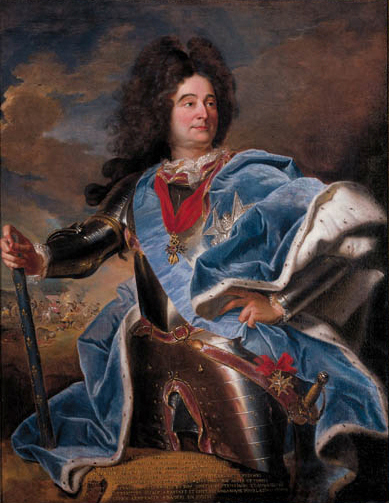
Of all the men who were wounded at Malplaquet, one of the most distinguished was Claude Louis Hector de Villars, Duc de Villars. Like the Comte d'Artagnan, he was the victim of a musket shot which hit him in the knee. Despite his obviously painful injury, the newly-created Marèchal de France insisted on remaining with his troops and continued giving orders from a litter until he finally fainted. He was then carried back to the French camp. The incident is referred to in his private memoirs. He mentions that he had his wounds dressed "at once" - he also attest to the immense amount of pain he must have been in by writing that once he was insensible he was carried all the way back to Quesnoy without his knowing it. 

It is not surprising that the Marèchal de Villars was a popular man with his troops. Besides this fervent devotion to duty, he had voluntarily made do with the decreased rations of the common soldiery after the disastrous winter of 1709.


Marèchal de Villars


A few decades later, Louis de Brienne de Conflans, Marquis d'Armentières, found himself at the battlefield of Guastalla during the War of the Polish Succession. There, he served under the Marèchal de Coigny when the battle commenced on 19 September 1734. At the time, Louis was 23 years old and had commanded his own regiment since the age of 16. During the battle Louis was wounded by a musket shot which hit him in the neck. Remarkably, Louis survived but he must have had a visible scar which he carried until his death in 1774.


The Battle of Fontenoy was the greatest military triumph of Louis XV's reign but it saw its fair share of death and injury as well. One who experienced just than on his own body was Marc-René de Voyer de Paulmy d'Argenson, marquis de Voyer and son of the Minister for War. Marc-René was Mestre de Camp of the Berry-regiment which meant that he led the charge against an English detachment. In some manner, he appears to have been knocked unconscious and was dragged back behind French lines. For two hours, he remained unresponsive and was generally believed to be dead. It is not unlikely that he suffered at least a concussion and appears to have made a full recovery. 

Marc-René was wounded again, 13 years later when he partook in the Battle of Crefeld. However, this particular injury is unspecified and does not appear to have been serious either. 


File:Battle of Fontenoy 1745.PNG
The Battle of Fontenoy


One man who did not sustain his wound on European soil was a man with an impressive amount of first-names: Jean Baptiste Charles Henri Hector d'Estaing, more commonly referred to as the Comte d'Estaing. He offered his services when France (once again) went head-to-head with England in India. The Comte d'Estaing was posted to the siege of Madras in December 1758. During a minor battle between French and English troops, the Comte d'Estaing found himself in a very unfortunate situation when he was unhorsed by the English troops. Nevertheless, he continued to fight until he was stabbed twice with a bayonet. Only then did he formally surrender.

Rather than shipping him the long way back to France, he was taken into the very city that he was besieging. His wounds were treated but cannot have been particularly bad since he was soon negotiating with the English governor. He was given the opportunity to be released on parole but initially preferred to be kept until an exchange of prisoners could take place - this would also allow him to resume fighting. It was not until the arrival of the English fleet at Madras that the Comte accepted his situation and agreed to the parole. The consequence was that he would only be released - unmolested - if he refrained from further action against the English. 


Noël de Jourda de Vaux, comte de Vaux, maréchal de France (1705-1788).jpg
Comte de Vaux - wounded five times during his career

By the end of his career, Noël Jourda de Vaux, Comte de Vaux, had participated in five major battles, thirty sieges and earned the esteem of two Marèchaux de France: de Broglie and de Saxe.

The Comte de Vaux was wounded no less than five times. In and of itself, such a number might not seem terribly high but considering the non-existing hygiene and dubious medical practices, this is quite impressive. He sustained his first two wounds in the battles of Parma and Guastalla while serving as a captain in 1734. Five years later, he found himself once again engaged on Italian soil - more precisely at Corte. While holding his post in a monastery, he and his troops were set upon by about 2.000 Corsicans. At a disadvantage, he was wounded twice but the French soldiers managed to drive the Corsicans out which left an opportunity for medical treatment. 

His final wound is the only one we know the origin of. At the siege of Bergen-op-Zoom, his division was deployed to the village of Vouet. It was here that an enemy force of 10.000 men descended upon the French soldiers who had to retreat. During the battle, a shell exploded near the Comte which caused his final battle scar.