Monday, 29 November 2021

What Happened to the Children of Louis XIV and Marie Thérèse?

Louis XIV married the Spanish Infanta Marie Thérèse in 1660 and their marriage was shortly followed by the announcement that the queen was with child. She went into labour on 1 November 1661 and gave birth to a healthy son - the much-desired heir of the young French monarch. So far, their union had been ideal - a harmonious marriage which had quickly resulted in a son and heir. But the young infant - named Louis for his father and grandfather - would be the last child of the couple to survive infancy. He would be followed by five siblings; all of whom would be buried at a very young age.

Marie Thérèse was soon pregnant again and hopes rose that she would give France another prince. Instead, she gave birth to a girl on 18 November 1662 and the child was named Anne Élisabeth. Around Christmas, the young princess suddenly fell seriously ill. The doctors noted that she suffered from a "chest infection" - sadly, due to the disparages between modern and 17th century medicine, there is no set definition for exactly what was meant by this diagnosis in modern medical terms. It has been suggested that she potentially caught a type of pneumonia. She died on 30 December 1662. The following day, her heart (as per custom) was taken to Saint-Denis by her grand-mother, Anne of Austria. 

In eerily similar circumstances to their first daughter's short life, Marie Thérèse went into labour almost on the very same day; this time, the queen's pains began on 16 November 1664. Her efforts resulted in another girl who was given the names Marie Anne. Much like her sister, Marie Anne would not live for long. She died on 26 December 1664. Unlike her siblings, there appear to have been no given explanation for her untimely death.


Fil:Queen Marie Thérèse and her son the Dauphin of France, dated circa 1663 by Charles Beaubrun.jpg
Marie Thérèse and her son, Louis -
ca 1663


One could easily understand that the couple would wait a few years before attempting to conceive a fourth child. It was not until 2 January 1667 that Marie Thérèse went into labour for the fourth time - much to the irritation of her contemporaries, the queen gave birth to a third daughter in a row. The infant was named after its august mother: Marie Thérèse. For a while, the young girl seemed to outdo her sisters in strength. She passed the ominous one month, then two months - eventually she had passed an entire year. By this time she was referred to as Madame Royale or La Petite Madame.

She was absolutely adored by her parents who had her painted despite her young age. Her mother were already eagerly arranging for a prestigious match - preferably with a Spanish prince. Sadly, at the age of 5, when the family was at Château Neuf at Saint-Germain, Marie Thérèse fell seriously ill. As with her siblings there has been some speculation as to what ailed the little princess. Elizabeth Lurgo (author of Marie-Louise d'Orléans) assert that Madame Royale suffered from acute tuberculosis. Through the memoirs of Madame (Elizabeth Charlotte of the Palatinate) we are led to believe that the doctors had performed a procedure on the child. More specifically, Madame recalls that they had performed a "cautery" on the nape of her neck which had "drawn her mouth all to one side" - exactly in connection to what the doctors had seen fit to cauterize her neck is not mentioned. Madame does say that shortly before she died her mouth resumed its normal position. 

The young princess was cared for by her own parents and several other courtiers whose names are known to history; including those of Mesdames de La Vallière and de Montespan. Both of the king's mistresses were noted as caring for the child as she lay in her bed.

Exactly what she suffered from is - and will probably remain - unknown. What is certain is that the young Marie Thérèse succumbed to her illness. She died on 1 March 1672.

Her father was said to be completely distraught and could not stop weeping. Meanwhile, her mother had not been allowed to be present at the moment of death, as she was pregnant again - it was thought that the shock might endanger the new baby.


Marie Thérèse de France, Madame Royale by Jean Nocret (Museo del Prado).jpg
Marie Thérèse with a lemon - she looks 
remarkably like her mother in this portrait


Louis XIV was given the news that his wife was pregnant again in 1668. This time, the queen gave birth to a boy. He arrived on 5 August 1668 and was promptly named Philippe Charles. As was customary for young male heirs, he was immediately given a title. Thus, Philippe Charles became known as the Duc d'Anjou. Particularly the child's mother had plans for his future; she was noted as having approached La Grande Mademoiselle with less-than-subtle suggestions that she should leave her immense fortune to Philippe Charles. Understandably, La Grande Mademoiselle found the hint somewhat distasteful. However, they would not have to bicker over it for long.

The couple were again staying at the Château de Saint-Germain-en-Laye when the young prince became seriously ill. To the horror of his parents, he seemed to be suffering from a similar chest infection to Anne Élisabeth. On 10 July 1671, the young Duc d'Anjou followed his three sisters to the grave.

It would appear that the king was not with his son when he died as the Abbé Bousset was charged with informing the king of his death. Louis took refuge - with his court - at the nearby Château de Maisons.


Marie Thérèse would conceive her final child in the late autumn of 1671; on 14 June 1672 she gave birth to a boy: Louis François. He was given the same title as his older brother whose death had preceded his own birth by 11 months. Thus, Louis François became the Duc d'Anjou and would be baptized on 1 November. Sadly, he would not live to see his first birthday - he died on 4 November 1672 at Saint-Germain-en-Laye.

Because Louis François had died so young, there are no portraits of him. Like his sister, Marie Anne, there are no available explanation for his death. By this time, tongues at court were wagging and the deaths of the king's children were seen by some as divine punishment for the king's incessant infidelities.


Detail of a family portrait from 1670 with nearly all their 
children: 1) Louis, le Grand Dauphin, 2) Philippe Charles,
3) Marie Thérèse, Madame Royale, 4) Anne Élisabeth and
5) Marie Anne

The couple never had more children nor did Marie Thérèse conceive again. Upon the birth of their last son, Marie Thérèse was 34 years old. While this is not an age that excludes pregnancy by any means, it should not be ignored that the royal couple had suffered immense heartbreak over the last decade. They had had the euphoria of welcoming six children into the world - and the heartbreak of burying five of them.

There are several factors that must be considered when posing the question: what happened to the royal children? First, child mortality was rampant in the 17th century. For once, this was an aspect of life in which rich and poor were very similar. While the numbers for the 17th century are murky at best, we do know that 18th century France had an infant mortality rate of one in three. As such, it was hardly surprising that Louis and Marie Thérèse were almost bound to lose a child. Still, the fact that the couple lost five out of six children far surpasses the 1/3 rate. 

Naturally, it cannot be ruled out that the very place of privilege enjoyed by the young children did little to aid their chances of surviving infancy. As any other child of their time they were at risk of catching a myriad of deadly diseases and the doctors had no vaccines. In reality, even the "cures" used by the leading medical men of the day would be just as likely to further weaken the patient than to restore them - especially if the patient was an exhausted infant.

It is interesting that three of the children died while staying at the same place: Saint-Germain-en-Laye, the birthplace of their father. Located near the river Seine, Louis XIV had Le Nôtre rebuilt the gardens with all the marvels of a baroque garden which included fountains and other waterworks - perhaps the presence of so much water made the place susceptible to diseases such as pneumonia? One can only speculate.


The Grand Dauphin as a child


Finally, there is one aspect that should not be ignored. Louis and Marie Thérèse were first cousins. A study by H. Delacour, F. Ceppa and P. Burnat ("Louis XIV et Marie-Thérèse d'Autriche: un couple à travers le prisme de la génétique") looked into exactly whether this close familial connection had an impact on the remarkably high child mortality of the couple. The authors examined the remains of the sole surviving child of the couple: the Grand Dauphin. The result was quite as could be expected: the Grand Dauphin were far more inbred than the king's other children by his mistresses. This meant that he was more vulnerable to the physical and mental disabilities brought on by inbreeding - he was also more likely to have genetic diseases. 

It therefore seems likely that the rampant infant mortality combined with a high degree of inbreeding had a direct impact on the offspring of the Sun King and his wife. Considering that Madame Royale would have been married off to a Spanish prince, had she lived through childhood, it is all too easy to imagine how this tragic circle could have continued for generations.

Thursday, 25 November 2021

Court Artefacts: Scientific Instruments

The Dauphin's Globe(s)
Louis XVI commissioned this extraordinary globe in 1786; it was meant to serve his son, the dauphin Louis Joseph, for his geography lesson. The globe is supported by three dolphins and is actually two globes in one: a terrestrial and a celestial. It was made by Edmé Mentelle (geographer) in collaboration with Jean-Tobie Mercklein (mechanic), painted by François Vernet and finally gilded by Jean-Nicolas Gardeur. The inner globe shows the raised land borders and sea ridges in relief. Furthermore, there is another interesting feature: the upper part of the outer globe is Old World while the lower part is the New World.


Court Artefacts: Miscellaneous

Louis XVI used this notecase for his secret correspondence with Beaumarchais. The case is made from red leather and decorated with golden details; the interior is lined with green silk. Due to the confidential contents, the notecase was protected by a lock which required a password to open it - that password was "A LOUIS" or "To Louis". The six metal disks would have to be aligned correctly to open it - much like a safe. The case was sold by the auction house Thierry de Maigret who appraised to to between 15.000-20.000 euros - however, it ended up selling for 110.000 euros.


Sunday, 21 November 2021

Marie Antoinette's Diamond Bracelets

On 9 November 2021, the auction house Christies sold a remarkable pair of diamond bracelets. Christies have sold hundreds of pristine pieces of jewllery over the years but these bracelets are spectacular due to two particular factors. First, the diamonds themselves are stunning. Secondly, they belonged to Marie Antoinette.

Once imprisoned during the French Revolution, the royal family attempted to hide or smuggle out their precious jewellery collections. Marie Antoinette took it upon herself to carefully wrap her jewels in cotton to protect them. Those jewels of the ci-devant queen that did manage to survive the revolution were often broken up - and on occasion sold separately - and thus no longer represent their original shape. That is where these bracelets stand out: they have remained largely intact in more than two centuries.


Photo from Christies' website

Marie Antoinette ordered the bracelets in 1776 for a staggering 250.000 livres; a sum that she would struggle to pay and would eventually turn to her husband, Louis XVI, for help. From the king's meticulous private expenditure book we find several entries of interest. On 18 February 1777, he noted: 

"Paid the Queen, on account of the 162.600 livres which she owes Boehmer for diamond bracelets, 24.000 livres"

Boehmer was the man who created and sold the bracelets to the queen. He was also the man behind the infamous Diamond Necklace which brought the queen's reputation to an all-time low after she was erroneously accused of having attempted to purchase it.


Detail of Wertmuller's portrait
showing the chatelaine

News of the extravagant purchase was immediately spread throughout Europe. One key source were the foreign ambassadors, including the Austrian Comte de Mercy d'Argenteau. It was he who informed Maria Theresia, the queen's mother, which he did on 16 July 1776 in a private letter. In this letter, the ambassador report that the bracelets cost nearly 300.000 livres; he also mentioned that the queen had had to give several of her own diamonds in trade which the jewellers appraised unreasonably low. As so often before, the Austrian Empress had a stern opinion on the matter which she certainly did not attempt to hide in her letter of 2 September 1776. In this written reproach, the mother lecture her daughter that she has "unsettled her finances" by such a lavish purchase. To the rather frugal Empress, such an expense was nothing less but "humiliating", as she made sure to inform her daughter. 


Marie Antoinette is portrayed wearing her bracelets in the portrait of 1785 by Wertmuller. Enjoying a walk with her two children near the Petit Trianon, the queen is adorned with a chatelaine made up of two large diamond bracelets - the very ones purchased in 1776.

The bracelets are made up of 56 large, round diamonds each - four of which are mounted on the clasp while the three at the very centre are larger than the rest. This amounts to a total of 112 diamonds of 140-150 carats.


Marie Thérèse wearing the 
bracelets in 1816

During her imprisonment, Marie Antoinette managed to successfully smuggle out the bracelets. In a twist of fate, the very man she sent these - and other - jewels to were none other than the Comte de Mercy d'Argenteau who stored them in Brussels for a few years. They were then sent to the court of Vienna where they would be handed over to her daughter, Marie Thérèse - the only surviving member of the inner royal family. She would be painted wearing one of them in 1816.

From then, they would remain in the possession of her family until they were finally sold for 7.117.308 euros or 5.974.993 pounds.

Tuesday, 16 November 2021

Auctioning the Past: A Court Collection

As one of the biggest and most sophisticated auction houses, Christies has had its fair share of auctions dealing with the remains of Versailles. One particular such took place on 16 April 2012 during which several pieces of art of the French royal family was sold.


A descriptive volume
A different sort of remnant of the court was this book from 1740. It is a detailed account of the wedding and subsequent celebrations held in honour of Madame Louise Élisabeth's wedding to Don Felipe of Parma. Madame Louise Élisabeth was the eldest daughter of Louis XV - and the only one to marry. Such volumes were nothing new; during the reign of Louis XIV, publications would detail any larger royal festivities - particularly after the court moved out of Paris.


Presumed to be Madame Adélaide
This portrait - which fetched 21.250 euros - is presumed to be of Madame Adélaide, the fourth daughter of Louis XV. It is the work of Louis Dupont. If you think the style is very similar to court favourite Nattier, then you are correct. Dupont was a protégé of the archbishop of Bayeux (a member of the Luynes-family) who paid for him to study under Nattier.


Travelling trunks 
Travel trunk in red leather with the coat-of-arms of Marie Thérèse of Savoy, Comtesse d'Artois. When the court travelled from residence to residence, the royal family often transported their personal belongings in trunks such as these.


A similar item is the travelling trunk below which belonged to one of Mesdames, the daughters of Louis XV. It is hazarded that this particularly trunk was used to store items of clothing in - possibly for Madame Adélaide. 

Madame Élisabeth and the Dauphin
Madame Élisabeth, sister of Louis XVI, is portrayed in a park next to her nephew, the Dauphin. The watercolour sketch is by Antoine-Louis-François Sergent-Marceau who completed it in 1786; in a rather disturbing turn of events, four years later he would join the revolutionaries and later still, partake in the September Massacres of 1793. Just eight years after he painted this sketch both of the sitters were dead - the young dauphin of illness in 1789 and Madame Élisabeth by guillotine in 1794.


The young Comte de Provence
Presumed to be a portrait of the Comte de Provence as a child, this portrait was painted by an unnamed member of Louis Tocque's entourage. The orders and the blue sash worn by the young boy clearly denotes his royal status.


The king's case
This case in red leather has two interlaced L's underneath a crown - it is therefore likely that they belonged to Louis XV himself. It looks remarkably much like the travel trunks and might have been used for storing smaller bowls when the king was on the move - which was very frequently. Within the case are two smaller compartments; the key also bears the French coat-of-arms.


An ill-fated child
Another presumed portrait, this one shows the young Duc de Bourgogne. As the eldest son of Louis Ferdinand and Marie Josèphe de Saxe, he was to have inherited the title of dauphin after his father. Unfortunately, he died at the age of just 10 years - this portrait is presumably painted when he was seven years old by Louis Dupont. Upon his - and his father's - premature death, the throne went to his younger brother: Louis XVI.


Courtly nécessaire
This toilet nécessaire is marked with the arms of the Marquis and Marquise de Guesnon. It contains ten glass bottles and several small pots of Sèvres porcelain. The styling of the box is very in tune with the passion for Far Eastern influences. It is estimated to have been made between 1774-80 which places it in the beginning of the reign of Louis XVI. We know from the Almanach de la Cour that Jean Blaise Guesnon died in 1784 and had previously been employed in the king's household.


Portrait of a favourite
The Princesse de Lamballe is depicted by Marie-Victoire Lemoine in this portrait from 1779. At this point, Madame de Lamballe was recognised as part of Marie Antoinette inner circle; despite her young age, the Princesse was a widow and extremely wealthy. At court, she held the impressive position of Surintendante of the Queen's household - the highest position available to a woman at court.


Madame Élisabeth's chair
Fetching a staggering 109.000 euros, this single chair was commissioned by Madame Élisabeth for her apartment at Compiègne. It was delivered to her at an unknown date but duly stamped with its provenance.


The queen seated
A little known portrait of Marie Antoinette, seated on a sofa, was sold for 18.750 euros. It is attributed to Louis-Charles Gauthier d'Agoty. The sellers (the Comte and Comtesse Niel) claims that Élisabeth Vigée Le Brun painted it by memory in 1796 - three years after the queen's execution. It was later given to the Duchesse d'Angoulême - better known as Madame Royale, Marie Antoinette's daughter.


And a loyal friend
This incredibly smug-looking dog is said to be no other than the famous Mimi, favourite companion of Madame de Pompadour. It is said to be by Fragonard who made it in 1754 for the Marquis de Marigny, brother of the royal favourite. It would seem that the beloved pet has been given its very own pearl for its pink ribbon.


Saturday, 30 October 2021

Portrait Gallery: Marie Thérèse Raphaëlle, Dauphine of France

Born as the daughter of Philip V of Spain and his consort, Elisabeth Farnese, Marie Thérèse Raphaëlle was married to Louis Ferdinand de Bourbon, Dauphin of France. Their marriage took place in 1745 as a part of the reconciliation between France and Spain made necessary by the abrupt return of Infanta Marie Anne Victoire to Spain. She was initially meant to have been the wife of Louis XV but her young age and the king's dire need for an heir resulted in the betrothal being broken up. Now, some twenty years later, the two families reunited with the marriage of Louis and Marie Thérèse Raphaëlle.

While this union proved remarkably happy, it would also prove to be very short. Finding herself to be pregnant, Marie Thérèse went into labour on 22 July 1746. Sadly, she would not survive the delivery and died at the age of 20.


1) Portrait of Marie Thérèse Raphaëlle a year before her death but after her wedding to Louis Ferdinand, that is in 1745. The portrait was painted by Daniel Klein the Younger.

2) Louis-Michel van Loo painted the young dauphine in 1745 in a white silk robe volante.

3) This portrait by Jacobo Amigoni shows Marie Thérèse Raphaëlle in a far simpler attire than the other two. Rather than the heavy diamond jewellery, the dauphine is adorned simply with a flower in her hair and a pearl earring.


4) Painted between 1729-1733 shows a very young Marie by Jean Ranc. Given that she was born in 1726, she would be between 3 and 6 years old here.

5) Another portrait by Louis-Michel van Loo, although this particular portrait is of an unknown date. Still, given the obviously young age of the sitter, it was likely painted while she was still in Spain.

6) While the exact time of this portrait is unknown there are several clues in the portrait itself. An ermine-trimmed cape with golden fleur-de-lis is draped over Marie Thérèse Raphaëlle's shoulder and she has a portrait of her husband in her bracelet - hence the portrait must have been painted after her wedding. This limits the time frame to 1745-46.


7) Yet another piece of work by van Loo, this is a very good example of an official state portrait. Decked out in fine jewels and once again draped in her adopted country's fleur-de-lis, Marie Thérèse Raphaëlle is otherwise dressed in heavy brocaded silk.

8) Jacopo Amigoni returned to depict the dauphine once again and repeated his remarkably simplistic style. The portrait is presumed to be of Marie Thérèse Raphaëlle and does have some similarities, notably the long, slim nose.

9) Louis Tocqué is behind this second version of a state portrait. Compared to the one by van Loo, Marie is depicted as having a wider face than in her other portraits.


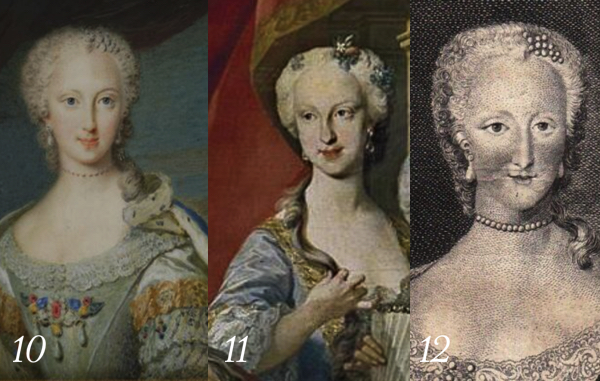
10) This miniature was painted in 1744 after the style of van Loo but not by that artist himself. The portrait was likely made in connection with the betrothal of the young couple.

11) Detail of family portrait done in 1743. Marie Thérèse Raphaëlle was depicted next to her younger sister, Maria Antonia Fernanda. Louis-Michel van Loo was also behind this particular image.

12) Engraving of the short-lived dauphine which appears to have been made from the same sketch as the miniature in number 10 - but was likely drawn by another artist as the features are slightly different.

Tuesday, 26 October 2021

Portrait Gallery: Marie Antoinette: Archduchess & Dauphine

October 16th, marked the 227th anniversary of the execution of Marie Antoinette. In honour of her memory, this post focuses on the portraits of the ill-fated young woman who would one day become queen of France - and end her days on the scaffold.

Marie Antoinette was born on 2 November 1755 and became Dauphine of France upon her marriage to Louis Auguste on 16 May 1770. When negotiating her marriage, one of her strongest, physical characteristics was her flawless skin - described as a perfect mixture of milk and roses. Finally, she would ascend the throne on 10 May 1774. 


The Archduchess (1755-1769)


1) The very first image of the new-born girl whose life would end so tragically - the artist behind it is unknown but the large eyes are remarkably similar to later portraits of her.

2) One of the lesser known portraits of the very young Marie Antoinette, this aquarelle was the work of Johann Christoph von Reinsperger. 

3) The 7-year old archduchess was painted in this blue gown with pink/blue bows and pearly white laces by Jean-Étienne Liotard in 1762. The portrait clearly shows her remarkably slim waist - even for a child of her age. It would be that very waist that would make her unwilling to wear the rigid French corsets demanded by court etiquette at Versailles.


4) Liotard had a busy year in 1762 with the imperial Austrian family. Besides the first portrait mentioned, he made an entire series of the numerous children of Maria Theresia. This particular one shows Maria Antonia and looks remarkably different to the one he made of her earlier that year.

5) A sisterly portrait depicting Marie Antoinette (aged 8-9 and wearing pink) with her sister Marie Caroline (cut out, but wearing blue). The two were good friends despite their different natures - whereas the young Antonia was pliable and amiable, Carolina was far more headstrong and independent.

6) The imperial family of Austria was depicted by Martin van Meytens in 1764-65. As one of the youngest children, Antonia can be spotted almost in the background. The portrait above is a detail of the complete painting.


7) The style of this portrait by an anonymous artist is very different than any of the other portraits made of the young archduchess. Dating back to 1767, Marie was 12 years old when she was painted in this electric blue gown. 

8) One of the most famous portraits of the young Marie Antoinette, this one was also painted in 1767. It has generally been attributed to the court painter Martin van Meytens. However, despite being widely associated with Antoinette, the portrait has been the focus of some speculation. Some point out that it looks remarkably much like one of her sisters, particularly Maria Carolina.

9) Dressed up in suitably French fashion, this was the portrait sent to Louis Auguste in 1769, to give him a likeness of the girl who was to become his wife. It was painted by Joseph Ducreux.


10) For some reason, Marie Antoinette was often depicted wearing deep blue while still living at the Viennese court. This particular portrait was finished in 1769 by Franz Xavier Wagenschön and shows the young girl occupied with one of her favourite pastimes: music. This would be one of her last portraits painted as an Austrian archduchess as she would be married shortly afterwards. 

11) Another portrait by Ducreux, the young woman looks almost like a doll with her perfect porcelain skin and large, blue eyes. 

12) A slightly earlier portrait of the archduchess by Joseph Hauzinger who painted Marie in around 1765. Note how different the style of gown is to her French counterparts - it is far more simplistic in the skirt itself.

The Dauphine (1770- May 1774)


13) Joseph Ducreux would return to paint the new dauphine in 1770, shortly after her wedding. The result was the charming portrait of a young, refined girl in delicate pink ruffles. The royal ermine has discreetly been draped over her shoulder and the golden fleur-de-lis can just be spotted over the other - clearly marking her new allegiance. 

14) The inspiration for this portrait was the one above - hence the very similar facial expression and pose. The painter was Jean-Baptiste Charpentier the Elder who completed the portrait in 1770.

15) A far more masculine portrait is this by Joseph Kranzinger who painted the dauphine in 1772. Marie Antoinette wore a riding habit of red velvet and a black tricorne hat - the female riding habits of the time were basically male attire slightly altered to fit the female body. When she arrived at Versailles, Marie Antoinette did not know how to ride which proved an obstacle in her marriage and her position at court. The French court had always had a lasting love affair with hunting and her new husband was an ardent hunter himself. Thus, in an effort to get closer to him, the young dauphine learned to ride and sent this portrait to her mother.


16) Back in far more regal attire, this 1773 portrait by Drouais shows a young woman impeccably dressed according to French fashion: high, sleek hair, diamond-encrusted choker and intricate silk gown. The luxury is not a coincidence, as she is dressed in full court costume or grand habit. Later, this would be used as a reference for a tapestry made at Gobelins in 1775. The portrait is currently in the Victoria and Albert Museum.

17) Painted at the age of 16 by Joseph Kreutzinger in 1771. It is far more ethereal than the other portraits and she seems almost ghostly. Rather interestingly, at Versailles, Marie Antoinette was dressed far more in shades of pink than in the blue of her childhood.

18) Another portrait by Drouais, this one is of the very popular allegorical type. For centuries, the kings of France (and elsewhere) had themselves painted as various deities - this particular time, Marie Antoinette is Hebe, the goddess of youth. It was commissioned by Louis XV in 1772 and marked for his study at Chantilly alongside a portrait of the Comtesse de Provence as the goddess Diana. It remained there until the revolution.