Wednesday, 12 June 2013

Louis Philippe Staircase

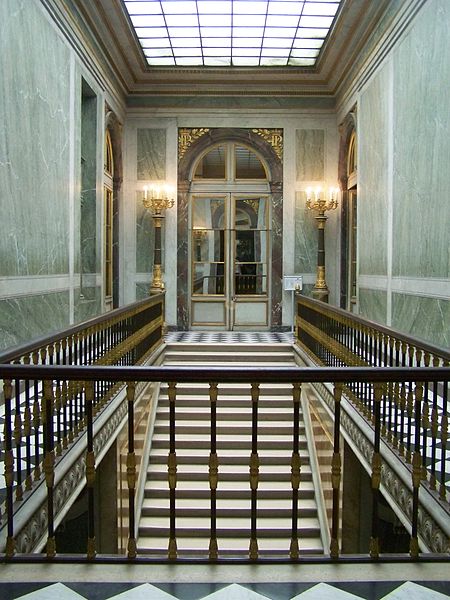
The Louis Philippe Staircase is of a simple construction compared to other staircases that can be found in the palace. The floor's pattern changes between black and white square tiles; this pattern is continued on both levels of the staircase. The surrounding walls are made of green and grey marble. It has been named after Louis Philippe who became King of the French in 1830 with the restoration of the Bourbon monarchy. The sky-light lets in light through most of the day; otherwise there are the two standing candlesticks.


View from the bottom of the staircase

Monsieur le Lapin

It was not always the royal family or the royal favourite's that were the victims of the wide-spread caricatures. The remarkably well-dressed rabbit is a caricature of the Marquis de Boissy and du Coudray who was infamous for his greedy nature as well as his large fortune. The reference to a rabbit is based on a legend that the Marquis - in a desperate attempt at saving money - sat on top of his suitcases so that he did not have to pay for an extra piece of luggage (the stagecoach can be seen in the background). In French this "manoeuvre" was called monter en lapin - lapin meaning rabbit.

Tuesday, 11 June 2013

The Death of the Lost King of France

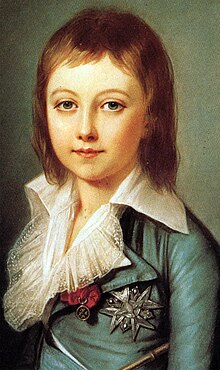
Louis Charles (the second son of Louis XVI and Marie Antoinette) had followed his parents when they were taken from Versailles to Paris by an angry mob in October 1789. When Louis XVI was executed on January 21, 1793, Louis Charles had become King Louis XVII automatically. At this time he was just eight years old. So far the little boy had stayed from his mother and his aunt but this was to change.

Louis Charles in 1792
On July 3, 1793 Louis Charles was suddenly removed from his mother and taken to a windowless room in the Temple prison. Antoine Simon was appointed care-taker of the precious prisoner. Antoine Simon was determined to raise the child in such a manner that he would forget his royal inheritance and in this way not want to take the throne. During his imprisonment the little King was pressured on several occasions until he finally told his interrogators what they wanted to hear: that his mother, Marie Antoinette, had molested him sexually. These accusations were used against the dethroned Queen at her trial - of course the accusations were not true. But his mother was send to the guillotine nonetheless and Louis Charles had become an orphan.

His prison cell (still barricaded) was filthy and as a consequence hereof Louis Charles fell ill. Louis Charles was alone for most of the time until a man with the name of Barras entered the cell on July 27, 1794. Barras would report that he had found the child severely neglected but Louis Charles himself never said anything about his treatment; it is quite possible that he was too afraid to do so. In 1795 (on June 8) he died of tuberculosis - alone in his dark cell.When the Bourbon dynasty was restored a lot of the documents of the Temple prison was destroyed which mean that we have very little written evidence of what actually happened to Louis Charles while he was imprisoned on his own.
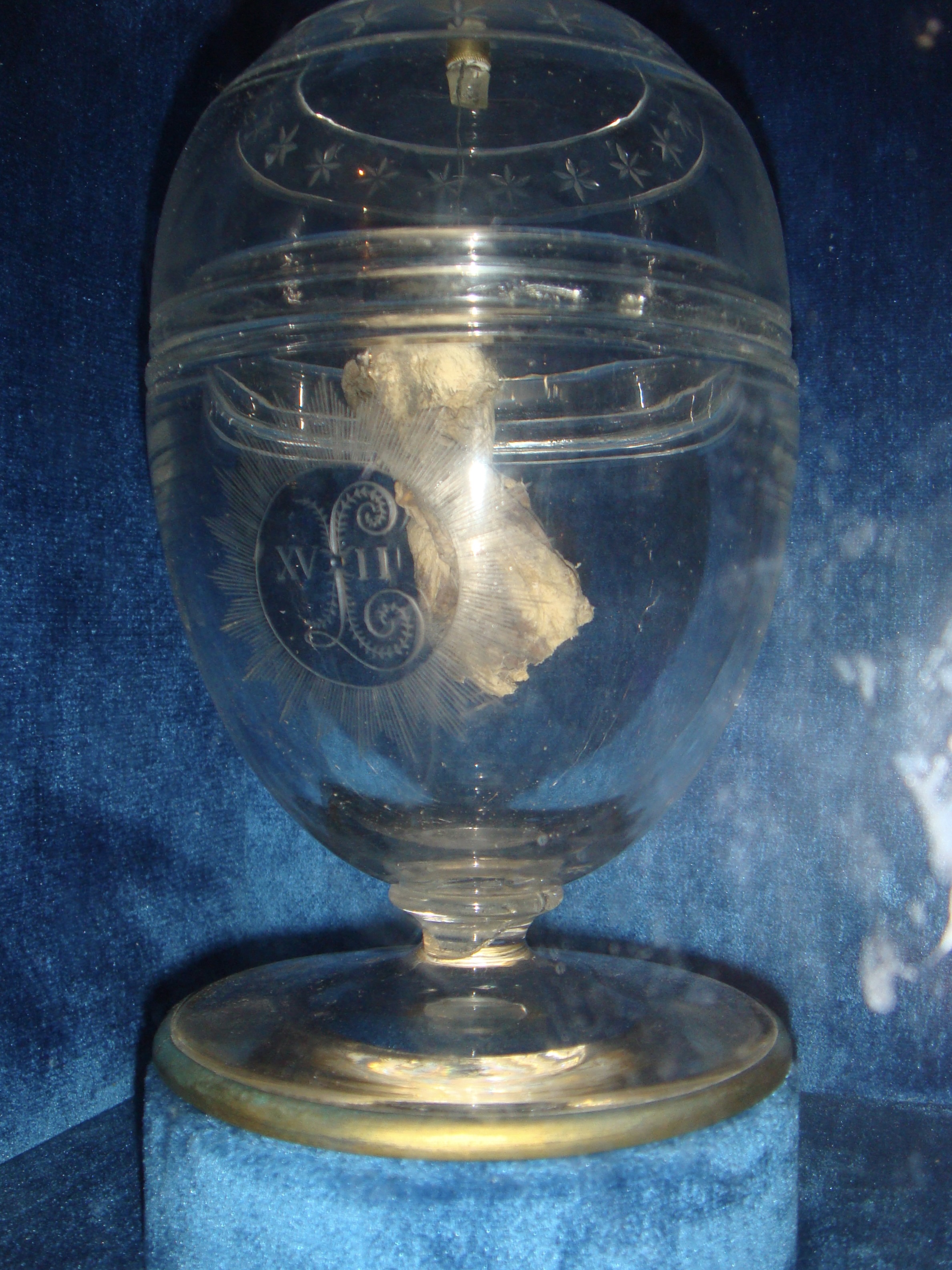
Originally, the body of the ten-year old King of France was buried in the cemetery of Ste. Marguerite. Recent research has revealed that the little boy who was reburied in Saint-Denis was indeed the son of Marie Antoinette; the identification was made with DNA from the child's heart.

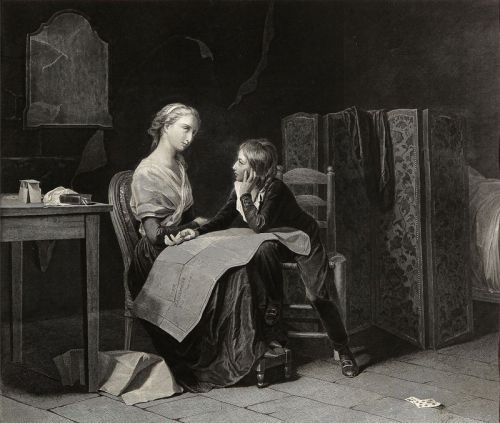
Depictions of Louis Charles' imprisonment


The heart of Louis Charles - it was from here
that DNA was taken
Interrogation of Louis Charles 
"The Dauphin in the Temple"
Louis Charles and Marie Thérèse (probably their last meeting)


Antechamber of Marie Antoinette

If you are to judge by the décor of this room then this was not a room of significant importance since it is kept in a completely simple style. The walls are partly covered with white wood and partly painted in a deep scarlet. Instead of a chandelier it is a lantern that illuminates the room. The floor has been kept in the same pattern as can be seen in most rooms at Versailles. Today the paintings are the most elaborate part of this room.


Joseph Marie Terray by Alexander Roslin (1774)


Stag's Courtyard

The Stag's Courtyard (Cour des Chefs) was created on the order of Louis XIV and has been changed several times during the reigns of Louis XV and Louis XVI. It leads to the King's inner apartments. The courtyard derives its name from the sculptures of deer that has been attached to the walls - the antlers are genuine deer-antlers. The all-round balcony enabled the courtiers - and the King - to move between the King's inner apartments without having to navigate through the labyrinth of rooms inside the palace.


Close-up of one of the terracotta deer

Former Chamber of Poets of Marie Leszczinska

The wood-work is very characteristic with its moss-green patterns on a yellow background. When the varnish-maker Martin created a new varnish in 1728 (it was supposed to compete with the luxurious varnishes from Asia) it was used for the wood-work in this room. It is believed that the wood-work was originally created for Marie-Josephe de Saxe but was moved to this room when Marie Antoinette wanted expanded her Golden Cabinet. The motives on the walls are mostly depicting rural scenarios featuring farmers and their wives.


The Queen's Minor Library

This is the smaller part of the Queen's library and has been kept in the same style as the Grand Library. Consequently, the room is remarkably simple compared to the other rooms in the Queen's apartments with its plain book cabinets with windows that allows a peek at the books - and of course the dark turquoise used for the lower part of the book cabinets. A fireplace takes up a good deal of space at one of the rear walls - on top of it is a bust of Marie Antoinette which stands in front of a large mirror.


From this angle the Golden Cabinet can just be seen through the door
The bust of Marie Antoinette