![]() |
| The magnificent clock |
Monday, 10 June 2013
Dining Room aka. "After the Hunt"
This was originally a bathroom but was transferred into a salon. It derives its name from the weekly dinners given by Louis XV who would invite the few monsieurs and madames who had gone with him on one of his countless hunts. The food delivered to this room was made in the King's private kitchens that Louis XV had installed on the second floor.
Louis XVI's Wardrobe
Louis XVI did not change much at Versailles but this particular room is an exception. The door is hidden and leads from the King's Bedchamber - it was created on the order of Louis XV in 1738 but was at this time half the size of the wardrobe it would become. The beautiful golden wood-work is the work of Jean-Siméon and Jean-Hugues Rousseau who would finish the room in 1788 (it would be their last work done to Versailles). The architect was Richard Mique. The wood-work includes emblems with symbols relating to the navy, trade, agriculture, science and the arts. The white and gold-style was very popular at this time which is why some of the other rooms looks similar to this one.
Thanks to two large windows (facing the Cour des Cerfs) the room is well-lit. The floor is of the same wooden pattern that can be seen through the entire château. When the revolution hit France this room was spared complete destruction. The only things that were changed was the removal of the royal insignias and arms as well was the large mirrors - the mirrors were probably sold. The fireplace is the same as was installed when the room was first created; the golden decorations were made by Pierre Gouthière. Behind one of the doors there is a toilet!
![]() |
| Voilà - a toilet! |
Sunday, 9 June 2013
Marie Clotilde, Princesse de France
A Family of Swine

The royal family - portrayed as pigs - is being taken back to the barn. The pamphlet was made after the family made its failed attempt to flee to Varennes. The two at the front of the wagon is Louis XVI and Marie Antoinette, behind them are Madame Royale and the Dauphin - it is worth noticing that the Dauphin was the only one who was not insulted in the texts that circulated this cartoon; he was considered to be "a young shoot on a rotten tree". But the rest of the family did not escape so easily.
Louis XVI is described as being stupid and shy and that "nature was sorry to have created [him]"
Marie Antoinette receives the most trashing (as usual) and even her mother, Maria Theresia, is described as having had unnatural relationships with animals such as tigers and bears which resulted in Marie Antoinette. The French Queen herself is both ugly, worn-out and hideous - besides this she "eats France's money in the hope of one day devouring the French, one by one".
The young Madame Royale was only twelve years old when this happened but her young age does not spare her in the humiliation. It is thought that she already has her mother's vices and is born to "suck the blood of slaves [!]".
The last one is Madame Elisabeth (the back of the wagon with the hat) is labelled as an "evil slut" who is "as nasty as she once was pretty".
Where did the money go??
This pamphlet named "Le Defecit" shows Louis XVI (wearing a red jacket) pointing at the chests containing tax money and asks "Where are all the taxation money?". The man in the blue jacket is the Minister of Finance, Necker, exclaims "They were there the last time I checked!". Meanwhile an aristocrat and a member of the clergy is sneaking out of the door - carrying sacks filled with the people's money. This is a classic example of how the nation saw not only the clergy and the nobility but also the King who is completely ignorant of the theft . much like he was considered to be ignorant about anything concerning the state.
Monday, 3 June 2013
The Riding Habit
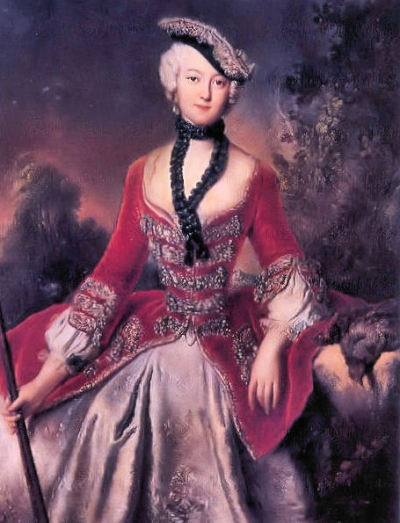
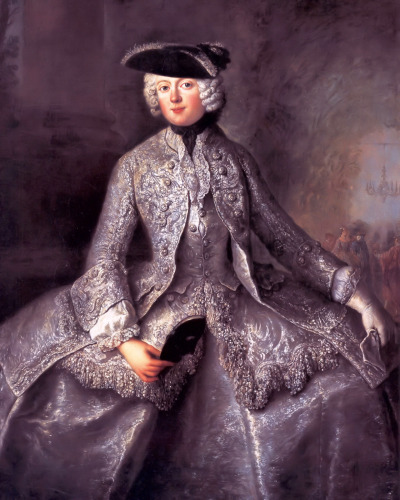
Being a lady included riding like a lady - in a side-saddle. But like everything else connected with fashion you did not just throw on a gown and then go out hunting with the King. No, a riding habit consisted of several essentials: jacket, shirt, hat, boots, gloves and so on.
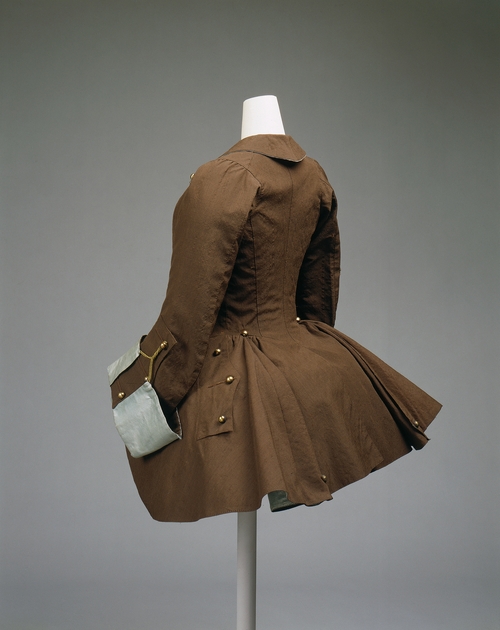
The main design of a riding habit was very masculine compared to what the ladies of Versailles usually wore. One notable difference was the colours: a riding habit was almost always darker than the everyday-dress. And then there was the question as how to combine the exercise of riding with the strict rules of fashion? Between 1730 and 1750 women actually wore the panniers - or hoops - that gave their dresses that characteristic volume even while riding. However, even the most fashion-minded ladies must have realized the inconvenience of this and by the middle of the 1750's it was common to loose the panniers - of course they could be replaced by hip pads.
The jacket was tailored which meant that it was close-fitting - another trait taken from men's fashion. But there was one point in which women's riding fashion stood out and that was the width of the jacket. Around 1730 (probably to keep the silhouette with the panniers intact) the jacket was considerably shortened and made wider. As fashions changed the jacket did not have to be closed. Around 1770 it was common to see a lady with her jacket only fastened by a hook. This created a completely new possibility to decorate your riding habit since the buttons no longer served a purpose.
The hats followed a gentleman's fashion as well and as such were often tall and made in dark colour. It was common to attach a veil to the back of the hat. Normally it was tricorn hats or top hats that were used for this particular activity.
The main design of a riding habit was very masculine compared to what the ladies of Versailles usually wore. One notable difference was the colours: a riding habit was almost always darker than the everyday-dress. And then there was the question as how to combine the exercise of riding with the strict rules of fashion? Between 1730 and 1750 women actually wore the panniers - or hoops - that gave their dresses that characteristic volume even while riding. However, even the most fashion-minded ladies must have realized the inconvenience of this and by the middle of the 1750's it was common to loose the panniers - of course they could be replaced by hip pads.
| Back of a riding habit |
The jacket was tailored which meant that it was close-fitting - another trait taken from men's fashion. But there was one point in which women's riding fashion stood out and that was the width of the jacket. Around 1730 (probably to keep the silhouette with the panniers intact) the jacket was considerably shortened and made wider. As fashions changed the jacket did not have to be closed. Around 1770 it was common to see a lady with her jacket only fastened by a hook. This created a completely new possibility to decorate your riding habit since the buttons no longer served a purpose.
The hats followed a gentleman's fashion as well and as such were often tall and made in dark colour. It was common to attach a veil to the back of the hat. Normally it was tricorn hats or top hats that were used for this particular activity.
| Sophie Marie Gräfin Voss (1746) |
| Marie Antoinette (of course) also follows the rules of fashion |
| |
| Princess Amalia of Prussia (c. 1740-50) |
Sunday, 2 June 2013
Lovers and Threats
Louise Henriette de Bourbon Conti was married to Louis Philippe, Duc d'Orléans and the couple actually had a happy marriage - at first. But as it often was with these "convenient" marriages of the court, the passion soon faded. While her husband showed an increasingly disturbing passion for gambling (which earned him several debts) Louise Henriette looked for love elsewhere. And she certainly found it.
At the time she was known to have had one constant lovers and several others just "passing by"..
The Comte de Melfort was rumoured to be one of them. In the memoirs of Jacques Casanova (written by Giacomo Casanova) the Comte de Melfort was mentioned as
At the time she was known to have had one constant lovers and several others just "passing by"..
The Comte de Melfort was rumoured to be one of them. In the memoirs of Jacques Casanova (written by Giacomo Casanova) the Comte de Melfort was mentioned as
"the favourite of the Duchess of Chartres, who had just become the Duchess of Orléans".It is believed that the two of them met at the Château de Saint-Cloud shortly after the birth of her first-born son in 1747. Louis Philippe was not pleased. He demanded that she gave up her lover immediately or be sent away to a convent! For all we know this seems to have ended the affair.
| Louise Henriette de Bourbon Conti |
Subscribe to:
Posts (Atom)


.png)
.png)
.png)