Showing posts with label versailles-departments. Show all posts

Saturday, 12 July 2014

The Royal Livery

Life at court may not have been the most hygienic but it certainly was colourful. Not only the courtiers in their lavish court costumes but the servants as well contributed to the colourful everyday. Most courtiers of a significant rank had their own livery in colours matching their emblem.
The King's livery between 1770-1780 was red, white and blue - the same colours as France's current flag - and was to be worn by all members of his household. Tony Spawforth suggests in his book "Versailles: A Biography of a Palace" that the colours of the King's livery was chosen as to echo the colours of the interior design of the palace with it's blue tiles and red bricks.

As with everything else the detail was the place to find meaning. There was no "standard"-uniform for a member of the King's household; it varied according to the wearer's rank within the household. A high-ranking servant would be sure to have braids of a finer material while lesser members had to make due with coarser cloth.
But still, this was the King's livery and they had to stand out. So, the fabric used for the uniform was strictly inspected and simply sent back if it did not meet the high standards - this happened in 1780 for instance. The details were equally luxurious. The braids were either of silk or linen, the button-holes embroidered and silver or gold adorned the buttons. It was in the braids that an observer could read the rank of a servant. There were two kind of braids which varied in size. The small braiding was for the lower-ranking servants such as page boys, gardener boys and generally junior member of staff. The grand braid was for the more important servants who were more on display such as coachmen, footmen, pages (note the difference between a pageboy and a page) and sedan chair carriers. This amount of finery also meant that quite a substantial sum was paid to maintain the livery of the King.

Grand Livery at Versailles for men in the King's employ between 1770-80
The King's livery 1770-80 - judging by the amount of braiding this was for a high-ranking servant

The Queen had her own livery too and in the same colours as the King. However, the colours were reversed so that the main fabric colour was red and the braids blue while the King's were the opposite. The question of livery once caused trouble for Marie Antoinette when she (financially sensibly) convinced her husband to buy St. Cloud in her name rather than have the expense of a governor. The issue lay in that servants wearing her livery was to be found at the front gates of St. Cloud which in the eyes of her enemies was a clear sign that she dominated the King.


Fig. 2 : Pierre-Denis Martin, Vue générale du château de Marly, prise de l'abreuvoir (détail), 1724, huile sur toile : 137 × 155 cm. Versailles, châteaux de Versailles et de Trianon, MV 741.
Notice the coachman and the riding servant in their liveries
The detail of "The Siege of Tournais and its' citadels" (beneath) show a man wearing livery similar to the one above. However, this painting is from 1745 which means that the colours did not change from Louis XV's reign to that of his successor - perhaps a slight design change?


Fig. 7 : Pierre Lenfant, Siège de Tournai et de ses citadelles, 14 mai 1745 (détail), troisième quart du xviiie siècle, huile sur toile : 275 × 248 cm. Versailles, châteaux de Versailles et de Trianon, MV 210.

It was also common that servants' livery changed depending on what royal château the royal household was staying at. For example the livery for Compiègne was green while blue was to be worn Choisy.

Tuesday, 1 April 2014

The Lack of Toilets

There were hardly any toilets at Versailles and with a court counting several thousand people it turned out to be more than a little problem. The servants, the commoners who came to look at their monarch even the aristocrats would occasionally relieve themselves in corners and courtyards though this was not as often as has later been implied. Visitors - including Horace Walpole - complained about the awful smell that hung over everything; even the gardens were not free for the hideous odour. Thanks to the many reports of ambassadors and foreign visitors the splendid palace became known as one of the filthiest in the world - not exactly what had been expected. The problem became so acute that Louis XIV put a new rule in place according to which the hallways were to be cleansed for faeces (if there was any) and dirt once every week. Also, many of the King's beloved orange trees were put into vases inside the palace in an attempt to mask the smells.

However, there were other alternatives since - after all - relieving yourself in a corner was far from being socially approved. During the many parties held at Versailles it was not uncommon for the guests to bribe the servants of the courtiers to let them use their masters' chamberpots and if this was not possible there were "commodes" where the toilets are currently located. So at least something was done about it but as you say no smoke without fire!

The Queen's toilet
Courtiers who lived at Versailles would often have their own "commode" which was a seat with a chamber pot underneath; it was brought when needed and then taken away when you were done. It is estimated that there were 300 of these at Versailles but it was not near enough. Th ruthlessly honest Duc de Saint-Simon once said of the Princesse d'Harcourt that she would often urinate while walking making her hated by the many servants who had to clean up after her. It was even said of Louis XIV himself would go to the toilet while driving a carriage! When at Fontainebleau the courtiers would normally hold their water until dusk at which time they would rush to the lawns and simply do their business then and there.
No one thought of training the many pet dogs of the courts to go outside so occasionally these would urinate indoors to the embarrassment of their owners. Consequently, the animals would contribute as well to the "delicious" smells everywhere.

Just like in the city servants threw out waste from night pots into the inner courtyards; a story goes that once the Dauphine Marie Antoinette and her sister-in-law the Comtesse de Provence were headed for the apartments of Madame Victoire when they stopped at an inner courtyard for a moment. Just at that time a servant threw out such a night pot out the window nearly hitting the two princesses - some might think that it was done on purpose considering that the window belonged to Madame du Barry! The only people who had actual toilets were the King, the Queen and the Dauphin and these were not installed until 1768. It seems strange though that iron pipes could be dug to provide water for the fountains in the gardens but not to carry away waste...

Monday, 31 March 2014

The Kitchens - Feeding the Court

The kitchens - as well as the stables - were located outside the château itself to spare the courtiers the smells and noises. It is estimated that no less than 2000 people were employed to work in the kitchens especially during the many banquets. Normally the meals of Versailles were divided into categories: hors d'oeuvre, soups, main dishes, fruit and interval courses. For every category there were between two to eight dishes - this meant that during a day Louis XIV would have tasted between 20-30 dishes!
Since the kitchens were located so far away - and Louis XIV insisted on eating his dinners in the King's Apartments - most meals were served cold.

Another luxurious aspect connected to the kitchen are the icehouses used to store ice for the courts drinks and dishes. One of the surviving can hold 1120 cubic metres of ice! The ice was brought by servants from the Lake of the Swiss Guards and was then hacked into place - the ice was no small matter. In an age without electrical freezers it was an extreme luxury to have your own ice which meant that the ice was guarded by the palace guards!

Sadly, the kitchens that belonged to Versailles were demolished in the nineteenth century.


Nothing of the kitchen remains but here is the King's
kitchen garden

Sunday, 30 March 2014

The Royal Stables


Louis XIV, Louis XV and Louis XVI were all passionate hunters and as such took great interest in their horses. The royal stables at Versailles are divided into two: the Grand Écurie (Great Stable) and Petite Écurie (Small Stable). Strangely enough the two stables are actually the same size but belonged to different parts of the administration.

The Grand Écurie
The Grand Equerry was responsible for the Grand Écurie where the horses were expertly trained for either huntings or warfare. These horses were reserved for the King and the princes alone. Since especially Louis XIV was fond of equestrian entertainments the Grand Écurie was often used for court entertainments such as horse races which would take place on the area immediately outside the Grand Écurie as well as displays of dressage. This usage is also shown in the very design of the stable which has been built with carved wooden beams and frescoes depicting horses.
It was Jules Hardouin Mansart who also added the two stables which were finished in 1683. Originally they were built to house no less than 600 horses. Chandeliers of glass hangs from the ceiling as a gentle reminder of the splendour of the nearby palace. Today the Grand Écruie is used to house the collection of coaches and carts collected by Louis-Philippe.

The Grand Écurie


The Petite Écurie
Under the administration of the First Equerry the Petite Écurie was used for housing the many carriages and carts belonging to the royal family. Here were also horses available for the courtiers who did not have the right to have a horse in the Grand Écurie - it was not uncommon that the King unexpectedly would invite a courtier to join the hunt in the last moment and then a horse had to be provided for him. These horses counted draught horses as well as saddle horses.


The Petite Écurie

Detail of the entrance

The Royal Guards

Being the absolute centre of power also means that you are always in danger and must therefore always be protected. This has always been the case for royalty but as with everything else at the French royal court at Versailles guards became a matter of honour. But lets take a look at how and what the royal guards actually were.

The royal guards were divided into two categories: the indoor guards and the outdoor guards. Those who served as outdoor guards came from either an infantry of Swiss Guards or French Guards known as the Garde du Corps. They would normally be dispatched from their regiments to Versailles where they would stand guard for one week before returning to their infantry. But naturally here was another piece of etiquette which meant that the French Guards had the right to protect the area immediately outside the bedroom of Louis XIV.
The indoor guards consisted of both Swiss Guards and the Garde du Corps. The Swiss Guards were armed with halberds with the royal arms on the blade and dressed in dark blue and red uniforms. These Swiss Guards were known as the Cent Suisses or the Hundred Swiss; they would serve the royal family until it was forced to leave for Paris in 1789. At the end of Louis XIV's reign the number of guards posted at Versailles amounted to 2960. Both indoor and outdoor guards were housed underneath what is now the Minister's Court. Once Mare Leszczynska walked by and happen to see a guard sleeping; after that it became commonplace that the guards (who slept on camp beds) were screened by screens. The right to obtain personal guards was a privilege reserved only for the King, the Queen and the Dauphin. The King's personal guard consisted of somewhat near 400 soldiers up until it became too expensive. Naturally not all of these guards could be housed on the grounds of Versailles itself but were housed in barracks. Louis XV had had wooden barracks erected for his French gendarmes on the place d'armes; this building was demolished in 1831 long after the actual guards had vanished from sight.

Among other duties it was the guards' responsibility to open and close the many gates found around the château; they had the right to remove any weapon of the visitors that might be used to kill or harm the King. Whenever a royal prince passed they were to present arms and it was equally required that they knew who held the title of Duc because whenever such a one passed the guards were to stamp their feet twice. Furthermore they were to guard the Masses said in the chapel and escort the monarchs to and from there. At all times 12 guards would be placed in the Queen's Guards' Room; these were part of the indoor guards. At night Scottish guards - eventually there were very few actual Scots in the regiment - took over and made sure that the royal palace was locked up as far as possible.

Eventually it was to be Marie Antoinette who broke protocol when she even invited her personal bodyguards to dance in her balls which had never been seen before. It should be said that it was not uncommon for higher ranking members of the royal guards formed friendships with the courtiers and some were even known to have had liaisons with ladies of the court. In the end - when most royal guards had abandoned the royal family - it was a wounded but still loyal royal guard who hammered on the door of the Queen's chamber to warn her that the palace had been stormed. It was he who saved the Queen's life by giving her opportunity to escape before he was brutally killed himself by the raging mob.

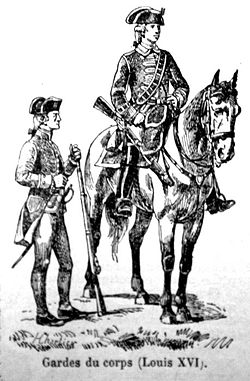
French guards during Louis XVI


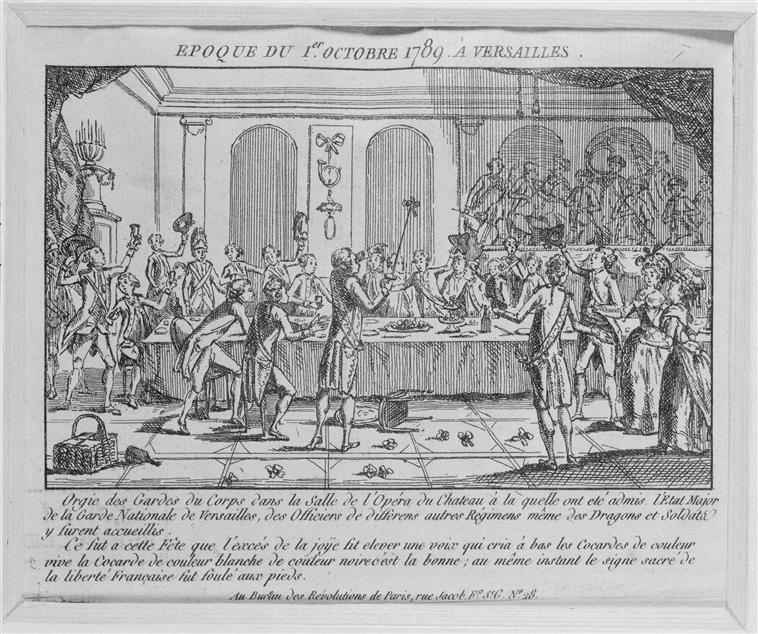
Banquet of the guards upon the arrival of the Flanders Regiment just four
days before the mob attacked Versailles

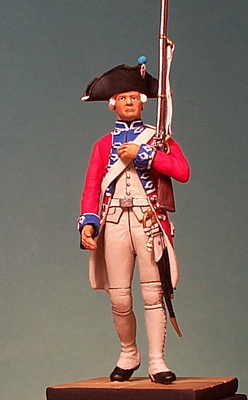
Model of a Swiss guard as he would have looked
at Versailles

Wednesday, 20 November 2013

The King's Kitchen Garden

Louis XIV wanted to have his own supply of vegetables and fruits and to this he ordered his gardener Monsieur de La Quintinie to create a garden separate from those at Versailles. Thus work began to establish this garden covering 9 hectares at the edge of what is now known as the Saint Louis District in 1678. Monsieur de La Quintinie had his work cut out for him because the earth of the chosen area was poor and not optimal for gardening. Actually the only reason for why Monsieur de La Quintinie had to make due with this piece of land instead of one he himself had suggested was that Louis XIV wanted to have his garden within reach. The royal gardener even said of the land that it was: "of a sort you would never want to find anywhere". Nevertheless the garden was already sprouting fruit in 1683.

Thanks to M. de La Quintinie Louis XIV was now supplied with fresh fruits such as strawberries (in March), lettuce (in January) and melons (in June). At the time it was a huge symbol of the King's power that he was able to produce his very own vegetables even during the winter. Just around this time peas was quite new and as most new things they became a particular popular treats - and of course Louis XIV could get them from his kitchen garden too. It even became possible to grow coffee beans here during Louis XV.
Louis XIV's favourite thing about his garden was the fruit trees - there are 5000 of them of different varieties and all shaped in delicate geometrical shapes! He was so excited about these trees that he would even show them off to his more prominent guests; whenever the King took his guests to the garden through a magnificent gate called the Grille du Roi and was created by Alexis Fordin. The herb garden was vast as well with 40 different specimens ready to be taken to the royal salads. To create a royal atmosphere the architect Mansart was brought in and it is thanks to him that the garden is now rich on elevated terraces. Also the large water reservoirs, the buildings and the stairs are work of Mansart.

Monsieur de La Quintinie had created a special system in order to keep the garden alive. At the very centre of the garden is a large water reservoir and it is from here that the garden is watered through a series of drainage pipes. The entire garden consists of 28 smaller gardens - rather enclosed small gardens - at the periphery and 16 square gardens laid around the centre fountain. It took 30 gardeners to keep the garden in shape and the royal stables made sure that there was a constant supply of manure.

Today the garden is almost exactly as it was when Louis XIV walked through it and the only few changes have been made on the order of his successors.