Saturday, 7 December 2024

House of Melun

The family of Melun were amongst the French aristocracy since time immemorial; over the years, the family had divided into no fewer than nine different branches of which five were extinct by the birth of Louis XIV. This left four extant families - for clarity's sake, the various branches have been named by the rank of their individual heads: Prince d'Epinoy, Vicomte de Melun, Marquis de Richebourg and Marquis de Cottenes.

The following post only focuses on the family of the princes d'Epinoy as the remaining families did not appear frequently - or at all - at the French court.


Princes d'Epinoy

1. Alexandre Guillaume de Melun & (1) Louise Anne de Béthune, (2) Jeanne-Pélagie de Rohan-Chabot

Alexandre was the second son of the former Prince d'Epinoy and inherited the title when his older brother was killed at the siege of Aire. Like his brother, Alexandre was a keen soldier who participated in several campaigns for Louis XIV. Prior to his birth, the lands of his family had been divided into various families (most had gone extinct) but after having sustained a particularly unpleasant wound, he petitioned Louis XIV to have those lands restored to him. Grateful for his services on the battlefield, Louis XIV acquiesced which led to the restoration of the lands of Antoing, Cysoing and Roubaix. The lands were dearly won as he would suffer from his war wounds for the remainder of his life.

He was married initially to Louise Anne de Béthune, the daughter of the Duc de Charost. Louise Anne fell pregnant in 1666 and died in childbirth at the age of 23. The child was:

  • Louise Marie Thérèse, Duchesse de Charost

Secondly, Alexandre married Jeanne-Pélagie de Rohan-Chabot, the daughter of the Duc de Rohan. At the time of their wedding, Alexandre was 32 years older than his new wife. Jeanne-Pélagie gave birth to four children:
  • Marie Marguerite Françoise, unmarried
  • Anne, unmarried
  • Louis, Prince d'Epinoy
  • François Michel Auguste, died at 17

2. Louis de Melun & Élisabeth-Thérèse de Lorraine

Louis must have kept a very low profile as little is known of his life. He was made marèchal de camp in 1702 before dying of smallpox in 1704. His marriage was suitably grand for the seventh Prince d'Epinoy. Élisabeth-Thérèse was a princess of Lorraine and princesse de Lillebonne in her own right. She was a personal friend of the Grand Dauphin and served as lady of honour to the Princesse de Conti. 

The couple had two children:
  • Louis, Prince d'Epinoy
  • Anne-Julie-Adélaide, Princesse de Soubise

Élisabeth-Thérèse

3. Louis de Melun & (1) Armande de La Tour d'Auvergne, (2) Marie Anne de Bourbon

Beside the inherited title of Prince d'Epinoy, Louis was made Duc de Joyeuse after the extinction of the ducal family of that name. Louis is mostly known for his bizarre death; he was apparently killed by a stag during a hunt at his own estate at the age of 30. His body was never recovered.

Armande died just a year after their marriage at just 19. She died in childbirth; sadly, she had lost her own mother just the previous month.

Marie Anne de Bourbon was the granddaughter of Louis XIV by Madame de Montespan. She was the daughter of the Prince de Condé which made her a princess of the blood. The marriage was conducted in secret as the disparity of their ranks - despite her husband's lineage - was considerable. She appears to have been genuinely attached to Louis and was distraught by his early death. She was the head of the queen's household and as such had considerable status at court. She never remarried.

Louis had no children by either of his wives, so the title went to his nephew, a Rohan by his father's side.


undefined
Marie Anne de Bourbon


The Complicated Labours of Marie Thérèse

Marie Thérèse was brought to France in 1660 as the bride of Louis XIV. Her marriage had a dual purpose: ending hostilities between France and Spain and producing an heir to the French throne. Marie Thérèse duly fell pregnant the following year and would eventually give birth to a total of six children - and bury five. As queen of France, she was subjected to the ritual of public childbirth; unfortunately, two of her pregnancies proved to be near-fatal to the mother.

From the moment Marie Thérèse had fallen pregnant, she had taken precautions. Not only would a miscarriage obviously involve a set-back in the plans for filling the nursery but Marie Thérèse had her own reasons for being apprehensive. Her own mother had died from complications of a miscarriage and Marie Thérèse was understandably afraid of suffering the same fate. Consequently, she remained firmly planted in sofas for as long as possible.


Marie Thérèse as a young woman

The birth of the Grand Dauphin

On 31 October 1661, the court was informed that the queen had gone into labour. Marie Thérèse had become queen of France the year before when she married her first-cousin, Louis XIV. The new queen quickly became pregnant and by Halloween, the baby was due.

Marie Thérèse was facing an arduous deal. By tradition, the birth of an heir to the throne was not a private event and her bedchamber was filled with those high enough on the hierarchical ladder to bear witness to the event. This precaution was to ensure that a stillborn, disabled or - gasp - female child was not substituted for a healthy, male child. While those who were present would eventually see the birth of the Grand Dauphin, they would also witness a harrowing birth.

The young queen - 23 years old - was experiencing her first childbirth. According to contemporary sources, the birth was particularly difficult. The labour dragged on and on throughout the night, thus utterly exhausting Marie Thérèse. Louis XIV remained by her side until five in the morning when he was informed that the queen might not survive the childbirth. He then removed himself to the chapel and prayed for his wife - and son. Having prayed for a while, the king returned to the queen, took her hand and remained by her side until the child was finally born.

For hours, it was uncertain whether Marie Thérèse would survive the birth. The situation became so dire that she was administered the last rites. As it happens, a royal birth was always attended by various high-ranking clergymen for this particular situation. One of those present was the Abbé de Choisy - he would later be present at the birth of the Grand Dauphin's own first child. 

Another witness was Marguerite de La Cuisse. She had neither high rank nor great fortune - but she was a "wise woman" or as close to a midwife as possible. Naturally, the queen was already surrounded by doctors but the presence of a woman whose sole profession was to deliver children must have been a comfort to Marie Thérèse. Marguerite lived and worked in Paris and the king is said to have issued a secret order to fetch her for the birth. There appears to have been a collaboration between Marguerite and the doctors - somewhat unusual for the time, but it serves to show the respect Marguerite had earned in her trade.

It was mentioned that the queen was already ill when she went into labour which could hardly have been beneficial to the strength she needed for the ordeal ahead.

The poor Marie Thérèse was finally released from her agony just before noon on 1 November, when her son was born. Undoubtedly, the experience must have been terrible for her - the pain and anxiety in itself but also having to go through that in front of a group of spectators. Over the next decade, she would repeat the process a further five times - and buried all five successive children. 

While the king's behaviour was both supportive and kind, his attention did not remain long with his long-suffering wife. Having completed a thanksgiving pilgrimage to Chartres, he returned directly to court - but not to the queen. Instead, he rejoined his mistress, Louise de La Valliere, while Marie Thérèse was left to recover by herself and her ladies. The king and queen's relationship was said to have rewarmed after the birth but the position of Louise de La Valliere as the king's official mistress was undeniable - and likely hard for the queen to ignore. In fact, she was said to be heart-broken by the increasingly obvious affair.

Fil:Queen Marie Thérèse and her son the Dauphin of France, dated circa 1663 by Charles Beaubrun.jpg
Marie Thérèse with the Grand Dauphin

A second close call

In the first half of 1664, it became obvious that the queen was pregnant again. Her last child had been born in November 1662 (a son who died that same December) and hopes were high that the queen would deliver a third son. For months, the pregnancy progressed as planned. Marie Thérèse was scheduled to give birth in December 1664 - but then something went wrong.

In early November, the queen's health went drastically downhill. She became feverish and complained of pains in her legs and back. While it may be expected that a woman in her eight month of pregnancy would experience unpleasant sensations in both legs and back, the queen's situation was far worse than just unpleasantness. In fact, she was said to be in considerable pain.

On 16 November - nearly a month before her due date - Marie Thérèse went into labour in dramatic fashion. Once again, Marie Thérèse nearly succumbed during the birth. As she gave birth, Marie Thérèse became so weak that the clergymen brought out the last sacraments again. However, this time Marie Thérèse utterly refused to take them. She is said to have uttered: "I will gladly take communion but I do not want to die".

As before, Louis XIV was by her side and it was he who eventually convinced her to submit to the last rites. The fact that she eventually gave in undoubtedly gives the impression that Marie Thérèse herself felt her strength waning. The birth dragged on and on to the point where Louis XIV allegedly inquired whether it would be possible to save the mother before the child was born.

The doctors present were utterly helpless and their solution was more cruel than helpful. Their remedy was to force-feed the poor Marie Thérèse an emetic intended to make her vomit. Initially, Marie Thérèse understandably refused - can anyone blame her? - but the doctors wore her down. Once the emetic had taken its toll, Marie Thérèse was utterly exhausted. Seemingly by miracle, the child was eventually born - a girl who was promptly named Marie-Anne. The infant had been severely deprived of oxygen and was born almost purple in the face (this would later give rise to the unsubstantiated rumour that the queen had had a black child).

The doctors managed to revive the young Marie-Anne while Marie Thérèse herself was barely hanging on to life. In fact, afterwards, she suffered from severe convulsions which further weakened her health. It was suspected that she suffered "an attack of the nerves" for which her attendants threw water in her face. The conclusion was that she had generally nervous disposition and had become over-agitated by the ordeal - it is hard to see how anyone, stoic or hysterical by nature, could remain level-headed after such a terrible experience.

Sadly, Marie-Anne lived for just a little more than month, dying on 26 December 1664.

... and a third

Two years passed before Marie Thérèse found herself pregnant again - one could hardly blame her if she was apprehensive. On the very first day of 1667, Marie Thérèse went into labour for the fourth time after having gone through an entire nine months pregnancy.

As usual, the traditional birthing process was put into place. Louis XIV duly found his way into her chamber where he allegedly helped the leading doctor, Félix, strap Marie Thérèse's legs down to the birthing bed. Whether she had been restrained in a similar fashion previously is unclear but it can hardly have been reassuring. 

The birth - like the previous ones - was a long one. It was not until the following day (2 January 1667) that the child was born: another daughter, named Marie Thérèse after her long-suffering mother. She would become known as Petite Madame and for years, she seemed to thrive. Tragically, she died of consumption at age 5.

While Marie Thérèse recovered, court life went on. Just fifteen hours after the labour had ended, the court enjoyed the spectacle of a ballet composed by Molière, in which the king himself danced - alongside his mistress, Louise de La Vallière.
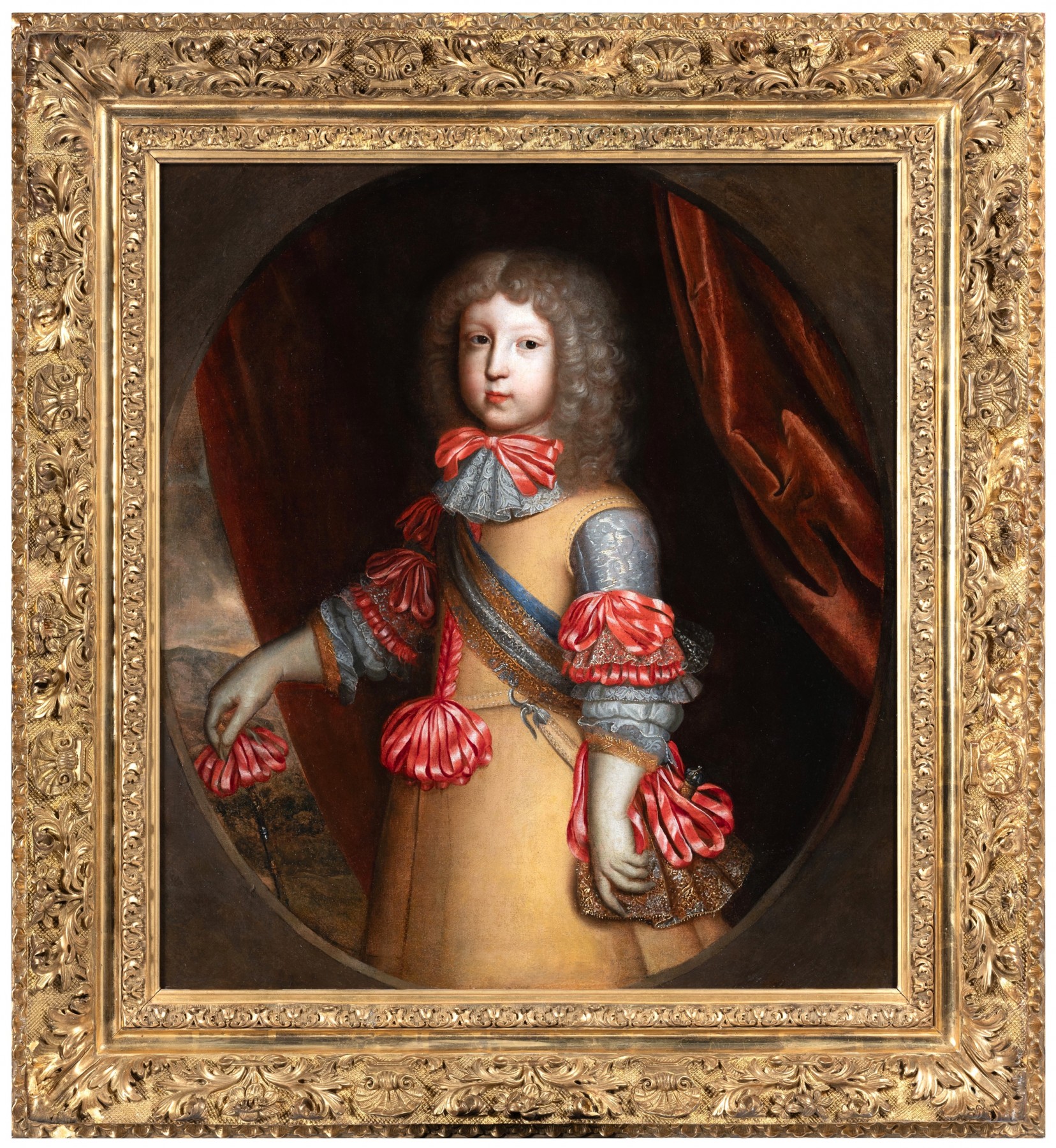

The Grand Dauphin - only surviving child
of Marie Thérèse


The three episodes were tragically typical of the treatment of Marie Thérèse - and other royal women. Nothing was mentioned about whether she received any care after her ordeal - such a thing would simply not have been recorded. In fact, that the birth of the dauphin was so difficult in itself is hardly ever mentioned at all. Instead, biographies of the king or the court typically only mention that the queen gave birth but never bothers to elaborate on the sufferings she went through or the fact that she nearly died. Ironically, the celebrations that followed the birth has been given more attention than the process which occasioned them. 

Likewise, the attentions bestowed upon her by the king was the focus point of considerable admiration. Naturally, this was a time when kings - or fathers in general - were rarely (if ever) involved in childbirth which did make the king's contribution both touching and unusual. However, the comment made by Madame de Motteville during the birth of the Grand Dauphin is quite telling:

"As long as she (the queen) was in great pain, the king seemed so distressed and so noticeably overcome with pain that he left no doubt of the love he had for her"

Full of admiration and attention of the king - the near-dying queen reduced to being in "great pain" while her husband is praised to the skies. Even afterwards, the efforts of the queen was not touched upon again.


Even for the standards of the time, the childbirths experienced by Marie Thérèse seems overly brutal. Strapped down, force-fed emetics and having religious items shoved in her face - icons of her own imminent death - there was nothing glamorous about Marie Thérèse's experiences. The queen herself left no trace of her own feelings in writing nor do any of the numerous memoirs seem to have given it a second thought.

Was she apprehensive upon her next pregnancy? She could hardly not have been anything but nervous, especially given her preexisting fears. Did she receive any post-natal care? How did she feel herself, how did she experience the ordeals? We do not know.

Thursday, 5 December 2024

The Greater They Are, the Harder They Fall: the Bankruptcy of the Prince de Guéménée

Henri Louis de Rohan had been born into one of the most distinguished families at the French court: that of Rohan. From an early age, he was seemingly destined for greatness. His immensely privileged birth, as the only son of the Prince de Guéménée, all but ensured that he would have a prominent position at court. At the age of 15, Henri Louis was married to his cousin, Victoire Armande Josèphe. 

The two were set for a brilliant court career. The Prince de Guéménée was made Grand Chamberlain to Louis XVI in 1775; the charge was amongst the highest-ranking at court and carried both a considerable income and prestige. Meanwhile, his wife was given the equally impressive - and coveted - post of governess to the Children of France. By all appearances, the two should have been set for life and they certainly behaved as if they were. Fully enjoying her position, Victoire made it a habit to threw elaborate gaming parties where more money was gambled away. 

Yet, in 1782, it all came crashing down. To the utter shock of both polite and impolite society, the Prince de Guéménée filed for bankruptcy. Most aristocratic families had some (or massive) debt but the debts incurred by the couple was truly enormous: 33 million livres. The sum remained the largest private bankruptcy of the entire Ancien Régime. Hitherto, it had been widely accepted that noblemen seldom paid their bills and even royalty had large debts, but these were typically protected by their very position in society. The bankruptcy showed the cracks in the foundation and must have rattled more than the couple themselves.


undefined
The Prince de Guéménée as a child


But how on earth did the couple manage to get themselves into that financial state? The couple owned numerous magnificent estates, jewels, carriages etc. but it was soon revealed that most had been heavily mortgaged. At this time, credit was normal and the higher-ranking a person was, the more credit they were typically given. A person such as the Prince de Guéménée - with his high-office at court, his ancient surname and his titles - was given far more credit than most. The problem was that he had kept on borrowing money even while already heavily in debt; that was considered a type of fraud or even theft. However, eventually, such a system was bound to collapse when no money went the other way. 

It quickly became public knowledge that Henri Louis had borrowed or owed money to practically everyone around him. Fellow aristocrats, tradesmen, bankers, craftsmen - even servants had been promised money that simply did not exist. In total, about 3000 creditors came forward when the bankruptcy was announced. The bankruptcy damaged hundreds of lives. Most of the people who were directly and most devastatingly affected had entrusted their savings or bonds to the care of the Prince de Guéménée. These ranged from famous figures such as Le Brun and the Duc de Lauzun to the peasants living on the prince's estates.

The case of the Duc de Lauzun underlines how the fall of one courtier often brought about that of another. Lauzun himself was deeply in debt, despite having a considerable fortune - the age-old paradox borne of the noble habit of never quite settling one's bills which let to mounting numbers of creditors. By 1780, a whole swarm of old creditors threatened to have Lauzun imprisoned if he did not pay up which he dearly did not want to. Instead, he made a decision which seemed clever at the time: he sold his landed estates to the Prince de Guéménée in return for life-long annuities of a staggering 80.000 livres per year. Thus, he could not be sued for the value of his land as he did not technically own it any longer. Yet, when Guéménée went bankrupt, that scheme floundered spectacularly. 

Furthermore, life at court was infamously expensive. To keep up with the constantly changing fashions, the Princesse de Guéménée had apparently racked up bills at her shoemaker for 60.000 livres while her constant parties further drained her coffers. Some pointed out that certain positions at court outright came with an expectation of some sort of largesse. This could be an "open table" which was essentially a buffet available to those at court and paid for by the private coffers of the incumbent - or it could be frequent social gatherings, such as gambling parties. Meanwhile, her husband equally dug deep into his pockets to keep the appearances of splendour alive. In other words, their very lives at court had created a vicious cycle of constantly requiring more money to keep up with their obligations and appearances while simultaneously having no money to repay what had already been borrowed. 


Cardinal de Rohan - the man who tried
but failed to consolidate the Rohan-
family's financial efforts


The remaining Rohan-family scrambled to close ranks but also to save themselves - the fate of the Prince and Princesse was already sealed but there was no reason why the family should lose the immensely important courtly positions. Having failed at warding off the catastrophe by selling horses, jewels, art etc, they petitioned the king to transfer the positions to other members of the Rohan-clan; but they were refused. The Comtesse de Marsan (herself a Rohan by birth and Louis XVI's own former governess) even appealed to the king for Henri Louis' son to be given a survivancier for his post as Grand Chambellan. A survivancier was a document which essentially reserved the post in question for a relative of the current holder. She was ultimately denied and the king chose the Duc de Bouillon instead. Likewise, the efforts of the Cardinal de Rohan to gather the family resources failed.

Marie Antoinette eagerly bestowed the influential post of governess on the Duchesse de Polignac, one of her closest friends. Some thought it unkind of the sovereigns to turn their backs so publicly to two otherwise familiar faces; the Rohans, for one, grumbled. In a twist of fate, it would be a Rohan (the Cardinal de Rohan, and cousin of the Prince) who dealt Marie Antoinette's reputation its final deathblow due to his part in the Affair of the Diamond Necklace. Meanwhile, their direct rivals used both incidents to point out that clearly the Rohan-Guéménée could not be trusted.


Yet, it would be unfair to say that the monarchs did absolutely nothing to aid their former acquaintances. The family of Rohan-Guéménée had been given ownership of a port city called L'Orient, located in Brittany. This was one of the few ports in France authorised to trade directly with the newborn United States of America and thus had opportunity for considerable revenue. Louis XVI bought the port back (ironically since the king technically was master of it already) at an inflated price. Eventually, a deal was struck that the family would receive an annual rent of 480.000 livres. The whole affair show the odd mixture of medieval sense of honour and cold financial truths. One of the missives sent from the family to the king clearly suggests that the king should reward the family for their "willingness" to let go of one of their most profitable possessions. In other words, the family had acted honourably by ... attempting to sell of its property to pay back the debts the family itself had incurred. 


At court, the couple was ruined - and not just financially. The scandal was immense and they were both obliged to resign their prestigious positions. Ironically, these would have been one of the few actual incomes they had but life at court was ruinously expensive. Henri Louis and Victoire were exiled to their private estates (him to the south, her to the north) and never regained former esteem. Although the end of their courtly life was surely a disgrace, it did not escape the notice of the public that while many of their smaller creditors were left destitute, they continued to live somewhat comfortably.


undefined
Victoire Armande


Such a blatant double standard would have struck a nerve in a society increasingly waking up to the societal injustices of its time. While some ranted angrily at the arrogance of these "old families", others wittily quipped that it was a bankruptcy on a scale reserved only for royalty and the Rohans. The joke being that the Rohans claimed to descend from the Dukes of Brittany which would make them pseudo-royal. It would certainly not have been safe for Henri Louis to venture into Paris at this stage; it was said that it was impossible to walk through the capital without hearing the Prince's name being discussed in the most heated terms. As for the seemingly callousness of separating them, Henri Louis and Victoire had already been living separate lives for years.

The financial ruin of the Prince de Guéménée was not merely a private-turned-public disgrace. He had merely done as countless, if not most, other courtiers did but he had failed spectacularly. The deficits in the royal and aristocratic houses were well-known but the practice of continued credit based solely on the grandeur of France's oldest names had remained in place. However, the drastic fall from grace cast an unpleasant spotlight on an untenable financial situation in a country that was already spiraling financially.

Tuesday, 3 December 2024

Impotence or Disease? The Childlessness of the Comte & Comtesse de Provence

Much has been made of the seven years that elapsed before Marie Antoinette finally became pregnant by Louis XVI. However, the young monarchs were not the only ones in the royal family who suffered from infertility. 

The eldest of the king's brothers - Louis Stanislas, Comte de Provence - was married to Marie Josèphine of Savoy. The marriage was celebrated on 16th April 1771; just about a year after the marriage of the dauphin to his Austrian archduchess. By then it was common knowledge at court that the marriage between Marie Antoinette and Louis XVI had not yet been consummated, so there was intense pressure on both couples. 

Quickly after the wedding ceremony, Louis Stanislas loudly boasted of his prowess and vowed that his wife was surely pregnant. Few people believed him, though, as he was known to go to great lengths to attempt to humiliate his older brother. Marie Antoinette herself urged her mother (via letter) not to believe the gossip that the newcomer was pregnant already, although it was immensely important to Marie Antoinette that her mother was not given new ammunition for her continual reproaches. 

It has been suggested that the Comte de Provence was impotent - some suggests that his considerable weight further impeded his chances of impregnating his wife. However, in 1774 the Comtesse de Provence fell pregnant - much to the chagrin of the still childless Marie Antoinette. Sadly, Marie Josèphine miscarried early on in her pregnancy and did not conceive again until 1781. This would be her last pregnancy (confirmed, at least) which tragically also ended in a miscarriage. Thus, the couple remained childless. 


undefined
Louis Stanislas

Considering that Marie Josèphine had fallen pregnant twice, it is clear that Louis Stanislas was not completely impotent. But what was the matter, then? Initially, wicked tongues blamed the new Comtesse de Provence whose personal hygiene was notoriously lacking. To be fair, that would not have been particularly inviting but could be overcome. Surely, the couple could hardly have been more ill-matched. Both Marie Josèphine and Louis Stanislas would later show either bisexual or homosexual tendencies which would obviously have further complicated matters. 


When the Comte took a mistress, the Comtesse de Balbi, the courtiers began to cast glances at her midriff - would she fall pregnant by the king's brother? Alas, no. Despite being with Louis Stanislas as early as 1779, she did not become pregnant until around 1793, when she had fled with the Comtesse de Provence abroad. By this point, it was obvious that it could not be the child of the Comte de Provence as they had not seen each other physically for months on end. That also prompted their final rupture. 

While Louis Stanislas was clearly not entirely impotent - as evidenced by the two pregnancies of Marie Josèphine - he clearly was not particularly fertile. As for his wife, she would turn to female lovers and it therefore is impossible to tell if she could have had children by another man, if she had so tried.


undefined
Marie Josèphine


Another theory is that the Comte de Provence had diabetes - both type 1 and type 2 can affect a man's chances of impregnating a woman. He experienced rapid weight gain and the lack of knowledge of the disease would have meant that it was entirely unmanaged. His death in 1824 was of gangrene which was said to have begun in exactly unmanaged diabetes. Upon his death, an autopsy was performed which showed no obvious indication that Louis Stanislas had actually been impotent which could indicate that diabetes was to blame.

Sunday, 1 December 2024

The Unknown Heiress of Madame de Maintenon

The existence of Madame de Maintenon at the court of Versailles was an odd one. Initially, she was recognised as the king's official mistress but their subsequent marriage - if it ever occurred - was never formally recognised by the king; consequently, she was never officially made queen of France. 


Typically, the family of the king's mistress stood to benefit immensely from their connection. Madame de Maintenon's predecessors certainly had had their share of the loot. Louise de La Vallière's brother as well as the sisters of Madame de Montespan all reaped the benefits of the royal favour. Both women had another massive boon: their children by the king. Madame de La Vallière had had five children by Louis XIV of which two survived into adulthood and were amply provided for - the daughter by a marriage to the Conti-family and the wayward son by high-ranking military appointments before his premature death at 16. Her brother, too, received a handsome pension, a very advantageous marriage and several appointments that certainly did not correspond to his experience.  


Meanwhile the numerous offspring of Madame de Montespan - 7 in total of which 5 survived into adulthood - were married into the highest echelon of French aristocracy. Her sons were furthermore given prestigious positions both in the military and the subsequent regency. Her recalcitrant husband, however, got nothing due to his indecent display of disagreeing with his wife being the king's mistress. 


But what of Madame de Maintenon? She had been married once before to Paul Scarron but had never had children herself - at least none that were recorded. When she became Louis XIV's mistress she had either entered menopause or simply never conceived for she had no children by the otherwise notoriously virile king either. Yet, the position of royal mistress (and potential wife) remained remarkable lucrative and she therefore needed an heir - or in this case, an heiress. 

While Madame de Maintenon had no children of her own, she did have immediate family, albeit far less illustrious than the incomparable Mortemarts of Madame de Montespan. Her father, Constant d'Aubigné, had been married twice. The first marriage was to Anne Marchant who gave him a son, Theodore. The second marriage was to Jeanne de Cardilhac who gave birth to three children: Madame de Maintenon, Charles, and another son.

While two of Madame de Maintenon's brothers either never had children or were not in contact with her, Charles d'Aubginé did. Charles had married Geneviève Piètre in 1678; however, neither of them had either money or status. They had a single child between them: Françoise Charlotte d'Aubigné.


undefined
Françoise with Madame de Maintenon

The young Françoise was therefore Madame de Maintenon's niece and it was on her that Madame de Maintenon focused her attention. It was a stroke of remarkable luck for Françoise. Her parentage would otherwise likely have meant a mediocre marriage to an equally impoverished nobleman. However, the interference of Madame de Maintenon changed everything for her. As it happened, it was Françoise's own parents who reached out to their suddenly very influential relative.

Madame de Maintenon agreed to help their financial troubles and take Françoise under her wing but made certain conditions. For one, the young Françoise was to be brought up according to Madame de Maintenon's own ideas and it would be her who chose her future husband. Having little other choice, Charles and Geneviève agreed.

The timing was perfect; Françoise was born in 1684 which meant that her formative years were spent under Madame de Maintenon's care. Once she turned 13, Madame de Maintenon was ready with a marriage. As could be expected, the king's mistress had aimed high - and succeeded. She had set her sights on the ancient and powerful Noailles-family, even going so far as seeking out the heir to the dukedom of Noailles.


Sensing an opportunity for royal favour, the Duc de Noailles agreed to the match between his son, Adrien Maurice, and Françoise. It cannot be what he had had in mind for his heir. After all, Françoise came with no connections beyond Madame de Maintenon and in 1698 - when the marriage took place - there was no telling whether Madame de Maintenon would remain forever in the king's favour. Furthermore, the bride was penniless.

Fortunately, the latter could easily be remedied. Madame de Maintenon made Françoise the primary beneficiary of her will which meant that upon her death, Françoise would inherit not only the considerable fortune amassed by Madame de Maintenon but also the estate of Maintenon itself. A letter by Madame de Maintenon suggests where the dowry came from. A match to a duke's heir was not cheap. Besides her own estates, the king had given 800.000 livres while the father had had to hand over 100.000 livres.


Madame de Maintenon's brother himself also benefited personally. He was made governor of Berry and received the cordon bleu before dying in 1703.

Saturday, 30 November 2024

Amable Gabrielle de Noailles, Duchesse de Villars

One of the numerous members of the Noailles-family, Amable Gabrielle was born on 18th February 1706 as the second child of the Duc de Noailles. Little is known of her childhood which was likely spent with her family's governess before a suitable match was found for her. At the age of 15 she was betrothed and married to Honoré Armand de Villars, the heir to the dukedom of Villars. At the time of her marriage she was described as being "beautiful, very well-made and perfectly brought up".

The marriage was not particularly good; Honoré was notoriously homosexual which greatly impeded the couple's quest for an heir. As it happens, they would only have a single child. On 18th March 1723, Amable Gabrielle gave birth to a daughter whom she named Aimable-Angélique. Aimable-Angélique would later be married to the Comte d'Egmont. It was rumoured that Aimable-Angélique was not the daughter of Honoré at all but rather of more elevated parentage - and considering that her supposed father was a duke, that is saying a lot. The potential candidate for Aimable-Angélique's father was Jean-Philippe d'Orléans, a prince of the blood as the son of the Regent, Philippe II. Either way, Honoré officially accepted paternity of the young girl - the couple never had more children.


Meanwhile Amable Gabrielle's career at court was taking off - she was presented at court and placed as dame du Palais to Marie Leszczynska in 1727. The two women found a common cause in their love of philanthropy; Amable Gabrielle was often with the queen when she undertook charitable work. Furthermore, Amable Gabrielle was accepted as one of the queen's personal friends which secured her position but did not grant her particular influence at court as the queen herself had none. On the contrary, Louis XV ensured that his wife had no impact on politics or even appointments at court. 

A true testimony to the regard she had inspired with the queen was the appointment in 1742 of Amable Gabrielle as dame d'atours. This position was amongst the highest available to women at court and placed the Duchesse de Villars in charge of the queen's wardrobe. The benefits were considerable and she became one of the few ladies at court with her own income.


Amable Gabrielle

Amable Gabrielle made very little fuss at court during her tenure ship. She was a remarkable bibliophile, pious, and readily slipped into the retired inner circle of the queen. It was also rumoured that she had an affair with the Comte d'Argenson but that is unconfirmed. It does seem, though, that her and her husband lived entirely separate lives. It was to her - and the Duchesse de Luynes - that Madame de Pompadour turned when her physical relationship with the king ended. In an interview with the two ladies, the royal mistress confessed that henceforth her relationship with the king would be as a close friend and advisor. 

She remained in her position until the queen's death in 1768 - a considerable feat for any court official. Upon the death of Marie Leszczynska, Amable Gabrielle was amongst the women who were promised a role in the household of the soon-to-arrive dauphine, Marie Antoinette. Consequently, Amable Gabrielle transferred to the service of the 15-year old dauphine.


By this point, Amable Gabrielle was 64 years old and found it difficult to properly fulfill her role. Unfortunately, the dauphine's wardrobe descended into chaos with spending going through the roof and administration becoming chaotic. According to the report by the Austrian ambassador to Marie Antoinette's mother, Empress Maria Theresia, the age and infirmities of the Duchesse de Villars was wrecking havoc on the dauphine's wardrobe. During the 18 months that Amable Gabrielle was in charge, the wardrobe's expenses rose from 120.000 livres to 350.000 livres. 

It was a rather awkward state of affairs as high-ranking officials were rarely fired. Amable Gabrielle herself was both from a powerful family and had married into another; furthermore, she was widowed in 1770 which would have made a dismissal seem callous. However, before long that problem solved itself in a very natural way. 

On 16th September 1771, Amable Gabrielle died and was succeeded by the far more suitable Adélaide Diane de Cossé. 

Friday, 15 November 2024

Marie Adélaide of Savoy: A Spy in Their Midst?

The arrival of the just 11-year old Marie Adélaïde of Savoy in 1697 ushered in a rejuvenated era at Versailles. The court had become increasingly morose during this latter part of the Sun King's reign, especially as the influence of Madame de Maintenon rose. However, the newly arrived girl breathed fresh air into the marble halls of the palace with her natural joy and childlike naïveté. Marie Adélaïde became the Duchesse de Bourgogne when she married the king's eldest grandson which also placed her on the path of becoming Queen of France - she technically already ranked as first-lady of Versailles as there was neither queen nor dauphine.

Tragically, Marie Adélaïde died prematurely at the age of just 26 - she was followed shortly after by her husband and eldest son. Upon her death, her private apartment was naturally gone through and the clean-up brought an unexpected surprise. Several letters found in her apartment clearly showed that the devoted grand-daughter in law of the Louis XIV had been forwarding sensitive information to her birthplace, the court of Savoy. But was it spying?

Upon the discovery, the king is said to have exclaimed: "So the little rascal tricked us!" - the statement smacks of invention. Firstly, it was claimed by Duclos in 1745 - he was just 8 years old when the event took place. Secondly, how would he possibly have known what two people had said in a private conversation at a place he was not at?


Marie Adélaïde

The recipients of these letters included her father, Victor Amadeus II of Savoy, whose most reliable characteristic was his tendency to change sides in the never-ending conflicts of Europe. As it happens, it had been one of those conflicts that had even placed Marie Adélaïde at Versailles. 


From the very beginning of her stay at Versailles, she had utterly charmed Louis XIV. It was later said - somewhat cynically - that she was one of two people the king had ever truly loved, the other being his mother. She had cast herself into the arms of Madame de Maintenon whom she affectionately called "ma tante" (my aunt), a discreet middle-ground as Maintenon was not officially recognised as the king's wife. As mentioned, she had been in France longer than in her native Savoy but nevertheless remained in contact with her parents and sister in Savoy.  


But was Marie Adélaïde truly a spy - and if so, a willing one? Surely, keeping in contact with one's family cannot be said to be espionage per say but she might have been unwittingly regaled her family with information that turned out to be important.

Yet it would erroneous to suppose that the charming, naive 12-year old bride remained so her entire life. Actually, she was already remarkably politically astute at that tender age. She certainly recognised the need to keep on the good side of Madame de Maintenon although she might not have entirely understood her relationship with the king. For one, while she would certainly have been briefed by her parents and instructors beforehand, it was her own doing that they became so close. That she was keenly intelligent was obvious. One observer described her as having a "solid intellect and much good sense".


So it seems unlikely that the childish child turned into a childish woman - but intelligence or keen wit does not necessarily lead to maliciously spying on the people she loved. After all, she seemed genuinely attached to both the king, her husband and ma tante - she certainly knew them better than she had ever known her father. Her letters definitely proof as much. Her sister had been married off to the Spanish king but that did not prevent Victor Amadeus of attempting to work against both his daughters' adoptive countries. In fact, Marie Adélaïde was often highly critical of her father in her letters which seems to emphasise that she did not habour an unquestioning filial loyalty. 


Marie Adélaïde's father,
Victor Amadeus II

There is another aspect to be considered: what, exactly, could she have imparted to Savoy, even if she had wished to divulge French state secrets? She had no access to either state nor military councils or papers, she was not included in political discussions and the king infamously never discussed politics with either family or courtiers. Even though she was occassionally allowed to rummage playfully through the king's drawers, it is extremely unlikely that such a prudent man would have permitted it if he had had state secrets lying around.

A letter from 1711 to her mother gives an indication of what might have been the motive for providing intimate details from her life: the alliance. She expressed her desire to bring her father "back to reason" - the man was (once again) considering abandoning his current alliance for a fresh, tempting one. To Marie Adélaïde that would have been disastrous. Not only would it cause an immense rift between her birth family and her in-laws, it would make her situation extremely unpleasant. By keeping "the family" close, she might have attempted to restrain her father from any lapses in loyalty.

Nothing from her behaviour since her arrival in France indicated that she still personally identified herself as a Savoyard rather than a Frenchwoman - the sad reality of princesses was the expectation that they surrender their entire identity upon their marriage into the French royal family. For instance, she repeatedly referred to "us" and "our" when speaking of French interests.

Those interests were not merely those of an ailing grandfather-in-law - her own husband stood to become king and once she had given birth, her son would inherit after him. Any trouble caused by such division would have had a direct impact on not only her life but on the country she was adored by.


The conclusion must be that Marie Adélaïde certainly kept a correspondence with her family - but it seems very unlikely that she was actively betraying her French family.