Tuesday, 9 August 2016

Robe à la Française


Beautifully preserved, this robe à la Française, is either French or British. It was created between 1760-65. The fabric is a silk plainly weaven (faille) and decorated with metallic lace trim and floral embroideries. It is currently in Los Angeles. 

Woman's Robe a la Francaise and Petticoat LACMA M.56.6a-b (1 of 5).jpg

File:Woman's Robe a la Francaise and Petticoat LACMA M.56.6a-b (5 of 5).jpg


Here are some photos of the exquisite details of this gorgeous gown:


Monday, 8 August 2016

House of de La Fare

The house of de La Fare had its roots in Languedoc and traces their noble ancestry back to the latter half of the 12th century. At court they held positions such as gentlemen of the King's chamber whereas in the army they had the distinctive rank of Marèchal. 
The house split into six different branches of which five were active during the reign of Louis XIV. Since the principal branch became extinct a couple of centuries before the birth of Louis XIV I focus on the other five.

de Montclar
Originated with Antoine, Marquis de La Fare and Vicomte de Montclar who married Marie-Engracie d'Alleman. Together they had eight children of which the second-born son (eldest surviving child), Jean Francois inherited his father's titles. Three of the couple's daughters married into the nobility while one remained unmarried.

Jean Francois married Marie de La Fare and had three children by her - three girls. The eldest, Marguerite Charlotte, married the Marquis de Chabrillan who served as a general. The middle girl, Francoise Mélanie, inherited three marquisates: de Saint-Martin, de La Fare and de Mirabel - she married Jean-Baptiste de Pavée de Villevielle. The youngest daughter did not marry.

The line died out with the death of Francoise Mélanie since none of the daughters had children.

d'Alès
Francois, Baron de Lasalle, was the founder of this branch together with his wife Anne de Cambris, Baronne d'Alès. They had no less than eleven children; five of these went into the church either as abbots or nuns while two died young. Francois was succeeded by Christophe who was elevated to the Comte de Lasalle; none of his two children had children of their own.

The youngest son of Francois and Anne - Jacques Alexandre - became the one to carry the d'Alès-family on. His marriage to Jeanne de Rochemore d'Aigremont in 1728 resulted in a single son whose family received the title of Marquis de La Fare d'Alès.

The line died out in 1870.


Philippe Charles, 4th Marquis de La Fare
- of the d'Alès-branch

de Tornac
Founded by Henri, Marquis de Tornac who was married to Isabeau Pelot in 1664. They had seven children of which three died young and another became an abbot. The youngest daughter, Félice, became the Marquise d'Anduze through her marriage in 1705 but did not have children. The eldest son - Antoine Denis Auguste - added the title of Baron de La Fare to their titles. However, the line died out when Antoine had a single daughter who did not have children.

de La Tour
Louis held the title of Baron de La Fare before the de Tornac-branch inherited it. He had married Elisabeth de Gasc with whom he had two children: Louis and Joseph. Louis was made Baron de La Tour and married Francoise de Montmart in 1662. But their only son - another Louis - had two girls who both died in their infancy.

de Vénéjan
This last branch was founded by Joseph (the second son from the de La Tour-branch) who inherited the title of Baron de La Fare. In 1682 he married Jeanne de Pierre de Bernis and had four children. Two of these died young while the other remained somewhat estranged from court life. The eldest son, Francois Gabriel, married Madeleine de Plaisse and had an extensive family.

Francois Gabriel was elevated to the rank of Marquis de La Fare while his great-grandson - Gabriel Joseph Anne Henri - achieved the greatest honour of becoming a Duc.

The line died out in 1925 when the last member - Marie Thérèse - died.

Image illustrative de l'article Anne-Louis-Henri de La Fare
Cardinal Anne-Louis-Henri de La Fare
- of the Vénéjan-branch


Titles held by the House of de La Fare:
Baron de La Fare - Comte de La Fare - Marquis de La Fare - Duc de La Fare
Baron de La Tour
Marquis de Tornac
Baron de Lasalle - Comte de Lasalle
Baron d'Alès
Vicomte de Montclar

The Sword

The sword has always been a symbol of power and rank and that continued into the ancien regime. It accounted for an elementary part of a gentleman's court clothing. In fact it was so essential that a saying ran "A gentleman is never fully dressed without a sword".
As it happens it was required to wear one if a visitor wanted to watch the royal family dine - if the visitor did not have a sword themselves they could rent on at the entrance to the palace. Without one a man would not be permitted to join the presence of the King.

Wearing a sword remained a symbol of rank. As such on the Ducs and peers could wear their swords at the Parlement and during the King's lit-de-justice. The King himself wore a sword which was fastened to his side by his grand master of the wardrobe.

French court sword

The court sword consisted of a thin blade and an often elaborately decorated hilt with a sheath. Using a sword was a basic part of a boy's education primarily since they were expected to spend some time with the army. On some occasions they were used for duelling but this was considered a hush-hush affair in the late 18th century although it still occurred.
Since the court sword was not intended to be used it decreased in size and became slimmer until it gained the "needle"-look. This turned out to be ideal for duelling.

More French hilts

The swords rarely exceeded 85 cm in length. The hilt could be decorated to immense proportions with engravings, gemstones or etchings.

Louis XIV paid for presentation swords for a great deal of his European co-monarchs at high costs. For example the Sun King paid 40.000 livres for the Duke of Buckingham, 36.000 livres for the Duke of Mantua and an astonishing 76.000 livres for the son of Augustus the Strong!

As seen in portraits

Frederik V of Denmark-Norway
Barely visible but it's there

The Cravat

The cravat took over from the previous fashion of having stiff lace collars framing the neck - these collars became impractical when the style of long hair became the trend. Around 1660 the cravat spread from Paris through Europe and were quickly accepted as the replacement for the collar.

Originally, the cravat was a simple piece of fabric wrapped around the neck in a careless knot but - as is often the case with fashion - it became more elaborate and more opportunities emerged. There was a tendency to take inspiration from how the military wore their clothing and this was indeed the case with the cravat as well. As it happens the cravat got its name from Croatian troops (serving Louis XIII and Cardinal Richelieu) - named cravates in French - who wore white pieces of cloth around their necks.


Another style adapted from the military was the steinkerk which got its name from the Battle of Steinkerk. The ends were folded over one another as one would when starting a braid and was then led through a buttonhole. The style gave off a dishevelled look which was quite intentional; allegedly the troops of the Battle of Steinkerk did not have time to properly tie their cravats.  This became the favourite type of cravat at the French court and would remain so until the 1720's.

Quickly, the cravat spread from the Croatian soldiers to the French aristocracy to the French common people and from there out into Europe. Aristocrats had the luxury of choosing expensive materials and different knots while the working men managed with simply a piece of cloth.

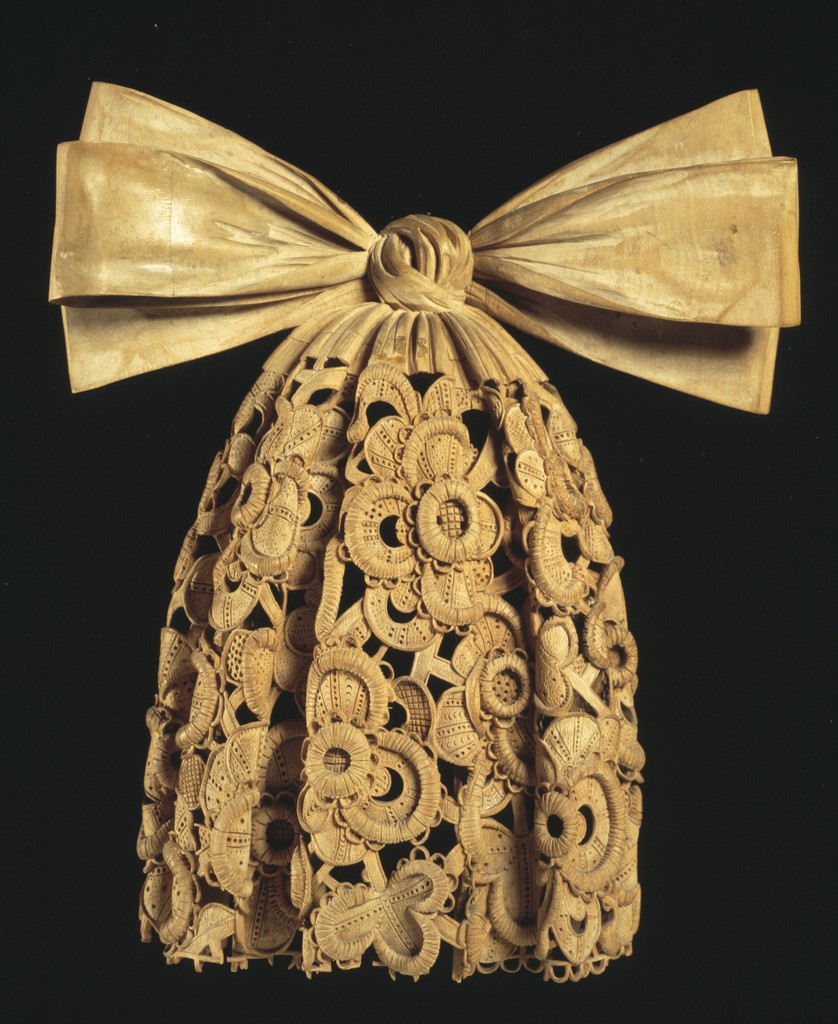
Wooden cravat which was in the collection of Horace Walpole.
It gives a very accurate description of how it looked

Lace became quite a favourite among the nobility and as such it is often seen in portraits. Others were made from cambric, muslin or linen. To keep the expensive laces in place the cravat was tied with an aptly named cravat string; basically, a ribbon to tie around the cravat to keep it where it ought to be. In the 1680's these strings were gradually abandoned and the ends were allowed to hang loosely. This style remained in fashion for quite a while.

The early years of the 18th century the style of having the piece of fabric tied closely around the neck and was either buckled or buttoned in the back. To stiffen off the fabric a sort of cardboard was often added. Eventually, another piece of fabric - this time in black - was added to the "stock" as the style was called. This was usually accompanied by a lovely jabot which was basically frilled laces. This remained in style until the 1770's.


Stock buckle -
used to tie the fabric tightly around the neck

In the 1770's cravat made a comeback due to the so-called macaronis. These were young dandies who were often seen sporting a cravat after having completed their grand tour in Italy and thus it became the trend again.

The remnants of a cravat still exists in men's fashion today - only we call it a tie.

As seen in portraits:

Louis XIV, 1667
James II, 1686

Comte d'Angivillier wearing a "stock" and laced jabot


An English gentleman

Dining in Style

These contain both the etiquette for the King's dinners and for dining amongst the nobility in general.


  • Each course was prescribed a specific place on the table and was not to be moved from that spot
  • All the food was served at once - this was known as dining a la Francaise in comparison to dining a la Russe (in the Russian style) where dishes were served individually
  • Courtiers helped themselves to whatever they desired but could not get up to get to a dish out of their reach. Instead, it was normal to pass a plate along for their neighbour to fill it with the desired dish - but with moderation
  • There were three courses: soup/fish, roasts and desserts
  • Gentlemen must always remove their hats when at the King's dinner table even if the King is not there in person
  • All food and drink provided for the royal family was served to them since royalty could not reach for anything themselves
  • When the King dines with the Queen au grand couvert they are served by ladies only and not by the King's own servants. This stems from an ancient tradition whereas the Queen is only to be seen surrounded by her ladies  

Saturday, 6 August 2016

Common Courtesy

These are some of the "simple" rules that everyone associated with court life knew to follow.


  • One is never to knock at a door to gain admittance. Instead, a visitor may use their fingernail to scratch on the door frame
  • When promenading a gentleman must always acknowledge an acquaintance. If this was a lady he was to bow - but only if she acknowledged him first
  • Ladies walking together must take care not to walk more than two abreast so as to not block the way for others
  • Courtiers were not allowed to address members of the royal family directly. They were to respectfully remove their hats if they chanced upon them (if they were gentlemen). The only time a courtier could directly address royalty was if they were spoken to
  • When standing it is considered well-mannered to have the left foot in front and the legs slightly bent
  • One can never immediately turn their back on their superior. If one is to leave the presence of a superior it is customary to bow and take a few step backwards while still facing the superior. Then one may leave.

Thursday, 4 August 2016

Fashion

The outrageous fashions of the 18th century is one of the first things that pops into people's head when the word "Versailles" comes up. France was the leading lady in fashion; every court strove to copy the lavish styles pouring from Paris. The Queen of France was the undisputed fashion icon and was expected by both court and commoners to advance new trends and constantly show off the highest couture.

Ladies' Fashions


Relateret billede

Clothing

Bas de Robe


Compère


Petticoat


Zone Style


Accessories 


Calèche

Chateleine

Coif


Engageants 

Fan


Manteau

Mantle

Medici Ribbon

Mouche

Muffs


Gentlemen's Fashions


Billedresultat for 18th century fashion plate man

Clothing


Breeches

Cloak


Waistcoat


Accessories

Bourse

Cane


Unisex Clothing

Galerie des Modes, 23e Cahier, 1ere Figure  Young Wife, as she is led to the altar; she is dressed in a gown of Pekin* trimmed with gauze ribbon and flowers.  Her gown is full dress over a medium hoop: the man conducting her is wearing a suit and a vest with a gold ground embroidered around with colored gold threads. (1779)


Accessories

Gloves

Jesuit/Brunswick

Parasol

Pelisse