Monday, 11 April 2016

Louis Alexandre de La Rochefoucauld d'Enville, Duc de La Rochefoucauld

Louis Alexandre de La Rochefoucauld d'Enville was born into one of the oldest noble families in France. On 4 July 1743 he was born in Paris as the son of Jean-Baptiste de La Rochefoucauld and Marie-Louise-Nicole de La Rochefoucauld.

His first marriage took place in 1762 when he married Louise-Pauline de Gand de Mérode but the union was to remain without children. That same year also brought him the title of Duc de La Rochefoucauld with the death of his grandfather (his own father having died earlier). Eighteen years later Louis Alexandre found himself a widower still without an heir and decided to marry Alexandrine-Charlotte de Rohan-Chabot. What hopes he must have had regarding fathering an heir is unknown but his second marriage also remained without issue.

Through these years of marriage it would seem that Louis Alexandre fostered a keen interest in the natural sciences. Eventually, this led to him presiding as President of both the Royal Academy of Sciences and the Royal Society of Medicine.
Besides his love for the sciences, the Duc was a well-travelled man. In his youth he had made his grand tour of Europe which brought him through Germany, Sweden, Savoy, England, Switzerland and Italy.


Portrait du duc d'Anville


After his second marriage, Louis Alexandre turned his attention to helping his close friend, Benjamin Franklin, whom he had translated several literary works for before. As it happens, Louis Alexandre was a great supporter of the American side in their war against Britain. Considering the circle which Louis Alexandre moved in he appeared to have been interested in some of the new enlightenment ideas. For example his circle of friends includes names such as Turgot and Desmarest.

By 1789 the revolution was stirring and Louis Alexandre took his seat as a member of the States General. Having originally supported the third estate - he had been one of 47 aristocrats who had openly laid their weight behind the third estate - the drastic turn of events unnerved the otherwise liberal Duc. He managed to keep a place in politics after the fall of the first Assembly but then made the political mistake of opposing Pétion.

Things were now getting too dangerous for Louis Alexandre to remain in Paris. Despite his well-known sympathies for the revolutionary cause he was still a nobleman and a high-ranking one at that. On 10 August 1792 he abruptly resigned his position and fled France to avoid the increasing hostile atmosphere. Despite his efforts, Louis Alexandre never made it out of France. At Gisors he was apprehended while trying to get his wife and mother to safety.

On 4 September Louis Alexandre was murdered by militants who had assembled to fight the Prussians - their other main task was to hunt down fleeing aristocrats.  

Élisabeth Thérèse de Lorraine, Princesse d'Epinoy

Élisabeth Thérèse de Lorraine was born on 5 April 1664 into a cadet branch of the House of Guise. Through her father she was related to King Henri IV of France as the late King's great-granddaughter.

At court she was known as Mademoiselle de Commercy which was a region within Lorraine.
Despite being from a large group of children Élisabeth Thérèse was the only one who married. That event took place in 1681 when she was wed to Louis de Melun, Duc de Joyeuse and Prince d'Epinoy, Later, Élisabeth Thérèse would add the title of Duchesse de Luxembourg-Saint-Pol to her already extensive collection when she bought the title from Marie d'Orléans. She and her husband went on to have two children.

For Élisabeth Thérèse it had always been her destiny to make her career at court. There she had spent her youth and there she would spent the majority of her life. Her position at court was one of some prestige; she was placed in the service of Marie Anne de Bourbon (a legitimised daughter of Louis XIV) where she would quickly assert herself as a part of the Grand Dauphin's inner circle.


It was through that very circle that she met Louise Françoise de Bourbon (another natural daughter of the King) whom she would become very close friends with. However, not everyone was convinced that Élisabeth Thérèse was there solely for her own amusement. The ever critical Duc de Saint-Simon was convinced that both Élisabeth Thérèse and her sister reported back to Madame de Maintenon on everything that happened in the Grand Dauphin's apartments.

In 1721 Élisabeth Thérèse's fortune was enlarged when her aunt, the Grand Duchess of Tuscany, died and left Élisabeth Thérèse her inheritance. Sadly, Élisabeth Thérèse would have no children to leave her own titles and fortune to; both her children died before she did but her daughter had given her five grandchildren.

When she was not at court Élisabeth Thérèse lived in Paris at the Hôtel de Mayenne. Here both she and her husband would die in 1748.

A Royal Mésalliance

Of the four marriages arranged by Louis XIV to the advantage of his illegitimate children the one that brought on the greatest scandal was that of Françoise Anne de Bourbon. Known at court as Mademoiselle de Blois, she was the natural daughter of Louis XIV by Madame de Montespan and had been legitimised at the age of four. Her bridegroom, Philippe II d'Orléans, had no stain of illegitimacy which caused quite a scandal. Not only was he a member of the royal family, Philippe II was the only legitimate nephew of Louis XIV and therefore one of the most eligible bachelors at court.

It was clear from the beginning that one of the greatest opponents of the match was the mother of the bridegroom, Elizabeth Charlotte of the Palatinate.

Elizabeth Charlotte, "Madame"

Louis XIV realised that he could not persuade his sister-in-law to accept the match and began a tactic meant to coax her instead. The method adopted by the Sun King can only say to be undignified: as the new year of 1690 was celebrated the King neglected to pay Elizabeth Charlotte's pension which she was totally dependent on. Even this trick could not sway the proud German-born Princesse.

As to the father of Philippe II, the King's brother (Philippe I or simply "Monsieur"), he was no less displeased with the match. Here, however, Louis knew who to turn to. Monsieur's affair with the infamous Chevalier de Lorraine was well-known and the King had no scruples turning to his brother's lover. Consequently, the Chevalier suddenly received a far better treatment by the King which prompted Madame (Elizabeth Charlotte) to write in a letter to her aunt that she was sure the Chevalier had promised the King to persuade Monsieur.


Françoise Anne - the bride who caused all the
trouble

The bridegroom himself was not pleased with the match. He had always been partial to his prospected wife's sister which definitely complicated matters. Here, too, Louis XIV was convinced that he could apply pressure to the right source and achieve his desired goals. The tutor of Philippe II was Abbé Dubois who acted as that very source. Added with the pressure of his tutor, Louis XIV himself laid in a word. With the war going on it was impossible for the King to find a suitable bride abroad and so Philippe II should be honoured that he was offering his own daughter.

Eventually, Philippe II answers the King that it is not up to him but rather his parents to make the final choice. Monsieur realises that he cannot win against his august brother and relents but not without showing his displeasure. Now the problem of Madame remained to be solved and that can easily be said to be the hardest one.

If anyone had doubted the Duchesse d'Orléans' feelings on the subjects those doubts were cleared away when she slapped her son across the face in the middle of the hall of mirrors and then turned her back on the King as he bowed to her. The courtiers could only watch in utter astonishment at the spectacle but there was nothing to be done. Once the papal dispensation had arrived (the couple being cousins) the wedding took place.

Elizabeth Charlotte never forgave her brother-in-law this match which she thought so demeaning. To her daughter-in-law she was equally resolute in avoiding a close relationship.

Sunday, 10 April 2016

Marrying a Royal Bastard

Although the courtiers of Louis XIV had grown accustomed to the King having his own way there was one particular decision (or rather several) that send a wave of indignation through his court. One thing was that the King had had his illegitimate children legitimised - that had been done before - but it was a whole other thing to have them married into the most powerful families.

A marriage suggested by the King was more of an order than an actual suggestion. No one could successfully deny the King's marriage plans no matter how demeaning a match may seem. In total Louis XIV married four of his legitimised children into the power-elite at court:

Marie Anne de Bourbon was the daughter of Louise de La Vallière and was known as Mademoiselle de Blois. She was married to Louis Armand, Prince de Conti in 1680 but the marriage remained childless and she was widowed at a young age.

Louis Auguste de Bourbon received the title of Duc du Maine when he was legitimised. In 1692 he married Anne Louise Bénédicte de Bourbon which proved to be a disaster. Anne Louise Bénédicte was deeply ashamed of being made to marry a bastard and was never faithful to her husband.

Louise Françoise de Bourbon, known as Mademoiselle de Nantes, was married to Louis de Bourbon, Duc de Bourbon in 1685. As compensation for marrying beneath his rank the Duc de Bourbon received not only a dowry of one million livres but also the promise of the post of surintendante of the King's household after the death of his father.

Françoise Marie de Bourbon or Mademoiselle de Blois undoubtedly won the marriage lottery. In 1692 she married the King's only legitimate nephew, Philippe II d'Orléans, who would rule as Regent during the minority of Louis XV. As it turned out the greater the match, the greater the scandal.
The bridegroom's mother - Elizabeth Charlotte of the Palatinate - was far from pleased when she heard of the betrothal; she slapped her son in full public and even turned her back on the King when he saluted her. Many would probably have done the same, had they dared, since "the bastards" as the Duc de Saint-Simon used as a reference for the King's children were little liked and their elevation was widely detested.


One way that Louis XIV attempted to compensate for the lack of actual legitimacy was through his daughters' dowries. Each of his daughters received an immense dowry: Louise Francoise's hand was given with the sum of 1.000.000 livres while her younger sister was sent off with twice that sum.

Madame de Maintenon was another driving force behind the illustrious matches of the King's bastards. Never having any children of her own, she had been governess to the children of Madame de Montespan by the King and had grown very attached to them. Consequently, she dedicated her life to their advancement and especially the marriage between Françoise Marie and Philippe II is considered to be her doing.

Another attempt at raising the prestige of the ceremonies was the presence of the exiled King of England. At both the weddings of Mademoiselle de Blois and the Duc du Main the English King was present and even handed the latter his chemise at the bedding ceremony.

Marie Anne de Bourbon, Duchesse de Vendôme

Born on 28 February 1678 Marie Anne de Bourbon did not have the greatest prospects for a happy family life. Her father, Henri Jules, Prince de Condé, was notorious for his abusive nature and it was a well-known fact that he often beat his wife, the Bavarian Anne Henriette. Sadly, her Marie Anne would also become a victim of her father's abuse as was the case with her siblings.

What she did not have in family happiness Marie Anne could "make up for" in her status. She was born a Princess of the Blood and was known as Mademoiselle de Montmorency before her marriage. Her father was the First Prince of the Blood which meant that there would be no shortage of suitors even though she was the ninth child to her parents.


Originally, her father had wanted to marry her off to the Italian Duke of Mantua but that never came to be. Instead, Marie Anne remained at the Hôtel de Condé where she had been born and spent her entire life so far. Her father died in 1709 which can only have been a relief to her mother as well as those of her siblings still living at home.
Now, it would normally have been up to her mother or eldest brother (who died around this time too) to negotiate a marriage for her. Given that her siblings had married grandly as was expected (her eldest sister married the Prince de Conti while her eldest brother wedded a legitimised daughter of Louis XIV) it was in the cards that she would too.

Marie Anne de Bourbon, Duchess of Vendôme.jpg


This, however, was not to be done the normal way. Marie Anne had no intentions of marrying her mother's choice and was aided by her sister, Louise Bénédicte, in arranging a match for herself. Consequently, Marie Anne married Louis Joseph, Duc de Vendôme on 21 May 1710.

The couple was only united for two days since Louis Joseph left for his château d'Anet while Marie Anne remained at the château de Sceaux where the ceremony had taken place. In the end the marriage was to be a short one. Marie Anne was widowed already two years after her marriage and had had no children. Despite the short marriage it would seem that the couple was on good terms; Louis Joseph died he left his wife the title and dukedom of d'Étampes which meant that she now held that title in her own right.

After her husband's death, Marie Anne moved to Paris where she settled in the Hôtel de Vendôme. Here, she initiated several improvements to the hôtel which would remain her residence until her death. Sadly, that event was not long in happening. Marie Anne died on 11 April 1718 at forty years old.

The Bourgogne Faction

The Bourgogne Faction was centred around Louis, Duc de Bourgogne and by extension his popular wife, Marie Adélaïde of Savoy. The faction was convinced that France was in great need of reform as to the governmental system. This shared opinion was what sparked the faction; the Duc de Bourgogne had developed into an intelligent young man who himself was greatly in support of reforming his grand-father's (Louis XIV) system.


Billedresultat for duc de bourgogne
The Duc de Bourgogne

The main protagonist of the faction was the Duc de Bourgogne's tutor, Abbé Fénelon. The Abbé (or Archbishop) was outspoken to say the least. He authored several letters and treatises which were harsh in their critics on the Sun King's regime and nothing short of absolutely adoring of the Duc de Bourgogne. However, in 1699, the King had had enough of Fénelon's critics. He banished him from court and forbade him from having any contact with the royal family.


Other members included the Colbert family such as the Duc de Chevreuse and the Duc de Beauvilliers. The infamous Duc de Saint-Simon has also been connected to the faction.


Duc de Chevreuse (Colbert's son)

The circle around the Duc de Bourgogne remained steadfast. High moral principles were the trademark of the faction which included several of the most progressive philosophers of the time as well as aristocrats who sympathised with the lower classes. The development towards a less absolute monarchy was a main agenda for the factions; rather than the all-mighty King they were in favour of delegation some aspect of governmental power to the provinces.

The disgraced Fénelon
During the life of the Grand Dauphin the group had little to no influence. Then, in 1711, the Grand Dauphin died which meant that the Duc de Bourgogne was now Dauphin. Suddenly, the Bourgogne faction stood to gain everything. The chance of reform seemed to be within reach. The ageing King's health was deteriorating so those who looked to the future sought the next in line. Yet, an ageing King is still King and the Dauphin had not nearly enough influence to achieve the faction's goals.

The end of the Bourgogne Faction came just a year later. The Duc de Bourgogne and Marie Adélaïde both fell ill and died to the great horror of the court. Officially, this was the end and the surviving members would themselves follow their idol to the grave soon after. The ideas did not die out though. During the regency of the Duc d'Orléans government was indeed divided into several sectors which had been one of the main goals of the Bourgogne faction.

Sedan Chairs at Versailles

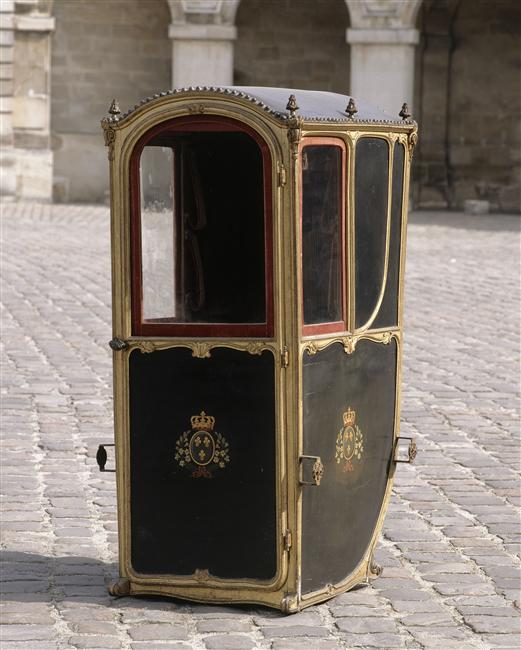
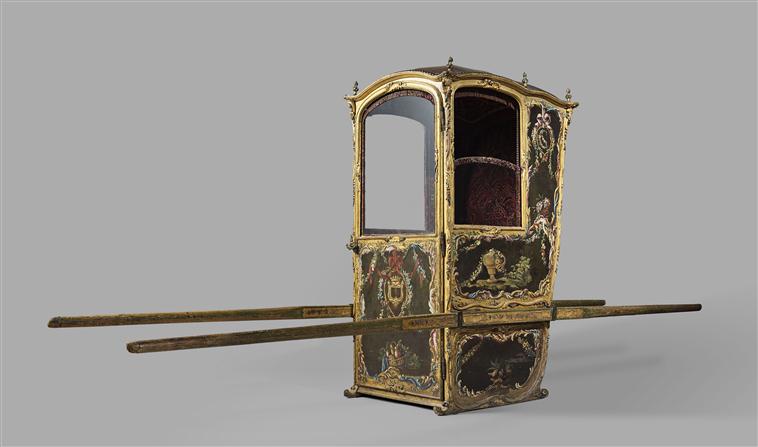
The vast complex of buildings which Versailles and the growing city around had turned into meant that getting from one place to another could be quite a hassle. In came the sedan chairs or chaise à porteur which is basically a seat in a box which is carried by two men; one in front and one in the back.

Those who did not have the Honneurs de Louvre were obliged to disembark their carriages at the gates but did have the opportunity of hailing a sedan chair for the remainder of the way up to the palace itself. Of course, to have this option also meant that sedan chairs had to be available immediately around  the royal residence. In 1674 Louis XIV gave his veteran servicemen as well as the abounding number of homeless and wounded ex-soldiers monopoly on the work as carriers of sedan chairs around the royal palaces.
The sedan chairs for rent were all painted blue; a colour which was shared by livery of the men who carried them. The fare from the gate to the palace was 6 sous.


A chaise à porteur from the King's household


Closed
Inside the palace only royalty had the privilege of using a sedan chair in the Grand Apartments. In August 1715 Louis XIV was carried to the apartments of Madame de Maintenon in such a one.

When Louis XV established the Parc-aux-Cerfs chaises à porteur was used to transport the young girls to a hidden door leading up to the King's private chambers. These chairs would always have their windows covered. The same secrecy was often adopted by Louis XV when he went on night tours to balls; on these occasions he preferred to use a kind of sedan chair which was fitted on a wheel and dragged by a single porter.


Even Marie Antoinette's brother, Emperor Joseph, used a sedan chair when he paid his sister a visit in 1777.


As fashion became an ever more important aspect of court life so did the chaise à porteur. To keep the ladies' ever-rising hairstyles intact and the lush silks and velvets of the gentlemen dry every courtier with respect for himself had one. It was the norm to have one's coat-of-arms painted on the sides and back of the sedan chair. Naturally this meant that everyone could tell who was going where. It created quite a bustle of gossip when Madame de Pompadour's sedan chair - with its mistress inside - was seen paying a visit to Maurepas who had never been a friend of hers.


The design of the private sedan chairs became evermore intricate. In the reign of Louis XV it was hard to find one that was not gilded with gold and had a comfortable seat inside rather than a mere plank with a flat pillow.

As Marly became Louis XIV's favourite retreat the popularity of personal chaises à porteurs once again came into play. The distance could be considered somewhat far - especially considering that the King was not as young as he had been - and it was quite normal for the King together with Madame de Maintenon and the Duchesse de Bourgogne to go in this manner.
Speaking of Louis XIV he had a particular fondness for the man employed to carry the front poles of his personal sedan chair. This man was named d'Aigremont and it also fell to him to open the door for the King.

A French sedan chair currently at Compiègne

Occasionally, the sedan chair was taken outside the environs of Versailles. When Louis XIV went to inspect his troops he always took his court with him. Madame de Maintenon was given the luxury of been transported there and viewing the troops through the three glass panes in her chaise à porteur.

A beautiful example from 1720

Undoubtedly, the use of sedan chairs came as a relief to a great deal of people. The elderly courtiers was spared the need to walk the immense gardens and considering that - depending on their rank - they would often not be allowed a seat when the King was there, it must have been a relief. For those who struggled with their health it was good news too. In his later years, Louis XIV often took to seeing his gardens in this way since he often suffered from pains in his legs. When Marie Adélaïde, Duchesse de Bourgogne had had a hard delivery of her first son, she too, took advantage of it.