Friday, 6 December 2013

An Exotic Creature

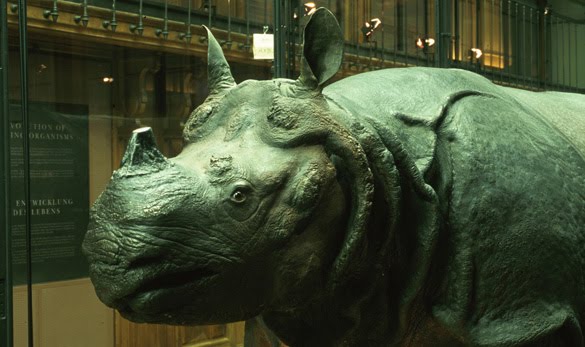
Louis XV was given the unusual gift of a rhinoceros by the French governor Jean-Baptiste Chevalier in Chandernagore in 1769. This meant that the rhinoceros - which was a male - was sent on its way from India to France where it landed on 4 June 1770. However, the strange creature did not arrive at the menagerie at Versailles before 11 September because there was no vehicle capable of transporting the heavy animal so one had to be built first.
For 22 years the rhinoceros made spectators at Versailles gasp at the strangeness of the animal but sadly the rhinoceros had a sad ending. During the revolution a revolutionary saw the animal as a sign of royalty and hacked it to death with his sabre. The mutilated corpse was then brought to the natural institute in Paris where it was stuffed and its skeleton was taken out and is now on display. There was one strange little discovery made as late as 1992 when it was found out that the horn actually belonged to a black African rhinoceros instead of the Indian rhinoceros' horn which is much smaller. After this the horn was exchanged with a horn of a Indian rhinoceros.


Louis XV's rhinoceros

Thursday, 5 December 2013

The Menagerie

It has always been common for royals to have exotic animals and the Kings of Versailles was no different. Louis XIV had his architect - and namesake - Louis Le Vau built a menagerie in the south-west part of the Versailles gardens. The menagerie itself was centred around the building and from there seven areas separated by walls spread out in a fan-pattern; each area is closed off with a fence facing the pavilion.
The first animals (including birds) arrived there in 1664. This menagerie was the first to be built in the Baroque style in Europe. However, the menagerie was not just for the entertainment of the King and his courtiers it also contributed to natural science. Whenever an animal died Louis XIV gave the remains to scientists which meant that the knowledge on this area experienced a boom in this period.

Map of Versailles, by Delagrive (1689-1757), 1746.
Location of the menagerie, 1746

Louis XIV had another menagerie built at the château of Vincennes but the purposes of the two menageries were vastly different. The one at Vincennes emulated the animal fights seen in Ancient Rome where exotic animals were pitted against each other. Such a fight was staged for the amusement of the Persian ambassador who got first row seats to a fight between a tiger and an elephant. The menagerie at Versailles was completely different. No such ferocious fights were to be held near the King's permanent residence. The menagerie at Versailles was made to enhance the King's prestige as well as to provide interesting sights for the courtiers.

It is a sign of the Grand Monarch's fondness for his grand-daughter-in-law, Marie Adelaide of Savoy, that he granted her free use of the menagerie as a present. Consequently, the young Duchesse de Bourgogne would entertain her guests there for evening soirees as well as daytime parties.

Drawing of the menagerie during Louis XIV
The Kings would take their companions and royal guests with them for a stroll in the menagerie; often they would sail there via the Grand Canal. Louis XV was not that interested in the exotic animals and left the care of the menagerie to his mistresses. During his reign that the menagerie - and the conditions of the animals - declined dramatically. No effort was made to receive an elephant which had been gifted to the French King and it consequently was sent marching from the coast to Versailles. The walls were crumbling from lack of maintenance which eventually caused the escape of an elephant in 1782.

But Louis XVI also had a fondness of the animals and sent out a list of animals he wished to add to the menagerie including an elephant, two zebras (one male and one female), baboons and 6 guinea-fouls. Louis XVI would never actually receive the elephant and only got one zebra but that did not mean that all life went out of the menagerie. During this period a lion, a panther, a tiger, hyenas, ostriches and monkeys made out the inhabitants.

Billedresultat for versailles menagerie
Digital rendition of how the menagerie looked

When the revolution swept the royal family away it would seem that time was running out for the animals as well. However, by this time the interest for natural science was greater than ever and the newly established government became concerned about the animals. Instead of killing them it agreed that they should be moved to a zoological garden in Paris exactly in the menagerie of the Jardin des Plantes. The politicians had seen with concern the rise of exotic animals among commoners and it seemed like a perfect solution to confiscate the animals and at the same time gather the remaining animals of Versailles in one place. We know that the lion made its way to Paris but - like all the other animals - it had to make due with living in the basement of the menagerie because the parks for the animals had not yet been finished. Finally, the collection in 1794 counted the lion from Versailles, a leopard, a sea lion, a polar bear etc. All together 32 mammals and 26 birds made up the collection. Sadly most of them died in the great starvation of 1795.


Billedresultat for versailles menagerie
Air-view of the menagerie from 1724

The King's Eagle Brooch

Billedresultat for louis xiv eagle brooch


Louis XIV owned the Eagle Brooch and may have acquired it from Marie-Louise de Gonzague who was the widow of two Polish Kings when she died in 1667. The body of the brooch is made of garnet and has been adorned with square rubies with the exception of two rubies on the tail piece - these are heart-shaped. The eagle is holding both the sceptre and the orb which are both symbols of royalty. The rest of the body is painted in white enamel except for the feathers in black enamel. Despite the possibility of having belonged to a Polish Queen the style of the brooch indicates that it might have been made in Paris. 

Adressing Everyone

Even a courtier could not life forever bolted up within his château but had to make his way out in the world of peasants and non-titled citizens - and of course there was an etiquette here too. The difference is that this etiquette was not known to the courtiers alone but to the common man and woman as well, it was common knowledge if you will. Since it was unlikely that a nobleman would have any occasion to talk to a commoner the rules of etiquette was often regarding the quick address when meeting each other.

First of all you could never just say "yes" or "no" without adding a "Madame" or "Monsieur" afterwards. In some situations it would not only be a titled person who had the right to be addressed a certain way. Whenever anyone walked into a shop it was expected that they would be greeted as either "Madame", "Mademoiselle" or "Monsieur" as well as being greeted with a polite wish of good day - both on entering and leaving the store.
In other cases it could be gender that decided what level of civility you would receive - remember chivalry had not died yet. This was - and still is in France - especially applied in restaurants where a waitress would be addressed as either "Mademoiselle" or "Madame" whereas a waiter would simply be a "garçon" meaning plainly "boy". Of course in ruder establishments (perhaps a brothel or a cheap inn) the tone would of course be very different.

In the army there was no need to pay any extra respect to women since they were simply not there. A soldier would always be addressed according to his rank and in this way his rank became a part of his title. If you met with a General you would say "mon Général", if it was a Captain "mon Capitaine". Notice that in these cases "Monsieur" was completely left out but the address was still respectful. Dealing with the clergy was something that was far more likely for both men and women since it was normal for noble families to send their daughters to a convent until they reached a certain age and their son (if he was the second or third son) to become a clergyman. Addressing a nun was not different from what it is today and she would always be "ma Sæur".
Finally there was the addressing of those who held a title and this was not solely those who was of noble descent. For example a professor would also be considered to fall under this category and would therefore be "Monsieur le Professeur". Of course this means that a nobleman could be "Monsieur le Comte" or "Monsieur le Duc".

Diner

Naturally the King had to eat but not every meal was performed the same way. The Souper (supper) was at 10 at night but the King would also have another meal called the Diner (dinner). Often this meal took place in the King's own bedchamber and only men were allowed to be present. Only the King was allowed to sit during this ceremony which means that even those who had the right to sit otherwise was expected to stand. There was only one person whom this rule could be broken for: the King's brother who had the privilege of handing the King his napkin and would be invited to sit with the King once in a while (well, it is family is it not?).

Remember that when this meal was over the King had already gone through plenty of dishes before the Grand Couvert had even taken place!
"In all professions, every person affects a look and a countenance to appear as he would like to be perceived; thus one can say that the world is composed of nothing but outward appearances”
DUC DE LA ROCHEFOUCAULD 

Monday, 2 December 2013

Wonderful Enlightenment

Bernard Tartinville is the (master)mind behind this gorgeous photo series inspired by the art of the Enlightenment in the 18th century. It is decadent, extravagant and exquisite to the very detail. It seems only appropriate that this series is named "Marie Antoinette".